Content Menu
● Understanding Activated Carbon Pore Structures
● Why Pore Size Distribution Matters More Than Surface Area
● Comparing Micro, Meso and Macro Pores in Key Applications
>> Water Treatment and Heavy Metal Removal
>> Air and Gas Purification (VOC, HCN and Toxic Gases)
>> Food & Beverage, Chemical and Pharmaceutical Uses
● Pore Structures by Raw Material – Coal, Coconut Shell and Wood
>> Typical Pore Characteristics by Base Material
>> Surface Morphology and Open Pore Distribution
● How Pore Structures Impact Adsorption Capacity, Kinetics and Selectivity
>> Capacity – How Much Can Be Adsorbed?
>> Kinetics – How Fast Adsorption Occurs
>> Selectivity – What Gets Adsorbed Preferentially
● Expert Insight – Matching Pore Structures to Real Industrial Uses
● Case Snapshot – Designing Pore Structures for HCN Defence
● Practical Selection Checklist for Buyers and Engineers
● How Guangdong Tongke Activated Carbon Co., Ltd. Tailors Pore Structures
● Work With a Pore‑Focused Supplier
● FAQs
● References
How different pore structures affect activated carbon performance is not just a theoretical topic – it is a design lever that directly determines removal efficiency, service life and cost in real industrial applications. As a manufacturer like Guangdong Tongke Activated Carbon Co., Ltd., understanding and engineering pore size distribution is the fastest path to building high‑performance, application‑specific activated carbon grades. [tongkeac]
From an industrial buyer's perspective, activated carbon is never "one size fits all". The pore structure – how many pores, how big they are, and how they are distributed – controls adsorption capacity, kinetics and regeneration behavior across water treatment, air and gas purification, food & beverage, chemical processing and pharmaceutical applications. In this guide, I will walk through how different pore structures affect performance, share lab data and field experience, and explain how a manufacturer like Guangdong Tongke Activated Carbon Co., Ltd. tailors pore design for real‑world processes. [xmtkhxt]
Understanding Activated Carbon Pore Structures
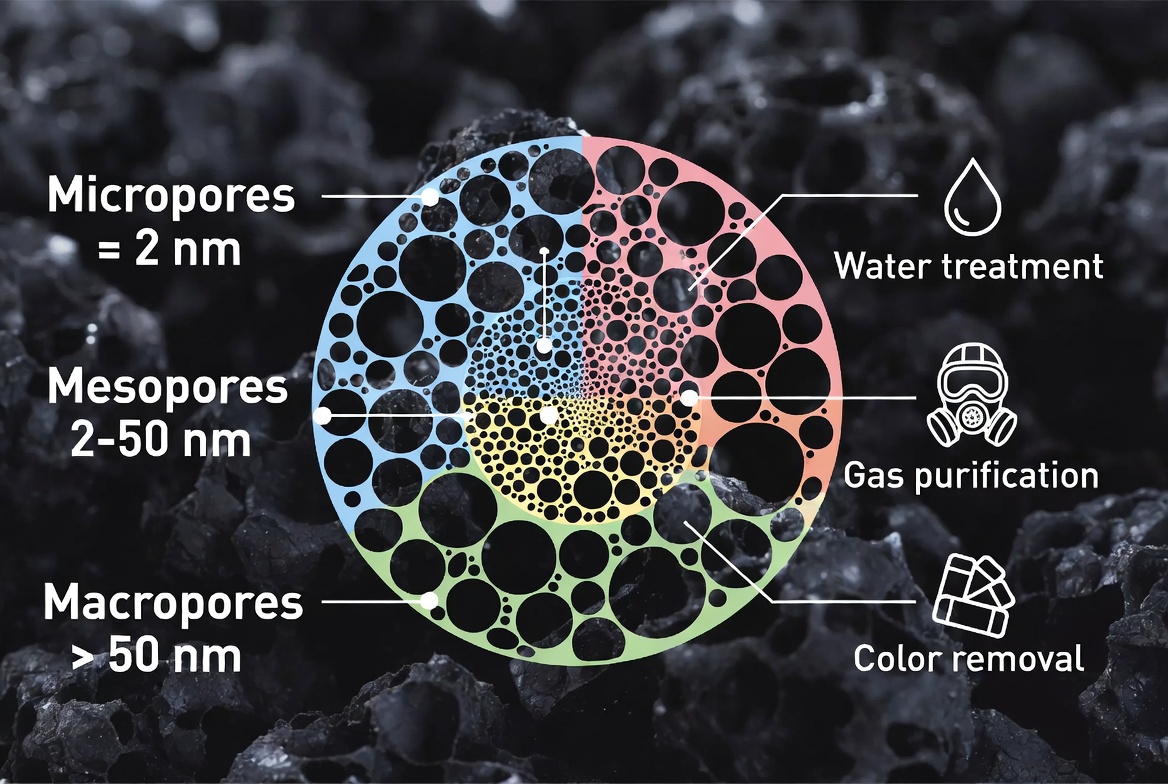
Activated carbon contains a complex network of micropores, mesopores and macropores, each contributing differently to adsorption. Internationally, pores are typically classified by diameter: [tongkeac]
- Micropores: < 2 nm
- Mesopores: 2–50 nm
- Macropores: > 50 nm
From an R&D standpoint, micropores provide most of the surface area and are crucial for adsorbing small molecules and ions in water treatment. Mesopores and macropores act as transport highways, enabling faster diffusion of larger organic molecules, dyes, and VOCs into the micropore network. [xmtkhxt]
Why Pore Size Distribution Matters More Than Surface Area
Many buyers still ask: "What is the BET surface area?" Yet BET alone can be misleading. In a detailed study on Pb(II) removal from water, three activated carbons with similar surface chemistry but different pore distributions showed that the sample with the highest BET area did not deliver the highest adsorption capacity. Instead, the best performance correlated with: [tongkeac]
- A higher volume of effective micropores (0.4–0.6 nm)
- A more uniform distribution of open pores on the carbon surface
This tells us that for real‑world water treatment and heavy metal removal, effective pore ranges and distribution patterns predict performance more reliably than a single surface‑area number. [tongkeac]
Comparing Micro, Meso and Macro Pores in Key Applications
Water Treatment and Heavy Metal Removal
For dissolved ions (Pb(II), Cu(II), etc.), laboratory data show that 0.4–0.6 nm micropores are "effective adsorption pores", while certain mesopore ranges can even hinder adsorption. In one experiment, pores between 10.5–20.6 nm, 20.6–55.6 nm and 5.2–10.5 nm were associated with reduced Pb(II) uptake, despite high overall pore volumes. [tongkeac]
From a plant operator's perspective, this means:
- Carbons with optimized narrow micropore distributions deliver higher removal efficiency per kg.
- Excess large mesopores without corresponding micropores can inflate surface area but add little to ion adsorption capacity.
For a supplier like Guangdong Tongke Activated Carbon Co., Ltd., controlling this micropore fraction is essential when designing grades for municipal water, industrial wastewater and heavy‑metal polishing. [tongkeac]
Air and Gas Purification (VOC, HCN and Toxic Gases)
Gas‑phase applications are often driven by diffusion rates and interaction with specific functional groups. In research on activated carbon supported metal oxide catalysts for HCN protection, an effective pore size window of 1.2–2.1 nm enabled better adsorption of cuprammonium complexes, producing well‑dispersed Cu₂O active sites and longer HCN defence times. [xmtkhxt]
Key insights from that work:
- When the 1.2–2.1 nm pore volume exceeds about 0.1424 cm³/g and > 2.1 nm pore volume stays below ~0.0824 cm³/g, HCN defence time exceeds 30 minutes. [xmtkhxt]
- Excess mesopores (> 2.1 nm) cause metal nanoparticles to aggregate, cutting dispersion and reducing catalytic protection performance. [xmtkhxt]
For air and gas purification systems, this shows why gas‑phase carbons and catalytic carbons must be engineered around both pore size distribution and metal dispersion, not just surface area. Manufacturers that can tune these pores consistently give OEMs more stable breakthrough curves and longer bed life in respirators, solvent recovery units and emission control systems. [tongkeac]
Food & Beverage, Chemical and Pharmaceutical Uses
In food and beverage decolorization and odor removal, target molecules are larger organics, pigments and off‑flavor compounds, which rely more heavily on mesopores to access internal surfaces. An optimal structure combines: [tongkeac]
- Sufficient micropores for strong adsorption of smaller contaminants.
- A well‑developed mesopore system for faster mass transfer of larger molecules.
From an engineer's viewpoint in a sugar refinery or beverage line, carbons with balanced micro–meso networks give shorter contact time requirements and more predictable color removal, while preventing excessive pressure drop. Similar logic applies to pharmaceutical and fine chemical processes, where pore design impacts purification efficiency, yield, and regulatory compliance (residual impurities, color, odor). [tongkeac]
Pore Structures by Raw Material – Coal, Coconut Shell and Wood
Typical Pore Characteristics by Base Material
Different feedstocks naturally favor different pore architectures after activation: [tongkeac]
| Base material | Dominant pores | Typical features |
| Coconut shell | Microporous | High micropore volume, harder structure, ideal for small molecules and gases. (tongkeac) |
| Bituminous/anthracite coal | Mixed micro–meso | Flexible pore tuning, good for broad‑spectrum industrial uses. (tongkeac) |
| Wood | More mesopores | Larger pore sizes, useful for color removal and organic molecules. (tongkeac) |
From a sourcing and design perspective, a manufacturer like Guangdong Tongke Activated Carbon Co., Ltd. leverages these natural tendencies and then applies tailored activation conditions (steam, chemical activation, temperature profiles) to shape the final pore distribution for specific industries. [tongkeac]
Surface Morphology and Open Pore Distribution
Experimental work with carbons AC1, AC2 and AC3 showed that samples with evenly distributed open pores on the surface achieved higher saturating adsorption capacity than those with concentrated or aggregated surface pores. This is because uniform, accessible surface pores allow contaminants to reach internal micropores more effectively, avoiding early blockage of pore entrances. [tongkeac]
In practice, this finding influences how industrial carbons are milled, pelletized or shaped:
- Uniform grain size and controlled pellet geometry improve external accessibility.
- Avoiding excessive surface aggregation helps maintain effective diffusion pathways into the micropore network. [tongkeac]
How Pore Structures Impact Adsorption Capacity, Kinetics and Selectivity
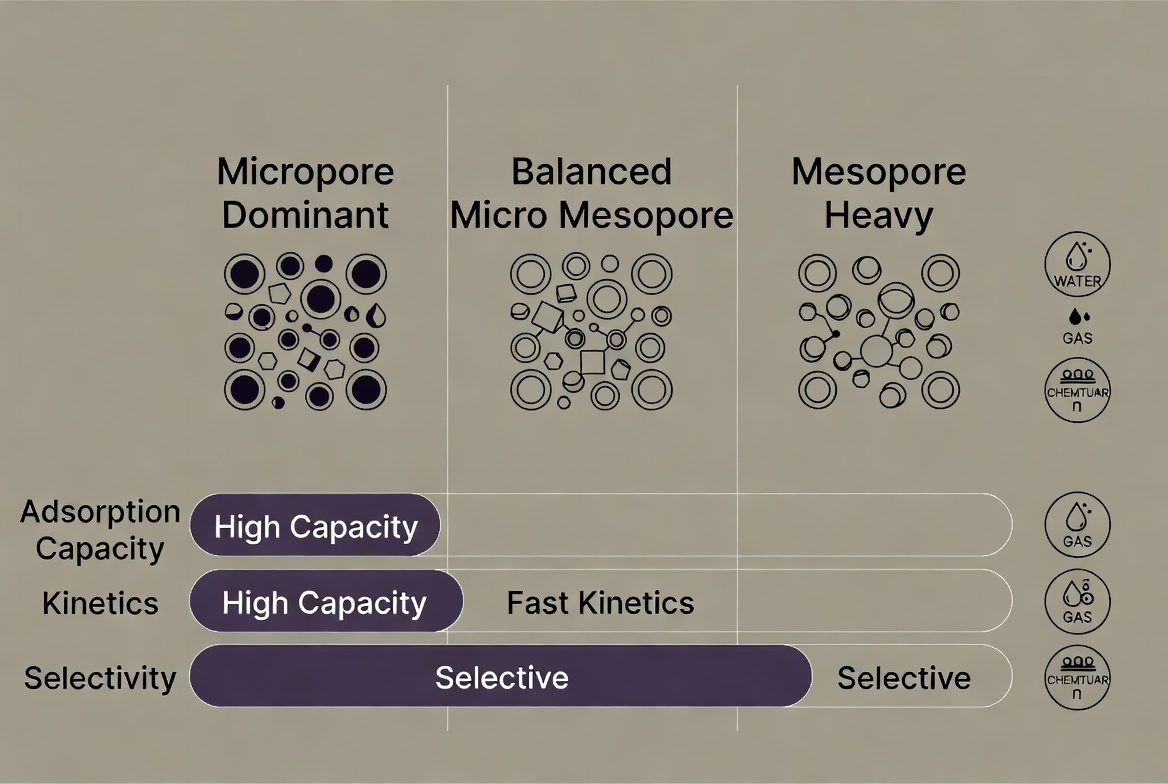
Capacity – How Much Can Be Adsorbed?
Capacity is driven by the volume of effective adsorption pores in the right size range for the target contaminant. For Pb(II), the 0.4–0.6 nm range was identified as the main contributor to adsorption, and samples with higher volume in that range achieved higher saturating capacity, even at lower total surface area. [xmtkhxt]
For gas‑phase catalysts, the 1.2–2.1 nm window allowed better impregnation and dispersion of active metal species, translating into longer protection times against HCN. In both cases, capacity correlates more with tuned pore windows than with generic "high surface area". [xmtkhxt]
Kinetics – How Fast Adsorption Occurs
Adsorption kinetics depend on:
- Presence of mesopores and macropores for rapid transport of molecules.
- Short diffusion paths from bulk solution or gas phase into micropores. [tongkeac]
Carbons with a carefully graded micro–meso network reach equilibrium faster, a crucial advantage in continuous flow systems and fixed beds where contact time is limited. For operations managers, this means lower residence time, shorter columns, or higher throughput at the same removal efficiency. [tongkeac]
Selectivity – What Gets Adsorbed Preferentially
Because pore sizes approximate molecular dimensions, pore structure indirectly controls selectivity. Microporous carbons favor smaller molecules and ions, while mesoporous carbons better accommodate bulky organics, dyes, and long‑chain VOCs. [xmtkhxt]
In catalytic carbons, pore sizes that match precursor complex dimensions ensure better loading and dispersion, which in turn enhances selectivity and conversion for specific reactions or toxic gas neutralization. Different industries exploit this by specifying pore distributions that align with the molecular weight and size of their target contaminants, rather than relying on generic grades. [xmtkhxt]
Expert Insight – Matching Pore Structures to Real Industrial Uses
Drawing on project work with industrial buyers, three practical rules consistently improve performance when selecting or designing activated carbon grades:
1. Start with the contaminant profile, not with the carbon grade.
Map target molecules (size, polarity, gas vs liquid) and use that to define the ideal micropore–mesopore balance before you request a specification. [xmtkhxt]
2. Use pore volume in specific ranges as a core specification.
For heavy metals, ask suppliers about micropore volume in the 0.4–0.6 nm window; for gas‑phase catalysts, ask for 1.2–2.1 nm pore volume and limits on larger mesopores. [xmtkhxt]
3. Validate performance with application‑specific tests.
Instead of generic iodine or methylene blue numbers alone, run breakthrough curves, isotherm tests or protection‑time measurements that reflect your actual process conditions. [xmtkhxt]
Manufacturers like Guangdong Tongke Activated Carbon Co., Ltd. can then adjust activation parameters and impregnation processes to meet these targeted pore distributions, offering custom solutions rather than off‑the‑shelf compromises. [tongkeac]
Case Snapshot – Designing Pore Structures for HCN Defence
A published study on HCN defence using activated carbon supported metal oxide catalysts gives a clear illustration of pore engineering in action. By limiting mesopore volume above 2.1 nm and increasing pore volume in the 1.2–2.1 nm range, researchers achieved significantly longer defence times, exceeding 30 minutes. [xmtkhxt]
From a practical design standpoint:
- The chosen pore window allowed cuprammonium complexes to penetrate and deposit uniformly, creating dispersed Cu₂O active sites.
- Suppressing oversized mesopores avoided particle aggregation and loss of active surface area. [xmtkhxt]
Similar design logic can be applied to carbons for respirator cartridges, industrial gas filters, and emergency response systems, where protection time and reliability are non‑negotiable performance metrics. [xmtkhxt]
Practical Selection Checklist for Buyers and Engineers
When specifying activated carbon for a new project or retrofit, buyers can use this simple checklist to align pore structure with performance goals:
1. Define your primary objective.
- Heavy‑metal removal, organic removal, odor/VOC control, catalytic reaction or toxic gas defence.
2. Collect basic contaminant data.
- Molecular size, charge, expected concentration range, competing species.
3. Request pore structure data, not just BET.
- Micropore volume distribution (e.g., 0.4–0.6 nm, 1.2–2.1 nm).
- Mesopore volume in ranges that matter for your application.
4. Align base material with your process.
- Coconut shell carbons for gas‑phase and small molecules.
- Coal‑based or wood‑based carbons for broader or larger organics. [tongkeac]
5. Pilot test under realistic conditions.
- Run isotherm or breakthrough tests with your actual water, gas or process stream.
By integrating pore structure specifications into procurement, you move from "commodity carbon" purchasing to engineered adsorption media, which is where most of the performance and cost gains are found. [tongkeac]
How Guangdong Tongke Activated Carbon Co., Ltd. Tailors Pore Structures
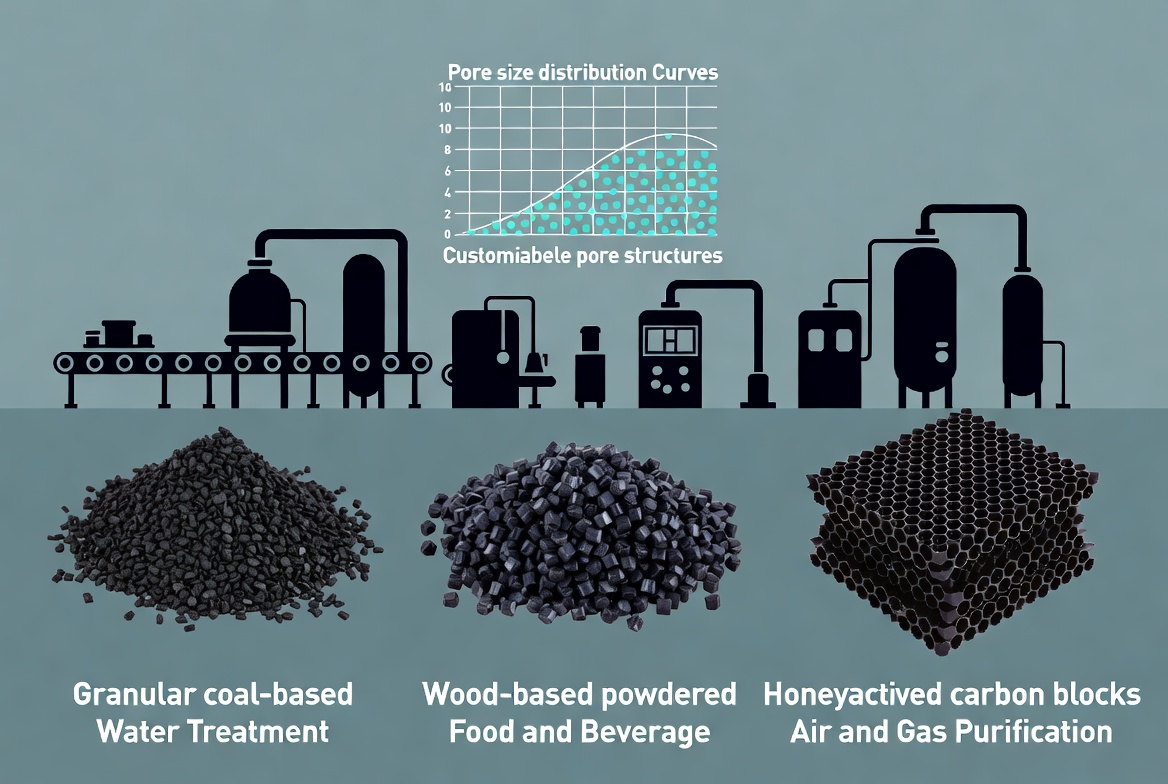
As a China‑based manufacturer, Guangdong Tongke Activated Carbon Co., Ltd. produces wood‑based powdered, coal‑based granular and honeycomb activated carbons for global industrial clients. Across these product lines, pore structures are tuned through: [tongkeac]
- Controlled activation processes that modulate micropore and mesopore development.
- Grading and shaping (granular, pellet, honeycomb) that optimize surface accessibility and flow. [tongkeac]
For OEMs and end users in water treatment, air purification, food & beverage and chemicals, this allows the company to offer customized pore profiles tailored to specific contaminants, regulations and operating conditions, instead of generic grades. [tongkeac]
Work With a Pore‑Focused Supplier
To fully leverage the impact of pore structures on activated carbon performance, industrial buyers and engineers should:
- Review current specifications and add pore size distribution requirements alongside surface area and hardness.
- Engage with manufacturers that can discuss and adjust micropore and mesopore volumes based on your application data. [tongkeac]
If you are planning a new project or upgrading existing filtration and purification systems, contact Guangdong Tongke Activated Carbon Co., Ltd. to discuss your contaminant profile, target performance and regulatory constraints, and request customized grades with engineered pore structures that match your process. [tongkeac]
FAQs
Q1: Why is pore size distribution more important than BET surface area?
Because specific pore ranges, such as 0.4–0.6 nm for Pb(II) removal and 1.2–2.1 nm for HCN defence catalysts, directly determine real adsorption performance, while BET is only an aggregate metric. [tongkeac]
Q2: Which pore structures are best for heavy‑metal removal from water?
Narrow micropores in the 0.4–0.6 nm range have been identified as effective adsorption pores for Pb(II), and similar ranges are beneficial for other small ions. [tongkeac]
Q3: How do pore structures affect catalytic activated carbons for toxic gas protection?
Pore windows that match precursor complex sizes (around 1.2–2.1 nm) improve metal loading and dispersion, while excess larger mesopores cause aggregation and weaken defence performance. [xmtkhxt]
Q4: Do different raw materials naturally create different pore structures?
Yes, coconut shell tends to form highly microporous structures, coal‑based carbons produce adjustable mixed pore networks, and wood‑based carbons often show more mesopores suitable for larger organic molecules. [tongkeac]
Q5: How can buyers ensure they choose the right pore structure for their application?
Buyers should define their contaminant profile, request detailed pore size distribution data and pilot test candidate carbons under realistic operating conditions before making large‑scale decisions. [tongkeac]
References
1. Yang J‑Y. et al. "Effect of Activated Carbon Pore Structure on the Adsorption of Pb(II) from Aqueous Solution." Acta Physico‑Chimica Sinica. Link: https://www.whxb.pku.edu.cn/article/2015/1000-6818/WHXB20151005.shtml
2. "Effect of Pore Structure on HCN Defence Performance of Activatied Carbon Supported Metallic Oxide Catalyst." AEEISP Journal. Link: https://www.aeeisp.com/lchxygy/article/doi/10.3969/j.issn.0253-2417.2020.03.005?viewType=HTML
3. Guangdong Tongke Activated Carbon Co., Ltd. – About Us. Link: https://www.tongkeac.com/aboutus.html
4. Guangdong Tongke Activated Carbon Co., Ltd. – Wood Based Powdered Activated Carbon Product Page. Link: https://www.tongkeac.com/wood-based-powdered-activated-carbon.html
5. Guangdong Tongke Activated Carbon Co., Ltd. – Honeycomb Activated Carbon Block Product Page. Link: https://www.tongkeac.com/honeycomb-activated-carbon-block.html
6. Guangdong Tongke Activated Carbon Co., Ltd. – Anthracite Coal Granular Activated Carbon Article. Link: https://www.tongkeac.com/is-anthracite-coal-granular-activated-carbon.html
7. Guangdong Tongke Activated Carbon Co., Ltd. – Is Activated Carbon The Same As Activated Charcoal? Link: https://www.tongkeac.com/is-activated-carbon-and-activated-charcoal-the-same.html
8. Guangdong Tongke Activated Carbon Co., Ltd. – How To Reuse Activated Carbon? Link: https://www.tongkeac.com/how-to-reuse-activated-carbon.html


