Content Menu
● What "mesh size" really means
● Why mesh size matters differently for water vs air
● How mesh size is specified in practice
● Typical mesh sizes for water treatment
● Typical mesh sizes for air and gas purification
● Direct comparison: Water vs air mesh size selection
● How mesh size influences performance
● Case insight: Mesh size optimization in water treatment (expert perspective)
● Case insight: Mesh size optimization in air and gas applications
● Mesh size and base material: Coconut, coal, and wood
● Practical selection guide: Choosing mesh size for water systems
● Practical selection guide: Choosing mesh size for air and gas systems
● Beyond mesh size: Integrating mesh with system design
● Why work with a specialized activated carbon manufacturer
● Call to action: Optimize your mesh size today
● Frequently Asked Questions (FAQ)
● References
Activated carbon mesh size is one of the most critical – and misunderstood – parameters when designing water treatment and air or gas purification systems. As a manufacturer and exporter like Guangdong Tongke Activated Carbon Co., Ltd. (Tongke), we see every day how the wrong mesh size can lead to pressure drop, poor contact time, media loss, or simply underperforming filters in both liquid and gas applications. [tongkeac]
In this guide, I will unpack activated carbon mesh size from a practical, engineer-level perspective and explain how requirements differ between water and air applications, so you can specify the right product with confidence. [tongkeac]
What "mesh size" really means
In activated carbon, mesh size describes the particle size distribution based on standard sieves, often using the US mesh system such as 4×8, 8×16, 12×40, 20×50, or similar designations. A 12×40 mesh carbon, for example, means most particles pass through a 12-mesh sieve but are retained on a 40-mesh sieve, giving a defined granular range that balances surface area and hydraulic performance. [tongkeac]
Key points about mesh size:
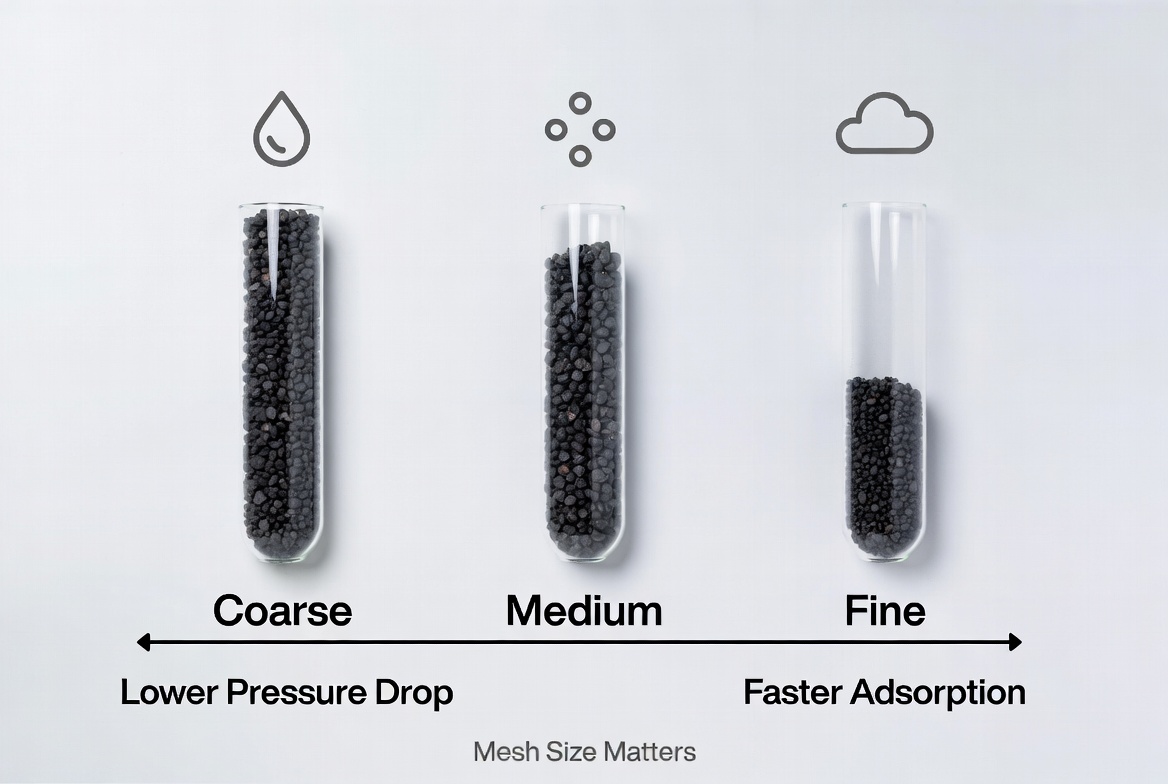
- Lower first number = larger granules (e.g., 4×8 is coarser than 12×40).
- Higher second number = smaller granules and narrower particle size window.
- Mesh size affects external surface area, pressure drop, contact time, backwashing behavior, and dust generation in both water and air systems. [tongkeac]
Because mesh size is only one part of the specification, professional buyers should always consider it together with iodine number, CTC (carbon tetrachloride) activity, hardness, and moisture content when evaluating activated carbon products. [tongkeac]
Why mesh size matters differently for water vs air
Even when using the same base material (coconut shell, coal, or wood), the optimal mesh size can vary significantly between water treatment and air or gas purification. [tongkeac]
- Water treatment prioritizes hydraulic performance: avoiding excessive pressure drop, ensuring sufficient empty bed contact time (EBCT), and controlling fines that can escape into downstream equipment.
- Air and gas purification cares more about pressure drop at given face velocities, resistance to attrition, and low dust levels to protect blowers and downstream equipment. [tongkeac]
Put simply, water systems generally tolerate slightly finer mesh sizes than air systems, as liquids handle smaller particles differently than gases and allow backwashing to reclassify the bed. [tongkeac]
How mesh size is specified in practice
From a manufacturer's perspective, specifying mesh size means controlling the granulation and screening process so that a defined percentage of carbon falls within target sieve ranges. For example, a 12×40 mesh GAC might require: [tongkeac]
- Minimum 90% retained between 12 and 40 mesh
- Maximum 5% passing 40 mesh (fines control)
- Maximum 5% on 12 mesh (oversize control)
Professional suppliers like Tongke use vibratory sieves, magnetic separation, and dust extraction to maintain consistent mesh distribution across large production batches for both water and gas-grade carbons. [tongkeac]
Typical mesh sizes for water treatment
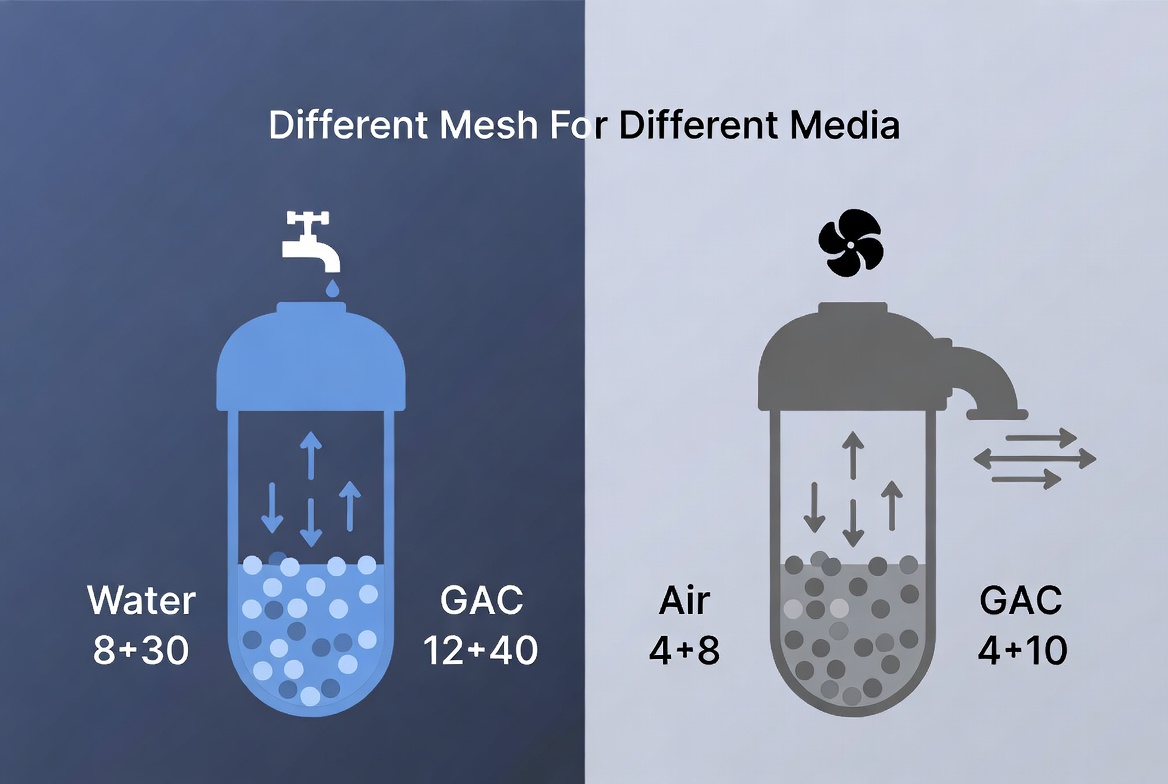
In drinking water, wastewater, and process water treatment, you'll most often see granular activated carbon (GAC) in 8×30, 8×16, 12×40 or similar mesh ranges. [tongkeac]
Why these mesh sizes work for water:
- Balance of kinetics and hydraulics: Medium mesh GAC offers enough external surface area for adsorption while keeping pressure drop manageable at typical flow rates. [tongkeac]
- Backwash reclassification: Particle ranges like 8×30 or 12×40 allow efficient bed expansion during backwash, preventing channeling and maintaining uniform flow distribution.
- Control of fines: Well-controlled mesh distribution reduces the risk of carbon fines entering service lines or downstream processes. [tongkeac]
Common water applications and mesh choices:
- Municipal drinking water filters: often 8×30 or 12×40 GAC for chlorine, taste, and odor control.
- Industrial process water: 8×16 or 12×40 depending on pressure constraints and target contaminants.
- Wastewater polishing: coarser ranges like 4×8 or 8×16 where organic loads are high and pressure drops must stay low. [tongkeac]
Typical mesh sizes for air and gas purification
For air and gas purification, including VOC removal, solvent recovery, or odor control, mesh size choices shift towards slightly coarser grades to manage pressure drop at higher superficial velocities. [tongkeac]
Common mesh ranges include:
- 4×8 or 4×10 for industrial exhaust, solvent recovery, and large HVAC systems.
- 6×12 or 8×16 for gas-phase adsorption where designers balance kinetics and pressure drop.
In gas-phase applications, even modest reductions in pressure drop can significantly lower blower energy consumption, so engineers tend to avoid overly fine meshes. [tongkeac]
Direct comparison: Water vs air mesh size selection
The table below summarizes how typical mesh size preferences differ between water and air applications while using similar raw materials and production technologies. [tongkeac]
| Parameter | Water treatment (GAC) | Air & gas purification (GAC) |
| Typical mesh range | 8×30, 8×16, 12×40 | 4×8, 4×10, 6×12, 8×16 |
| Key design priority | EBCT and hydraulic performance | Pressure drop and dust control |
| Backwash requirement | Regular backwash to control fouling | Usually non-backwashed fixed beds |
| Fines tolerance | Low (protects downstream filters/pumps) | Very low (protects blowers/ducts and occupants) |
| Typical contact time | 5–20 minutes in fixed beds | Seconds to minutes depending on system design |
In practice, many industrial users standardize on a limited set of mesh sizes across both water and air lines, then fine-tune bed depth and flow rates to meet performance targets. [tongkeac]
How mesh size influences performance
Mesh size is directly linked to adsorption kinetics, pressure drop, and handling characteristics. [tongkeac]
1. Adsorption kinetics
- Smaller particles (higher mesh numbers) offer more external surface area and shorter diffusion paths, which often leads to faster adsorption rates.
- This is especially useful in water polishing applications where contaminants must be removed quickly in relatively compact vessels. [tongkeac]
2. Pressure drop
- As mesh size becomes finer, pressure drop increases for both liquids and gases.
- In water, designers can often compensate with larger vessel diameters or lower flow velocities; in air systems, this might not be economical or technically feasible. [tongkeac]
3. Bed stability and attrition
- Coarser meshes (e.g., 4×8) are typically more robust and generate less dust under vibration, backwashing, or pneumatic conveying.
- Finer meshes may provide better kinetics but can be more prone to attrition and fines generation, which affects both outlet quality and system maintenance. [tongkeac]
Case insight: Mesh size optimization in water treatment (expert perspective)
From a practical project perspective, a typical municipal water utility may start with a standard 8×30 GAC for chlorine and organics removal, then fine-tune mesh size based on real-world performance. [tongkeac]
Common optimization steps include:
1. Baseline evaluation: Monitor differential pressure, EBCT, breakthrough curves, and backwash frequency with existing mesh size.
2. Pilot tests: Trial a finer mesh (e.g., 12×40) in a small pilot filter to assess improved kinetics and taste/odor removal.
3. Trade-off assessment: Compare gains in adsorption performance against increases in pressure drop and backwash water consumption.
4. Standardization: Once optimal mesh size is identified, align purchasing specifications for all plants to reduce inventory complexity and ensure consistent performance. [tongkeac]
Experienced suppliers support this process with granule sizing data, column test results, and practical recommendations based on comparable installations in drinking water and industrial water treatment. [tongkeac]
Case insight: Mesh size optimization in air and gas applications
In air filtration or solvent recovery, the design constraints differ: face velocities can be high, and fans or blowers have finite pressure budgets. [tongkeac]
A typical gas-phase project might proceed as follows:
1. Start with 4×8 or 4×10 GAC to ensure low pressure drop at design velocity.
2. Evaluate breakthrough performance and ensure that odor or VOC limits are consistently met.
3. If breakthrough occurs too quickly, engineers may increase bed depth, reduce face velocity, or blend in a slightly finer mesh while keeping pressure drop within acceptable limits.
4. For critical or high-temperature streams, special impregnated or pelletized carbons with tailored mesh ranges can be used to increase adsorption selectivity and mechanical strength. [tongkeac]
Industrial buyers can work with manufacturers to define custom mesh windows for specific air and gas streams, especially when dealing with aggressive or high-load environments. [tongkeac]
Mesh size and base material: Coconut, coal, and wood
Beyond mesh size, the choice of raw material (coconut shell, bituminous coal, lignite, or wood) affects pore structure and performance in both water and air applications. [tongkeac]
- Coconut shell carbon: Typically has a high proportion of micropores, making it ideal for removing low molecular weight organics and VOCs in both water and air.
- Coal-based carbon: Offers a broader pore size distribution, suitable for industrial wastewater and gas treatment with diverse contaminants.
- Wood-based carbon: Often used for decolorization and specific adsorption tasks in liquid-phase processes, especially in food and beverage or pharmaceutical applications. [tongkeac]
Professional-grade suppliers design mesh size and base material together to match application needs, rather than optimizing each variable in isolation. [tongkeac]
Practical selection guide: Choosing mesh size for water systems
When specifying activated carbon for water applications, consider the following practical steps.
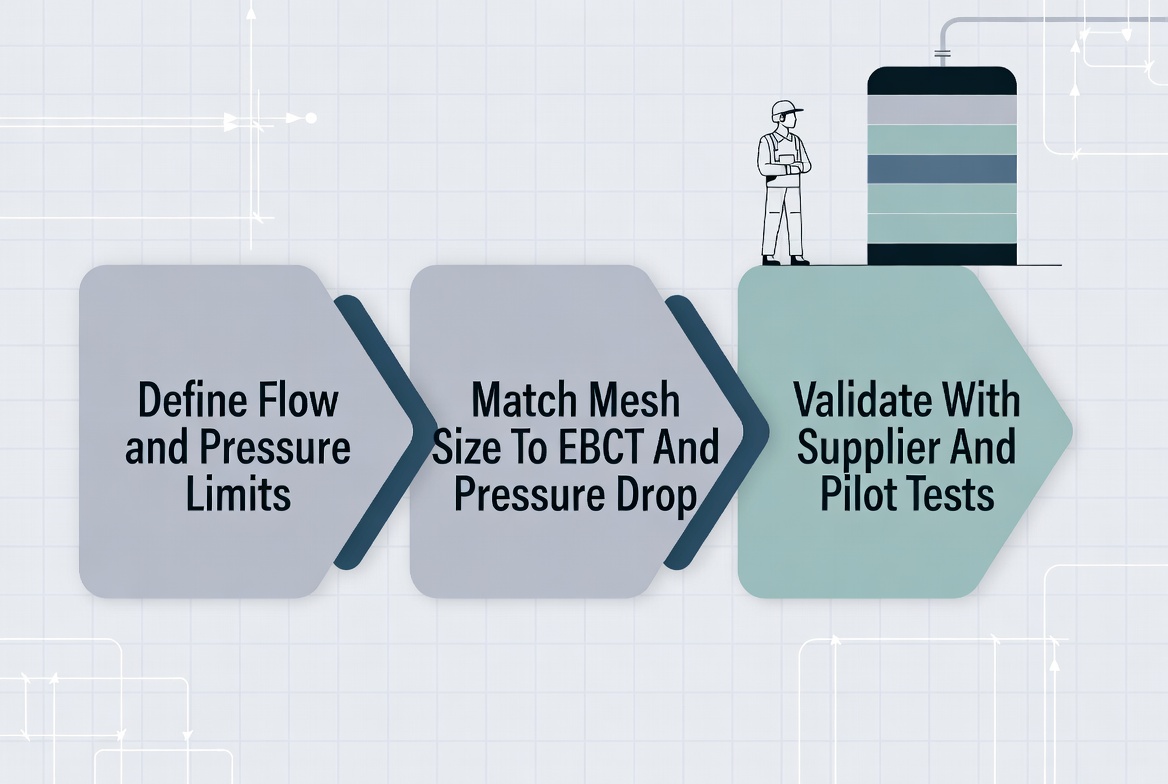
1. Define your process constraints
- Target EBCT (e.g., 10–20 minutes)
- Maximum allowable pressure drop across the bed
- Backwash capabilities (flow, frequency, available water)
2. Match mesh size to flow
- Higher flow, higher pressure limit: Prefer coarser mesh (e.g., 8×16, 8×30) to manage head loss.
- Moderate flow with high removal requirements: 12×40 or similar mesh may improve kinetics without exceeding pressure drop limits. [tongkeac]
3. Consider downstream equipment
- Sensitive membrane systems, fine filters, or dosing lines require strict fines control, so choose carbons with tight mesh specifications and low dust. [tongkeac]
Working with a manufacturer experienced in water and wastewater treatment ensures that mesh size is aligned with your hydraulic profile, contaminants, and regulatory targets. [tongkeac]
Practical selection guide: Choosing mesh size for air and gas systems
For air and gas purification, the selection logic focuses more on pressure drop and mechanical robustness.
1. Define face velocity and pressure budget
- Map out existing fans or blowers and their available static pressure.
- Estimate pressure drop through ducting, filters, and other equipment to determine the allowable pressure drop for the carbon bed. [tongkeac]
2. Choose mesh size accordingly
- Where pressure budgets are tight, start with coarser GAC (4×8 or 4×10) to minimize pressure drop.
- For critical VOC or odor control, combine proper mesh size with adequate bed depth and optimized residence time. [tongkeac]
3. Protect against dust and attrition
- Select high-hardness carbons and mesh ranges that minimize fines.
- Consider periodic inspections and replacement planning based on mass loss and bed settlement in long-term operation. [tongkeac]
Beyond mesh size: Integrating mesh with system design
Mesh size should never be viewed in isolation. In real projects, it must be coordinated with:
- Bed depth and vessel geometry
- Flow regime (upflow/downflow, fixed bed/expanded bed)
- Backwash or regeneration strategy
- Contaminant profile (molecular weight, polarity, concentration)
Manufacturers like Tongke routinely support clients with application engineering, aligning mesh size and other carbon parameters with overall system design to achieve predictable adsorption performance and lifecycle cost optimization in both water and air systems. [tongkeac]
Why work with a specialized activated carbon manufacturer
A capable supplier offers more than standard products – they provide mesh-size-optimized, application-specific solutions:
- Custom mesh distributions for particular water or air flows.
- Tailored carbons for food & beverage, chemical, pharmaceutical, and industrial emissions.
- Technical support on filter sizing, EBCT calculations, and pressure drop estimation.
With extensive experience in powdered, granular, pelletized, and specialty activated carbons, manufacturers such as Guangdong Tongke Activated Carbon Co., Ltd. supply integrated solutions for water treatment, air and gas purification, and other industrial processes globally. [tongkeac]
Call to action: Optimize your mesh size today
If you are designing or upgrading water treatment filters or air and gas purification systems, reviewing your activated carbon mesh size is one of the fastest ways to unlock better performance at lower lifecycle cost. By partnering with an experienced manufacturer, you can select the right mesh size, base material, and carbon type tailored to your specific process conditions. [tongkeac]
For project consultations, technical support, or to request sample evaluation and quotations, you can reach out to a professional activated carbon producer with a proven track record in global industrial applications and custom-engineered solutions. [tongkeac]
Frequently Asked Questions (FAQ)
1. What is the difference between 8×30 and 12×40 mesh GAC?
8×30 mesh GAC has slightly larger particles and generally lower pressure drop, while 12×40 offers finer particles and faster adsorption kinetics but higher pressure drop at the same flow rate. [tongkeac]
2. Can the same mesh size be used for both water and air applications?
In some cases, yes; however, many systems benefit from using slightly finer mesh in water and coarser mesh in air because of differences in pressure constraints and dust control requirements. [tongkeac]
3. How often should activated carbon with a specific mesh size be replaced?
Replacement frequency depends on contaminant loading, flow rate, and bed depth; operators typically monitor breakthrough indicators like residual chlorine, VOC levels, or odor to determine regeneration or replacement intervals. [tongkeac]
4. Does mesh size affect regeneration or reactivation?
Yes. Finer meshes can be more susceptible to attrition during handling and regeneration, so coarser meshes often show better mechanical stability over multiple reactivation cycles. [tongkeac]
5. What if my system experiences high pressure drop after switching mesh sizes?
If pressure drop increases after changing to a finer mesh, consider adjusting flow rate, increasing vessel diameter, or reverting to a coarser mesh that still meets removal targets while staying within design pressure limits. [tongkeac]
References
1. Guangdong Tongke Activated Carbon Co., Ltd. – Official Website. Available at: https://www.tongkeac.com/
2. Guangdong Tongke Activated Carbon Co., Ltd. – Activated Carbon Product Page. Available at: https://www.tongkeac.com/activated-carbon.html
3. Guangdong Tongke Activated Carbon Co., Ltd. – Powdered Activated Carbon for Water Treatment. Available at: https://www.tongkeac.com/powdered-activated-carbon-water-treatment.html
4. Guangdong Tongke Activated Carbon Co., Ltd. – Product Category Overview. Available at: https://www.tongkeac.com/productcategory.html
5. Guangdong Tongke Activated Carbon Co., Ltd. – Top Coconut Shell Activated Carbon Manufacturers And Suppliers in Vietnam. Available at: https://www.tongkeac.com/top-coconut-shell-activated-carbon-manufacturers-and-suppliers-in-vietnam.html


