Content Menu
● Understanding Iodine Value – What It Really Measures
● Two Carbons, Same Iodine Value – Why Performance Diverges
● Pore Size Distribution – The Hidden Dimension Behind Iodine Value
>> Micropores vs Mesopores vs Macropores
>> Case Insight – Water Treatment Plant Troubleshooting
● Raw Material and Activation Method – How Origin Shapes Performance
>> Coconut Shell, Coal, Wood, Lignite and Anthracite
>> Activation Process and Surface Chemistry
● Particle Size, Shape, and Mechanical Strength – Performance in Real Systems
>> PAC vs GAC vs Extruded Pellets
>> Mechanical Strength and Attrition
● Comparing Two Activated Carbon Products – Key Technical Parameters
>> Example Technical Comparison Table
● From Lab Numbers to Field Performance – Application Context Matters
>> Water Treatment and Beverage Applications
>> Air and Gas Purification
● Expert Insight – How Industrial Buyers Should Evaluate Activated Carbon
● Guangdong Tongke Activated Carbon – Tailored Solutions Beyond Iodine Value
● Practical Selection Checklist – Choosing Between Two "Similar" Carbons
● Conclusion – Why Iodine Value Is Necessary but Not Sufficient
● FAQs – Activated Carbon and Iodine Value
● References
As an industrial user or purchaser, it is tempting to treat iodine value as the single benchmark for activated carbon quality. Yet in my work with global manufacturers and water treatment operators, I repeatedly see plants struggle when two carbons with identical iodine numbers behave completely differently in real-world systems. This article explains, from a practitioner and industry expert perspective, why iodine value is only one piece of the puzzle and how to evaluate activated carbon more holistically for your process. [tongkeac]
Understanding Iodine Value – What It Really Measures
Iodine value (often expressed in mg/g) is a widely used indicator of micropore volume in activated carbon. In practice, it measures how much iodine can be adsorbed from solution under standardized conditions, which correlates primarily with pores smaller than about 2 nanometers. [tongkeac]
For many buyers, a higher iodine value implies higher adsorption capacity and better performance. That assumption is partly correct for certain applications, such as color removal in sugar or organics adsorption from water, but it ignores critical structural and operational factors. [tongkeac]
- Strength of the indicator: Simple, widely available, easy to compare lots. [tongkeac]
- Key limitation: Focuses on specific micropores and does not fully describe mesopores/macropores, kinetics, or mechanical strength. [tongkeac]
When we look at iodine value alone, we risk overlooking how the carbon will behave in dynamic filtration systems, gas-phase adsorption beds, or regenerable systems. [tongkeac]
Two Carbons, Same Iodine Value – Why Performance Diverges
From a plant engineer's point of view, what matters is how fast contaminants are removed, how long breakthrough is delayed, and how stable the media remains during operation. I have seen multiple cases where two suppliers offer carbons with 1000 mg/g iodine value, yet one performs reliably in continuous operation while the other fouls early, breaks down mechanically, or shows inconsistent removal efficiency. [tongkeac]
This divergence usually comes from four core factors:
- Pore size distribution differences
- Raw material and activation method
- Particle size and shape (PAC vs GAC vs extruded pellets) [tongkeac]
- Process design and operating conditions in the end user's system
Even slight deviations in these parameters can significantly change adsorption kinetics, pressure drop, and real service life. [tongkeac]
Pore Size Distribution – The Hidden Dimension Behind Iodine Value
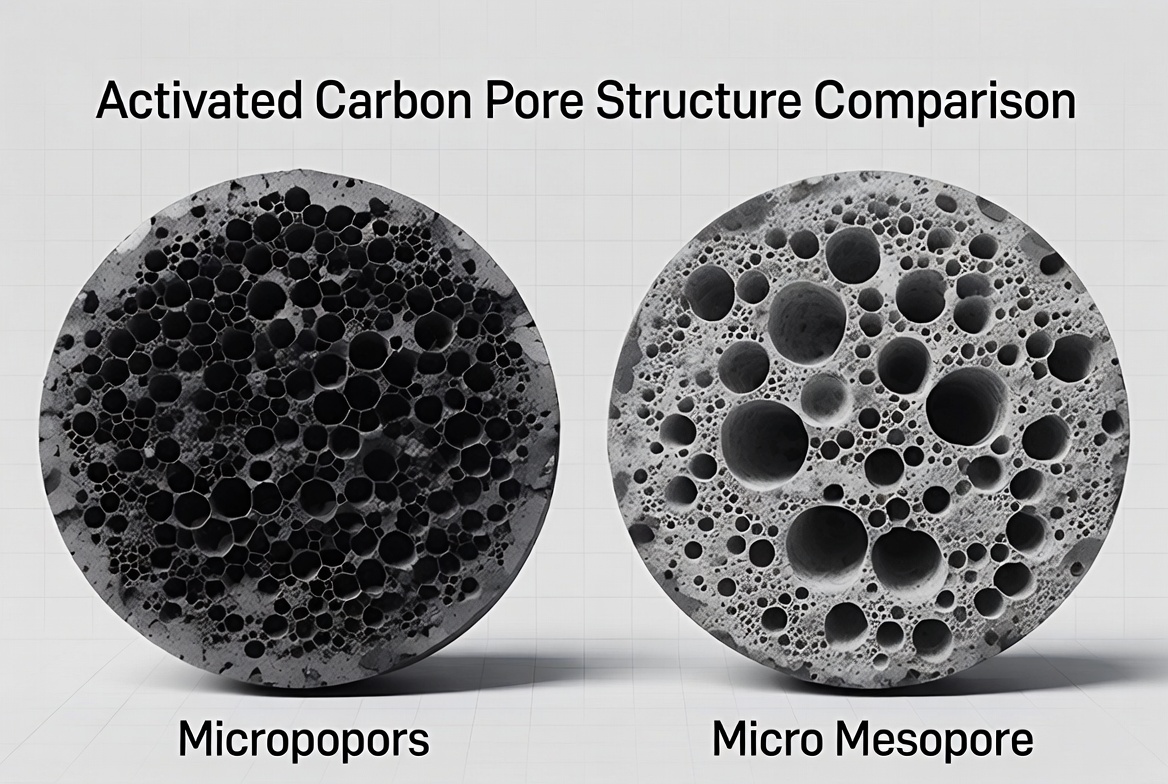
Micropores vs Mesopores vs Macropores
While iodine value is dominated by micropore contributions, many industrial contaminants interact strongly with mesopores and macropores. [tongkeac]
- Micropores: Critical for adsorption of small organic molecules and certain gases.
- Mesopores: Improve diffusion rates and are vital for larger molecules, such as many dyes and complex organics in industrial wastewater.
- Macropores: Mainly serve as transport channels, giving contaminants access to inner pore networks.
Two carbons can exhibit the same iodine value yet have very different mesopore/macropore proportions, leading to contrasting adsorption rates and breakthrough behavior. In gas-phase applications such as VOC control, a product with more developed mesopores may outperform another despite identical iodine numbers. [tongkeac]
Case Insight – Water Treatment Plant Troubleshooting
In one water treatment scenario, operators switched from a coconut shell-based granular activated carbon to a coal-based product, both rated at 1000 mg/g iodine value. The replacement showed: [tongkeac]
- Faster initial color removal
- Earlier breakthrough and more frequent media replacement
Post-audit revealed that the coconut-based carbon had a more balanced micro–meso pore structure, supporting better diffusion and sustained adsorption of larger dissolved organics. The coal-based product, though comparable in iodine value, was optimized for different contaminant profiles and therefore mismatched to the plant's water chemistry. [tongkeac]
Raw Material and Activation Method – How Origin Shapes Performance
Coconut Shell, Coal, Wood, Lignite and Anthracite
Activated carbon producers such as Guangdong Tongke Activated Carbon Co., Ltd. supply products based on coconut shell, coal (including anthracite and lignite), wood, and blended raw materials. Each raw material family yields a different base pore structure and mechanical behavior after activation. [tongkeac]
- Coconut shell carbon: High microporosity, strong hardness, suitable for many potable water and food applications. [tongkeac]
- Coal-based carbon (including anthracite, lignite): Broader pore distribution; often preferred for industrial wastewater and gas-phase VOC control. [tongkeac]
- Wood-based carbon: More meso/macropores, useful for color removal and purification of larger organic molecules. [madeinchina]
Even when iodine values match, two carbons from different raw materials will interact differently with specific contaminants and offer distinct resistance to mechanical attrition, thermal stress, and regeneration procedures. [tongkeac]
Activation Process and Surface Chemistry
Beyond raw material, producers can tailor performance via steam activation, chemical activation, and post-treatment (e.g., washing, impregnation). These choices shape: [tongkeac]
- Surface functional groups influencing adsorption of polar vs non‑polar species
- Ash content and leachable metals, critical for food, beverage, and pharmaceutical applications
- pH and surface charge, affecting adsorption of ionic species
Thus, two carbons with identical iodine value may still differ significantly in selectivity, pH stability, and compatibility with downstream processes such as disinfection or catalytic reactions. [tongkeac]
Particle Size, Shape, and Mechanical Strength – Performance in Real Systems
PAC vs GAC vs Extruded Pellets
Guangdong Tongke Activated Carbon Co., Ltd. offers powdered activated carbon (PAC), granular activated carbon (GAC), pelletized and honeycomb forms for different industrial applications. Particle configuration and mechanical strength strongly influence system behavior: [madeinchina]
- PAC: High surface area exposure and fast adsorption kinetics, but challenging for filtration and handling. [tongkeac]
- GAC: Easier backwashing, lower dust, scalable for large filter beds. [tongkeac]
- Pellets and honeycomb: Preferred for gas-phase adsorption with controlled pressure drop. [madeinchina]
If two GAC products share the same iodine value, the one with higher hardness, lower attrition, and more uniform particle size often maintains bed integrity and performance longer. [tongkeac]
Mechanical Strength and Attrition
In continuous systems such as packed beds for air and gas purification, mechanical breakdown of carbon leads to:
- Rising pressure drop
- Loss of effective bed depth
- Elevated fines, potentially contaminating downstream equipment
Differences in mechanical strength and abrasion resistance arise from raw material choice and activation conditions. That is why industrial users must evaluate both iodine value and hardness/attrition indices when comparing products. [tongkeac]
Comparing Two Activated Carbon Products – Key Technical Parameters
To make comparison clearer, the simplified table below illustrates how two products with the same iodine value may still diverge in critical properties. Values are indicative rather than specific to any single grade. [tongkeac]
Example Technical Comparison Table
| Parameter | Product A (Coconut GAC) | Product B (Coal GAC) |
| Iodine value (mg/g) | 1000 | 1000 |
| Dominant pore type | Micropores | Mixed micro–mesopores |
| Apparent density | Lower | Higher |
| Hardness / abrasion | High | Medium |
| Ash content | Lower | Higher |
| Typical application focus | Potable water, food | Industrial wastewater, VOCs |
| Breakthrough behavior (example) | Later | Earlier |
This illustrates why identical iodine numbers do not guarantee identical field performance, especially when operating conditions and contaminant profiles differ. [tongkeac]
From Lab Numbers to Field Performance – Application Context Matters
Water Treatment and Beverage Applications
In municipal water and beverage production, operators prioritize:
- Stable chlorine and organic removal
- Minimization of taste and odor issues
- Regulatory compliance and traceability
Here, iodine value is important, but contact time, empty bed contact time (EBCT), water temperature, pH, and competing organics all influence actual adsorption capacity. A carbon optimized for EBCT of 10–20 minutes may underperform in shorter contact systems despite having an impressive iodine number. [tongkeac]
Air and Gas Purification
For air and gas treatment – such as solvent recovery, VOC removal, and odor control – kinetic behavior and diffusion rates through the pore network become decisive. Gas-phase systems often operate at higher temperatures, different humidity levels, and variable contaminant loads. [tongkeac]
Two carbons with the same iodine value may exhibit different:
- Adsorption kinetics for specific VOCs
- Capacity at service temperature
- Regeneration efficiency if thermal or steam regeneration is applied
That is why industrial gas treatment plants commonly request more detailed adsorption isotherm data rather than relying solely on iodine value. [tongkeac]
Expert Insight – How Industrial Buyers Should Evaluate Activated Carbon
Drawing on best practices from OEMs, EPC contractors, and large-scale end users, a more robust evaluation approach includes:
1. Define application objectives clearly
- Target contaminants (e.g., specific VOCs, color, COD)
- Required removal percentage and breakthrough time
2. Request extended technical data
- Pore size distribution profiles
- Hardness, ash content, moisture
- pH, surface area, bulk density
3. Match media type to system design
- PAC for dosing in clarifiers or batch treatment
- GAC for continuous fixed-bed systems
- Pelleted or honeycomb for gas-phase beds and odor control
4. Conduct pilot or on-site tests
- Side-by-side evaluation under real operating conditions
- Monitoring of breakthrough, pressure drop, and regeneration behavior
By following these steps, buyers go beyond the "one-number" mindset and select the carbon that is genuinely fit-for-purpose. [tongkeac]
Guangdong Tongke Activated Carbon – Tailored Solutions Beyond Iodine Value
Guangdong Tongke Activated Carbon Co., Ltd. has developed a portfolio of powdered, granular, pelleted, honeycomb, wood-based, and coconut shell-based activated carbons serving water treatment, air and gas purification, food and beverage, chemical, and pharmaceutical applications. Rather than recommending products solely on iodine value, Tongke's technical team works with customers to align: [tongkeac]
- Raw material and pore structure with contaminant profile
- Particle size and mechanical strength with system design and maintenance plans
- Certification and compliance needs in regulated sectors
This collaborative approach allows end users to combine quantitative lab data with on-site performance, closing the gap between specification sheets and real-world reliability. [tongkeac]
Practical Selection Checklist – Choosing Between Two "Similar" Carbons
When two suppliers present activated carbon products that share the same iodine value, use the following checklist to guide your decision:
1. Confirm pore size distribution
- Ask for detailed micro/meso/macropore data and adsorption isotherms.
2. Review raw material origin
- Compare coconut shell vs coal vs wood vs lignite in light of your contaminants.
3. Check mechanical properties
- Hardness, attrition, and particle uniformity for your bed design.
4. Assess chemical properties
- Ash content, pH, and surface chemistry relevant to your process.
5. Evaluate application-specific performance
- Pilot tests or historical case studies from similar plants.
By applying this checklist systematically, buyers can move beyond single-parameter procurement and achieve more stable and efficient operations. [tongkeac]

Conclusion – Why Iodine Value Is Necessary but Not Sufficient
Iodine value remains a valuable baseline indicator of activated carbon quality and micropore capacity. However, industrial experience shows it is not sufficient on its own to predict how two products will perform in complex water, air, gas, or process environments. [tongkeac]
To unlock consistent performance and lower total cost of ownership, plant engineers, procurement teams, and OEM designers must consider pore size distribution, raw material, particle form, mechanical strength, and system-specific conditions alongside iodine value. [tongkeac]
If your team is currently evaluating two activated carbon products with the same iodine number, engage with a technical specialist from Guangdong Tongke Activated Carbon to review your process data and contaminants before finalizing the choice. [tongkeac]
FAQs – Activated Carbon and Iodine Value
Q1: Is a higher iodine value always better for water treatment?
Not always. While a higher iodine value generally indicates more micropore capacity, overall performance depends on pore distribution, contact time, and water chemistry. [tongkeac]
Q2: Why does my filter bed clog faster after switching to a new carbon with the same iodine value?
The replacement may have different particle size distribution or lower mechanical strength, causing more fines and increased pressure drop despite similar iodine values. [tongkeac]
Q3: Are coconut shell and coal-based activated carbons interchangeable if iodine numbers match?
They are not automatically interchangeable. Differences in pore structure, ash content, and mechanical behavior can lead to distinct performance and service life in specific applications. [tongkeac]
Q4: How should I compare two carbons for gas-phase VOC control?
Request adsorption isotherms for your target VOCs, review pore size distribution and pellet properties, and perform pilot tests at operating temperature and humidity instead of relying on iodine value alone. [tongkeac]
Q5: Can iodine value predict regeneration performance?
Iodine value alone cannot. Regeneration behavior is influenced by raw material, activation method, mechanical strength, and how contaminants interact with the pore network. [tongkeac]
References
1. Guangdong Tongke Activated Carbon Co., Ltd. – Official Website. Available at: [https://www.tongkeac.com/] [tongkeac]
2. Guangdong Tongke Activated Carbon Co., Ltd. – Granular Activated Carbon Product Information. Available at: [https://www.tongkeac.com/granular-activated-carbon.html] [tongkeac]
3. Guangdong Tongke Activated Carbon Co., Ltd. – Lignite Activated Carbon Product Information. Available at: [https://www.tongkeac.com/lignite-activated-carbon.html] [tongkeac]
4. Guangdong Tongke Activated Carbon Co., Ltd. – Product Portfolio Overview (Powder, Granular, Pelletized, Honeycomb, Wood, Coconut Shell). Available at: [https://www.madeinchina.com/supplier/tkcarbon/mall/page-2.html] [madeinchina]
5. Tongke Technical Article – "Is Anthracite Coal Granular Activated Carbon?" Discussion on raw materials and activated carbon properties. Available at: [https://www.tongkeac.com/is-anthracite-coal-granular-activated-carbon.html] [tongkeac]


