Content Menu
● What Are Powdered and Granular Activated Carbon?
>> Powdered Activated Carbon (PAC) in Continuous Processes
>> Granular Activated Carbon (GAC) for Fixed‑Bed Filters
● Key Technical Differences: PAC vs GAC in Continuous Filtration
>> Side‑by‑Side Technical Comparison
● Process Design Perspective: Which Is Better for Continuous Filtration?
>> When Granular Activated Carbon Is the Better Core Choice
>> How PAC Can Enhance a GAC‑Based Continuous System
● Cost, Maintenance, and Lifecycle Considerations
>> CAPEX vs OPEX in Long‑Term Operation
>> Maintenance and Operational Complexity
● Market and Industry Trends You Should Consider
>> Growing Demand for Activated Carbon in Water Treatment
>> Why Coal‑Based PAC and GAC Remain Competitive
● Expert Design Guidelines for Choosing PAC or GAC in Continuous Systems
>> Practical Selection Framework from an Engineer's View
>> Typical Hybrid Strategy We Recommend
● Application Case Insight (Continuous Wastewater Filtration)
>> How GAC and PAC Perform in Real Plants
● How Guangdong Tongke Activated Carbon Supports Your Continuous Systems
>> Customized Coal‑Based PAC and GAC Solutions
● Conclusion – So, Which Is Better for Continuous Filtration?
● FAQs: Powdered vs Granular Activated Carbon in Continuous Filtration
● References
Powdered and granular activated carbon each excel in different parts of a continuous filtration system, and the "better" choice depends on your process design, contaminant profile, and lifecycle cost targets. For most fixed-bed continuous filters, granular activated carbon (GAC) remains the primary backbone, while powdered activated carbon (PAC) is often used as a flexible, complementary polishing or shock‑load control step. [generalcarbon]
In modern water, air, and process liquid treatment, continuous filtration systems demand stability, predictable performance, and manageable operating costs. PAC and GAC are both coal‑based activated carbons widely used in these systems, but they behave very differently in terms of dosing, hydraulics, and regeneration. PAC typically offers rapid adsorption and flexible dosing, while GAC is optimized for long‑term, fixed‑bed continuous operation. [heycarbons]
From the perspective of an industrial process engineer or plant manager, the right decision is rarely "PAC or GAC only"; instead, it is about selecting the right primary medium (usually GAC) and deciding whether to integrate PAC as a strategic tool for seasonal peaks, new contaminants, or temporary upgrades. As a coal activated carbon manufacturer and exporter, Guangdong Tongke Activated Carbon Co., Ltd. can design both PAC and GAC grades tailored to your actual continuous flow conditions, from municipal water plants to chemical and pharmaceutical systems. [tkcarbon.en.made-in-china]
What Are Powdered and Granular Activated Carbon?
Powdered Activated Carbon (PAC) in Continuous Processes
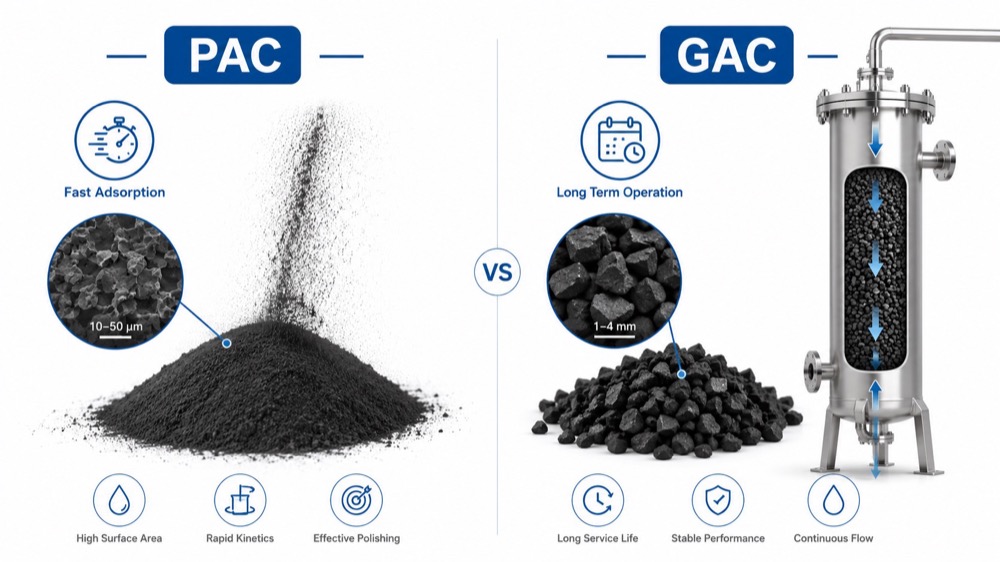
Powdered activated carbon (PAC) consists of very fine particles, typically below 0.18 mm in diameter. The small particle size yields a very high external surface area, enabling fast adsorption kinetics and quick response to sudden contaminant spikes. [tingyuancarbon]
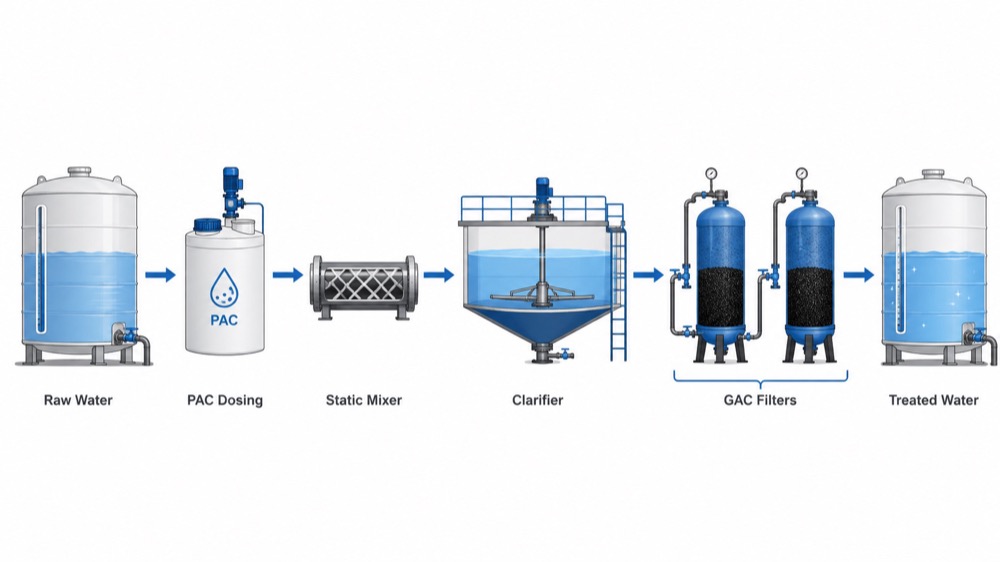
In continuous filtration systems, PAC is usually dosed into the process stream or a contact basin and then removed downstream by sedimentation, dissolved air flotation, or secondary filtration. This makes PAC particularly useful when you need:
- Short‑term or seasonal treatment capacity
- Rapid response to taste, odor, or micro‑pollutant events
- Trial or pilot treatment without redesigning existing filters
Because PAC remains suspended and is not a fixed bed, it does not provide structural support or long-term hydraulic stability inside a continuous filter vessel. Instead, it behaves like a reagent that you dose and remove, similar to a chemical treatment step rather than a permanent filter medium. [generalcarbon]
Granular Activated Carbon (GAC) for Fixed‑Bed Filters
Granular activated carbon (GAC) is made of larger particles, typically 0.2–5 mm, often produced from coal, coconut shell, or wood. The particle size is optimized for fixed‑bed adsorbers, where water or gas flows continuously through a packed bed of granules. [heycarbons]
In continuous filtration systems, GAC offers:
- Long service life with stable flow and pressure drop
- Regenerability or reactivation in many industrial setups
- Mechanical strength to withstand backwashing and hydraulic shocks
GAC is widely used in municipal and industrial continuous filters for dechlorination, organic removal, and polishing after biological or advanced oxidation steps. Because it stays in place inside the vessel, GAC is inherently more suitable as the primary medium in a continuous filtration line. [tingyuancarbon]
Key Technical Differences: PAC vs GAC in Continuous Filtration
Side‑by‑Side Technical Comparison
| Factor | Powdered Activated Carbon (PAC) | Granular Activated Carbon (GAC) |
| Typical particle size | < 0.18 mm (fine powder) (generalcarbon) | 0.2–5 mm granules (generalcarbon) |
| Typical use mode | Dosed into flow, removed by separation (generalcarbon) | Fixed bed in continuous filters (generalcarbon) |
| Adsorption speed | Very fast due to high external surface (generalcarbon) | Slower but stable over long contact time (generalcarbon) |
| Best suited for | Shock loads, short‑term issues, trials (generalcarbon) | Long‑term continuous operation (generalcarbon) |
| Hydraulic behavior | Can increase sludge load, no bed structure | Defined pressure drop and bed expansion |
| Regeneration option | Usually not regenerated | Often thermally reactivated or replaced (generalcarbon) |
| OPEX profile | Ongoing chemical‑like dosing cost | Higher CAPEX, lower long‑term cost per m³ (generalcarbon) |
This table shows why most continuous filtration systems rely on GAC as the primary media, while PAC plays a supporting role for more flexible, event-driven control.
Process Design Perspective: Which Is Better for Continuous Filtration?
When Granular Activated Carbon Is the Better Core Choice
As a process designer, your first question should be: "Do I need a stable, predictable fixed bed?" If the answer is yes, GAC is usually the better core choice for continuous filtration systems.
GAC is favored when:
- You operate 24/7 fixed‑bed filters for drinking water or industrial process water
- You need consistent pressure drop and predictable breakthrough curves
- You plan to send exhausted carbon for regeneration to reduce lifecycle cost
Industry experience shows that continuous GAC filters can achieve robust removal of persistent organic compounds when properly sized and operated, often as a polishing step after biological treatment or ozonation. In one wastewater case study, a combined ozonation, sand/anthracite, and GAC setup reduced persistent mobile substances down to around 13 μg/L in the effluent, highlighting the value of GAC in a multi‑barrier continuous system. [pubmed.ncbi.nlm.nih]
How PAC Can Enhance a GAC‑Based Continuous System
While GAC forms the backbone, PAC can be strategically integrated in front of or parallel to GAC filters. PAC is particularly valuable in continuous systems for:
- Managing unexpected contaminant peaks or seasonal taste and odor events
- Temporarily meeting tighter discharge limits before a permanent upgrade
- Piloting new treatment concepts without modifying existing GAC vessels
Because PAC doses can be ramped up or down quickly, you gain operational flexibility that traditional fixed beds alone cannot provide. However, this flexibility comes with added sludge handling and chemical dosing complexity, which must be factored into the overall system design. [generalcarbon]
Cost, Maintenance, and Lifecycle Considerations
CAPEX vs OPEX in Long‑Term Operation
From a total cost of ownership (TCO) perspective, GAC and PAC behave very differently over the lifetime of a continuous filtration plant.
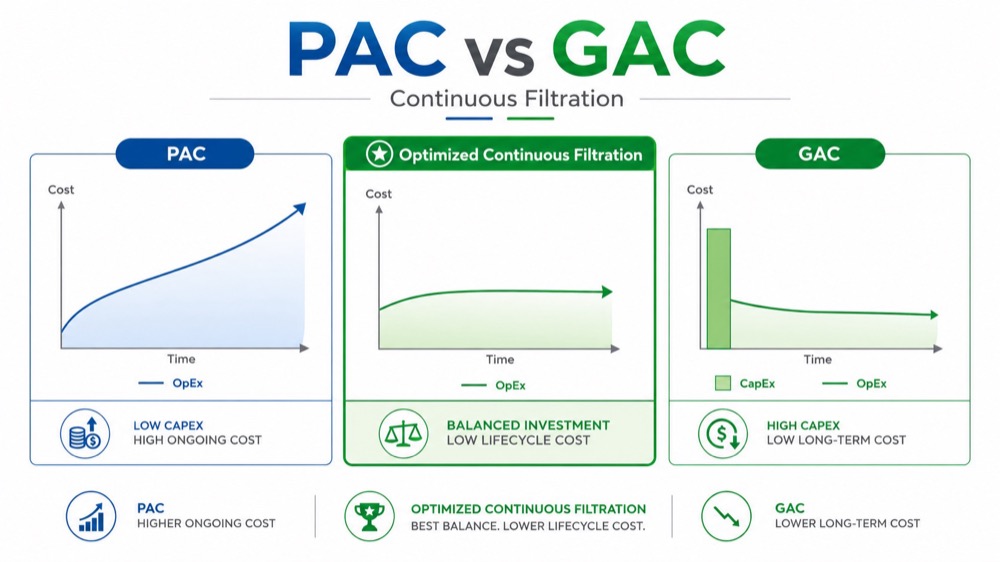
- GAC often requires higher initial investment for vessels and media, but its ability to be thermally reactivated or replaced in bulk usually lowers the cost per treated cubic meter over time. [generalcarbon]
- PAC is relatively inexpensive per kilogram but is consumed continuously, more like a reagent than a fixed asset. In global market analyses, PAC accounts for a large share of revenue in activated carbon due to its widespread dosing across water, food, and pharmaceutical sectors, underlining its high throughput and consumption rate. [grandviewresearch]
For large‑scale continuous systems, repeated PAC consumption and sludge disposal can outweigh the initial savings if PAC is over‑relied upon as the main treatment step. A balanced design typically uses GAC as the base and PAC as a tactical supplement.
Maintenance and Operational Complexity
Continuous PAC dosing requires:
- Dosing equipment calibration and monitoring
- Sludge handling infrastructure
- Careful integration with upstream and downstream processes
GAC‑based continuous filters, by contrast, require:
- Periodic backwashing to control headloss
- Scheduled carbon replacement or regeneration campaigns
- Monitoring of breakthrough indicators (e.g., TOC, specific contaminants)
From a UX perspective for plant operators, GAC systems feel more like classic filters, while PAC systems feel closer to chemical dosing steps. The right mix depends on your team's skills, automation level, and risk tolerance.
Market and Industry Trends You Should Consider
Growing Demand for Activated Carbon in Water Treatment
Industry data indicates that the activated carbon market for water treatment is growing steadily, driven by stricter regulations, micro‑pollutants, and industrial discharge control. For example, one market outlook projects the activated carbon for water treatment segment to reach around USD 5.8 billion by 2033, with a compound annual growth rate of 6.4% from 2026 to 2033. [linkedin]
Another analysis forecasts the broader industrial activated carbon market to reach approximately USD 9.49 billion by 2026, emphasizing continued investment in filtration and purification technologies. These trends suggest that continuous filtration systems using both GAC and PAC will remain central to compliance and ESG‑driven process optimization in the coming decade. [researchdive]
Why Coal‑Based PAC and GAC Remain Competitive
Although alternative adsorbents and advanced oxidation processes are evolving, coal‑based activated carbon remains highly cost‑effective and scalable for large industrial and municipal systems. Coal‑based GAC offers robust mechanical strength and tailored pore structures for demanding continuous filters, while coal‑based PAC can be optimized for rapid adsorption of specific contaminant classes. Manufacturers like Guangdong Tongke Activated Carbon Co., Ltd. leverage this flexibility to align product grades with sector‑specific needs in water, air, food and beverage, chemical, and pharmaceutical applications. [tkcarbon.en.made-in-china]
Expert Design Guidelines for Choosing PAC or GAC in Continuous Systems
Practical Selection Framework from an Engineer's View
As an engineer or technical manager, you can use the following decision framework when specifying PAC vs GAC for a continuous filtration system:
1. Define your primary goal.
- Long‑term, stable operation and predictable breakthrough → prioritize GAC.
- Highly variable, seasonal, or emergency contamination → consider PAC as an additional tool.
2. Characterize contaminants and influent variability.
- Persistent, regulatory‑driven organics → fixed‑bed GAC with appropriate empty bed contact time (EBCT).
- Short‑term taste, odor, or color events → upstream PAC dosing.
3. Assess infrastructure and operator capability.
- Strong sludge management and chemical handling → PAC easier to integrate.
- Limited operator bandwidth, preference for mechanical solutions → GAC favored.
4. Model lifecycle economics.
- Compare carbon replacement or regeneration cycles for GAC vs projected PAC consumption and sludge costs over 5–10 years.
5. Pilot and validate.
- Use small‑scale GAC columns and PAC dosing trials to refine EBCT, dose curves, and performance factors before full‑scale deployment.
Typical Hybrid Strategy We Recommend
For many of our industrial clients, an optimal hybrid strategy looks like this:
- Install coal‑based GAC filters as the main continuous polishing step after biological treatment, coagulation, or oxidation.
- Keep a PAC dosing system ready upstream, to be activated during seasonal peaks, process upsets, or when new contaminants are detected.
- Use online monitoring and periodic laboratory analysis to adjust PAC dosing and schedule GAC change‑outs.
Application Case Insight (Continuous Wastewater Filtration)
How GAC and PAC Perform in Real Plants
In a documented municipal wastewater case, PAC treatment alone achieved only partial removal of persistent mobile substances, reducing total concentrations from roughly 103 μg/L to 87 μg/L in the effluent. By contrast, a subsequent treatment train that combined ozonation, sand/anthracite filtration, and final GAC filtration brought these substances down further, to around 13 μg/L. [pubmed.ncbi.nlm.nih]
For continuous filtration design, this demonstrates that GAC is particularly effective as the final polishing step, especially in conjunction with upstream oxidation and conventional filtration. PAC can help, but when used alone, it may not deliver deep polishing for all priority pollutants at continuous plant scale.
How Guangdong Tongke Activated Carbon Supports Your Continuous Systems
Customized Coal‑Based PAC and GAC Solutions
As a specialized Chinese manufacturer, Guangdong Tongke Activated Carbon Co., Ltd. offers a full range of coal‑based powdered and granular activated carbon grades for water, air, and process applications. Our technical teams work with engineers worldwide to: [tkcarbon.en.made-in-china]
- Select GAC particle size and pore structure for your target EBCT and hydraulic profile
- Define PAC dosing strategies for seasonal or emergency scenarios
- Tailor products for sectors including water treatment, air and gas purification, food and beverage, chemical processing, and pharmaceuticals [tkcarbon.en.made-in-china]
By combining lab testing, pilot support, and application know‑how, we help you turn theoretical PAC vs GAC comparisons into a real‑world, optimized continuous filtration design.
Conclusion – So, Which Is Better for Continuous Filtration?
For most industrial and municipal continuous filtration systems, granular activated carbon is the better primary choice thanks to its mechanical stability, predictable performance, and favorable lifecycle cost in fixed‑bed operation. Powdered activated carbon remains extremely valuable as a flexible, fast‑acting complement, ideal for shock loads, seasonal issues, and incremental upgrades without changing hardware. [grandviewresearch]
In practice, the most robust strategy is to deploy coal‑based GAC as your core continuous medium, supported by smart PAC dosing where variability, regulatory pressure, or risk management require extra control. If you share your flow rate, contaminant profile, and regulatory targets, Guangdong Tongke Activated Carbon Co., Ltd. can help you translate this strategy into a practical PAC/GAC specification and supply plan tailored to your plant. [tkcarbon.en.made-in-china]
FAQs: Powdered vs Granular Activated Carbon in Continuous Filtration
1. Is powdered activated carbon suitable as the only treatment in a continuous filtration system?
PAC can be used continuously via dosing, but it is rarely the only treatment because it increases sludge load and lacks the structural stability of a fixed GAC bed. Most plants use PAC as a supporting step rather than the sole technology. [pubmed.ncbi.nlm.nih]
2. How do I decide between PAC and GAC for a new industrial water line?
Start from your long‑term continuous operation needs and regulatory targets; if you need stable, year‑round polishing, GAC should be your primary media, with PAC as a flexible add‑on for variability and emergencies. [heycarbons]
3. Can PAC and GAC be used together in the same continuous system?
Yes, many advanced plants dose PAC upstream for shock events and rely on downstream GAC filters for final polishing and regulatory compliance. This hybrid approach balances flexibility and stability. [generalcarbon]
4. Are coal‑based activated carbons still competitive versus newer adsorbents?
Coal‑based PAC and GAC remain highly competitive due to their cost‑effectiveness, scalability, and tunable pore structures, especially in large municipal and industrial continuous filtration systems. [grandviewresearch]
5. How often should GAC be replaced or regenerated in continuous operation?
Replacement or regeneration frequency depends on influent load, EBCT, and performance targets, but many plants plan change‑out cycles based on breakthrough curves and annual or multi‑year maintenance windows. A supplier with application expertise can help model optimal intervals. [pubmed.ncbi.nlm.nih]
References
1. General Carbon. "Granular vs. Powdered Activated Carbon: Key Differences." [Link] [generalcarbon]
2. Heycarbons. "Granular Activated Carbon vs Powdered Activated Carbon." [Link] [heycarbons]
3. Tingyuan Carbon. "Comparative Analysis Of Granular Pellet And Powdered Activated Carbon." [Link] [tingyuancarbon]
4. PubMed. "Efficacy of activated carbon filtration and ozonation to remove persistent and mobile substances – A case study in two wastewater treatment plants." [Link] [pubmed.ncbi.nlm.nih]
5. LinkedIn Insight. "Activated Carbon for Water Treatment Market Dynamics." [Link] [linkedin]
6. Research Dive. "Activated Carbon Market to Embark on Positive Growth." [Link] [researchdive]
7. Grand View Research. "Activated Carbon Market Size & Share | Industry Report 2033." [Link] [grandviewresearch]
8. Guangdong Tongke Activated Carbon Co., Ltd. Company Profile. [Link] [tkcarbon.en.made-in-china]


