Content Menu
● What Is Activated Carbon?
● How Do Activated Carbon Air Filters Work?
● What Do Activated Carbon Air Filters Remove?
● Limitations: What Activated Carbon Does Not Do
● Do Activated Carbon Air Filters Really Work in Practice?
● Benefits of Activated Carbon Air Filters
● Key Design Factors That Affect Performance
● Saturation and Replacement of Activated Carbon
● Activated Carbon vs HEPA and Other Filters
● Best Applications for Activated Carbon Air Filters
● Maintenance Tips for Long-Lasting Performance
● Conclusion
● FAQ About Activated Carbon Air Filters
>> (1) How effective are activated carbon air filters for VOC removal?
>> (2) Do activated carbon air filters remove dust and allergens?
>> (3) How often should activated carbon air filters be replaced?
>> (4) Are activated carbon air filters safe to use at home and in industry?
>> (5) Can activated carbon in air filters be regenerated and reused?
● Citations:
Activated carbon air filters do work and are highly effective at removing many gases, odors, and volatile organic compounds (VOCs) from indoor air when properly designed, sized, and maintained. However, activated carbon air filters do not capture dust, pollen, or other solid particles and must be combined with mechanical filters such as HEPA to provide complete air purification.[1][2][3][4]
What Is Activated Carbon?
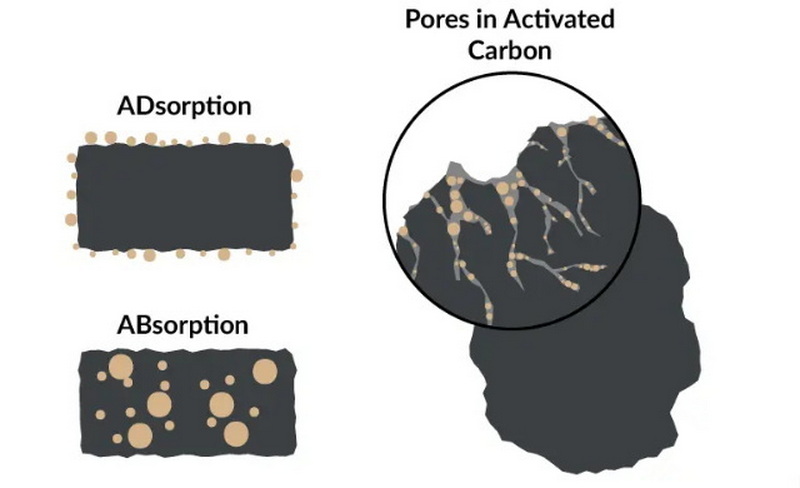
Activated carbon is a specially processed form of carbon with an extremely high internal surface area and a network of micro-, meso-, and macropores that can adsorb large amounts of molecules from air and gases. In air filters, this activated carbon is usually produced from coal, coconut shell, or other carbonaceous materials and then activated by steam or chemicals to create billions of tiny pores.[2][5]
- The internal surface area of just a few grams of activated carbon can be comparable to a football field, giving enormous capacity for odor and VOC adsorption.[5]
- Different pore sizes allow activated carbon to capture different molecule sizes, from small VOCs to larger odor molecules.[2][5]
How Do Activated Carbon Air Filters Work?
Activated carbon air filters work by adsorption, a process where gas molecules and vapors are attracted to and held on the surface of the activated carbon, rather than absorbed into the bulk material. As polluted air passes through the filter, VOCs and odor molecules stick to the internal surface of the activated carbon pores, and cleaner air exits the filter.[6][7][5][2]
- Adsorption is driven by physical forces and sometimes chemical interactions between the activated carbon surface and the gas molecules.[7][2]
- Air purifiers with activated carbon pull air through a carbon bed or carbon-loaded filter, trapping gases inside the activated carbon while releasing purified air back into the room.[4][7]
What Do Activated Carbon Air Filters Remove?
Activated carbon air filters are very effective at removing many VOCs, odors, and troublesome gases that ordinary mechanical filters cannot capture. These activated carbon filters are widely used to treat VOCs from paints, solvents, furnishings, smoking, cooking, and industrial processes.[1][6][2]
- Activated carbon is known to adsorb common VOCs such as benzene, toluene, and other organic compounds that impact indoor air quality.[8][1]
- Activated carbon air filters are frequently installed in air purifiers, HVAC systems, range hoods, and industrial exhaust systems specifically for odor and VOC control.[6][2]
Limitations: What Activated Carbon Does Not Do
Although activated carbon air filters are powerful for gases, they are not designed to capture solid particles like dust, pollen, pet dander, or mold spores. For full protection against particulate matter (PM2.5, allergens), activated carbon needs to be combined with particulate filters such as HEPA or other mechanical filters.[3][9][10][4]
- Manufacturers and experts consistently note that activated carbon filters alone are not a substitute for HEPA filtration when particulate removal is required.[10][4]
- In addition, activated carbon performance can drop in very humid environments, because moisture can block pores and reduce adsorption capacity.[11]
Do Activated Carbon Air Filters Really Work in Practice?
Real-world tests and field experience show that activated carbon air filters can significantly reduce indoor VOC levels when the filter contains enough activated carbon and is properly regenerated or replaced. For example, research on activated carbon fiber filters has demonstrated high VOC removal efficiencies of around 70–80% for many VOCs after suitable regeneration, and modeling shows large concentration reductions when combined with ventilation strategies.[12][8]
- Independent studies and industry data confirm that activated carbon is one of the most effective media for VOC and odor control in indoor environments.[1][2]
- However, some very small or reactive compounds such as formaldehyde may be less efficiently removed by standard activated carbon air filters, requiring special formulations or complementary technologies.[8][1]
Benefits of Activated Carbon Air Filters
Activated carbon air filters offer several clear benefits for homes, offices, and industrial environments where gas and odor control is essential. When correctly selected and maintained, activated carbon helps create cleaner, more comfortable air for building occupants and workers.[3][5][2][6]
- Strong VOC and odor removal: activated carbon is highly effective at reducing smells and many chemical vapors that cause discomfort or health concerns.[2][6]
- Versatility and scalability: activated carbon air filters can be used in small consumer purifiers or large industrial systems handling various process and exhaust gases.[9][2]
Key Design Factors That Affect Performance
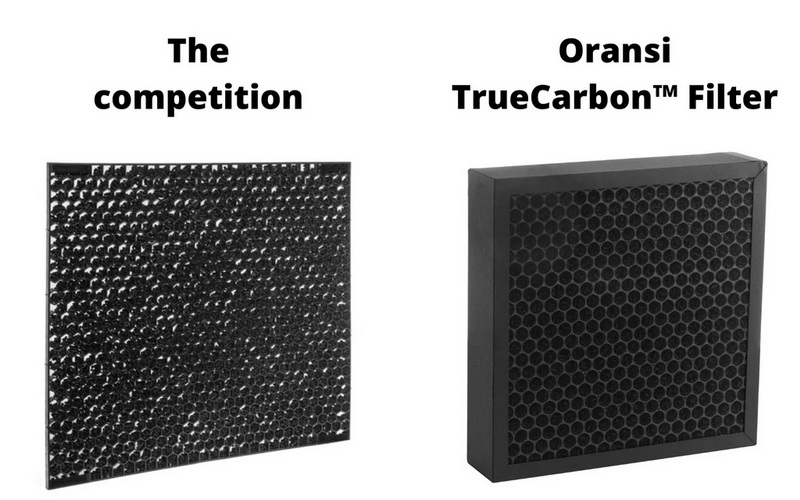
The effectiveness of activated carbon air filters depends heavily on filter design, including the amount of activated carbon, contact time, airflow, and pore structure. If the filter has too little activated carbon or the air passes through too quickly, there is not enough time for adsorption and the filter will remove fewer VOCs.[12][9][2]
- Studies show that achieving target indoor VOC reductions often requires a specific mass of activated carbon, making carbon loading a critical design parameter.[12]
- Optimal airflow and proper sizing of the activated carbon bed ensure that polluted air spends enough time in contact with the activated carbon surface to achieve good removal efficiency.[9][2]
Saturation and Replacement of Activated Carbon
Activated carbon air filters do not work forever: their pores gradually fill up, and the activated carbon becomes saturated with pollutants. Once saturated, an activated carbon filter can no longer effectively adsorb new VOCs and, in some cases, may even desorb previously captured compounds back into the air.[11][9][1]
- Because of saturation, activated carbon filters must be replaced or regenerated at recommended intervals to maintain performance and avoid breakthrough of VOCs.[11][1]
- Some industrial systems use activated carbon media that can be thermally regenerated or replaced in bulk, while most consumer filters are designed as replaceable cartridges.[8][2]
Activated Carbon vs HEPA and Other Filters
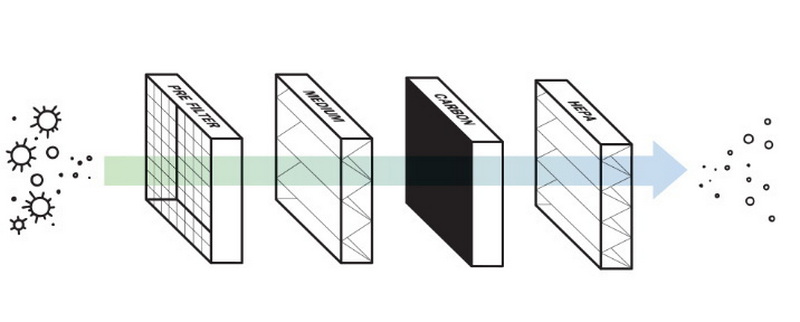
Activated carbon air filters target gases and odors, while HEPA and similar mechanical filters target particles; using both together provides more complete air cleaning. Many modern air purifiers combine a HEPA filter for particulate matter with an activated carbon filter for VOCs, creating multi-stage systems for comprehensive indoor air quality control.[4][10][3]
| Filter Type | Main Target | How It Works | Typical Use Cases |
| Activated carbon filter | Gases, VOCs, odors | Adsorption onto activated carbon pores tecnosida+1 | Odor control, VOC reduction in homes and industry gzcleanlink+1 |
| HEPA / mechanical filter | Dust, pollen, PM, bioaerosols | Physical interception of particles jaspr+1 | Allergy relief, PM2.5 reduction in purifiers/HVAC oransi |
| Pre-filter / coarse filter | Large dust, hair, lint | Simple mechanical screening jaspr | Protecting main filters and extending life |
- Guidance from air quality experts stresses that no single filter media can handle both gases and fine particles at the same time, so combining activated carbon and HEPA is standard practice.[10][4]
- Some advanced systems also integrate other technologies, but activated carbon remains the primary media for VOC and odor adsorption.[6][2]
Best Applications for Activated Carbon Air Filters
Activated carbon air filters are best used wherever gas-phase contaminants and odors are the main concern, especially in enclosed or sensitive environments. These applications make full use of the adsorption capacity of activated carbon and help meet regulatory or comfort targets for indoor air.[13][2][12]
- Typical uses include residential air purifiers, kitchen ventilation, smoking areas, laboratories, manufacturing plants, wastewater treatment odor control, and VOC capture from industrial exhaust.[2][6]
- Activated carbon is also used in personal protective equipment and specialized air cleaning systems to protect workers from hazardous gases and vapors.[7][13]
Maintenance Tips for Long-Lasting Performance
To ensure that activated carbon air filters continue to work effectively, regular maintenance and monitoring are essential. Neglecting replacement schedules or using activated carbon beyond its adsorption capacity undermines performance and can compromise indoor air quality.[3][9][1][11]
- Many suppliers recommend replacing activated carbon filters according to time-in-service, VOC load, or sensor feedback, sometimes using saturation indicators or pressure-drop monitoring.[11][2]
- Combining activated carbon with pre-filters protects the activated carbon from dust, extending the life of the activated carbon and keeping adsorption sites available for gases.[4][3]
Conclusion
Activated carbon air filters do work and are among the most effective technologies for removing VOCs, odors, and many harmful gases from indoor air when they contain sufficient activated carbon and are correctly maintained. However, activated carbon cannot capture dust and other particles, becomes saturated over time, and must be paired with mechanical filtration and regular replacement schedules to deliver consistently high air quality in homes, offices, and industrial environments.[9][1][2][3]
FAQ About Activated Carbon Air Filters
(1) How effective are activated carbon air filters for VOC removal?
Activated carbon air filters are widely recognized as one of the best options for VOC removal because their enormous internal surface area and pore structure allow them to adsorb a wide range of organic vapors. Studies and field data show substantial VOC reductions when adequate activated carbon mass and proper airflow are provided, although some small or reactive compounds such as formaldehyde may be more difficult to capture.[6][1][8][12]
(2) Do activated carbon air filters remove dust and allergens?
Activated carbon air filters do not effectively remove dust, pollen, pet dander, or other solid particles, because activated carbon media is optimized for gas-phase adsorption rather than mechanical interception. For dust and allergen control, a HEPA or equivalent mechanical filter should be used in combination with activated carbon, creating a multi-stage air purification system.[4][10][3]
(3) How often should activated carbon air filters be replaced?
Activated carbon air filters should be replaced according to manufacturer guidelines, which depend on VOC load, air volume, and application, because the activated carbon gradually becomes saturated with pollutants. If an activated carbon filter is not replaced on time, removal efficiency drops sharply and there is a risk that previously adsorbed VOCs may be released back into the air as conditions change.[1][9][11]
(4) Are activated carbon air filters safe to use at home and in industry?
Activated carbon air filters are generally considered safe and are widely used in residential air purifiers, commercial buildings, and industrial plants for VOC and odor control. As with any filtration system, safety and performance depend on correct design, appropriate ventilated installation, and regular replacement or regeneration of the saturated activated carbon media.[2][11][3]
(5) Can activated carbon in air filters be regenerated and reused?
In industrial applications, certain activated carbon media and activated carbon fiber filters can be thermally regenerated or regenerated with outdoor air to restore much of their VOC adsorption capacity. However, most consumer-grade activated carbon air filters are intended as disposable cartridges, and safe, effective regeneration of the activated carbon at home is usually not practical, so replacement is the standard approach.[8][9][11]
Citations:
[1](https://customfiltersdirect.com/blogs/air-filter-blog/does-activated-carbon-filter-remove-vocs-from-indoor-air)
[2](https://www.tecnosida.com/activated-carbon-filters-odour-voc-removal)
[3](https://activatedcarbondepot.com/blogs/news/activated-carbon-in-air-purification-its-role-in-improving-indoor-air-quality)
[4](https://jaspr.co/blogs/news/activated-carbon-filters)
[5](https://www.stadlerform.com/en/health/neutralise-odours/combat-odours-with-an-activated-carbon-filter)
[6](https://www.gzcleanlink.com/the-science-behind-how-activated-carbon-filters-remove-contaminants/)
[7](https://oransi.com/blogs/how-it-works/activated-carbon-activated-carbon-adsorption)
[8](https://energyanalysis.lbl.gov/publications/energy-efficient-indoor-voc-air)
[9](https://neroindustry.com/activated-carbon-air-filters-everything-you-need-to-know/)
[10](https://oransi.com/blogs/how-it-works/hepa-filters-vs-activated-carbon-filters-pros-and-cons)
[11](https://www.abestorm.com/blogs/news/what-are-activated-carbon-filters)
[12](https://www.sciencedirect.com/science/article/abs/pii/S0045653522018070)
[13](https://terra-bloom.com/blogs/news/activated-carbon-air-filters-untangling-the-true-from-the-false)
[14](https://news.mit.edu/2021/study-finds-indoor-air-cleaners-fall-short-removing-volatile-organic-compounds-1029)
[15](https://puragen.com/uk/insights/the-effectiveness-of-activated-carbon-filters/)
[16](https://www.reddit.com/r/AirQuality/comments/14xow2a/do_air_filters_hold_onto_vocs/)
[17](https://www.airpurifierfirst.com/buying-guides/best-air-purifiers-for-vocs/)
[18](https://ww2.arb.ca.gov/resources/documents/effectiveness-advanced-air-purifiers-and-filtration-reducing-h2s-no2-vocs-and)
[19](https://pmc.ncbi.nlm.nih.gov/articles/PMC9866597/)
[20](https://cleanair.camfil.us/air-filtration-faqs/odor-removal-technology/)


