Content Menu
● Adsorption vs Absorption: The Core Difference
>> What is adsorption?
>> What is absorption?
● Why Activated Carbon Uses Adsorption, Not Absorption
● Mechanisms of Adsorption on Activated Carbon
● Why the Distinction Matters in Real Projects
● Honeycomb Activated Carbon: Structure and Advantages
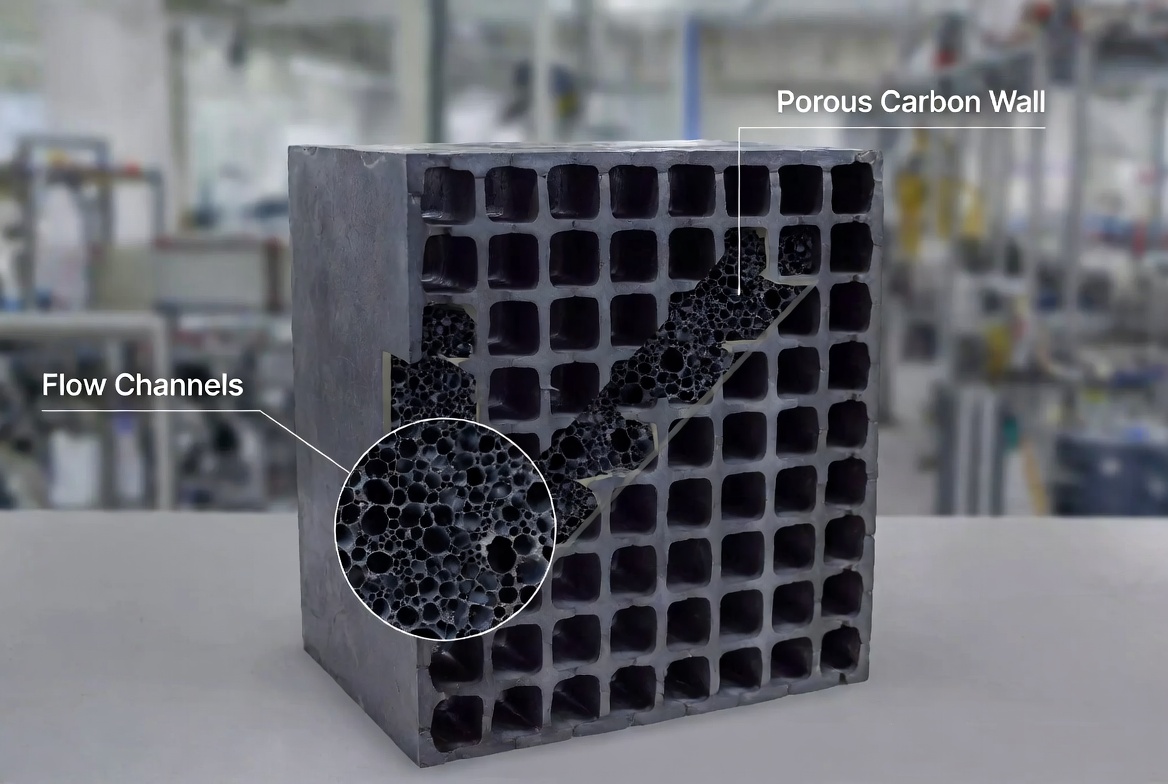
>> What is honeycomb activated carbon?
>> Typical industrial applications
● How Adsorption Works in Honeycomb Activated Carbon Systems
>> Step‑by‑step process
>> Key design parameters engineers should not ignore
● When to Use Adsorption vs Absorption in Industrial Practice
● Market Trends: Why Activated Carbon Demand Keeps Rising
● Practical Selection Guide for Honeycomb Activated Carbon
● Where a Specialist Manufacturer Adds Value
● Call to Action: Talk to an Adsorption Specialist
● FAQs on Activated Carbon Adsorption vs Absorption
● References
Activated carbon works almost entirely through adsorption, not absorption, and understanding this difference is essential if you want reliable performance from your honeycomb activated carbon systems. In this in‑depth guide, I will unpack the science, show how it impacts real industrial projects, and explain when honeycomb activated carbon is the right engineering choice for your application. [naturecarbon]
Adsorption vs Absorption: The Core Difference
What is adsorption?
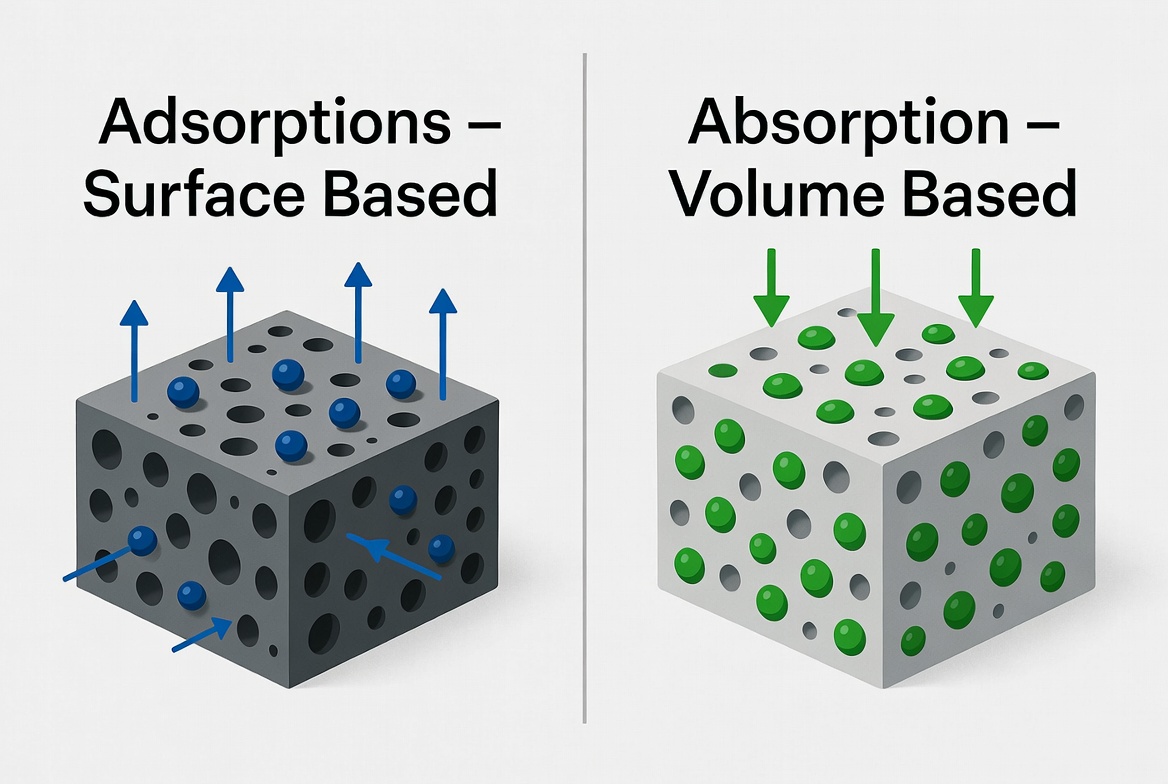
Adsorption is a surface‑based process where molecules from a gas or liquid phase attach to the surface of a solid, driven by physical forces or chemical bonding. In activated carbon, millions of micro‑ and mesopores create a huge internal surface area that offers countless active sites for these molecules to "stick". [airscience]
Key characteristics of adsorption on activated carbon: [airfiltration.mann-hummel]
- Surface phenomenon: Pollutants stay on the pore surfaces, not inside the bulk material.
- Reversible in many cases: With temperature or steam/air regeneration, the carbon bed can be partially restored.
- Fast kinetics: Particularly effective for low‑concentration pollutants such as VOCs and odor molecules.
- Highly dependent on pore structure: Pore size distribution and surface chemistry determine performance.
A simple way to visualize this is to imagine a city of microscopic rooms inside each carbon block, where pollutant molecules get trapped on the walls instead of being absorbed into a sponge‑like interior.
What is absorption?
Absorption is a volume‑based process where the absorbate penetrates into the bulk of another material, like gas dissolving into a liquid or a sponge soaking up water. In industrial gas treatment, absorption typically involves scrubbing gases into a liquid absorbent such as water, caustic solution, or organic solvents. [naturecarbon]
Key characteristics of absorption: [airfiltration.mann-hummel]
- Bulk phenomenon: Pollutants move into the interior of the absorbent.
- Driven by concentration gradients: Mass transfer from high to low concentration regions.
- Often energy‑intensive regeneration: Stripping or distillation is usually required to recover the absorbent.
- Better for highly soluble gases: Suitable when target contaminants dissolve easily in the chosen absorbent.
Why Activated Carbon Uses Adsorption, Not Absorption
Activated carbon is engineered to maximize surface area, often exceeding 500–1000 m² per gram, making it one of the most efficient adsorbents available for environmental purification. The carbon's pore network provides a combination of micropores, mesopores and macropores, creating both access channels and active sites for pollutant capture. [linkedin]
For honeycomb activated carbon in particular:
- The honeycomb channels reduce pressure drop and guide airflow or gas flow evenly through the structure.
- The activated carbon walls between channels are packed with pores where adsorption takes place.
- This geometry combines efficient mass transfer with low energy consumption in fans or blowers.
In practice, when you design or purchase honeycomb activated carbon, you are designing for adsorption capacity, kinetics, and regeneration behavior, not absorption into the bulk of the material. [airscience]
Mechanisms of Adsorption on Activated Carbon
From a technical perspective, adsorption on activated carbon can be grouped into two main mechanisms: [naturecarbon]
- Physisorption
- Driven by van der Waals forces and electrostatic interactions.
- Generally reversible and favored at lower temperatures.
- Typical for VOCs, odors, many organic vapors, and some inorganic gases.
- Chemisorption
- Involves stronger chemical bonding between the carbon surface (or impregnated chemicals) and the pollutant.
- Often irreversible or only partially reversible.
- Used for specific gases like H₂S, SO₂, or acid gases when the carbon is impregnated.
In industrial engineering, most honeycomb activated carbon filters for VOC and odor control rely primarily on physisorption, while specialized formulations can incorporate chemisorption for aggressive or corrosive gases. [sphericalinsights]
Why the Distinction Matters in Real Projects
Understanding adsorption vs absorption is not just theory; it directly impacts design decisions in water treatment, air purification, food processing, and chemical production. [sphericalinsights]
If you confuse the two, you may:
- Select the wrong equipment (e.g., liquid scrubber instead of carbon bed).
- Miscalculate residence time and bed volume.
- Overestimate regeneration effectiveness and media life.
- Misinterpret performance data in technical datasheets.
Engineers and procurement teams who clearly distinguish these concepts are able to specify more efficient, cost‑effective systems and communicate better with suppliers and end users. [sphericalinsights]
Honeycomb Activated Carbon: Structure and Advantages
What is honeycomb activated carbon?
Honeycomb activated carbon is an extruded or molded monolithic block with a regular "honeycomb" of channels (cells) running through it. Typical cell densities range from about 100 to 400 CPSI (cells per square inch), balancing pressure drop and adsorption surface. [qizhongcarbon]
Advantages of honeycomb structure for adsorption: [qizhongcarbon]
- Low pressure drop compared with packed granular beds at the same flow rate.
- Large geometric surface area for gas contact.
- Uniform flow distribution and reduced channeling.
- Easy handling and modular design for equipment builders.
Honeycomb blocks can be produced from coal‑based, wood‑based, or coconut shell‑based activated carbon, and can be customized in size, cell density, and impregnation depending on the target pollutants. [tkcarbon.en.made-in-china]
Typical industrial applications
Honeycomb activated carbon is widely used in: [tongkeac]
- Flue gas VOC removal and odor control
- Industrial exhaust treatment from coating, printing, painting, and chemical plants
- Solvent recovery systems
- Indoor air purification and cleanroom ventilation
- Gas‑phase filtration in electronics, packaging, and automotive sectors
In many of these scenarios, honeycomb carbon replaces or complements traditional packed beds when space, pressure drop, or maintenance constraints are critical. [sphericalinsights]

How Adsorption Works in Honeycomb Activated Carbon Systems
Step‑by‑step process
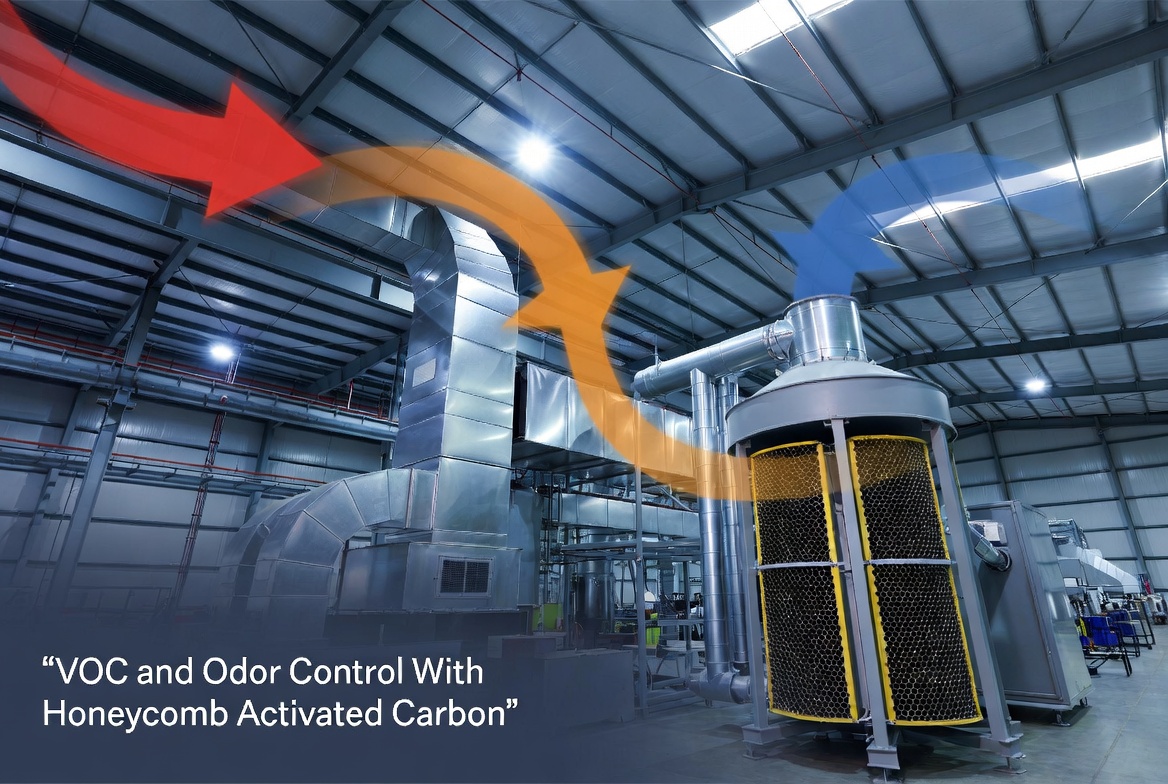
In a typical honeycomb activated carbon unit handling VOC‑laden air, the adsorption process involves: [airscience]
1. Contaminated gas enters the module and is evenly distributed across the honeycomb face.
2. Flow channels guide the gas through the block, maintaining uniform velocity.
3. Pollutant molecules diffuse from the bulk gas into the boundary layer near the channel walls.
4. Adsorption occurs when molecules reach active sites inside the pores of the carbon walls.
5. Cleaned gas exits with significantly reduced VOC or odor concentration.
6. When the carbon approaches saturation, the module is either replaced or thermally/steam regenerated depending on system design.
Key design parameters engineers should not ignore
When sizing honeycomb activated carbon solutions, engineers focus on: [qizhongcarbon]
- Gas flow rate and temperature
- Inlet pollutant concentration and composition
- Required outlet concentration (regulatory or process limit)
- Contact time (Empty Bed Contact Time, EBCT equivalent)
- Cell density and block depth
- Regeneration strategy or replacement interval
Selecting optimal parameters ensures a balance between capital cost, operating cost, and compliance risk, which is critical for global industrial facilities under tightening air and water standards. [sphericalinsights]
When to Use Adsorption vs Absorption in Industrial Practice
Although this article focuses on activated carbon adsorption, many plants use both adsorption and absorption in different steps. [airfiltration.mann-hummel]
You generally choose activated carbon adsorption when:
- Target contaminants are organic vapors, odors, or VOCs at low to medium concentrations.
- The goal is polishing after another treatment step, such as biological treatment or scrubbing.
- You need compact equipment with low pressure drop.
- You want modular systems that can be upgraded or relocated easily.
You choose absorption (scrubbers) when:
- Pollutants are highly soluble gases (e.g., ammonia, some acid gases).
- Reaction with the absorbent is desirable (e.g., neutralization with caustic).
- Large flow rates and high contaminant loads require bulk removal before polishing.
In many projects, a hybrid approach is ideal: a scrubber for bulk gas removal followed by honeycomb activated carbon for final polishing and odor/VOC control. [airfiltration.mann-hummel]
Market Trends: Why Activated Carbon Demand Keeps Rising
The global activated carbon market is experiencing strong growth driven by environmental regulations, industrial expansion, and health awareness. [bccresearch]
Recent data shows:
- The activated carbon market is projected to grow from USD 6.6 billion in 2024 to USD 10.2 billion by 2029, a CAGR of about 9.3%. [bccresearch]
- Activated carbon filters alone are expected to reach about USD 330 million by 2025, up from USD 267 million in 2020 (CAGR ≈ 4.4%). [linkedin]
- Air purification applications are among the fastest‑growing segments, especially where activated carbon is integrated with HEPA and multi‑stage filtration systems. [sphericalinsights]
For industrial buyers, these trends mean:
- More stringent emission limits and corporate ESG commitments.
- Growing demand for reliable and scalable honeycomb activated carbon solutions.
- The need to work with experienced manufacturers who can provide technical guidance rather than just commodity media.
Practical Selection Guide for Honeycomb Activated Carbon
From an engineer's perspective, selecting the right honeycomb activated carbon solution involves balancing performance, cost, and risk.
Core selection checklist:
- Define pollutants clearly
VOC type, molecular weight, polarity, and expected concentration range. [airscience]
- Specify process conditions
Gas temperature, humidity, pressure, and flow fluctuations. [airscience]
- Set performance targets
Emission limits, odor thresholds, and safety margins. [sphericalinsights]
- Choose block configuration
Cell density (CPSI), channel size, block dimensions, and packing layout. [qizhongcarbon]
- Plan maintenance and regeneration
On‑site thermal/steam regeneration vs periodic module replacement. [sphericalinsights]
By treating honeycomb activated carbon as an engineered solution—not a simple consumable—you can significantly extend media life, optimize pressure drop, and avoid unplanned shutdowns.
Where a Specialist Manufacturer Adds Value
Guangdong Tongke Activated Carbon Co., Ltd. is a dedicated activated carbon producer integrating R&D, production, and global sales, supplying wood‑based, coal‑based, coconut shell, and honeycomb activated carbon for a wide range of industrial applications. Our products are used in water treatment, air and gas purification, food and beverage processing, chemical production, pharmaceuticals, gold recovery, and many other sectors. [tongkeac]
From a project‑driven standpoint, working directly with a manufacturer provides:
- Tailored formulations (pore structure, impregnation, block size) for specific pollutants.
- Engineering support on sizing, contact time, and system layout.
- Consistent quality control and traceability across batches.
- Global logistics support for continuous supply.
For OEMs and end users, this translates into more predictable performance and total cost of ownership over the life of the system.
Call to Action: Talk to an Adsorption Specialist
If you are planning a new VOC control system or upgrading existing air or gas purification equipment, the way your activated carbon adsorbs contaminants will define overall performance and lifecycle cost. For tailored honeycomb activated carbon solutions, technical calculations, and sample testing, contact Guangdong Tongke Activated Carbon Co., Ltd. to discuss your specific pollutants, process conditions, and performance targets. [tongkeac]
FAQs on Activated Carbon Adsorption vs Absorption
1. Why is adsorption more important than absorption for activated carbon?
Because activated carbon is engineered for extremely high surface area, most pollutants are captured on the surface of its pores through adsorption, not absorbed into the bulk material. [naturecarbon]
2. Can honeycomb activated carbon be regenerated?
Yes, many honeycomb activated carbon modules can be regenerated using thermal or steam processes, depending on the pollutant type and system design, which helps extend service life and reduce waste. [airscience]
3. Is honeycomb activated carbon suitable for high‑humidity or high‑temperature gas?
It can be used under elevated humidity and temperature, but these conditions affect adsorption capacity and must be considered in sizing and media selection, sometimes requiring optimized formulations. [airfiltration.mann-hummel]
4. How does honeycomb activated carbon compare with granular activated carbon (GAC)?
Honeycomb activated carbon typically offers lower pressure drop, easier handling, and more uniform flow distribution, while GAC beds may be more flexible for certain liquid‑phase or deep‑bed applications. [qizhongcarbon]
5. Which industries benefit most from honeycomb activated carbon solutions?
Key beneficiaries include coating and painting lines, chemical and pharmaceutical plants, electronics manufacturing, packaging, food processing, and any facility where VOC and odor control is essential to meet regulations and protect workers. [tkcarbon.en.made-in-china]
References
1. Nature Carbon – "Activated Carbon Adsorption And Filtration Of Organic Pollutants" (definition of adsorption vs absorption, mechanisms). [naturecarbon]
2. Air Science – "Adsorption vs. Absorption: The Difference for Carbon Filters" (activated carbon structure and filtration behavior). [airscience]
3. MANN+HUMMEL – "Adsorption vs absorption: key differences" (surface vs volume processes, physisorption vs chemisorption). [airfiltration.mann-hummel]
4. BCC Research – "Activated Carbon Market: Types, Growth, and Global Markets" (market size and CAGR 2024–2029). [bccresearch]
5. LinkedIn – "Activated Carbon Filters Market worth $330 million by 2025" (activated carbon filters market growth 2020–2025 and mechanism overview). [linkedin]
6. Spherical Insights – "Top 25 Companies in Global Air Purification Activated Carbon Market 2025–2035" (air purification trends and multi‑stage systems). [sphericalinsights]
7. Guangdong Tongke Activated Carbon Co., Ltd. – Application overview (industrial use cases and company scope). [tkcarbon.en.made-in-china]
8. Qizhong Carbon – "蜂窝活性炭 | 用于挥发性有机化合物和气体处理的整体活性炭" (honeycomb activated carbon structure and CPSI range). [qizhongcarbon]


