
Language
Views: 277 Author: Tongke Activated Carbon Publish Time: 2026-08-27 Origin: Site


Content Menu
● What Makes Low Concentration VOC Removal Difficult?
● Activated Carbon Fiber vs. Granular Activated Carbon
● Why Activated Carbon Fiber Adsorbs VOCs Faster
>> High Surface Area in a Thin Media Layer
● Low Concentration VOCs Need Kinetic Performance
● Practical Comparison: ACF and GAC in VOC Systems
● The Role of Humidity and VOC Competition
● How to Specify Activated Carbon Fiber Correctly
>> 2. Measure Operating Conditions
>> 3. Choose the Right ACF Form
>> 4. Verify Breakthrough Performance
● ACF Can Improve System Design Flexibility
● Important Limits to Consider
● Partner With Guangdong Tongke for Custom ACF Solutions
● FAQ
>> Is activated carbon fiber better than granular activated carbon for VOC removal?
>> Why does activated carbon fiber adsorb VOCs quickly?
>> Can activated carbon fiber remove benzene, toluene, and xylene?
>> Does humidity affect activated carbon fiber performance?
>> Can ACF be used in HVAC filters?
>> How do I know when to replace activated carbon fiber media?
>> Can activated carbon fiber be regenerated?
Low concentration VOC control is one of the most demanding adsorption applications because the contaminant mass is small, contact time can be short, and outlet limits may be stringent. In these conditions, Activated Carbon Fiber (ACF) can outperform conventional granular activated carbon (GAC) by providing faster adsorption kinetics, a more accessible microporous structure, and a thin, uniform adsorption layer.
For industrial exhaust streams containing trace to low-level volatile organic compounds, the question is not simply "Which carbon has the highest total capacity?" It is whether the adsorbent can capture VOC molecules quickly and consistently before breakthrough occurs. This is where activated carbon fiber offers important practical advantages.
Low concentration VOCs are commonly found in coating, printing, electronics, pharmaceutical, chemical, packaging, food-processing, laboratory, and clean-air treatment environments. Typical contaminants may include:
- Toluene
- Xylene
- Benzene
- Ethyl acetate
- Acetone
- MEK
- Hexane
- Formaldehyde
- Styrene
- Chlorinated solvents
- Odor-causing organic vapors
At low inlet concentrations, the driving force for adsorption is weaker. VOC molecules are more dispersed in the air stream, so they must travel farther before reaching an available adsorption site. If the adsorbent has long internal diffusion paths or poorly accessible pores, part of the carbon's theoretical capacity may remain unused during real operating conditions.
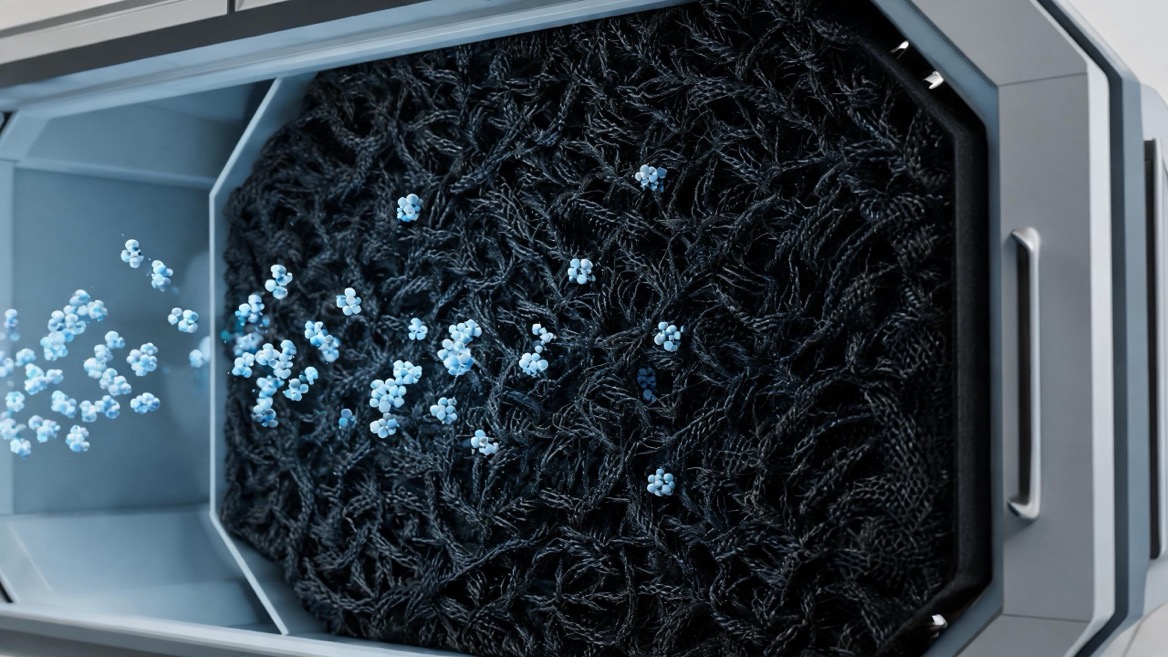
This is especially relevant in high-airflow systems. A conventional granular activated carbon bed may provide substantial carbon mass, but gas molecules must first cross the external film surrounding each granule and then diffuse through a complex internal pore network. When residence time is limited, these transport steps can become the main performance constraint.
Activated carbon fiber addresses this issue through its fiber-based structure and highly developed micropore network.
Activated carbon fiber is produced from carbonaceous precursor fibers that are stabilized, carbonized, and activated. The resulting material can be supplied as cloth, felt, paper, woven fabric, nonwoven media, or customized composite structures.
Granular activated carbon, by contrast, is generally supplied as particles, pellets, or granules made from raw materials such as coconut shell, coal, wood, or other carbon sources.
| Performance Factor | Activated Carbon Fiber | Granular Activated Carbon |
|---|---|---|
| Physical form | Fiber, felt, cloth, paper, nonwoven media | Granules, pellets, particles |
| Adsorption-site accessibility | High; many micropores are close to the fiber surface | More internal diffusion is often required |
| VOC adsorption rate | Typically rapid | Often slower under short contact time |
| Bed thickness | Can be very thin | Usually requires a deeper packed bed |
| Pressure drop potential | Can be low in properly designed media | Depends on particle size, bed depth, and airflow |
| Dust generation | Usually lower because fibers are integrated into a stable structure | Attrition and carbon dust may occur during handling or operation |
| Shape flexibility | Can be cut, laminated, pleated, stacked, or integrated into modules | Primarily used in fixed beds, cartridges, and bulk vessels |
| Best-fit applications | Low concentration VOCs, compact filters, fast-response systems | General vapor treatment, larger fixed beds, bulk adsorption systems |
The comparison does not mean that ACF is always the correct choice. GAC remains highly effective for many industrial VOC systems, particularly where large carbon beds, longer contact times, high solvent loading, or regeneration infrastructure are available. However, when the target is rapid capture of low concentration VOCs, ACF often provides a more efficient adsorption pathway.
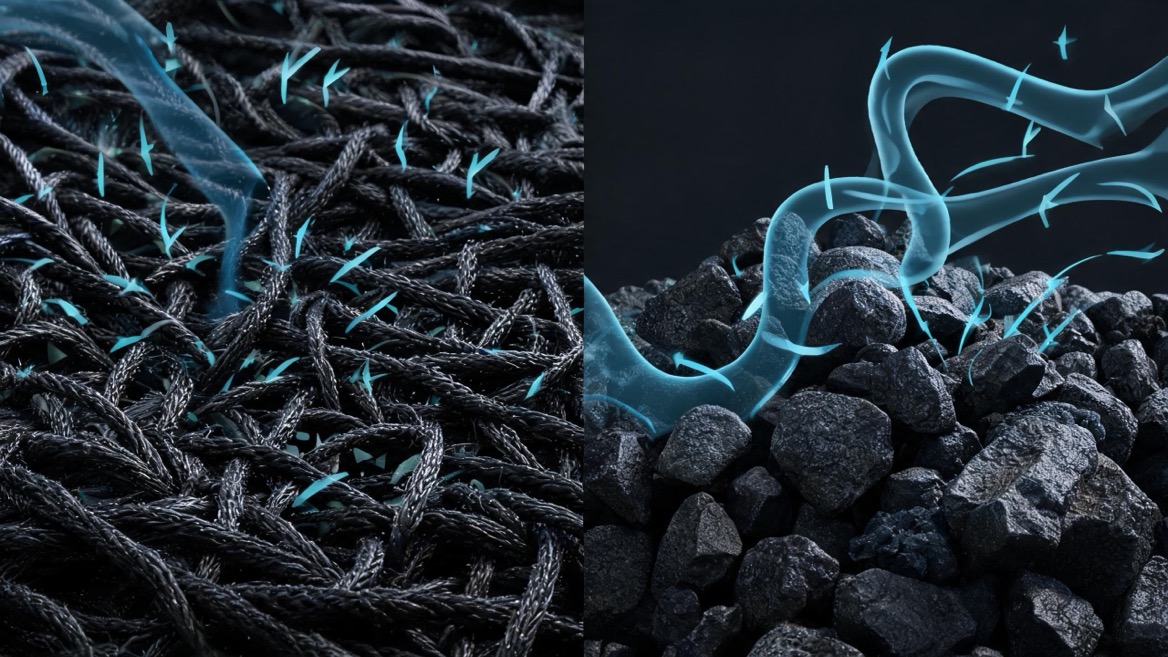
The greatest operational advantage of activated carbon fiber is its short diffusion path.
In a granular carbon particle, a VOC molecule may need to travel from the gas stream through the particle surface and deep into its pore structure before it reaches a strong adsorption site. In activated carbon fiber, micropores are distributed much closer to the external fiber surface.
This structure reduces mass-transfer resistance. Instead of waiting for molecules to travel deeply into a granule, the VOC can reach adsorption sites quickly.
Faster diffusion matters most when:
- Air velocity is high
- Equipment space is limited
- The VOC concentration is low
- The system requires a short contact time
- Outlet concentration must remain stable
- A compact filter design is required
Research on ACF has shown that its high surface area, high adsorption capacity, and rapid adsorption kinetics make it well suited to thin adsorbent configurations for nuisance-level organic vapors.
Micropores are extremely small pores that provide much of the adsorption energy needed to capture VOC molecules. In general, pores with dimensions close to the size of the target molecule can create stronger adsorption forces.
Activated carbon fiber often contains a high proportion of micropores. More importantly, these micropores are highly accessible because they are distributed around fine fibers rather than buried deep inside larger carbon granules.
For low concentration VOC adsorption, this can produce three practical benefits:
- Rapid initial capture when the air stream first enters the filter
- Better use of active surface area under short residence time
- More stable breakthrough performance when the system is correctly designed
Many ACF materials can reach or exceed 2,000 m²/g of specific surface area, although actual performance depends on precursor, activation level, pore-size distribution, density, humidity, and the target VOC.
A conventional GAC system often depends on a relatively deep bed to provide enough carbon mass and contact time. ACF can place a large adsorption surface area into a thin, lightweight, and formable layer.
This makes ACF particularly valuable in applications where a deep packed bed is impractical, such as:
- HVAC and air-purification filters
- Cleanroom air treatment
- Electronics manufacturing equipment
- Automotive cabin filters
- Respiratory and personal-protection components
- Compact odor-control units
- Laboratory exhaust treatment
- Small-scale chemical-process vents
- Portable VOC purification systems
From an engineering perspective, a thinner adsorption layer may reduce equipment volume. However, it must still be designed with adequate media area, airflow distribution, VOC loading capacity, and pressure-drop control.
A common purchasing mistake is to compare activated carbons only by iodine number, total surface area, or apparent bulk density. These data can be useful, but they do not fully predict how an adsorbent will perform in a live VOC stream.
For low concentration VOC treatment, the following factors are often more important:
1. Target VOC molecular size and polarity
2. Inlet concentration range
3. Airflow volume and face velocity
4. Relative humidity
5. Gas temperature
6. Required outlet concentration
7. Contact time
8. Breakthrough definition
9. Presence of competing vapors
10. Regeneration or replacement strategy
A high-capacity carbon is not automatically a fast carbon. If the adsorption sites are difficult to reach, the material may underperform in a short-contact-time application.
That is why activated carbon fiber is often selected for trace VOC and low concentration vapor capture. Its advantage is not merely total surface area. Its advantage is the speed at which the available surface can be used.
| Application Condition | Preferred Material | Reason |
|---|---|---|
| Compact, thin VOC filter | Activated carbon fiber | High surface area in a thin, flexible format |
| Fast airflow with short contact time | Activated carbon fiber | Shorter diffusion path and faster adsorption response |
| High-volume industrial exhaust with adequate vessel space | Granular activated carbon | Cost-effective bulk-bed configuration |
| Low concentration odor removal | Activated carbon fiber | Rapid capture of trace organic vapors |
| Solvent recovery with regeneration system | Granular activated carbon or engineered carbon bed | Suitable for large-scale cyclic adsorption systems |
| Pleated or laminated filter design | Activated carbon fiber | Easy conversion into fabric, felt, or composite media |
| High dust or attrition concern | Activated carbon fiber | Integrated fiber structure can reduce loose-particle handling |
| Mixed VOC stream with high humidity | Depends on testing | Competitive adsorption must be evaluated before selection |
The most reliable selection process is not based on a generic claim that one material is always "better." It is based on breakthrough testing using the actual VOC mixture, temperature, humidity, flow rate, and target outlet requirement.
Humidity can strongly affect low concentration VOC adsorption. Water vapor may occupy adsorption sites or alter how VOC molecules compete for available micropores. The impact varies with carbon chemistry, pore structure, VOC polarity, and relative humidity.
For example, nonpolar aromatic compounds such as toluene may behave differently from polar compounds such as acetone or MEK. A material that performs well for one vapor does not automatically provide the same performance for another.
Mixed-vapor systems require even more care. In practical exhaust streams, VOCs can compete with each other for the most energetically favorable adsorption sites. Research on ACF has shown that competitive adsorption can shorten breakthrough time and reduce the adsorption capacity available to each individual compound.
For this reason, Guangdong Tongke Activated Carbon Co., Ltd. recommends evaluating ACF materials with application-specific data rather than relying only on single-component laboratory tests.
A well-designed activated carbon fiber solution starts with a clear process profile. Before selecting an ACF cloth, felt, paper, or custom composite, collect the following information.
Identify the major VOCs and, where possible, their concentration ranges.
Include:
- Main VOC species
- Maximum and average concentration
- Intermittent peak emissions
- Mixed solvents or co-contaminants
- Required removal efficiency
- Target outlet concentration
Performance should be evaluated under actual or representative conditions.
Key parameters include:
- Airflow rate
- Temperature
- Relative humidity
- Pressure
- Daily operating hours
- Process fluctuations
- Available installation space
Activated carbon fiber can be customized into several physical forms:
- ACF cloth for structured and reusable systems
- ACF felt for higher loading and flexible installation
- ACF paper for thin filters and laminated products
- Pleated ACF media for increased adsorption area
- Composite media combined with particle filters or support layers
- Customized rolls, sheets, pads, and filter inserts
The correct format depends on whether the priority is adsorption capacity, pressure drop, mechanical strength, pleatability, particulate prefiltration, or product integration.
Breakthrough testing is more valuable than relying on static adsorption numbers alone.
A useful test plan should define:
- Challenge VOC or VOC mixture
- Inlet concentration
- Flow rate and face velocity
- Temperature and humidity
- Test duration
- Breakthrough threshold
- Pressure-drop limit
- Sampling method
A breakthrough curve shows when outlet concentration begins to rise. In commercial systems, operators should not wait until complete saturation. The carbon media should be replaced or regenerated before the outlet reaches the permitted limit.
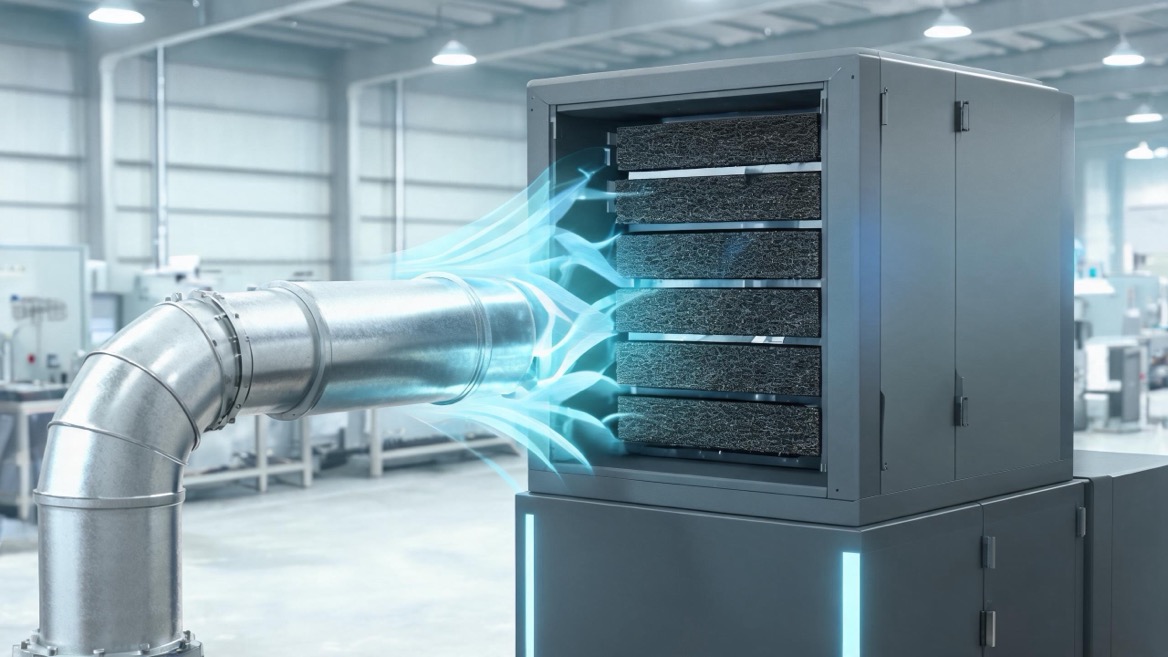
Activated carbon fiber is particularly valuable when engineers need adsorption performance without the size and weight of a deep granular bed.
For example, consider a coating line with a large airflow volume but relatively low VOC concentration. A conventional solution may require a large GAC vessel, substantial carbon inventory, and significant installation space. If the process instead needs a compact polishing stage after primary treatment, an ACF module can be used to capture residual VOCs in a thin, high-area structure.
This type of configuration may be suitable for:
- Final polishing after a primary VOC-control process
- Localized collection points near emission sources
- Odor control in air-handling units
- Recirculated-air purification
- Compact replacement filters
- VOC-sensitive production areas
The key point is that ACF is not only an adsorbent. It is also an engineerable media platform. Its form factor can support custom filtration designs that are difficult to achieve with loose granules.
Activated carbon fiber should be selected carefully, not universally.
ACF may not be the most economical option when:
- VOC loading is very high
- A large, deep carbon bed is acceptable
- Long contact time is available
- The system is designed mainly for bulk solvent recovery
- The air stream contains heavy oils, aerosols, or sticky contaminants
- Relative humidity is persistently high without adequate pretreatment
- The contaminant requires chemical impregnation rather than physical adsorption alone
Pretreatment is often necessary. Particulates, oil mist, condensable aerosols, and high-boiling compounds can foul the pore structure and shorten service life. A properly designed prefilter, mist separator, cooling step, or humidity-control stage can protect the activated carbon fiber and improve long-term performance.
Well-designed carbon adsorption systems must account for the solvent type, solvent load, airflow, temperature, humidity, bed condition, and breakthrough management. Properly designed systems can achieve consistently high VOC removal, while poor performance is often linked to operational or design problems rather than the carbon material alone.
Guangdong Tongke Activated Carbon Co., Ltd. manufactures and exports activated carbon fiber and other activated carbon products for industrial purification applications worldwide.
Our team can help evaluate your VOC treatment requirements and recommend a suitable solution based on:
- VOC composition and concentration
- Airflow and operating conditions
- Required outlet level
- Humidity and temperature
- Filter structure and installation space
- Replacement or regeneration strategy
- Product form, including ACF cloth, felt, paper, rolls, sheets, and customized filter media
Contact Guangdong Tongke Activated Carbon Co., Ltd. today to discuss a customized activated carbon fiber solution for low concentration VOC removal, odor control, air purification, or industrial gas-treatment applications.
Activated carbon fiber can be better for low concentration VOC removal, short contact time, and compact filter designs because its adsorption sites are generally more accessible. Granular activated carbon remains a strong choice for many larger bulk-bed and solvent-recovery systems.
ACF has a fibrous structure with micropores located close to the fiber surface. This shortens the diffusion path that VOC molecules must travel before reaching an adsorption site.
Yes. Activated carbon fiber can be designed for adsorption of aromatic VOCs such as benzene, toluene, and xylene. Actual performance depends on concentration, humidity, airflow, temperature, media weight, and breakthrough requirement.
Yes. Water vapor can compete with VOCs for adsorption sites, especially in mixed or humid gas streams. Application-specific testing is recommended where humidity is high or variable.
Yes. Activated carbon fiber can be incorporated into thin sheets, pleated filters, composite media, and air-purification modules. It is suitable for HVAC, cleanroom, odor-control, and recirculated-air applications when properly engineered.
Replacement timing should be based on breakthrough monitoring, operating history, inlet VOC loading, pressure drop, and required outlet concentration. A site-specific testing plan provides the most reliable replacement schedule.
Some ACF systems can be regenerated depending on the VOC type, system design, material configuration, and thermal stability requirements. For certain compact filters, replacement may be more practical than regeneration.
4. [National Library of Medicine — Adsorption Phenomenon of VOCs Released from Fiber-Based Products]
5. [University College London — A Critical Review on VOC Adsorption by Different Porous Materials]
6. [ScienceDirect — Removal of Volatile Organic Compound by Activated Carbon Fiber]


