Content Menu
● What Is Steam Activated Coconut Shell Carbon?
● Why Coconut Shell Is an Effective Raw Material
>> Key Advantages of Coconut Shell Carbon
● How Steam Activation Creates Adsorption Capacity
● Understanding the Pore Structure
● Main Industrial Applications
>> Water Treatment and Polishing
>> Air and Gas Purification
>> Food, Beverage, and Edible Oil Processing
>> Chemical Processing and Solvent Recovery
>> Gold Recovery
● How to Select the Right Grade
>> 1. Define the Contaminant
>> 2. Define the Operating Conditions
>> 3. Choose the Appropriate Particle Size
>> 4. Review the Full Test Package
● A Practical Verification Plan
● Common Buying Mistakes to Avoid
● Work With a Carbon Manufacturer
● Frequently Asked Questions
>> Is steam activated coconut shell carbon the same as ordinary charcoal?
>> Is coconut shell activated carbon better than coal-based carbon?
>> What does iodine number mean?
>> Can steam activated coconut shell carbon remove odors?
>> Can activated carbon be regenerated?
>> How do I choose between granular and powdered activated carbon?
>> What information should I send when requesting a quotation?
● References
Steam activated coconut shell carbon is a high-performance adsorbent made from coconut shell charcoal, heat, and steam. Its dense micropore structure, mechanical strength, and low-ash potential make it a practical choice for water treatment, air and gas purification, food processing, solvent recovery, chemical production, and gold recovery.
For industrial buyers, however, "coconut shell activated carbon" is not a complete specification. The right grade depends on contaminant size, concentration, flow rate, contact time, particle size, pressure drop, regeneration plan, and the purity requirements of the final process.
At Guangdong Tongke Activated Carbon Co., Ltd., we approach carbon selection as an engineering decision rather than a simple product purchase. A carbon with a high adsorption index may still underperform if its pore structure, mesh size, hardness, or surface chemistry does not match the real operating conditions.
What Is Steam Activated Coconut Shell Carbon?
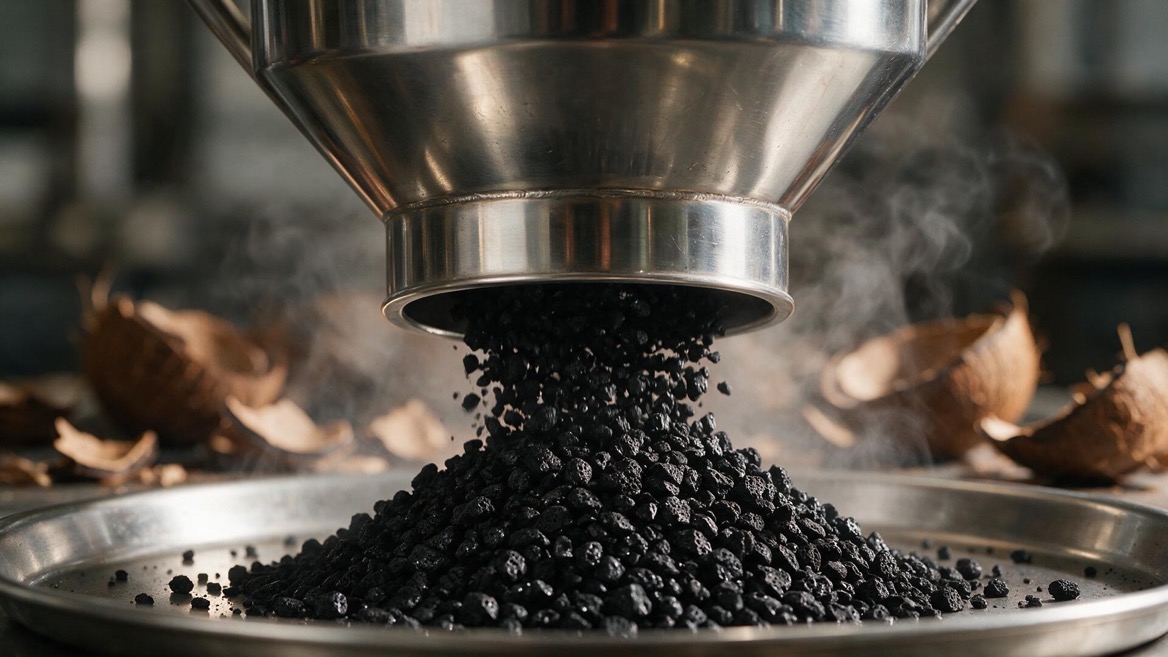
Steam activated coconut shell carbon is an activated carbon produced from hard coconut shells through two controlled thermal stages:
1. Carbonization converts cleaned coconut shells into carbon-rich char in an oxygen-limited environment.
2. Steam activation exposes the char to high temperatures and controlled steam. The steam reacts gradually with carbon atoms, opening and enlarging an internal network of pores.
This process transforms a dense agricultural by-product into a material with a very large internal adsorption surface. The external granule may look small, but its pore network provides countless sites where target molecules can be captured.
Unlike chemically activated carbon, steam activated carbon relies on heat and water vapor to develop porosity. This is an important consideration when selecting media for sensitive purification duties, including drinking-water contact systems, food and beverage processing, and certain pharmaceutical or fine-chemical applications.
Why Coconut Shell Is an Effective Raw Material
Not all activated carbon precursors create the same pore structure. Coconut shell is naturally hard, dense, and rich in fixed carbon. These characteristics support the development of a predominantly microporous carbon during steam activation.
Micropores are extremely small pores, generally below 2 nanometres in width. They are particularly useful for adsorbing relatively small molecules, including many odor compounds, dissolved organics, volatile organic compounds, and gold-cyanide complexes.
Key Advantages of Coconut Shell Carbon
- High mechanical hardness helps granules resist attrition in columns, filters, and gold-recovery circuits.
- Micropore-rich structure supports adsorption of many small organic contaminants.
- Low ash potential can be beneficial where mineral residues may affect product quality or downstream processing.
- High bulk density can provide more adsorption media per unit bed volume than lower-density alternatives.
- Renewable feedstock origin turns a coconut-processing residue into a functional industrial material.
- Flexible particle sizing allows the carbon to be supplied for fixed beds, pressure vessels, cartridge filters, packed towers, and specialized process systems.
The most important point is that coconut shell carbon is not automatically the best solution for every contaminant. Large dye molecules, high-molecular-weight organics, and viscous liquids may require a more mesoporous carbon, a blended pore structure, or a different carbon precursor.
How Steam Activation Creates Adsorption Capacity
Steam activation is a controlled gasification process. Carbonized coconut shell is heated while steam is introduced under carefully managed conditions. The steam reacts with accessible carbon sites and gradually creates porosity.
Too little activation can leave the carbon with insufficient pore volume. Too much activation can weaken the granules, reduce yield, increase breakage, and create pores that do not match the target contaminant.
For this reason, quality depends on much more than furnace temperature. Consistent production requires control of:
- Coconut shell charcoal quality and ash content
- Carbonization conditions
- Activation temperature and residence time
- Steam flow and activation intensity
- Cooling conditions
- Crushing and screening accuracy
- Dust removal and packaging
- Batch testing and traceability
A well-designed steam activation process balances adsorption capacity with hardness, pore accessibility, and service life.
Understanding the Pore Structure
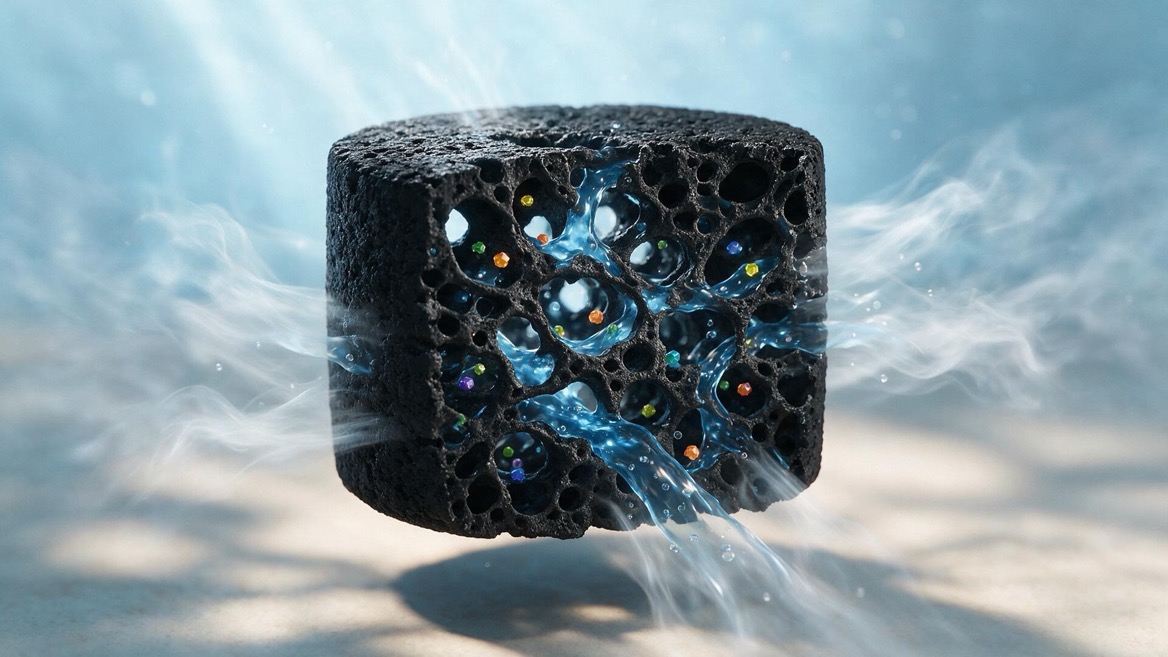
Activated carbon works through adsorption, not simple filtration. Molecules move from water, air, or gas into the carbon's internal pore network and are retained by physical interactions and surface chemistry.
| Pore Type | Approximate Size | Primary Function | Typical Relevance |
| Micropores | Below 2 nm | Adsorption of small molecules | Odors, VOCs, small dissolved organics, gold complexes |
| Mesopores | 2–50 nm | Transport pathways and larger-molecule access | Color bodies, larger organics, dye-related contaminants |
| Macropores | Above 50 nm | Entry channels to smaller pores | Improves fluid movement and pore access |
Steam activated coconut shell carbon is typically valued for its micropore development. This can provide excellent adsorption for small contaminants, but it also explains why a buyer should not select carbon on iodine number alone.
An iodine number is a useful relative indicator of activation and microporosity. It is not a universal prediction of performance for every contaminant, liquid, or gas stream. Real performance depends on the target molecule, fluid chemistry, competing contaminants, operating temperature, and contact time.
Main Industrial Applications
Water Treatment and Polishing
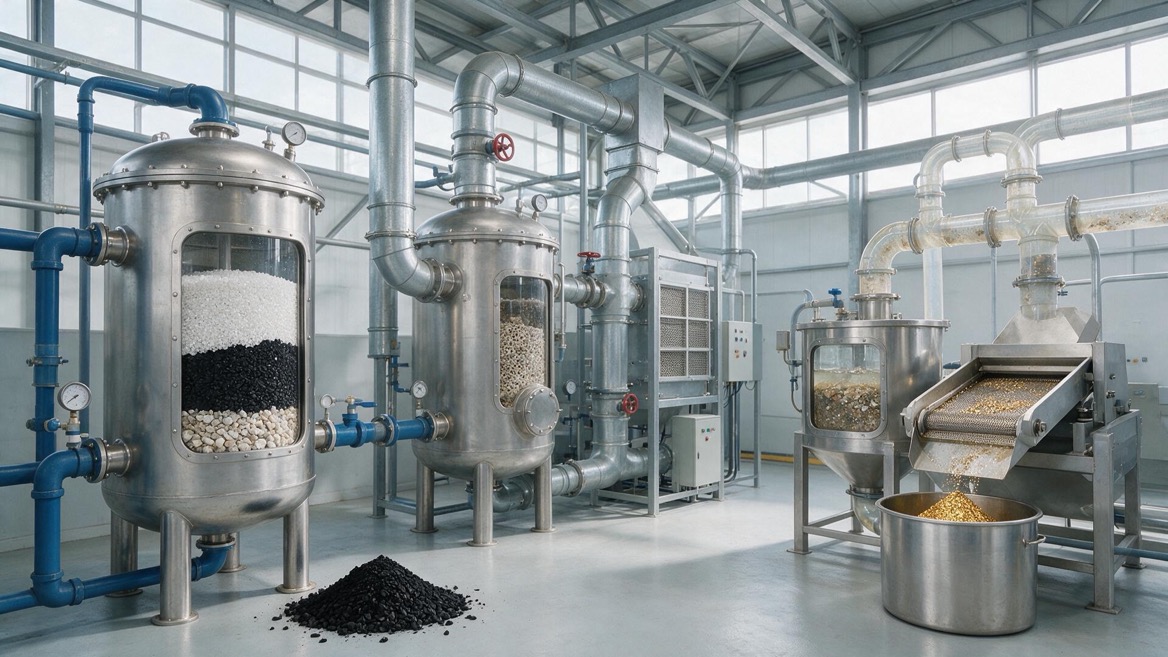
Steam activated coconut shell carbon is widely used in granular activated carbon filters for taste, odor, chlorine, selected disinfection by-products, pesticides, solvents, and natural organic compounds.
For potable-water and high-purity applications, buyers should assess both carbon performance and the requirements applicable to the complete water-contact system. Product documentation, extraction testing, conditioning procedures, and batch consistency can all matter.
For challenging contaminants, including persistent fluorinated compounds, granular activated carbon can be part of a treatment strategy. Yet performance varies substantially by compound chain length, influent concentration, empty-bed contact time, competing natural organic matter, and bed replacement schedule. Pilot testing is preferable to relying on a general claim.
Air and Gas Purification
Coconut shell activated carbon is effective in applications involving:
- Industrial odors
- Volatile organic compounds
- Solvent vapors
- Sulfur-containing odor compounds
- HVAC odor control
- Respirator and protective filtration media
- Biogas polishing and process-gas treatment
For air and gas treatment, adsorption capacity is influenced by relative humidity, temperature, contaminant concentration, gas velocity, and the presence of competing vapors. A carbon that performs well in dry laboratory air may behave differently in a humid exhaust stream.
Food, Beverage, and Edible Oil Processing
In food and beverage production, activated carbon can be used to improve color, odor, and flavor profiles or to purify process water. It may also support the treatment of syrups, sweeteners, alcoholic beverages, and edible oils.
The grade must be selected with care. The process team should define the target impurities, acceptable product loss, required mesh size, applicable food-contact requirements, and whether the carbon will be used once or regenerated.
Chemical Processing and Solvent Recovery
Steam activated carbon can capture and recover valuable organic vapors, including solvents used in manufacturing operations. It can also support purification of process liquids where trace organics, odor bodies, or unwanted color compounds must be reduced.
A solvent-recovery design should consider adsorption isotherms, vapor concentration, humidity, bed temperature, desorption method, fire risk, and the compatibility of the carbon with the complete recovery system.
Gold Recovery
Hard coconut shell carbon remains an important adsorbent for carbon-in-pulp, carbon-in-leach, and carbon-in-column circuits. In these systems, resistance to abrasion is essential because carbon is moved, screened, washed, regenerated, and reused repeatedly.
For gold recovery, buyers commonly focus on:
- Particle shape and size distribution
- Abrasion resistance and hardness
- Gold loading characteristics
- Screen retention
- Attrition-generated fines
- Acid-wash and thermal-regeneration compatibility
- Consistent performance across deliveries
How to Select the Right Grade
A successful activated carbon project begins with the process, not with a catalogue grade. The following selection process helps avoid common and expensive mistakes.
1. Define the Contaminant
Identify what must be removed. Provide its chemical name where possible, together with influent concentration, target outlet concentration, pH, temperature, and the presence of competing compounds.
For example, a small volatile solvent, a large dye molecule, and a sulfur odor compound require different adsorption conditions.
2. Define the Operating Conditions
Share the actual flow rate, pressure, temperature, humidity, bed dimensions, contact time, and expected operating cycle. These details determine whether the process needs granular, pelletized, powdered, or specially treated activated carbon.
3. Choose the Appropriate Particle Size
Smaller particles can improve adsorption kinetics because the diffusion path is shorter. However, they may also create higher pressure drop and more dust.
Larger particles can reduce pressure loss and retain better in fixed beds, but they may require longer contact time. The practical choice is a balance between adsorption rate, hydraulic performance, and carbon loss.
4. Review the Full Test Package
A technical data sheet should include more than one adsorption number. Depending on the application, review:
| Parameter | Why It Matters |
| Iodine number | Relative indication of micropore development |
| Hardness or abrasion resistance | Predicts fines generation and granule durability |
| Ash content | Indicates inorganic residue level |
| Moisture content | Affects delivered dry-carbon quantity |
| Bulk density | Helps calculate bed loading and freight efficiency |
| Particle-size distribution | Influences pressure drop and screen retention |
| Methylene blue value | Can help indicate access for larger molecules |
| pH and water-soluble ash | May matter in sensitive liquid processes |
Ask for the test method, batch result, sampling basis, and allowable tolerance. A single "typical value" is less useful than a documented batch specification.
A Practical Verification Plan
Before changing a full-scale carbon bed, conduct a staged evaluation.
1. Screen the grade on paper. Compare mesh size, hardness, ash, adsorption indices, density, and application suitability.
2. Test the actual process stream. Bench-scale adsorption testing should use real influent whenever possible, not only clean water or a simplified laboratory solution.
3. Run a pilot column. Measure breakthrough under realistic flow, temperature, pressure, and contaminant loading.
4. Calculate total operating cost. Include carbon consumption, freight, pressure drop, energy, labor, backwashing, regeneration, disposal, and downtime.
5. Approve a written acceptance standard. Confirm the test methods, tolerances, packaging, labeling, documents, and procedure for handling nonconforming material.
This approach often reveals that the lowest purchase price does not produce the lowest cost per cubic metre of water treated or per kilogram of contaminant removed.
Common Buying Mistakes to Avoid
The most frequent procurement error is treating activated carbon as a uniform commodity. In practice, a low-cost carbon with inconsistent hardness or particle size may produce excessive fines, channeling, pressure loss, media carryover, and premature replacement.
Avoid these mistakes:
- Selecting solely by iodine number
- Ignoring the molecular size of the target contaminant
- Comparing prices without comparing dry basis and bulk density
- Using a water-treatment grade in a demanding gas-phase process without validation
- Specifying mesh size but not size-distribution tolerance
- Overlooking ash, hardness, and water-soluble impurities
- Scaling up without a pilot test for complex industrial streams
- Assuming a certification applies to every grade, system, or intended use
Work With a Carbon Manufacturer
Guangdong Tongke Activated Carbon Co., Ltd. supplies activated carbon solutions for global industrial applications. We can support customers with product-grade discussions for water treatment, air and gas purification, food and beverage processing, chemical purification, pharmaceutical-related processes, and other adsorption duties.
To recommend a suitable steam activated coconut shell carbon grade, provide your application, fluid or gas composition, flow rate, contaminant profile, target performance, operating conditions, preferred particle size, annual volume, and destination market.
Contact our technical sales team to discuss a suitable activated carbon specification and request a sample or quotation.
Frequently Asked Questions
Is steam activated coconut shell carbon the same as ordinary charcoal?
No. Charcoal is the carbonized intermediate material. Activated carbon undergoes an additional activation stage that develops a much larger pore network and significantly improves adsorption capability.
Is coconut shell activated carbon better than coal-based carbon?
Neither is universally better. Coconut shell carbon is often preferred for hardness, density, and micropore-rich adsorption of small molecules. Coal-based grades may offer a broader pore-size distribution for some larger organic contaminants. Selection should follow application testing.
What does iodine number mean?
Iodine number measures the amount of iodine adsorbed under a defined test method. It is a relative indicator of microporosity and activation level, but it does not guarantee performance for every contaminant.
Can steam activated coconut shell carbon remove odors?
Yes. It is commonly used for odor control because many odor-causing compounds are small enough to access its micropore structure. Results depend on humidity, contact time, contaminant concentration, and the specific odor compounds present.
Can activated carbon be regenerated?
Many granular carbon grades can be regenerated in suitable industrial systems. Regeneration feasibility depends on the adsorbed compounds, carbon condition, operating history, contamination risk, and available regeneration technology.
How do I choose between granular and powdered activated carbon?
Granular activated carbon is commonly used in fixed beds, columns, and reusable filtration systems. Powdered activated carbon is typically dosed directly into a treatment process and later removed with sludge or other solids. The process design determines the right form.
What information should I send when requesting a quotation?
Provide the application, required carbon type, preferred mesh size, target contaminant, flow rate, annual demand, delivery location, packaging preference, and any required test parameters or compliance documents.
References
1. Lowden, V. M. C. M., Alexandre-Franco, M. F., Garrido-Zoido, J. M., Cuerda-Correa, E. M., & Gómez-Serrano, V. "Coconut Shell-Derived Activated Carbons: Preparation, Physicochemical Properties, and Dye Removal from Water." *Molecules*, 2026. [Read the full study]. [pmc.ncbi.nlm.nih]
2. Coconut Development Board, Government of India. "Activated Carbon: Processing Technology." Covers coconut-shell carbon production, steam activation conditions, and representative product parameters. [Read the technical document]. [coconutboard.gov]
3. ASTM International. "ASTM D4607-14(2021): Standard Test Method for Determination of Iodine Number of Activated Carbon." Defines iodine number as a relative indicator of carbon porosity and activation. [View the standard information]. [store.astm]
4. U.S. Environmental Protection Agency. "Treatment Options for Removing PFAS from Drinking Water." Explains the role of granular activated carbon in adsorption treatment and the need for carbon replacement after adsorption capacity is used. [Read the fact sheet]. [epa]
5. NSF. "NSF/ANSI/CAN 61 Testing and Certification." Explains health-effects evaluation and certification processes for materials, components, and systems that contact drinking water. [Read the certification overview]. [nsf]
6. Huamei Activated Carbon. "What Exactly Is Steam-Activated Coconut Shell Carbon?" The original article reviewed and expanded in this reconstruction. [Read the original page]. [huameicarbon]


