
Language
Views: 282 Author: Tongke Activated Carbon Publish Time: 2026-08-15 Origin: Site


Content Menu
● Virgin GAC vs Reactivated GAC at a Glance
● Which Option Has the Lower True Cost?
>> Cost Advantage of Reactivated GAC
● Performance: Can Reactivated GAC Match Virgin GAC?
>> Why Iodine Number Is Not Enough
● When Virgin GAC Delivers Better Value
● When Reactivated GAC Delivers Better Value
● A Five-Step Cost Decision Method
● Expert View: A Hybrid Program Often Wins
>> Is reactivated GAC cheaper than virgin GAC?
>> How much carbon is lost during GAC reactivation?
>> Does reactivated GAC have the same adsorption capacity as virgin GAC?
>> Can reactivated GAC be used for drinking water treatment?
>> When should I avoid reactivated GAC?
>> What information should I give an activated carbon supplier?
When industrial buyers compare virgin GAC vs reactivated GAC, the lowest purchase price is not always the lowest total cost. The right choice depends on adsorption performance, contaminant profile, carbon loss, logistics, compliance requirements, changeout frequency, and the cost of process interruption.
For many high-volume water, wastewater, air purification, and process-treatment applications, reactivated granular activated carbon (GAC) can reduce the lifecycle cost of carbon management. However, virgin granular activated carbon remains the stronger choice where a defined pore structure, maximum adsorption capacity, product purity, or strict application validation is required.
At Guangdong Tongke Activated Carbon Co., Ltd., we help industrial customers evaluate activated carbon by the result it must deliver—not only by the price per tonne. This practical comparison explains where each option creates value and how to calculate the more economical choice for your operation.
Virgin GAC is newly manufactured granular activated carbon that has not previously been used in an adsorption process. It is commonly produced from coconut shell, coal, wood, or other carbon-rich raw materials, then activated to develop a network of adsorption pores.
Because it starts as unused material, virgin GAC provides a predictable baseline for:
- Iodine number and adsorption capacity
- Particle size distribution
- Hardness and abrasion resistance
- Ash content and moisture level
- Pore-size profile
- Application-specific purity requirements
Virgin GAC is often selected for first-time system commissioning, critical purification steps, high-purity production, food and beverage processing, pharmaceutical applications, and projects where the feed stream is unknown or changing.
For example, coconut-shell virgin GAC is often preferred for small-molecule adsorption and vapor-phase purification because of its microporous structure. Coal-based virgin GAC may be selected for water treatment applications that require a broader pore distribution and robust hydraulic performance.
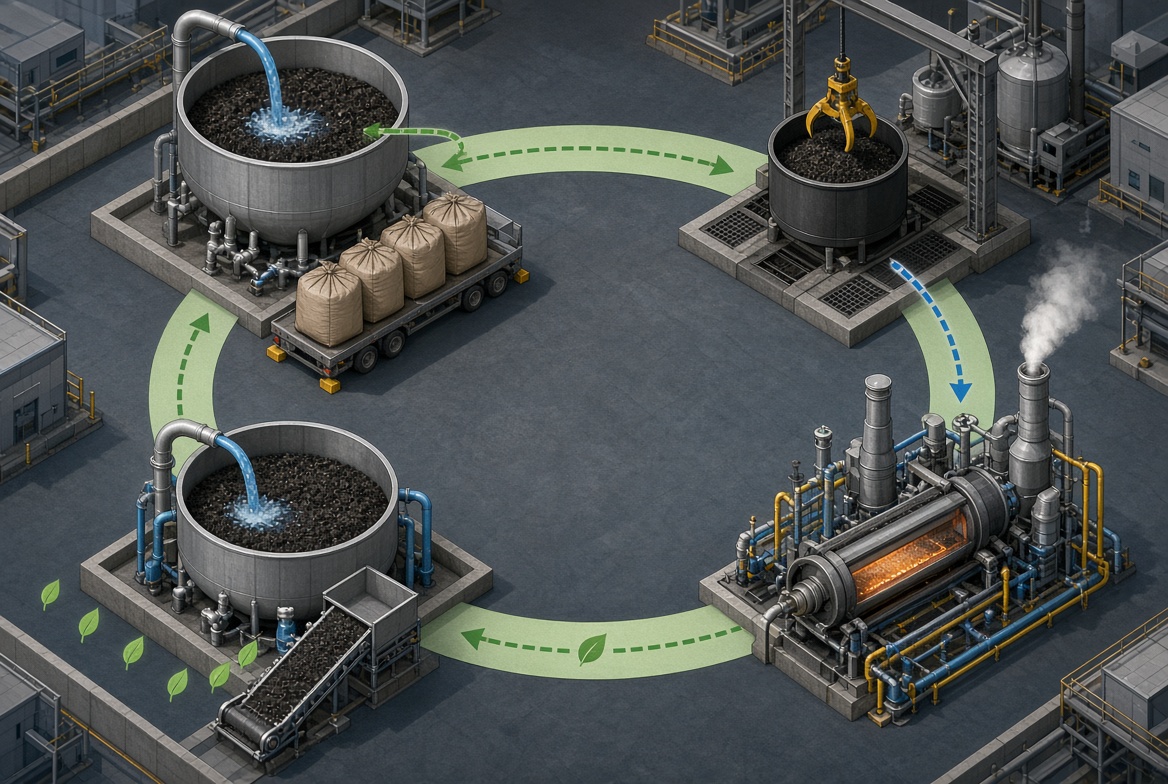
Reactivated GAC is spent granular activated carbon that has been collected after use and processed at high temperature to remove adsorbed organic contaminants and restore adsorption capacity.
A typical thermal reactivation sequence includes:
1. Drying to remove water.
2. Desorption and devolatilization to release volatile compounds.
3. Pyrolysis to break down residual organic matter.
4. High-temperature reactivation with controlled steam or oxidizing gas.
5. Screening, testing, and blending before the carbon is returned for reuse.
The process is designed to reopen pores that became occupied during service. In well-controlled applications, reactivated carbon can perform very effectively, particularly when the original carbon type, contaminant history, and reactivation conditions are well understood.
However, reactivation is not simply "cleaning used carbon." It is a technical recovery process. Carbon can be lost through handling, attrition, dust generation, and controlled burn-off. Industry guidance commonly anticipates that a portion of the carbon inventory must be replaced with virgin make-up carbon after each cycle.
| Evaluation factor | Virgin GAC | Reactivated GAC |
|---|---|---|
| Material origin | Newly manufactured activated carbon | Previously used GAC restored through reactivation |
| Initial adsorption capacity | Full, specified capacity | Can be strong, but must be validated for the target stream |
| Pore structure | Designed for the selected raw material and application | May change after service and thermal treatment |
| Cost per tonne | Usually higher | Often lower when carbon volume is large enough |
| Carbon loss | No reactivation loss before first use | Requires make-up carbon due to handling and thermal loss |
| Supply-chain needs | Purchase and deliver new carbon | Collect, transport, reactivate, return, and replenish |
| Best fit | Critical purity, unknown influent, new systems, specialty applications | Large recurring GAC programs with stable contaminant conditions |
| Quality control focus | Raw material, activation quality, physical properties | Traceability, contaminant compatibility, recovered capacity, particle integrity |
| Waste-management impact | Spent carbon still requires treatment or disposal later | Can reduce spent-carbon disposal and reuse existing inventory |
| Changeout planning | Straightforward replacement | Requires lead-time coordination and inventory planning |
Reactivated GAC often saves more money in large, repeat-use programs—but only when the entire carbon cycle is managed properly.
The right financial comparison is not:
Virgin GAC price vs.Reactivated GAC price
It is:
Cost per unit of verified treatment performance
A reliable lifecycle calculation should include:
- Carbon purchase or reactivation service cost
- Freight to and from the facility
- Spent-carbon removal and handling
- Disposal or destruction costs
- Virgin make-up carbon
- Changeout labor
- Downtime or lost production
- Testing and quality assurance
- Expected bed life before breakthrough
- Risk of off-specification treated water, air, or product
A supplier quote that appears inexpensive can become expensive if the carbon reaches breakthrough early, causes excessive pressure drop, produces fines, or requires an emergency changeout.
Reactivated GAC can create meaningful savings when a facility uses large volumes of carbon on a repeating schedule. The U.S. Environmental Protection Agency has reported that reactivation can reduce GAC replacement costs, while properly reactivated carbon can perform comparably to virgin carbon in appropriate applications.
One industrial reactivation provider reports typical savings of 20% to 40% compared with purchasing virgin GAC, while noting that results depend on the application and the reactivation program. This range should be treated as a planning reference, not a guaranteed outcome.
The main reasons reactivation may lower total cost are:
- Reduced spending on replacement carbon
- Lower spent-carbon disposal exposure
- Reuse of an existing carbon inventory
- Potentially lower material-related environmental burden
- More stable long-term carbon procurement for repeat programs
Reactivated GAC is not automatically the lowest-cost option. The economics weaken when transport distances are long, carbon quantities are small, or the spent carbon is unsuitable for recovery.
Important hidden costs include:
- Freight: Carbon may need to travel from the treatment site to a reactivation facility and back.
- Make-up carbon: Reactivation and handling create material loss, so virgin GAC is needed to restore bed volume.
- Inventory buffer: A facility may need spare carbon while its used carbon is being processed.
- Testing: Application-specific testing is necessary when treatment performance is critical.
- Contaminant restrictions: Some adsorbed materials can make reactivation difficult, unsafe, regulated, or uneconomical.
- Operational risk: A delayed return shipment can affect production continuity.
EPA documents indicate that approximately 5% to 10% of carbon may be destroyed during regeneration or lost in transport, requiring replacement with virgin carbon. In one EPA project summary, total loss averaged 8.6%, including reactivation and transport losses. That make-up requirement should be included in every reactivated GAC budget.
The practical answer is: sometimes, but it must be demonstrated for the actual application.
Reactivated GAC can recover substantial adsorption function after proper thermal treatment. Yet adsorption is influenced by much more than one laboratory number. A carbon that performs well for one influent may not perform equally well for another.
The key variables are:
- Original carbon raw material and grade
- Target contaminant molecular size and chemistry
- Concentration and loading pattern
- Competing organics
- pH, temperature, and water chemistry
- Contact time and bed depth
- Number of prior reactivation cycles
- Particle-size retention and hardness
- Residual inorganic or non-desorbable contamination
For water treatment, AWWA guidance emphasizes that reactivated GAC should have particle-size distribution, effective size, and uniformity characteristics comparable to the original material. It also recommends evaluating adsorption performance using water from the specific facility rather than relying only on generic test values.
Iodine number is useful, but it does not predict every real-world treatment result.
It primarily indicates a carbon's ability to adsorb iodine under controlled conditions and is commonly used as a general quality indicator. It does not fully measure:
- Adsorption of a specific chemical
- Performance with natural organic matter
- Resistance to competitive adsorption
- Breakthrough time in a full-scale bed
- Carbon behavior in humid gas streams
- Hydraulic performance and pressure drop
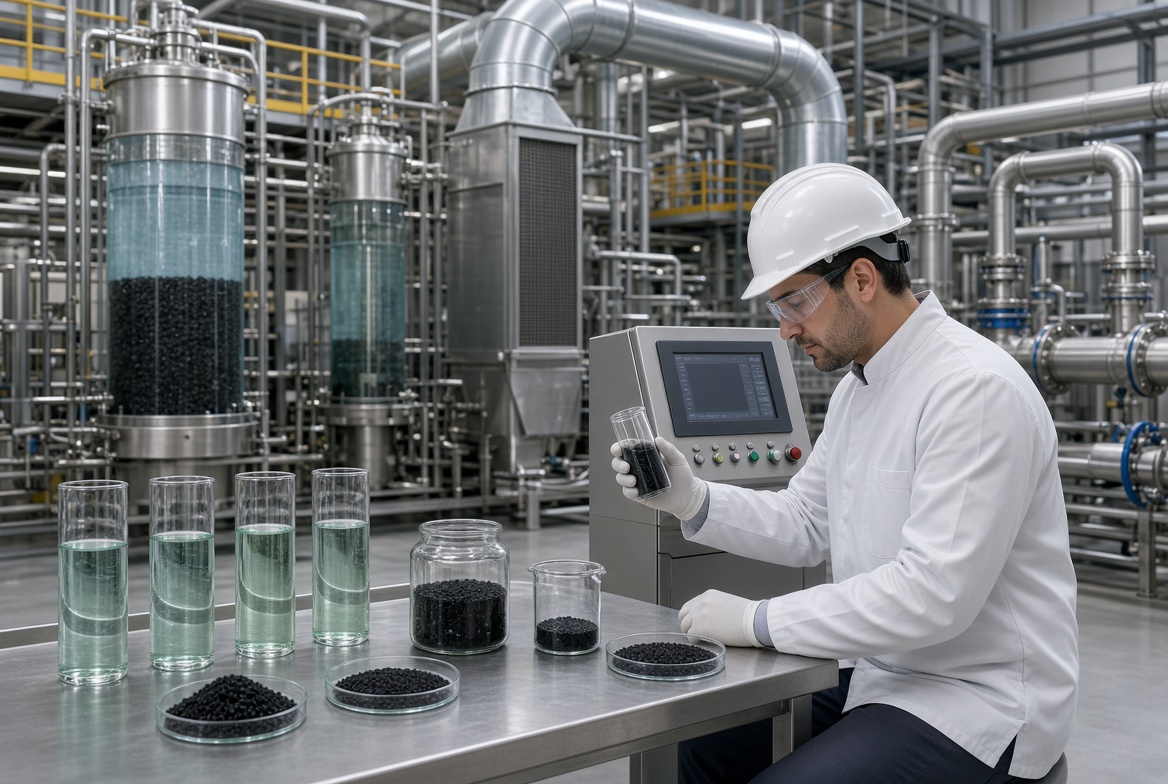
For a high-value process, buyers should request performance testing based on the actual feed stream or a representative sample. This is especially important for pharmaceuticals, food and beverage production, chemical intermediates, odor control, and complex industrial wastewater.
Virgin granular activated carbon is often the more economical operational decision when the consequences of underperformance are high.
Choose virgin GAC when you need:
- A new system baseline: Initial commissioning requires a known, consistent media specification.
- Maximum confidence in purity: This matters for food, beverage, pharmaceutical, and sensitive chemical applications.
- A customized pore structure: Specific raw materials and activation levels may be required for a target contaminant.
- Treatment of unknown or changing streams: Variable feed conditions make prior carbon history less useful.
- Low annual carbon volume: Small volumes may not justify return freight and reactivation logistics.
- Rapid supply: A direct virgin GAC shipment may be faster than a closed-loop reactivation cycle.
- Special impregnated products: Certain chemically modified carbons may not be suitable for conventional reactivation.
For example, a pharmaceutical manufacturer removing color bodies and trace organics from a high-purity liquid may prioritize a virgin, application-qualified carbon grade. The cost of product rejection, process contamination, or an unplanned shutdown can exceed any apparent saving from using recovered carbon.
Reactivated GAC is often a strong financial and operational option when the operation is stable, the carbon volume is substantial, and the spent material is appropriate for recovery.
Consider reactivated GAC when:
- Carbon replacement is frequent and predictable
- The same type of GAC is used repeatedly
- The contaminant profile is stable
- The facility manages large adsorption beds
- Spent-carbon disposal costs are significant
- A qualified reactivation route is available
- Testing confirms acceptable adsorption performance
- The site can maintain a practical carbon inventory buffer
Municipal and industrial water-treatment systems with recurring GAC changeouts are common examples. When carbon is traceable, collected separately, and reactivated under controlled conditions, a closed-loop program can reduce replacement demand while maintaining treatment performance.
Before choosing virgin or reactivated GAC, use this structured evaluation.
1. Define the treatment target.
Identify the contaminants, required outlet level, influent variation, operating temperature, flow rate, and contact time.
2. Review the current carbon history.
Record the carbon grade, raw material, service duration, breakthrough behavior, contaminant loading, and prior reactivation cycles.
3. Calculate delivered lifecycle cost.
Include carbon, freight, removal, reactivation, disposal, make-up material, testing, labor, and downtime.
4. Validate performance with representative media.
Compare virgin and reactivated GAC using your actual water, gas, or process liquid whenever possible.
5. Set acceptance criteria before ordering.
Define particle size, hardness, moisture, ash, iodine number where relevant, contaminant-specific performance, packaging, documentation, and delivery timing.
This approach prevents a common procurement mistake: selecting carbon based only on price per kilogram instead of the cost to maintain compliant, stable treatment.
In real industrial purchasing, the most effective answer is often not an either-or decision. A hybrid carbon strategy can balance reliability and cost control.
A facility may use virgin GAC for initial bed filling, critical production stages, or high-risk contaminants. It can then evaluate reactivation for routine changeouts once the loading pattern and performance data are established.
A reactivated-carbon program may also include virgin make-up carbon to restore bed volume after processing losses. This is not a weakness of the program—it is a normal part of maintaining the required media inventory and hydraulic design.
For facilities operating multiple adsorbers, a rolling program can be especially effective:
- One bed remains in service.
- One bed is on standby or being changed.
- Spent GAC is shipped for reactivation.
- Reactivated GAC returns with documented quality data.
- Virgin make-up carbon restores the required bed volume.
This model supports more predictable planning, provided the service partner has strong traceability, reliable logistics, and clear performance specifications.
The best choice between virgin GAC and reactivated GAC depends on your process—not a generic price comparison. Guangdong Tongke Activated Carbon Co., Ltd. supplies customized activated carbon solutions for water treatment, air and gas purification, food and beverage processing, chemical production, pharmaceutical applications, and other industrial uses.
Send us your target contaminant, operating conditions, carbon grade, annual consumption, and treatment objective. Our technical team can help you compare virgin GAC vs reactivated GAC by delivered cost, adsorption requirements, physical properties, and long-term operating risk—then recommend a practical carbon supply strategy for your facility.
Usually, reactivated GAC can cost less than virgin GAC in high-volume, repeat-use applications. However, the final result depends on freight, reactivation loss, virgin make-up carbon, testing, storage, and treatment performance. Compare total lifecycle cost rather than material price alone.
Loss varies by the carbon condition, equipment, transport, and operating method. EPA sources indicate that approximately 5% to 10% of carbon can be destroyed or lost during regeneration and handling, so make-up carbon is normally required.
It can recover strong adsorption performance, but it is not automatically identical to virgin material for every contaminant. The most reliable method is to test the reactivated carbon against the actual water, gas, or process liquid it will treat.
Yes, it can be used when the reactivation program, carbon handling, quality testing, and applicable approval requirements are properly managed. AWWA B605 provides guidance for procuring GAC reactivation services for potable water, wastewater, and reclaimed-water treatment.
Avoid or carefully validate reactivated GAC when the feed stream is unknown, product purity is extremely sensitive, the carbon contains problematic contaminants, annual volume is too low to support logistics, or a specific virgin carbon pore structure is required.
Provide the application, target contaminants, influent concentration, required outlet level, flow rate, temperature, pH, contact time, current carbon specification, annual consumption, vessel size, and any regulatory or product-purity requirements.
1. U.S. Environmental Protection Agency. [Granular Activated Carbon Reactivation: Performance, Cost, and Problems].
2. U.S. Environmental Protection Agency. [Carbon Adsorption for Wastewater Treatment].
3. U.S. Environmental Protection Agency. [Regeneration of Spent Granular Activated Carbon].
4. American Water Works Association. [AWWA B605-18: Reactivation of Granular Activated Carbon].
5. American Water Works Association. [AWWA B604-18: Granular Activated Carbon].
6. Calgon Carbon Corporation. [Carbon Adsorption and Reactivation White Paper].
7. ScienceDirect. [Changes in GAC Pore Structure During Full-Scale Water Treatment: A Comparison Between Virgin and Thermally Reactivated GAC]. [cfpub.epa]


