
Language
Views: 277 Author: Tongke Activated Carbon Publish Time: 2026-08-16 Origin: Site


Content Menu
● Leading Suppliers at a Glance
● 1. Guangdong Tongke Activated Carbon Co., Ltd.
>> Best fit
>> Best fit
● 5. Silcarbon Aktivkohle GmbH
>> Best fit
● 6. Carbon Service & Consulting GmbH & Co. KG
>> Best fit
● Technical Requirements for Pond Carbon
>> Recommended specification questions
>> Coconut shell vs. coal-based carbon
>> 1. Verify the supplier beyond the brochure
>> 2. Run a controlled sample process
>> Risk 1: "High iodine number" used as the only quality claim
>> Risk 2: Material substitution after sample approval
>> Risk 3: Excessive black fines
>> Risk 4: Wrong pore structure for the actual contaminant
>> Risk 5: "EU-ready" documentation without traceability
● Internal Sourcing Tip Few Buyers Discuss
● FAQ
>> 1. How can I check whether an ISO certificate is expired or invalid?
>> 2. Is CE marking required for Activated Carbon For Ponds?
>> 3. Should I choose coconut-shell or coal-based activated carbon for pond filtration?
>> 4. What tests should be included in a pond-carbon certificate of analysis?
>> 5. How do I prevent a supplier from changing the material after sending a good sample?
Germany is an important European market for activated carbon used in pond filtration, aquaculture water polishing, odor control, and industrial water treatment. Its strength comes from a mature chemical-processing base, strict environmental compliance culture, advanced filtration engineering, and central logistics position within the EU.
For professional buyers, however, "German supplier" does not always mean "German-made activated carbon." Many German companies combine local technical support, warehousing, reactivation, and application engineering with globally sourced raw materials or overseas production. The right choice therefore depends on your target water quality, particle-size requirement, purchase volume, compliance needs, and desired OEM support—not only supplier location.
Europe's activated carbon market was estimated at USD 1.06 billion in 2025 and is forecast to reach USD 1.45 billion by 2031, supported by environmental regulations, municipal water-treatment demand, and industrial emissions control. Powdered activated carbon represented 47.63% of the European market in 2025, although granular activated carbon remains particularly relevant for fixed-bed pond and water filtration systems.
This list is designed for pond-product brands, water-treatment distributors, aquarium and aquaculture equipment companies, private-label buyers, and industrial procurement teams looking for stable long-term partners.
The selection considers the following factors:
- Manufacturing and technical depth: Ability to supply granular, pelletized, powdered, coconut-shell, coal-based, or wood-based activated carbon with defined specifications.
- Quality-control process: Incoming raw-material inspection, iodine number testing, ash analysis, moisture testing, particle-size distribution control, abrasion resistance, and pre-shipment verification.
- Compliance readiness: ISO management systems, REACH registration where applicable, food-contact documentation where relevant, and third-party test support.
- R&D and customization: Capability to match pore structure, mesh size, hardness, ash level, packaging, washing method, and adsorption performance to the pond-filtration application.
- Supply stability: Production capacity, warehouse availability, lead-time management, export documentation, and logistics coordination.
- Commercial fit: Minimum order quantity, support for private-label programs, and flexibility for growing brands rather than only high-volume institutional accounts.
> Important technical note: CE and RoHS are not universal product certifications for loose activated carbon. CE marking applies only when a product falls within a relevant EU harmonized-product category, while RoHS is primarily relevant to electrical and electronic equipment. For activated carbon media, buyers should focus more directly on REACH, relevant ISO systems, application-specific test reports, and any food-contact or drinking-water requirements relevant to the end use.
| Supplier | Core Focus | Pond-Filter Suitability | Capacity / Supply Model | MOQ Flexibility | Publicly Stated Compliance |
|---|---|---|---|---|---|
| Guangdong Tongke Activated Carbon Co., Ltd. | Customized activated carbon for global industrial applications | Strong for OEM pond filters, aquarium media, water-treatment distributors | Annual capacity stated at 30,000 tonnes; direct export manufacturing | Small-MOQ support stated | NSF, Kosher, Halal; internal QC and third-party testing support |
| CarboTech Group | German-made activated carbon, activated coke, molecular sieves | Strong for technically specified European filtration projects | Integrated production, refining, packaging and reactivation in Germany | Quote-based | ISO 9001, 14001, 27001, 45001, 50001; REACH |
| Donau Carbon GmbH | Activated carbon, reactivation and filtration solutions | Strong for project-based water and air-treatment applications | International supply network and own production operations | Quote-based | REACH; ISO 9001/14001 cited for Philippines production facility |
| Chemviron Carbon GmbH | Broad activated-carbon and purification portfolio | Suitable for water-treatment and specialty purification needs | International manufacturer with extensive grade range | Quote-based | Confirm project-specific documentation directly |
| Silcarbon Aktivkohle GmbH | Granular activated carbon for water and air treatment | Relevant for GAC-focused water filtration | European specialty supplier | Quote-based | Confirm current certificates directly |
| Carbon Service & Consulting GmbH & Co. KG | Activated carbon, activated coke and filter media | Relevant for air, gas and water-purification systems | German production site in Vettweiß | Quote-based | Confirm current certificates directly |
*MOQ and production-capacity figures are frequently quotation-specific and may vary by raw material, mesh size, washing requirement, packaging, destination, and order schedule. Request written confirmation for each project.*
Guangdong Tongke Activated Carbon Co., Ltd. is a China-based manufacturer serving international buyers with customized activated-carbon solutions for water treatment, air and gas purification, food and beverage processing, chemicals, pharmaceuticals, and related applications. For pond-media brands and mid-sized filtration distributors, Tongke is particularly relevant when commercial flexibility and detailed OEM execution are priorities.
The company states that it has more than 20 years of industry experience, an annual production capacity of 30,000 tonnes, and a 3,000 m² warehouse. Its portfolio includes coconut-shell, coal-based, wood-based, honeycomb, pelletized, powdered, granular activated carbon, activated carbon fiber, and anthracite filter media. It exports to Southeast Asia, Europe, and North America.
- Flexible OEM support: Suitable for buyers requiring customized mesh sizes, bulk density, iodine number ranges, ash limits, moisture limits, washed or acid-washed material, private-label bags, and mixed-media filtration packages.
- Support for smaller brands: The company states that it supports competitive pricing and small minimum orders, which can be useful for new pond-filter brands, regional distributors, and brands testing a private-label line before scaling.
- Broader raw-material options: Coconut-shell carbon is often preferred for high microporosity and adsorption of low-molecular-weight organics, while coal-based grades can be selected when a balance of micropores and mesopores is needed.
- Quality-control orientation: Tongke reports end-to-end inspection, key-parameter testing, final pre-dispatch inspection, advanced production equipment, and support for third-party verification.
- Communication and supply coordination: For cross-border buyers, a manufacturer that can align technical specifications, documentation, packing, shipment schedules, and sample revisions in one workflow can reduce sourcing friction.
Tongke is a practical option for:
- Pond-filter activated carbon in 4×8, 6×12, 8×16, 8×30, or customized mesh ranges.
- Coconut-shell granular activated carbon for aquarium and ornamental-pond media.
- Coal-based granular carbon for larger-volume filtration and water-polishing projects.
- Private-label retail bags, neutral bulk bags, kraft-paper bags, PP woven bags, or palletized industrial packaging.
- Customized iodine number, CTC activity, ash, moisture, hardness, pH, and particle-size targets.
- Combination solutions involving activated carbon and anthracite filter media.
For pond applications, buyers should request a water-contact sample test rather than relying only on an iodine-number result. A higher iodine number does not automatically guarantee better removal of every dissolved organic compound, color body, odor compound, treatment chemical, or algae-related metabolite.
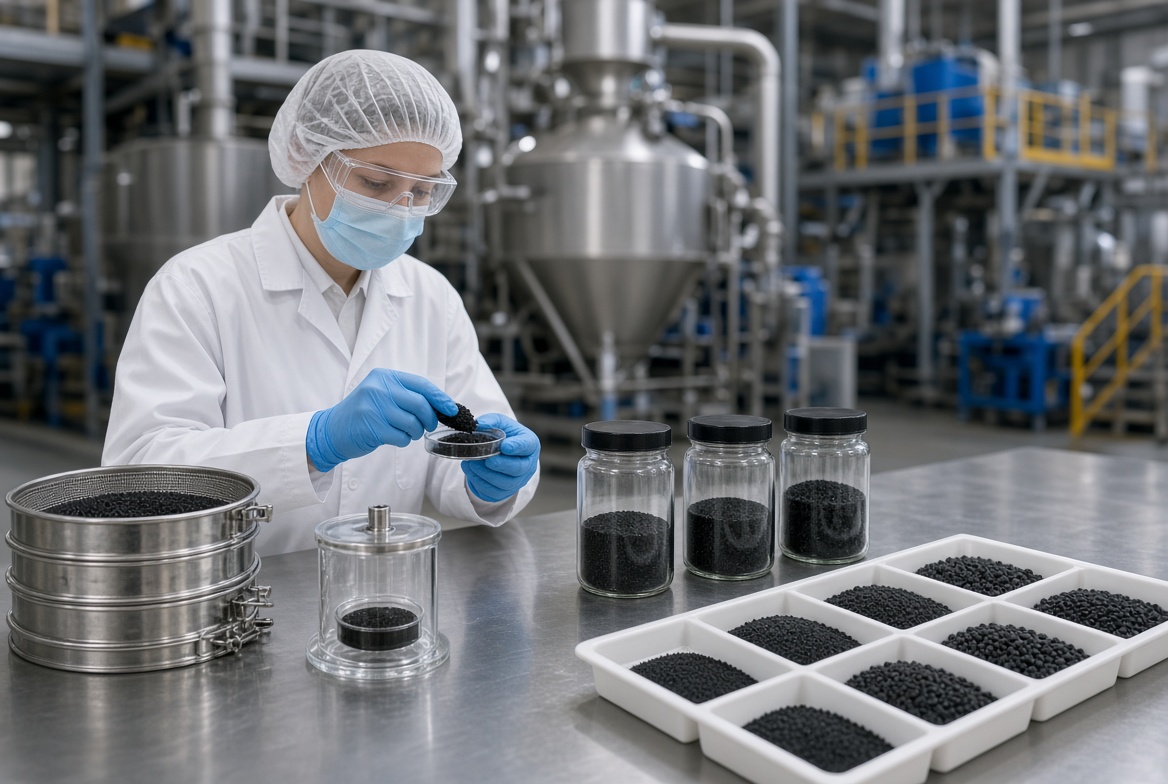
CarboTech Group is a Germany-based full-service supplier of powdered, granular, and extruded activated carbons. It operates in the Ruhr region, one of Germany's best-known industrial and chemical-processing clusters, where access to technical talent, industrial infrastructure, testing know-how, and European distribution networks supports its position in specialty carbon applications.
The company reports more than 60 years of experience and operates integrated facilities for the manufacture, refinement, and packaging of customized activated carbons, activated cokes, and carbon molecular sieves. Its raw-material scope includes hard coal, coconut coke, and charcoal.
- Strong fit for buyers needing German production and application support.
- Offers powdered, granular, and extruded activated-carbon formats.
- Provides reactivation capabilities, which may be valuable for industrial users with spent-carbon management requirements.
- Publicly lists ISO 9001, ISO 14001:2015, ISO 27001:2022, ISO 45001:2018, and ISO 50001:2018 certificates, as well as REACH registrations for activated-carbon categories.
- Suitable for demanding water, gas, emissions-control, and specialty purification programs.
For pond filtration, CarboTech may be most relevant when a buyer needs traceable technical documentation, European-grade consistency, or a filtration design that overlaps with industrial water-treatment requirements.
Donau Carbon GmbH, headquartered in Frankfurt am Main, supplies activated carbon, reactivation services, and filtration solutions for water treatment, air purification, and industrial applications worldwide. The company describes itself as having more than 100 years of expertise in activated carbon.
Its business model is particularly relevant to professional buyers that value a combination of material supply, spent-carbon reactivation, system support, and technical consultation.
- Long operating history and a global supply orientation.
- Broad application coverage, including air conditioning, exhaust air, waste-gas cleanup, and water-related purification.
- Offers special activated-carbon grades and spent-carbon reactivation services.
- Public REACH records list registrations for high-density and low-density activated-carbon categories.
- Operates a coconut-shell granular activated-carbon facility in Mindanao, Philippines; the company states this facility is ISO 9001 and ISO 14001 certified and operates under German quality and safety standards.
Donau Carbon is a strong candidate for buyers seeking:
- European technical and commercial support.
- Specialized granular activated carbon.
- Long-term industrial filtration programs.
- Carbon replacement and reactivation planning.
- Multi-site or multinational supply coordination.
For pond-media purchasers, request the specific grade's data sheet and ensure the material is appropriate for aquatic contact. General industrial activated carbon may have the wrong particle size, dust level, hardness, or pre-washing condition for consumer pond filtration.
Chemviron Carbon GmbH is a German manufacturer associated with activated carbon, carbon filters, and purification systems. Its portfolio includes more than 150 activated-carbon products for applications such as drinking-water treatment, air purification, sugar decolorization, and industrial purification.
This breadth makes Chemviron a relevant supplier for buyers whose pond-filter requirements are part of a wider water-treatment, food-processing, or industrial purification portfolio.
- Extensive activated-carbon grade selection.
- Experience across drinking water, industrial purification, air treatment, and decolorization applications.
- Suitable for technically complex requirements where adsorption performance must be aligned with a specific contaminant profile.
- Potential fit for larger projects that need more than standard retail pond-carbon media.
Chemviron may be appropriate for:
- Water-treatment companies.
- Integrated filtration-system builders.
- Buyers needing documented specialty grades.
- Projects requiring technical consultation on adsorption performance.
Because publicly visible supplier data may not show every facility certificate, annual capacity figure, or minimum-order policy, buyers should request current documentation directly before supplier qualification.
Silcarbon Aktivkohle GmbH is a Germany-based supplier known for granular activated carbon used in water and air purification. Industry sources identify its focus on coal-based and coconut-shell granular activated carbon, with relevance to municipal water treatment, industrial plants, and environmental services.
For pond applications, this granular-carbon focus is important because fixed-bed pond filters typically need a hard, low-dust material with a controlled particle-size range and adequate hydraulic performance.
- Strong relevance to granular activated-carbon applications.
- Coal-based and coconut-shell material options can support different water-treatment objectives.
- Suitable for buyers seeking European supply for water and air purification media.
- Likely most relevant for professional filtration companies rather than low-volume consumer purchases.
Silcarbon should be considered by buyers seeking:
- Granular activated carbon for fixed-bed filtration.
- Technical water-treatment media.
- European-market support and logistics.
- Coal-based or coconut-shell grade comparisons.
Ask for a current technical data sheet covering mesh distribution, iodine value or other adsorption indicators, ash, moisture, abrasion resistance, apparent density, pH, dust content, and recommended backwashing procedure.
Carbon Service & Consulting GmbH & Co. KG, commonly known as CSC, is a German manufacturer operating a production plant in Vettweiß. It produces activated carbon, activated coke, filter carbon, and filter anthracite for air and gas purification as well as water treatment.
Its combination of activated-carbon and mineral filter-media capabilities may be useful for larger pond, aquaculture, or water-treatment systems where activated carbon is specified alongside mechanical filtration media.
- German production base in Vettweiß.
- Product scope includes activated carbon, activated coke, filter carbon, and anthracite.
- Relevant for air, gas, and water-purification systems.
- Potential advantage for projects that need multi-media filtration design rather than a single carbon grade.
CSC may suit:
- Engineering contractors.
- Industrial-water and wastewater-treatment providers.
- Buyers sourcing activated carbon together with anthracite or other filter media.
- Pond-system builders developing larger recirculating-water installations.
Germany's activated-carbon sector benefits from industrial clusters in regions such as the Ruhr area, Frankfurt/Rhine-Main, and wider North Rhine-Westphalia. These regions combine chemical-industry infrastructure, environmental engineering expertise, testing laboratories, industrial logistics, and strong access to EU markets.
CarboTech's Ruhr-area position illustrates this advantage: it operates integrated production, refinement, and packaging facilities in an established industrial region. Germany is also expected to hold a leading share of European coal-based activated-carbon demand, supported by industrial infrastructure, environmental regulation, and chemical-manufacturing capacity.
That said, the most practical procurement model is often hybrid:
| Procurement Model | Main Advantage | Main Limitation | Suitable Buyer |
|---|---|---|---|
| German manufacturer | Technical support, local compliance familiarity, EU logistics | Often higher cost and less MOQ flexibility | Municipal, industrial and highly specified projects |
| German supplier with global production | European support with wider sourcing options | Origin and exact production site must be verified | Multi-country buyers and technical distributors |
| Direct Asian manufacturer | Competitive cost, deeper private-label support, flexible packaging | Requires stronger supplier verification and import coordination | Pond brands, distributors and OEM buyers |
| Multi-source strategy | Reduces supply interruption risk | Requires specification control across sources | Larger buyers with annual procurement programs |
Activated Carbon For Ponds is typically used to adsorb dissolved organic compounds, residual medications, color-causing compounds, odors, certain pesticides, and other unwanted contaminants. It is not a replacement for mechanical filtration, biological filtration, water changes, or correction of an underlying contamination source.
Before requesting quotations, define:
- Raw material: coconut shell, coal, wood, or blended carbon.
- Particle size: for example, 4×8 mesh, 6×12 mesh, 8×16 mesh, or 8×30 mesh.
- Iodine number: a comparative adsorption indicator, not the only quality metric.
- Molasses number or methylene-blue performance: potentially useful for larger organic molecules and color compounds.
- Ash content: high ash can reduce effective carbon content and introduce unwanted mineral residue.
- Moisture content: affects delivered net carbon quantity and shipping economics.
- Abrasion resistance or hardness: important to limit fines during transport, rinsing, and backwashing.
- Acid-washed or water-washed requirement: relevant when low ash or low leachable mineral content matters.
- Dust content: especially important in retail pond applications, where excessive black fines create customer complaints.
- Packaging: retail pouches, 5 kg/10 kg bags, 20–25 kg bags, big bags, or private-label formats.
| Factor | Coconut-Shell Activated Carbon | Coal-Based Activated Carbon |
|---|---|---|
| Typical pore tendency | More microporous | Often broader micro- and mesopore balance |
| Common pond use | Polishing water, odor control, low-molecular-weight organics | General water treatment, color and broader organic removal depending on grade |
| Hardness | Often high | Grade dependent |
| Dust-control potential | Good when properly screened and washed | Good when properly processed and screened |
| Selection advice | Evaluate actual water test performance | Evaluate actual water test performance |
The correct choice must be validated against the target contaminant and hydraulic design. A carbon that performs well for odor removal may not be the best option for tannin-like color bodies or larger dissolved organic compounds.
Ask for:
- Legal company name and registration details.
- Factory address and production-site address.
- Current ISO certificates, including certificate number, issuing body, scope, issue date, and expiry date.
- Product-specific technical data sheet.
- Recent certificate of analysis for the exact grade offered.
- SDS and REACH information for EU-bound shipments.
- Third-party laboratory report, if the end application requires one.
- Photos or video showing screening, washing, packing, laboratory testing, and warehouse procedures.
- Recent shipment references or anonymized export documents where commercially appropriate.
Do not accept a generic "ISO certified" statement without checking whether the certificate applies to the legal entity and manufacturing site supplying your product.
A reliable sample process has three stages:
1. Paper review: Compare the data sheet, certificate of analysis, safety documentation, mesh size, ash, moisture, and packaging specification.
2. Bench test: Rinse the sample using your intended procedure, observe fines generation, test pH and turbidity, and evaluate odor/color reduction using controlled pond or aquarium water.
3. Pilot order: Test the material under real operating conditions before committing to an annual contract.
For comparable supplier trials, use the same water source, contact time, carbon dosage, flow rate, filter configuration, and test method. Without a controlled protocol, one supplier may appear better simply because the test conditions changed.
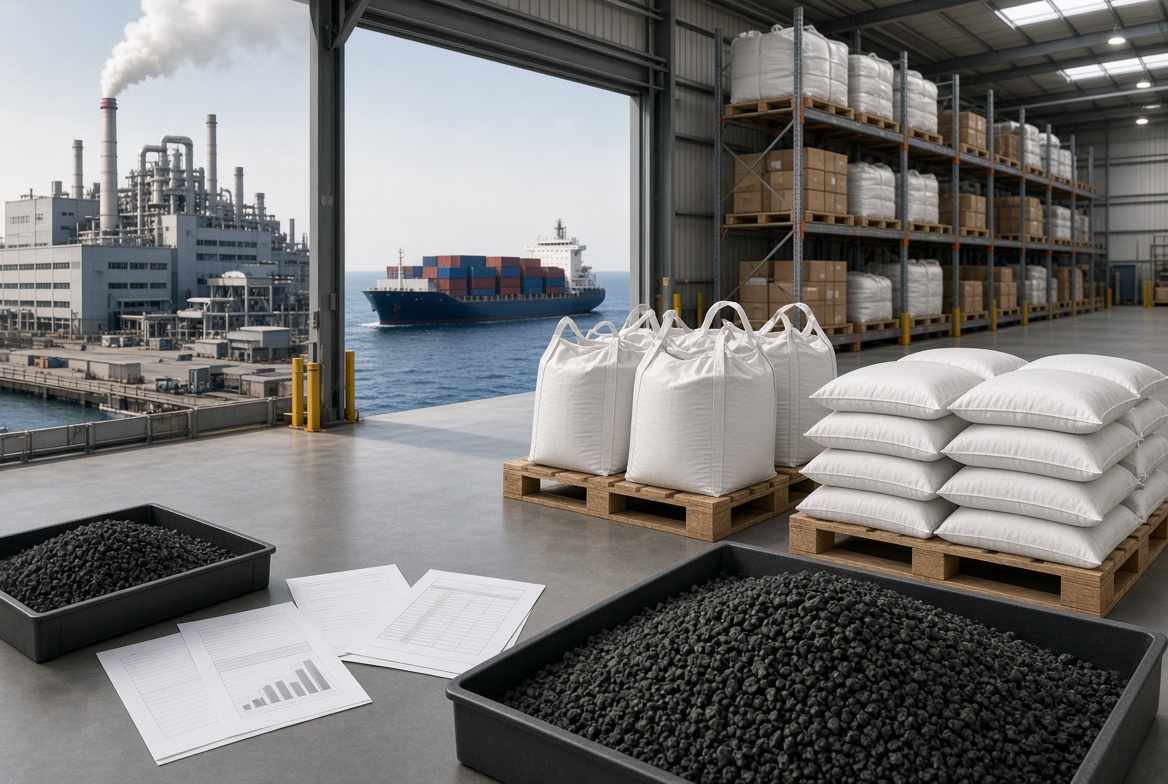
For export orders into Germany or other EU markets, clarify:
- Incoterm: EXW, FOB, CIF, DAP, or DDP.
- Packaging strength for sea freight and warehouse handling.
- Pallet requirements, pallet treatment, labeling language, and barcode needs.
- Whether the material is packed as hazardous or non-hazardous under applicable transport requirements.
- Customs classification, origin documentation, commercial invoice, packing list, bill of lading, and any requested compliance declarations.
- Container loading plan and moisture protection, especially for hygroscopic or paper-bag packaging.
Activated carbon has a finite adsorption capacity. It should be replaced or regenerated based on breakthrough performance, not only by calendar schedule. Buying a lower-cost grade with inconsistent particle size, high ash, or poor hardness can create more frequent replacement cycles and higher total operating cost.
A supplier may quote a high iodine value but omit ash, moisture, abrasion resistance, particle-size consistency, and water-rinse performance.
How to avoid it: Require a multi-parameter specification and a retained sample. Evaluate the same grade under realistic filtration conditions.
The production shipment may not match the original sample, especially when raw-material prices move.
How to avoid it: Include the approved sample code, specification limits, tolerance range, and pre-shipment inspection requirement in the purchase order.
Poorly screened or inadequately washed carbon can release dust, cloud pond water, clog filter pads, and create end-user complaints.
How to avoid it: Specify maximum fines, define the test sieve, require rinse guidance, and inspect a pre-shipment sample from the actual production lot.
A material can have an impressive generic data sheet but perform weakly against the buyer's specific contaminant profile.
How to avoid it: Request performance testing using real water or a representative contaminant challenge, not only general adsorption numbers.
A supplier may state that a product is suitable for Europe while providing no product-specific REACH or compliance documentation.
How to avoid it: Confirm the legal importer, REACH obligations, registration details where applicable, and document responsibility before shipment.
One of the most overlooked risks is apparent specification compliance caused by moisture and ash masking.
Two activated-carbon shipments can show a similar iodine number on paper, but one may contain more moisture and ash. Since buyers pay by delivered weight, higher moisture and ash can reduce the amount of effective carbon per tonne. This does not necessarily mean the material is defective—specifications can legitimately vary—but it must be controlled contractually.
A practical way to compare offers is to calculate the approximate dry, ash-free carbon basis:
Effective carbon fraction≈100%−moisture−ash
For example:
- Grade A: 5% moisture and 5% ash ≈ 90% effective carbon fraction.
- Grade B: 10% moisture and 12% ash ≈ 78% effective carbon fraction.
If Grade B is only slightly cheaper per tonne, it may cost more per unit of usable adsorption media. Ask suppliers to state the test method and tolerance limits for both moisture and ash, then compare total landed cost on a consistent basis.
Germany offers strong technical resources for activated-carbon procurement, especially for buyers needing European application engineering, reactivation services, regulated-market documentation, and specialized water-treatment support. CarboTech, Donau Carbon, Chemviron Carbon, Silcarbon, and Carbon Service & Consulting represent relevant options for different technical and commercial needs.
For pond-product companies, private-label distributors, and growing filtration brands, Guangdong Tongke Activated Carbon Co., Ltd. provides a complementary sourcing route: direct manufacturing, stated 30,000-tonne annual capacity, flexible MOQ support, customization across multiple carbon types, and export-oriented service for Europe and other international markets.
If you are sourcing Activated Carbon For Ponds, prepare a specification sheet first, request matched samples from at least three qualified suppliers, and compare performance on the same water source—not only price per bag or iodine number. For customized mesh size, packaging, washed grades, OEM labeling, or bulk supply, contact Guangdong Tongke Activated Carbon Co., Ltd. with your target application, annual volume, and required test parameters.
Ask for the full certificate PDF, certificate number, issuing certification body, legal entity name, factory address, scope, issue date, and expiry date. Then verify it through the certification body's public directory or by emailing the issuer. Also confirm that the scope covers manufacturing or processing of activated carbon—not an unrelated trading activity.
Usually, loose activated carbon media itself is not automatically subject to CE marking. CE requirements depend on the finished product category and applicable EU legislation. If activated carbon is sold inside an electrical pond-filter device, the device may have CE obligations, but the carbon media should be assessed separately for chemical, labeling, and application requirements.
Choose based on the contaminants, filter design, flow rate, and required pore structure. Coconut-shell grades are often valued for hardness and microporosity, while coal-based grades can provide a broader pore-size distribution. Test both candidate grades using the same pond water and operating conditions before finalizing a specification.
At minimum, request particle-size distribution, iodine number or equivalent adsorption indicator, ash, moisture, apparent density, pH, hardness or abrasion resistance, and dust/fines content. Depending on the application, also request water-soluble ash, acid-soluble ash, methylene-blue value, molasses number, heavy-metal screening, and leachability data.
Approve a retained reference sample, assign a lot code, attach the target specification to the purchase order, define acceptable tolerances, require a pre-shipment certificate of analysis, and reserve the right to inspect or test goods before final payment. For recurring orders, use third-party lot sampling at the packing stage.
- [CarboTech Group: activated-carbon products and company information] [carbotech]
- [CarboTech certificates and REACH information] [carbotech]
- [Donau Carbon: activated carbon, reactivation and filtration solutions] [donau-carbon]
- [Donau Carbon REACH information] [donau-carbon]
- [European Chemicals Agency: REACH Regulation]
- [European Commission: CE marking guidance]
- [European activated carbon market outlook, 2026] [globenewswire]


