
Language
Views: 208 Author: Tongke Activated Carbon Publish Time: 2026-08-14 Origin: Site


Content Menu
● What Is Powdered Activated Carbon?
>> Adsorption Is Not Simple Filtration
● Why PAC Is Used in Water Treatment
>> Organic Micropollutant Reduction
>> Algal Bloom and Emergency Response
>> Industrial Wastewater Polishing
● PAC Versus Granular Activated Carbon
● How to Select the Right Powdered Activated Carbon
>> 1. Define the Actual Contaminant Challenge
>> 2. Match Pore Structure to the Target
>> 3. Review Useful Quality Indicators
>> 4. Conduct Jar Testing Before Full-Scale Use
● PAC Dosing and Process Integration
>> Choosing the Injection Point
>> Preparing a Reliable PAC Slurry
● Four Operating Mistakes to Avoid
>> Treating PAC as a "Set-and-Forget" Chemical
>> Ignoring Natural Organic Matter
>> Relying on One Specification
>> Overlooking Residuals Management
● Why Work With Guangdong Tongke Activated Carbon
>> What is powdered activated carbon used for in water treatment?
>> What is the difference between PAC and GAC?
>> How much PAC should be added to water?
>> Can powdered activated carbon remove PFAS?
>> Does a higher iodine number mean better PAC performance?
>> Is PAC suitable for industrial wastewater reuse?
>> How should spent PAC be managed?
Clean water treatment is rarely a one-size-fits-all process. Source-water quality changes with rainfall, seasonal algae growth, industrial discharge patterns, chemical spills, and production demands. For these variable conditions, powdered activated carbon for water treatment gives operators a flexible adsorption tool that can be dosed quickly, adjusted precisely, and integrated into existing clarification and filtration processes.
At Guangdong Tongke Activated Carbon Co., Ltd., we work with water-treatment operators, engineering companies, distributors, and industrial users that need activated carbon solutions matched to real treatment conditions—not generic product claims. The right powdered activated carbon, often called PAC, can help reduce taste and odor compounds, color, chlorine residuals, dissolved organic matter, pesticides, solvents, selected pharmaceutical residues, and other adsorbable contaminants.
However, successful PAC treatment depends on more than purchasing a high-activity carbon. It requires choosing the right pore structure, testing it against the actual water matrix, selecting a practical dosing point, and monitoring removal results over time.
This guide explains how powdered activated carbon works, where it delivers the greatest value, and how to develop a more reliable PAC treatment strategy.
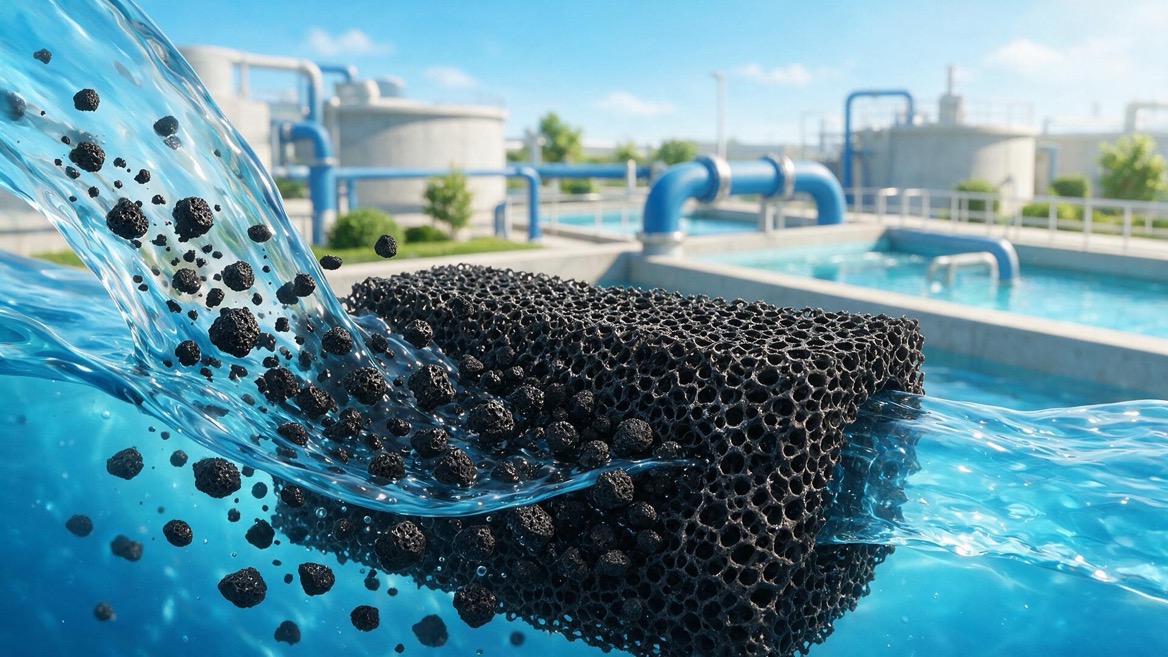
Powdered activated carbon is a finely milled adsorbent produced from carbon-rich raw materials such as coal, wood, or coconut shell. Through controlled activation, the material develops a dense network of pores. These pores create a very large internal surface where dissolved contaminants can attach.
PAC is generally supplied as a black powder with fine particle sizing. Its small particle size creates fast adsorption kinetics, meaning contaminants can reach active adsorption sites more quickly than they can with larger carbon particles.
Unlike granular activated carbon, which is usually installed in fixed-bed filters, PAC is commonly prepared as a slurry and injected directly into the treatment process. It is then removed along with sludge during sedimentation, dissolved-air flotation, clarification, or filtration.
PAC does not work like a screen that physically blocks particles. It works through adsorption.
During adsorption, target molecules move from water onto the internal surface of the carbon. The effectiveness of this process depends on the relationship between the contaminant and the carbon's pore network.
In practical terms:
- Micropores are important for many smaller dissolved organic molecules.
- Mesopores help transport and capture larger organic molecules, color bodies, and natural organic matter.
- Macropores act as pathways that help contaminants reach smaller internal pores.
- Surface chemistry can influence how strongly certain compounds interact with the carbon.
- Smaller PAC particles can improve adsorption speed, provided they are properly dispersed.
A carbon with excellent performance for one contaminant may not be the best option for another. This is why application testing matters more than relying on a single specification alone.
Powdered activated carbon is especially useful when treatment conditions are variable, seasonal, or urgent. It can often be introduced into an existing plant without the capital cost and footprint of a new fixed-bed adsorption system.
Taste and odor episodes are among the most common reasons for PAC use in drinking-water treatment. Earthy, musty, swampy, or mold-like odors may be caused by compounds such as geosmin and 2-methylisoborneol (MIB), often associated with algae and cyanobacteria.
Even when these compounds are present at very low concentrations, consumers may notice them. PAC can be added during these periods to reduce odor-causing compounds before finished water reaches distribution.
PAC can be applied to reduce many dissolved organic contaminants, depending on their molecular structure and the water chemistry. Typical targets may include:
- Agricultural pesticides and herbicides
- Industrial solvents and aromatic compounds
- Phenols and selected chlorinated organics
- Dyes and color-causing compounds
- Residual hydrocarbons after a spill or process upset
- Certain pharmaceutical and personal-care residues
- Natural organic matter that contributes to color or disinfection by-product formation
Removal performance must be validated for the actual target contaminant. Highly soluble, low-molecular-weight, or ionized compounds may adsorb weakly and may require another treatment barrier.
PAC is valuable when a plant needs to respond rapidly to changing source-water quality. During a harmful algal bloom, for example, operators may increase PAC dosage while optimizing coagulation and filtration to control taste, odor, and selected dissolved cyanotoxins.
This does not mean that every PAC grade will perform equally. Carbon feedstock, activation level, pore distribution, natural organic matter concentration, contact time, and the specific toxin all affect results. A site-specific test should determine the final selection and dose.
For industrial wastewater, PAC is often used as a polishing step after biological treatment, chemical precipitation, membrane separation, or clarification. It can support discharge compliance, reuse objectives, color reduction, odor control, and protection of downstream membranes or ion-exchange systems.
Typical industrial applications include:
- Chemical and petrochemical wastewater
- Textile dyeing and finishing effluent
- Food and beverage process water
- Pharmaceutical process streams
- Printing and packaging wastewater
- Pulp and paper wastewater
- Metal-finishing and specialty chemical applications
Both PAC and granular activated carbon are powerful adsorbents, but they serve different operational needs.
| Selection factor | Powdered activated carbon | Granular activated carbon |
|---|---|---|
| Physical form | Fine powder | Larger granules |
| Typical use | Flexible, intermittent, seasonal, or emergency dosing | Continuous treatment in fixed beds |
| Installation | Added into an existing process | Requires contactors or carbon filters |
| Adsorption speed | Generally faster because of small particle size | Typically slower, depending on bed design |
| Carbon recovery | Usually removed with sludge and not regenerated on site | Can be thermally regenerated in some applications |
| Best fit | Variable influent conditions and short-term contaminant events | Long-term, stable, continuous adsorption duty |
| Operational focus | Slurry handling, dose control, contact time, solids removal | Empty-bed contact time, breakthrough monitoring, backwashing |
PAC is not automatically better than GAC, and GAC is not automatically more economical. The right decision depends on contaminant loading, treatment frequency, available infrastructure, residuals handling, operating budget, and performance targets.
For a seasonal taste-and-odor event, PAC may be the practical choice. For continuous removal of a stable contaminant load, a properly designed GAC system may provide better long-term control. Some facilities use both: PAC for peak events and GAC for continuous polishing.
A product data sheet is important, but it is only the beginning. PAC selection should start with the treatment objective and raw-water conditions.
Begin with clear questions:
- What contaminant must be reduced?
- Is the objective odor control, color reduction, organic removal, or compliance support?
- What is the influent concentration range?
- Is the event seasonal, continuous, or accidental?
- What finished-water target must be achieved?
- Are multiple contaminants competing for the same adsorption sites?
A PAC grade selected for MIB odor control may not be the optimum grade for dye removal or for a wastewater stream containing high concentrations of natural organic matter.
Different raw materials and activation processes create different pore profiles.
Coal-based PAC is often selected for broad-spectrum adsorption and can provide a balanced distribution of micro- and mesopores. Wood-based PAC can offer a more developed mesopore structure, which may be useful for larger organic molecules and color compounds. Coconut-shell-based carbon is often valued for its microporous structure and hardness, particularly where smaller molecules are the priority.
The correct choice depends on the target compound and the water matrix. There is no universal "best activated carbon."
Common PAC specifications may include:
- Iodine number
- Methylene blue value or molasses number
- Particle-size distribution
- Ash content
- Moisture content
- pH
- Apparent density
- Acid-soluble ash
- Heavy-metal content, where relevant
- Food-grade, pharmaceutical-grade, or application-specific requirements
Iodine number can indicate adsorption potential for certain small molecules, but it should not be treated as a complete performance guarantee. Similarly, low ash can support purity and usable carbon content, but adsorption performance still depends on pore structure and the target contaminant.
Jar testing is the most practical way to compare PAC grades and determine an initial dose. It reveals how the carbon performs in the real source water, where natural organic matter, pH, temperature, turbidity, oxidants, and competing chemicals can all influence adsorption.
A basic PAC jar-testing program should:
1. Collect representative raw-water samples.
2. Test several PAC grades with different pore structures.
3. Evaluate a range of realistic doses.
4. Replicate the expected mixing and contact time.
5. Include the intended coagulant and process sequence.
6. Measure the target contaminant before and after treatment.
7. Compare removal, sludge impact, handling needs, and total treatment cost.
Do not select carbon based only on the lowest price per metric ton. The more relevant measure is the cost required to achieve the treatment target consistently.
A well-selected PAC can still underperform if it is fed at the wrong point or given inadequate mixing and contact time.
Common PAC injection points include the raw-water intake, rapid-mix basin, pre-sedimentation zone, coagulation stage, or another location upstream of solids removal. The best point depends on the available contact time and whether oxidation, coagulants, polymers, or other chemicals could affect adsorption.
For many systems, early addition provides more contact time. However, the operating team must consider whether upstream oxidation could alter the target compound, whether it could release dissolved contaminants from cells, and whether the carbon can be mixed effectively without causing settling or dust problems.
PAC needs sufficient time in suspension to adsorb the target compounds. The required contact time varies widely with the contaminant, PAC grade, water temperature, dose, and competing organics.
More dose does not always compensate for poor mixing or insufficient contact time. Likewise, a long contact time cannot overcome a carbon that has the wrong pore structure for the target molecule.
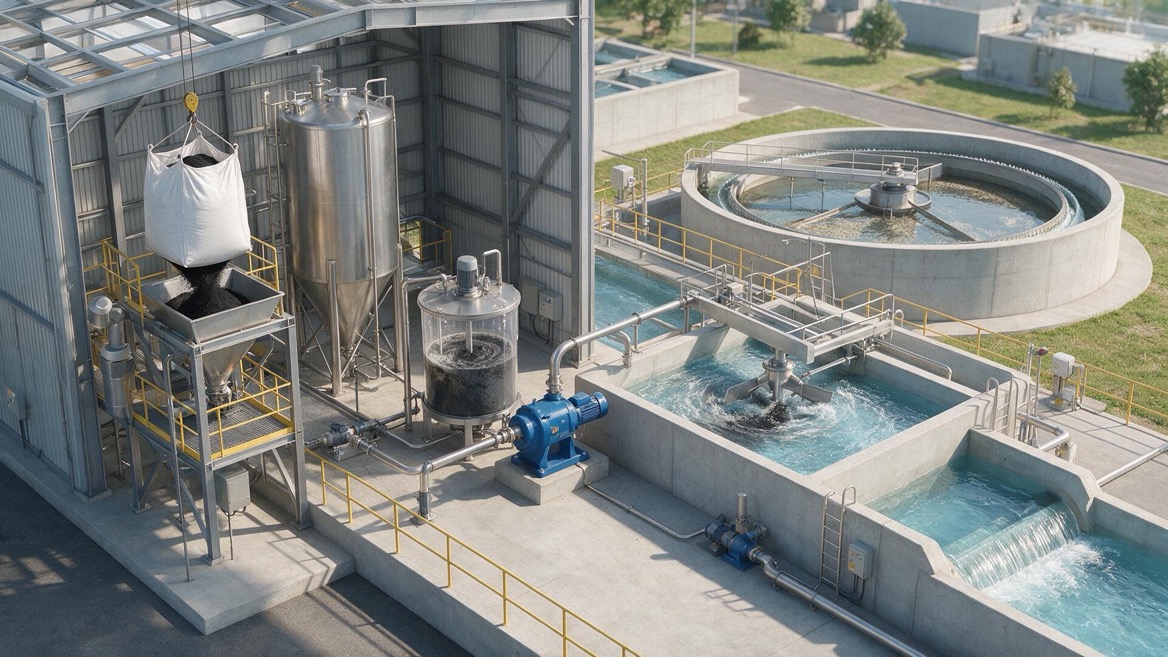
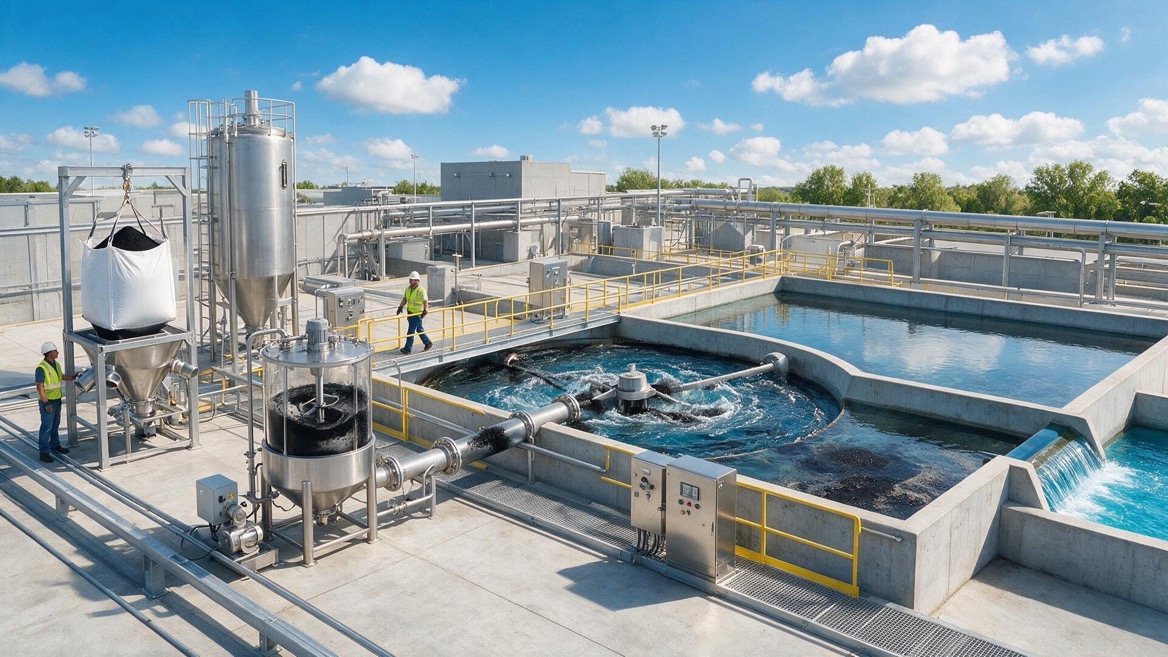
PAC should be handled as a controlled slurry, not as an occasional manual addition. A dependable dosing system typically includes:
- Enclosed bulk storage or bag-unloading equipment
- Dust-control measures
- A wetting and slurry-preparation tank
- Agitation to prevent settling
- Metering pumps or screw feeders
- Injection piping designed to avoid blockage
- Process monitoring and operator safety procedures
Fine carbon powder can create dust and housekeeping challenges. Good containment, ventilation, personal protective equipment, and clear operating procedures are essential.
Raw-water quality changes. A dosage that worked during one season may underperform during an algae event, after heavy rain, or when industrial loading rises. Track source-water trends and adjust based on verified performance.
Natural organic matter competes with target contaminants for adsorption sites. In high-NOM water, PAC demand can rise significantly. Improving coagulation, clarification, or pretreatment may reduce unnecessary carbon consumption.
A high iodine number alone does not prove that a PAC will remove every target compound. Confirm performance through representative testing.
Spent PAC becomes part of the treatment residuals. Plants should evaluate sludge volume, dewatering behavior, disposal requirements, and any downstream impact before increasing dosage substantially.
For export-oriented water-treatment projects, consistency matters as much as initial adsorption capacity. Procurement teams need stable specifications, responsive technical communication, suitable packaging, and product grades aligned with their process requirements.
Guangdong Tongke Activated Carbon Co., Ltd. supplies activated carbon solutions for water treatment, air and gas purification, food and beverage processing, chemical production, pharmaceutical applications, and other industrial uses. Our approach begins with the customer's treatment objective and operating conditions.
We can support project discussions around:
- Coal-based, wood-based, and coconut-shell activated carbon options
- Powdered, granular, pelletized, and application-specific carbon forms
- Particle size and adsorption-performance requirements
- Ash, moisture, pH, and purity expectations
- Packaging and export logistics requirements
- Sample evaluation and comparative testing
- Technical documentation for industrial procurement
The most effective PAC solution is not simply the carbon with the highest advertised number. It is the grade that delivers stable removal performance at an achievable dose in your actual treatment train.
If your facility is managing taste and odor episodes, color, organic micropollutants, wastewater polishing, or a changing raw-water source, begin with a defined testing plan.
Share your water type, target contaminants, current process flow, influent data, desired outlet target, available contact time, and estimated treatment volume. Guangdong Tongke can help you narrow down suitable powdered activated carbon options and arrange samples for application evaluation.
Contact our technical sales team today to discuss a PAC grade tailored to your water-treatment challenge.
Powdered activated carbon is used to adsorb dissolved contaminants, including taste- and odor-causing compounds, color bodies, selected pesticides, solvents, natural organic matter, and certain organic micropollutants. It is commonly dosed into the water-treatment process and removed later with solids.
PAC is a fine powder used for flexible dosing and rapid response. GAC consists of larger granules installed in adsorption filters or contactors for continuous treatment. PAC is usually removed with sludge, while GAC may be replaced or regenerated after it becomes exhausted.
There is no universal dose. The correct dose depends on the target contaminant, raw-water quality, natural organic matter, contact time, PAC type, and removal target. Jar testing with representative water is the preferred method for setting an initial dose.
Some activated carbons can reduce certain PFAS compounds, but performance varies significantly by compound, chain length, carbon type, contact time, influent concentration, and competing organics. A specific PFAS treatment program should be validated through laboratory and pilot testing rather than assumed from general PAC specifications.
Not necessarily. Iodine number is a useful indicator of adsorption capacity for particular small molecules, but it does not fully predict performance for larger molecules, color compounds, cyanotoxins, or complex wastewater. Pore-size distribution and real-water testing are also essential.
Yes, PAC can be used as a polishing step for industrial wastewater reuse when the target contaminants are adsorbable. It is often combined with biological treatment, coagulation, membrane filtration, or other technologies to meet a specific reuse target.
Spent PAC is generally captured in sludge or filter solids. Disposal or further treatment should be evaluated according to the contaminants adsorbed, local waste requirements, sludge-handling capacity, and the facility's residuals-management plan.
1. [Huamei Carbon — The Science and Solution of Powdered Activated Carbon in Water Treatment]
3. [U.S. Environmental Protection Agency — Cyanotoxin Management in Drinking Water]
4. [U.S. Environmental Protection Agency — Drinking Water Treatment for Cyanotoxins]
6. [AWWA — B600-24 Powdered Activated Carbon]
7. [MATEC Web of Conferences — Active Carbons and Their Functional Applications in Water Purification]


