Content Menu
● Introduction: Why Source Pond-Grade Activated Carbon from China?
● How to Evaluate a High-Quality Pond Activated Carbon Supplier
>> 1. Factory certifications and compliance
>> 2. R&D, testing labs and application engineering
>> 3. Quality control and production management
>> 4. Delivery reliability and service capability
● Selection Criteria for This Top 10 List
● Top 10 Activated Carbon for Ponds Manufacturers in China (2026)
>> 1. Guangdong Tongke Activated Carbon Co., Ltd.
>> 2. Heycarbons (Henan / Ningxia)
>> 3. Zhengzhou Zhulin Activated Carbon Development Co., Ltd.
>> 4. Hangzhou Nature Technology Co., Ltd. (Nature Carbon)
>> 5. Huamei Activated Carbon
>> 6. Leading Sichuan Activated Charcoal Manufacturers (Cluster Example)
>> 7. Other Specialized Chinese Industrial Activated Carbon Suppliers
● At a Glance: Comparison of Key Chinese Suppliers for Pond Carbon
● Technical Considerations for Activated Carbon for Ponds
● Industry Pain Points and "Internal" Pitfalls to Avoid
● Buyer's Guide: How to Verify and Work with Chinese Pond Carbon Manufacturers
>> 1. Checklist for initial supplier verification
>> 2. Sample and testing process
>> 3. Contracting and quality safeguards
>> 4. Logistics and documentation tips
● Conclusion and Call to Action
● Frequently Asked High-Level Procurement Questions
● Resources
Introduction: Why Source Pond-Grade Activated Carbon from China?
China is one of the largest production and export bases for coal-based and coconut-shell activated carbon, supported by mature raw material supply chains and dense industrial clusters in Guangdong, Henan, Ningxia and Zhejiang. Asia-Pacific already accounts for the largest and fastest-growing share of the global activated carbon market, which is projected to grow from about 8–9 billion USD in 2025–2026 to over 15 billion USD by 2030. For pond and aquaculture applications, this means stable supply, competitive pricing, and fast development of new grades tailored to stricter environmental and food-contact regulations. [thebusinessresearchcompany]
Compared with many other regions, Chinese suppliers now combine large-scale production (tens of thousands of tons per year) with flexible OEM/ODM services for small and mid-sized brands, which is exactly what many distributors and pond equipment brands are looking for. However, capability and reliability vary greatly between factories, so a structured selection framework is essential to avoid quality or compliance risks. [huameicarbon]
How to Evaluate a High-Quality Pond Activated Carbon Supplier
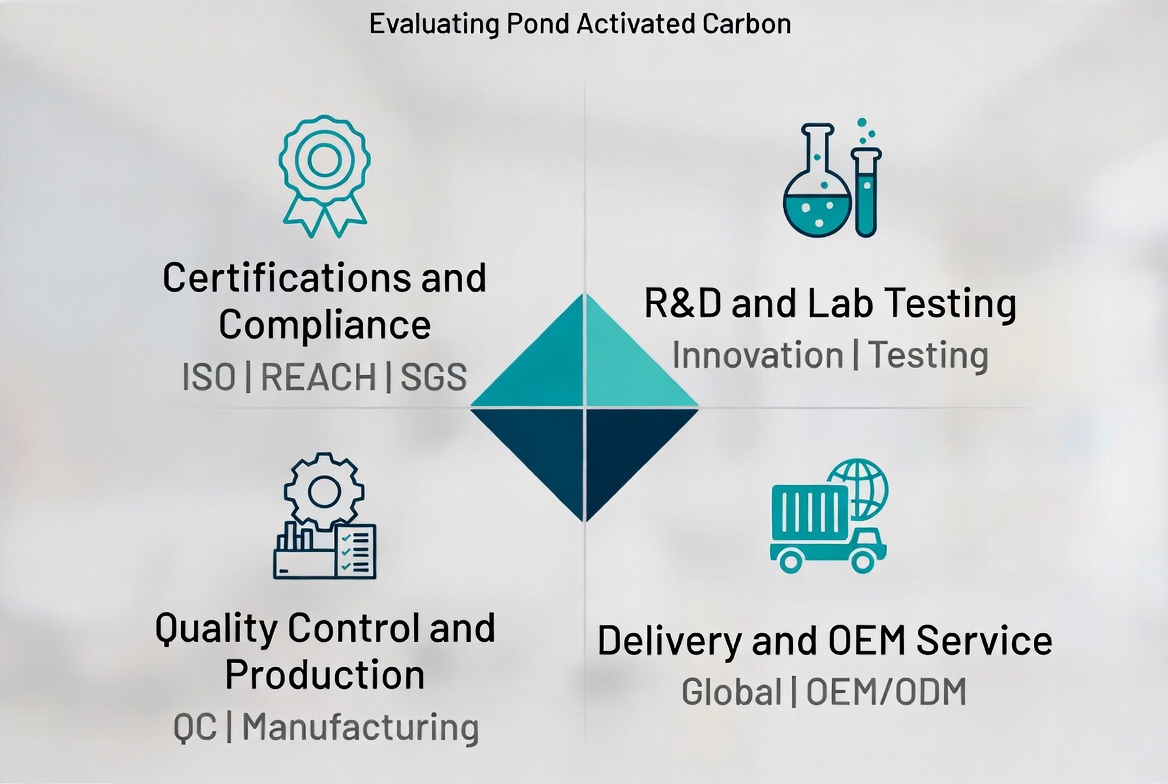
Before shortlisting any manufacturer, experienced buyers usually screen factories along four core dimensions: certifications, R&D and lab capability, quality control, and delivery/operations reliability. [activatedcarbonfactory]
1. Factory certifications and compliance
- Look for ISO 9001 and, where relevant, ISO 14001 and ISO 45001 for environmental and occupational health management. [huameicarbon]
- For water-contact and fish-safe applications, food-grade, HALAL, KOSHER or NSF-type certifications are positive indicators, especially when ponds are used for aquaculture or ornamental fish close to human living areas. [activatedcarbonfactory]
- Check whether the plant or products hold region-specific registrations or have a track record of meeting EU and US import control rules on activated carbon. [legacy.trade]
2. R&D, testing labs and application engineering
- Strong suppliers maintain independent laboratories with adsorption performance testing (iodine value, methylene blue, CTC), ash content, hardness and particle size distribution checks. [activatedcarbonfactory]
- Some leading Chinese manufacturers cooperate with universities or research institutes (for example, carbon research institutes and engineering schools) to develop new grades and production patents, which is useful if you need custom pond formulations (e.g., specific pH impact, faster dechlorination). [activatedcarbonfactory]
3. Quality control and production management
- Mature factories implement end-to-end testing: raw material checks, in-process control of activation temperature profiles, and final batch testing before shipment. [activatedcarbonfactory]
- Modern producers use digitized, visualized temperature and process control systems to stabilize pore structure and adsorption performance across batches, which is important to avoid inconsistent pond water clarity.
4. Delivery reliability and service capability
- Capacity (e.g., annual output in tens of thousands of tons) and warehouse scale indicate whether a supplier can support peak-season orders and buffer inventory. [activatedcarbonfactory]
- One-stop service covering logistics, documentation, customs support, and fast technical response is especially valuable for small and mid-sized pond brands without in-house engineers. [activatedcarbonfactory]
- Flexible MOQs and willingness to support third-party testing on every shipment are strong trust signals for long-term cooperation. [activatedcarbonfactory]
Selection Criteria for This Top 10 List
To build this 2026 list of "Top 10 Activated Carbon for Ponds Manufacturers in China", we used transparent criteria aligned with how professional procurement managers typically benchmark suppliers. [huameicarbon]
We prioritized suppliers that:
- Have at least around 15–20 years of experience in activated carbon production or related carbon materials. [activatedcarbonfactory]
- Provide coal-based and/or coconut shell activated carbon suitable for water treatment, including ponds and aquaculture. [zhulincarbon.en.made-in-china]
- Operate their own factories in China with visible R&D, lab, and QC capabilities, not just pure traders. [heycarbons]
- Export to multiple regions (such as Southeast Asia, Europe, and North America) and understand regulatory and documentation requirements. [naturecarbon]
- Are able to offer OEM/ODM, custom grades or packaging that pond brands and distributors typically require. [heycarbons]
The list is ordered for reader convenience, not as a strict ranking by size. Different buyers may prefer different suppliers depending on target market, budget, volume and certification needs. [huameicarbon]
Top 10 Activated Carbon for Ponds Manufacturers in China (2026)
1. Guangdong Tongke Activated Carbon Co., Ltd.
Guangdong Tongke Activated Carbon Co., Ltd. is a Dongguan-based manufacturer with more than 20 years of experience supplying customized activated carbon solutions for water treatment, air and gas purification, food and beverage, chemical and pharmaceutical applications. Its portfolio covers wood, coal and coconut shell activated carbon, honeycomb and pellet forms, activated carbon fiber and anthracite filter media, giving pond-related buyers a wide choice of grades for mechanical filters, trickling systems and polishing steps. [activatedcarbonfactory]
Tongke operates with an annual capacity of about 30,000 tons and exports from China to Southeast Asia, Europe and North America, which indicates both scale and familiarity with international compliance and logistics. The company emphasizes advanced production equipment and professional research laboratories, alongside strict end-to-end quality inspection and support for independent third-party testing on customer demand. [activatedcarbonfactory]
For pond applications, Tongke is particularly well suited to small and mid-sized brands seeking high‑value products with flexible MOQs, because it combines competitive pricing as a direct manufacturer with the ability to customize adsorption indexes, particle size and packaging. Its one-stop service covers procurement, logistics and technical support, and the team positions itself as a partner for long-term cooperation rather than just a spot supplier, which is attractive to distributors building private-label pond ranges. [activatedcarbonfactory]
- Approx. founding/experience: 20+ years in activated carbon
- Main markets: China domestic, Southeast Asia, Europe, North America
- Strengths: Custom water-treatment grades, strict QC, small MOQ with competitive pricing, strong global export experience [activatedcarbonfactory]
- OEM/ODM: Supports tailored specs and private-label solutions for different industrial and environmental applications, including pond and water treatment segments. [activatedcarbonfactory]
2. Heycarbons (Henan / Ningxia)
Heycarbons is a Chinese industrial activated carbon supplier originating from a Henan company that has been part of a Ningxia activated carbon group since around 2005. The company ranks among the top 20 in China's activated carbon industry and is recognized as an "environmentally advanced enterprise", with ISO certifications and a portfolio of 16 production-related patents.
Heycarbons manufactures pelletized, granular and powdered activated carbon made from coal, coconut shells and wood, with modern process control where activation temperatures and parameters are digitized and visualized. The company's independent laboratory cooperates with carbon research institutes and university PhDs, enabling tailored solutions and supported third‑party testing—useful for pond brands needing precise iodine values and hardness to avoid fines in filters.
- Experience: Operating since 2005
- Main markets: Global industrial users in environmental, food and chemical sectors
- Strengths: Strong R&D collaboration, modern process control, unified pricing policy with reasonable margins
- OEM/ODM: Provides customized grades and supports application-specific solutions, including environmental water treatment where pond and aquaculture requirements can be covered.
3. Zhengzhou Zhulin Activated Carbon Development Co., Ltd.
Zhengzhou Zhulin is a well-known manufacturer and supplier of activated carbon products, including coconut shell and coal-based activated carbon for water purification. Their catalog shows multiple granular products for water treatment with tailored mesh sizes (e.g., 6×12, 8×16, 8×30) and high iodine values, which are typical requirements for pond filtration applications where both adsorption and hydraulic performance matter. [zhulincarbon.en.made-in-china]
The firm focuses on factory-direct supply with an emphasis on low cost and fine particle water purification carbons while maintaining performance indicators like CTC and iodine values. This makes it an interesting option for buyers targeting cost-sensitive retail pond markets and bulk media sales, as long as they implement their own QC checks and sample validation. [zhulincarbon.en.made-in-china]
- Experience: More than a decade of manufacturing and export activity
- Main markets: Water treatment, industrial clients, global trading platforms
- Strengths: Wide product catalog, competitive pricing, multiple mesh options for water treatment [zhulincarbon.en.made-in-china]
- OEM/ODM: Able to support custom mesh and packaging; suitable for buyers with clear technical specifications. [zhulincarbon.en.made-in-china]
4. Hangzhou Nature Technology Co., Ltd. (Nature Carbon)
Nature Carbon is a Chinese company that positions itself as a global leader in high-grade activated carbon for environmental, food, pharmaceutical, automotive, chemical and military defense applications. Its expertise in wood-based and other specialty carbons is valuable for pond and aquaculture applications where low leachable impurities and stable performance are priorities. [naturecarbon]
The company emphasizes research, development and manufacturing, with a focus on high-quality adsorption materials rather than low-end commodity grades, which suits premium pond brands operating in Europe and North America. Buyers typically work with Nature Carbon when they need higher-performance grades and more stringent documentation packages. [naturecarbon]
- Experience: Long-standing presence in global activated carbon markets
- Main markets: Environmental, food, pharma, automotive, chemical sectors worldwide [naturecarbon]
- Strengths: High-grade materials, broad application experience, strong international orientation [naturecarbon]
- OEM/ODM: Supports customized product development and private-label arrangements for specialized water and air purification solutions. [naturecarbon]
5. Huamei Activated Carbon
Huamei is known internationally through market rankings of activated carbon companies and positions itself as a significant supplier with global outreach. Public information highlights its role among the top activated carbon players serving various industries, including water treatment and environmental protection. [huameicarbon]
While not pond-specific, its portfolio and export experience make it relevant for large-volume buyers of granular carbons used in municipal and industrial water treatment, who can then adapt these grades to pond and aquaculture requirements. However, smaller brands should pay extra attention to MOQs and communication efficiency due to its scale. [huameicarbon]
- Experience: Active in global market at scale
- Main markets: Environmental, water treatment and industrial applications worldwide [huameicarbon]
- Strengths: Scale, global presence, wide product portfolio [huameicarbon]
- OEM/ODM: Best suited to larger OEM programs or distributors consolidating multiple applications in one supplier. [huameicarbon]
6. Leading Sichuan Activated Charcoal Manufacturers (Cluster Example)
According to Chinese industrial rankings, Sichuan hosts several notable activated charcoal manufacturers for 2026, such as Sichuan Chuanlang Activated Carbon Co., Ltd. and Chengdu Zhongbang-related firms. These companies contribute to the regional cluster focused on chemical and energy-related activated carbon products. [b2bdata.baidu]
For pond-related activated carbon sourcing, Sichuan-based manufacturers can be interesting if your supply chain or customers are concentrated in western China or nearby countries, as freight routes may be more favorable. However, most of these factories are more focused on industrial and catalyst-related carbons rather than consumer pond products, so technical alignment and sample validation are critical. [b2bdata.baidu]
- Experience: Established in regional chemical and carbon industries
- Main markets: Domestic and regional industrial users [b2bdata.baidu]
- Strengths: Cluster synergies, regional logistics advantages, competitive pricing [b2bdata.baidu]
- OEM/ODM: Possible, but usually oriented to industrial specifications rather than small consumer SKUs. [b2bdata.baidu]
7. Other Specialized Chinese Industrial Activated Carbon Suppliers
Several other Chinese suppliers—often headquartered in Henan, Ningxia, Fujian or Guangdong—focus on industrial water and air treatment carbons and can also support pond applications through custom grades. Many of them offer coal-based and coconut-shell granular carbons with robust export experience and support OEM packaging, especially for B2B distributors. [heycarbons]
When evaluating these manufacturers, buyers should prioritize those with independent labs, visible international certifications and transparent willingness to share batch-wise test reports for every shipment. These capabilities are more decisive for pond applications than generic claims about "high quality". [heycarbons]
- Experience: 10–20+ years typical
- Main markets: Environmental, industrial and municipal water treatment
- Strengths: Technical familiarity with water treatment, scalable capacity [huameicarbon]
- OEM/ODM: Often flexible, especially for distributors consolidating volumes. [heycarbons]
At a Glance: Comparison of Key Chinese Suppliers for Pond Carbon
> Note: Data below is based on publicly available information and typical industry patterns; always verify exact figures and certifications directly with the supplier. [huameicarbon]
| Manufacturer | Typical annual capacity / scale | Main product types relevant for ponds | Indicative MOQ tendency | Key certifications / credentials | OEM/ODM suitability |
| Guangdong Tongke Activated Carbon Co., Ltd. | Around 30,000 tons per year of activated carbon and related media (activatedcarbonfactory) | Coal, wood, coconut-shell granular and pellet carbons; activated carbon for water treatment; anthracite filter media (activatedcarbonfactory) | Small MOQ, suitable for SMEs and new brands (activatedcarbonfactory) | NSF, KOSHER, HALAL; strict in-house QC; supports third-party testing (activatedcarbonfactory) | Highly flexible, strong in custom grades and packaging for water and environmental applications (activatedcarbonfactory) |
| Heycarbons | Top-20 industry player with multi-plant setup since 2005 | Coal, coconut shell and wood-based pellet, granular and powder carbons | Medium MOQ; focus on stable long-term programs | ISO-certified, environmentally advanced enterprise, 16 patents, independent lab | Strong in application-tailored solutions and technical OEM support |
| Zhengzhou Zhulin Activated Carbon Development | Significant industrial-scale capacity indicated by broad export catalog (zhulincarbon.en.made-in-china) | Granular coconut-shell and coal-based carbons with various meshes for water treatment (zhulincarbon.en.made-in-china) | Flexible for standard catalog items; may require higher MOQ for special specs (zhulincarbon.en.made-in-china) | Factory-direct producer with performance-focused specs (iodine, CTC) (zhulincarbon.en.made-in-china) | Suitable for private-label and mesh/packaging customization (zhulincarbon.en.made-in-china) |
| Hangzhou Nature Technology (Nature Carbon) | Global high-grade supplier with strong export footprint (naturecarbon) | High-grade activated carbon for environmental, food, pharma and water applications (naturecarbon) | Medium–high MOQ, more suited to established brands (naturecarbon) | Strong R&D, high-end positioning, global customer base (naturecarbon) | Good for premium OEM products where documentation and performance are critical (naturecarbon) |
| Huamei Activated Carbon | Recognized among top global activated carbon companies (huameicarbon) | Various activated carbons for water and environmental treatment (huameicarbon) | Higher MOQ typical of large-scale producers (huameicarbon) | Established global supplier status; widely referenced in market overviews (huameicarbon) | Best for large-volume OEM or multi-country distribution (huameicarbon) |
| Sichuan cluster manufacturers (e.g., Chuanlang etc.) | Regional chemical/energy-focused capacity (b2bdata.baidu) | Industrial activated charcoal for water and catalyst uses (b2bdata.baidu) | Industrial MOQs, generally higher than consumer-focused plants (b2bdata.baidu) | Regional industry recognition, local cluster synergies (b2bdata.baidu) | Possible for large industrial pond/aquaculture projects with clear specs (b2bdata.baidu) |
| Other industrial Chinese suppliers | 10,000+ tons/year typical in major factories (huameicarbon) | Granular and powdered carbons for water and air treatment (huameicarbon) | Varies; many are flexible when export volumes are stable (huameicarbon) | Mix of ISO and industry qualifications; must be checked case by case (huameicarbon) | Often very flexible on OEM/ODM, especially for regional brands (heycarbons) |
Technical Considerations for Activated Carbon for Ponds
For ponds and aquaculture, not all activated carbon grades are equally suitable. Professional buyers usually specify a combination of performance and physical properties, plus compliance parameters. [insightaceanalytic]
Key technical points include:
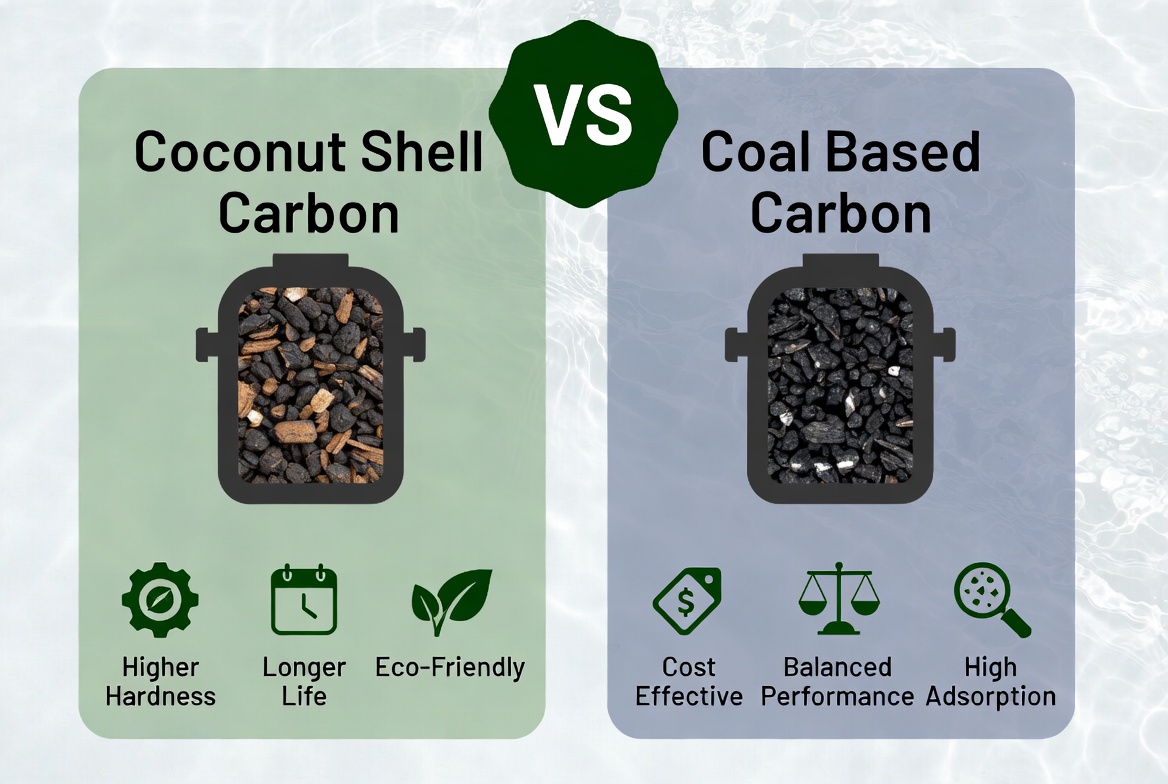
- Raw material base: Coconut-shell carbon typically offers higher hardness and more micropores, making it popular for ponds requiring long-lasting media and fine organic removal. Coal-based carbons can offer a good balance of cost and adsorption capacity, making them common in mainstream pond filters. [qizhongcarbon]
- Iodine value / adsorption capacity: Higher iodine values generally indicate greater micropore volume and better removal of dissolved organics, but the optimal level must match your application and budget. [grandviewresearch]
- Hardness and abrasion resistance: To avoid dust and fines clogging pond filters or harming fish gills, hardness and low attrition are crucial; this is where good process and QC make a difference. [activatedcarbonfactory]
- Particle size / mesh: Typical mesh sizes like 6×12, 8×16 or 8×30 are selected based on filter design, contact time and desired flow rates. [zhulincarbon.en.made-in-china]
- Regulatory and safety aspects: For ponds connected to aquaculture or landscaped environments, buyers may consult food-contact or environmental standards and require certificates such as NSF, HALAL, KOSHER or similar assurance that the carbon does not leach harmful substances. [thebusinessresearchcompany]
Industry Pain Points and "Internal" Pitfalls to Avoid
In real procurement practice, there are several recurring problems when importing pond-grade activated carbon from China. These rarely appear in public marketing copy but are widely known among experienced buyers. [huameicarbon]
1. Spec downgrading between sample and mass order
A common internal complaint is that the first sample batch has excellent iodine value and hardness, but later shipments quietly switch to lower-grade raw materials or blended lots. The internal workaround many large buyers use is to lock down a detailed technical specification and attach it as a contract annex, combined with random third-party lab tests on arrival. [huameicarbon]
2. Mesh drift and excessive fines
Some factories control iodine value but are less strict on actual screen analysis, leading to too many fines that clog pond filters. The insider strategy is to specify maximum percentage passing lower meshes (e.g., <1% under a certain size) and to reject or discount shipments that fail sieve analysis. [zhulincarbon.en.made-in-china]
3. Expired or "borrowed" certifications
One less-publicized pitfall is the use of expired ISO or food-grade certificates, or certificates borrowed from another factory within the same group. Experienced buyers always request certificate numbers and issuing bodies, then verify them directly with the certifying agency or via online databases. [legacy.trade]
4. Inconsistent packaging and labeling
For consumer pond brands, inconsistent bag design, language errors or missing batch numbers can create regulatory and brand-image risks. Large importers typically issue detailed packaging artwork and labeling SOPs, and they keep a "golden sample" on file in the factory to avoid uncontrolled changes. [huameicarbon]
5. Overpromised delivery during peak season
During peak export months, some suppliers overcommit production slots for pond and water-treatment carbons. Internal best practice is to reserve capacity via framework orders and to diversify across at least two qualified factories to avoid stock‑outs for your retail season. [huameicarbon]
Buyer's Guide: How to Verify and Work with Chinese Pond Carbon Manufacturers
1. Checklist for initial supplier verification
- Request full company profile, business license copy, product catalog and main export markets. [huameicarbon]
- Ask for high-resolution copies of ISO, NSF, HALAL, KOSHER or other certificates, with clear validity dates and scope descriptions. [legacy.trade]
- Confirm factory location, whether they are a manufacturer or trader, and ask for photos or videos of key production equipment and lab facilities. [activatedcarbonfactory]
2. Sample and testing process
- Start with 2–3 grades per supplier that match your target iodine value, mesh and application (e.g., koi ponds vs. commercial aquaculture). [zhulincarbon.en.made-in-china]
- Run your own comparative tests in target water conditions (organics load, pH, hardness) and consider sending sub-samples to third-party labs for adsorption and impurity testing. [insightaceanalytic]
- Keep detailed records of batch numbers and lab results to compare against future shipments and detect drift early. [activatedcarbonfactory]
3. Contracting and quality safeguards
- Attach a detailed technical datasheet (TDS) to your purchase contract, including iodine value range, moisture, ash, hardness and mesh distribution. [zhulincarbon.en.made-in-china]
- Include clauses on acceptable tolerance bands, third‑party inspection rights at origin or destination, and remedies in case of deviation (price reduction, replacement, etc.). [huameicarbon]
- For long-term programs, set up quarterly or semiannual audits, on-site or remote, to review QC records and calibration certificates. [activatedcarbonfactory]
4. Logistics and documentation tips
- Decide early whether to ship in bulk bags (FIBCs) or smaller consumer-ready bags; this affects packing, labeling and palletization. [huameicarbon]
- Ensure MSDS, COA, and, where needed, HS-code-specific documentation comply with your target country's regulations, especially in markets with active enforcement on activated carbon imports. [legacy.trade]
- For cost efficiency, consolidate pond carbon with other water-treatment products from the same region where possible, but avoid mixing incompatible or hazardous goods in the same container. [huameicarbon]
Conclusion and Call to Action
China will continue to play a central role in the global activated carbon market, with strong growth driven by water treatment, environmental protection and industrial applications up to 2030. For pond and aquaculture buyers, this means abundant supplier choices—but making the right choice requires rigorous evaluation of certifications, QC systems, R&D capability and delivery reliability, not just price. [grandviewresearch]
Guangdong Tongke Activated Carbon Co., Ltd., together with other established Chinese manufacturers highlighted here, offers a strong starting shortlist for procurement managers seeking long-term, high‑value partners for pond-grade activated carbon. If you are planning your next sourcing cycle, define your technical specs, shortlist 3–4 candidate factories, and move quickly to structured sampling and third‑party testing so you can lock in reliable supply before peak season. [naturecarbon]
Frequently Asked High-Level Procurement Questions
Q1: How can I verify whether a manufacturer's ISO certification is valid and not expired?
Ask the supplier for the certificate number, issuing body and validity period, then cross-check on the certification body's official website or via accredited databases. You can also call or email the certifier with the company's legal name and address to make sure the certificate is issued to that exact factory, not another entity in the group. [legacy.trade]
Q2: What iodine value should I look for in activated carbon used for ponds?
Most pond applications use carbons with medium to high iodine values to balance performance and cost, but the optimum value depends on water load, filter design and replacement cycles. It is better to test two ranges (e.g., mid and high iodine) in real pond conditions and evaluate both water clarity and replacement frequency before locking the spec. [qizhongcarbon]
Q3: How do I prevent suppliers from downgrading quality after the first order?
Use a detailed TDS attached to the contract, conduct random third‑party testing on incoming batches and maintain a clear non-conformance and corrective-action process. Building volume and a long-term relationship with a few reliable suppliers, such as established manufacturers with strong QC systems, also reduces the incentive to downgrade. [huameicarbon]
Q4: Is coconut-shell carbon always better than coal-based carbon for ponds?
Coconut-shell carbon usually has higher hardness and more micropores, which is beneficial for many pond filters, but it is often more expensive. Coal-based carbons from reputable suppliers can perform very well for many pond and aquaculture applications at a more competitive cost, especially when tailored to your use case. [qizhongcarbon]
Q5: What minimum order quantity should I expect when doing OEM pond carbon from China?
MOQs vary widely: factories specializing in OEM for small and mid-sized brands may support smaller MOQs (several pallets or a few tons), while large industrial suppliers may require higher volumes. Discuss your 12‑month volume plan and packaging needs upfront; many suppliers will adjust MOQs if they see a credible growth trajectory. [heycarbons]
Resources
- Global activated carbon market report 2025–2026 – The Business Research Company [thebusinessresearchcompany]
- Activated carbon market outlook to 2033 – Grand View Research [grandviewresearch]
- China activated carbon import control and scope rulings – U.S. International Trade Administration (legacy.trade.gov) [legacy.trade]
- Practical guide to importing activated carbon from China – Huamei Carbon [huameicarbon]
- Activated carbon industry reports focusing on global and China segments – ResearchInChina and other industry analysts [m.gelonghui]


