Content Menu
● Understanding Steam vs Chemical Activated Carbon
● How Activation Method Shapes Carbon Structure
● Service Life: What "Lasts Longer" Really Means
● Steam Activated Carbon: Strengths and Limitations
● Chemical Activated Carbon: Strengths and Limitations
● Which Lasts Longer in Real Applications?
>> Practical Rule-of-Thumb
● Typical Applications and Longevity Expectations
>> Water Treatment and Wastewater
>> Air and Gas Purification
>> Food, Beverage, and Pharmaceutical Processes
● Expert Insight: Coal-Based Steam Activated Carbon for Industrial Longevity
● Lifecycle Cost Perspective for Industrial Buyers
● Practical Selection Steps for Engineers
● Emerging Trends in Activated Carbon Longevity
● Steam vs Chemical Activation: Summary Table
● Where Guangdong Tongke's Coal-Based Steam Activated Carbon Fits Best
● Actionable Takeaways for Buyers and Engineers
● Call to Action: Optimize Your Carbon's Service Life with Guangdong Tongke
● Frequently Asked Questions (FAQ)
● References
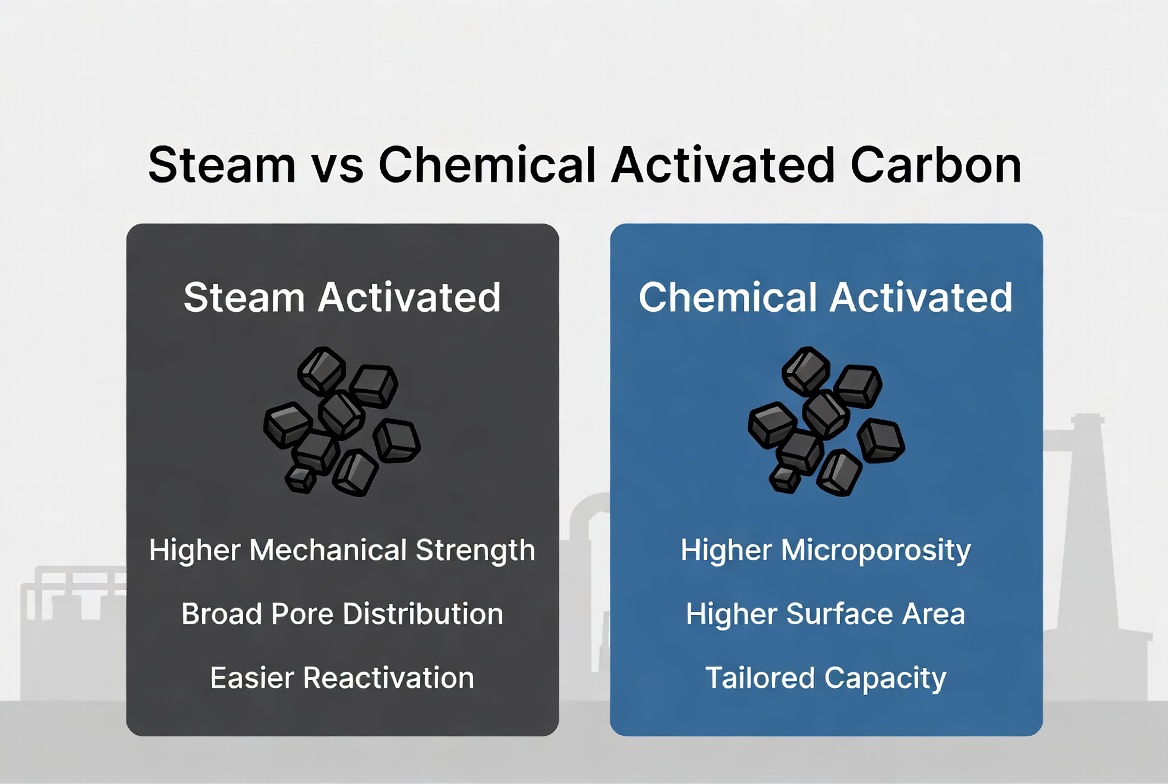
Steam activated carbon generally offers better mechanical strength and reactivation potential, while chemical activated carbon often achieves higher surface area and tailored pore structures—but which lasts longer depends on the specific process conditions and application environment. [xingsencarbon]
Understanding Steam vs Chemical Activated Carbon
Steam activation (also called physical activation) uses high-temperature steam or oxidizing gases to develop porosity in carbonized materials such as coal, wood, or coconut shell. Chemical activation impregnates raw material with chemical agents (e.g., acids, bases, or salts) and then heats it at comparatively lower temperatures to generate a high-porosity carbon structure. Both routes can produce high-performance activated carbon, but they create different pore-size distributions and mechanical properties that strongly influence service life. [epa]
How Activation Method Shapes Carbon Structure
The activation route determines the internal pore network, which directly governs adsorption capacity, kinetics, and regeneration behavior. Steam activation tends to produce a broad spectrum of pores—often with a higher proportion of mesopores and macropores—while chemical activation can yield more micropores and very high specific surface areas. For coal-based feedstocks, optimized steam activation often balances structural strength with sufficient microporosity, making it suitable for repeated thermal reactivation and long-term industrial use. [oransi]
Service Life: What "Lasts Longer" Really Means
When evaluating "which lasts longer," it is essential to distinguish between several dimensions of lifetime:
- Adsorption service life (time until breakthrough or required replacement).
- Mechanical life (resistance to attrition, crushing, and handling).
- Regeneration cycles (how many times the carbon can be reactivated and reused).
In water treatment, granular activated carbon typically exhibits a service life from 6 to 12 months under typical municipal or industrial conditions, but this can extend beyond 3 years in well-designed systems with controlled contaminant loads. From an equipment standpoint, carbon adsorption systems themselves often operate for 15–25 years, which underlines how critical proper carbon selection and regeneration strategy are to lifecycle cost. [carbontech.net]
Steam Activated Carbon: Strengths and Limitations
Steam-activated carbon produced from coal or other dense feedstocks is known for its structural robustness and stability in aggressive industrial environments. This robustness means lower attrition, reduced dust generation, and more efficient utilization of the carbon bed over extended operating periods. [calgoncarbon]
Key characteristics of steam-activated carbon:
- High mechanical strength and abrasion resistance. [xingsencarbon]
- Broad pore-size distribution supporting both large and moderate molecular species. [oransi]
- Typically more environmentally friendly due to the absence of chemical activating agents in the main process. [xingsencarbon]
However, steam activation may yield slightly lower micropore volume than some chemically activated equivalents, which can reduce capacity for very small molecules in specific applications, although this is highly process-dependent. [heycarbons]
Chemical Activated Carbon: Strengths and Limitations
Chemically activated carbons often reach very high surface areas and dense microporosity because the chemical agents open the structure more effectively at lower temperatures. This can significantly improve capacity for specific contaminants, particularly in high-value applications in food, pharmaceutical, or fine chemical refining. [sciencedirect]
Typical characteristics of chemically activated carbon:
- Higher specific surface area and enhanced micropore content. [sciencedirect]
- Tailored pore structure for narrow molecular-size windows. [oransi]
- Potentially lower activation energy and production temperatures, which can improve process efficiency. [oransi]
On the downside, chemical residues must be thoroughly removed, and mechanical strength may be less than that of coal-based steam-activated products if not carefully engineered, which in turn can impact long-term bed stability and service life. [heycarbons]
Which Lasts Longer in Real Applications?
The real-world longevity of steam vs chemical activated carbon depends on:
- Feedstock (coal, wood, coconut shell) and manufacturing quality. [sciencedirect]
- Operating conditions (temperature, pH, oxidants, and fouling tendencies). [carbontech.net]
- Regeneration or replacement strategy and system design. [epa]
In many industrial water and air treatment systems, coal-based steam-activated carbon is favored for long service life due to its higher mechanical integrity and reactivation resilience, allowing multiple regeneration cycles before replacement. For highly specialized separations where adsorption capacity per cycle is paramount—such as certain food decolorization or pharmaceutical purification stages—chemically activated carbons can deliver superior per-cycle performance but may require more careful handling and potentially more frequent replacement depending on process stress. [calgoncarbon]
Practical Rule-of-Thumb
- For long-term, regenerable industrial systems (e.g., large GAC filters, VOC control, industrial wastewater): steam-activated coal-based carbon usually delivers a longer overall lifecycle. [epa]
- For high-purity, batch-style processes where the focus is on maximum capacity per batch rather than number of regenerations, high-surface-area chemically activated carbons can be the better fit even if individual particles have shorter mechanical lifetimes. [xingsencarbon]
Typical Applications and Longevity Expectations
Water Treatment and Wastewater
In drinking water and industrial wastewater treatment, granular activated carbon beds are widely used to remove organic contaminants, taste and odor compounds, and trace pollutants. As noted, typical service life for GAC in water systems ranges from 6–12 months but can reach multiple years with proper pretreatment and operation. Coal-based steam-activated carbon is often preferred here because it withstands hydraulic stress, backwashing, and thermal regeneration better than many chemically activated counterparts. [ijcrt]
Air and Gas Purification
Activated carbon remains the dominant adsorbent for controlling volatile organic compounds (VOCs) and odorous gases in industrial and environmental air treatment systems. Steam-activated carbons, including coal-based grades, are commonly applied due to their combination of strength and broad-spectrum adsorption, and they can be reactivated multiple times without catastrophic loss of structure. For applications targeting specific pollutants like hydrogen sulfide or ammonia, carbons can also be chemically impregnated after activation to enhance selectivity, rather than relying solely on chemical activation during production. [generalcarbon]
Food, Beverage, and Pharmaceutical Processes
In food decolorization, sugar refining, and pharmaceutical purification, the focus often shifts to maximizing surface area and matching pore sizes to specific molecules. Chemically activated carbons—especially from wood or other biomass—are frequently used because they offer very high adsorption capacities and tailored pore structures. In these settings, the carbon may be used in batch or semi-batch mode, and replacement frequency is driven more by quality and purity targets than by mechanical life. [ijcrt]
Expert Insight: Coal-Based Steam Activated Carbon for Industrial Longevity
As a coal-based activated carbon manufacturer focused on global industrial applications, Guangdong Tongke Activated Carbon Co., Ltd. can leverage several strengths inherent to steam activation for lifecycle optimization:
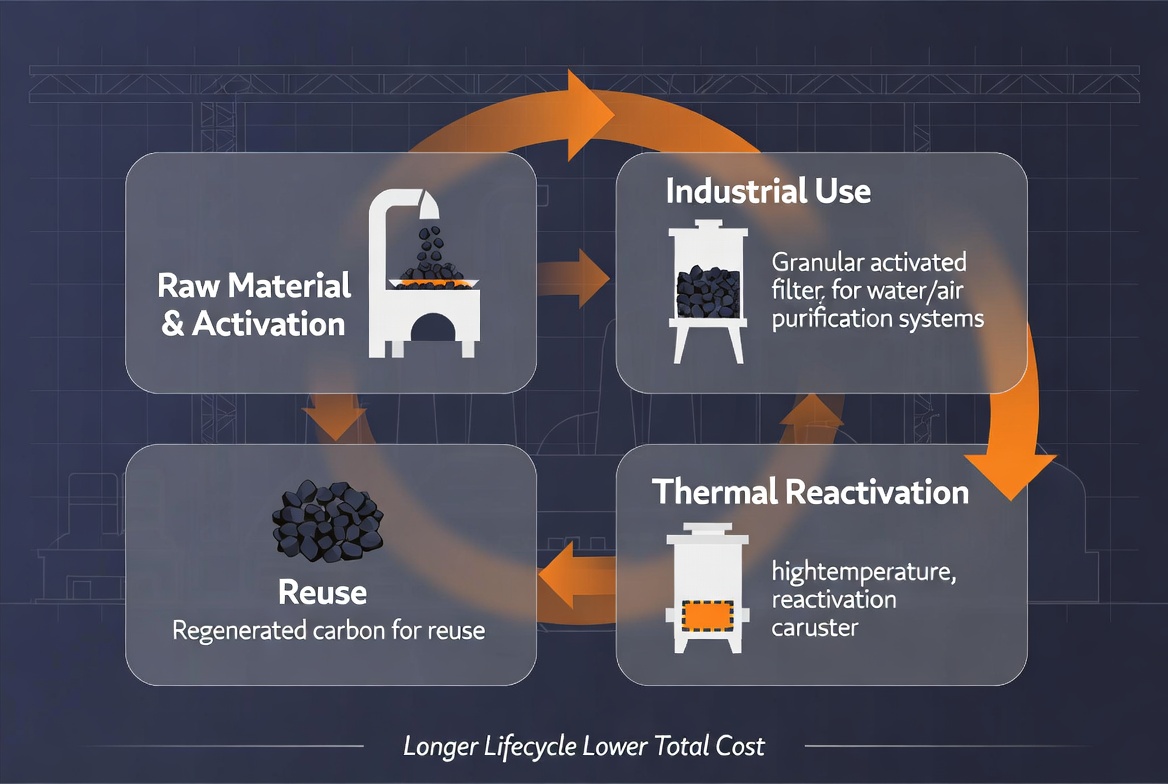
- Reactivation-friendly products: Steam-activated coal-based carbons can be thermally reactivated multiple times, extending practical service life beyond the initial use period. [calgoncarbon]
- Optimized particle size and hardness: Carefully controlled activation parameters combined with post-processing (crushing, grading, and dedusting) help achieve high hardness and low attrition loss, especially important in large packed beds. [calgoncarbon]
- Consistency across batches: Industrial clients in water, air, chemical, and pharmaceutical sectors often prioritize consistency and predictable performance over theoretical maximum surface area, which favors robust steam-activated grades. [ijcrt]
By combining physical activation with application-specific quality control—including iodine number, methylene blue value, hardness, ash content, and pore-size distribution—coal-based steam activated carbon can deliver both long operational life and stable performance across regeneration cycles.
Lifecycle Cost Perspective for Industrial Buyers
From an industrial buyer's perspective, "which lasts longer" should ultimately be framed as a lifecycle cost question rather than a purely technical comparison of activation methods. Even if chemically activated carbon delivers higher initial capacity, frequent replacement, higher fines generation, or complex disposal requirements can offset this advantage over time. [carbontech.net]
A simplified lifecycle cost comparison approach:
1. Calculate expected service life per cycle under realistic load conditions for both steam and chemically activated options, considering breakthrough curves and safety factors. [carbontech.net]
2. Estimate regeneration potential (number of cycles and performance retention per cycle) for each carbon type. [epa]
3. Include mechanical losses (attrition, fines, handling losses) and their impact on bed volume and pressure drop. [xingsencarbon]
4. Account for environmental and compliance costs, including any additional treatment required for spent chemically activated carbons that may contain residual activating agents or higher ash content. [oransi]
In many large-scale systems, these calculations often favor robust steam-activated coal-based carbons, particularly where reactivation infrastructure or service providers are readily available. [epa]
Practical Selection Steps for Engineers
Engineers responsible for specifying activated carbon in new or retrofit systems can follow a structured process:
1. Define critical performance metrics such as target contaminants, effluent limits, required bed life, and regeneration strategy. [ijcrt]
2. Match pore structure to pollutant profile, choosing more microporous, high-surface-area carbons (often chemically activated) for small molecules and more mesoporous steam-activated carbons for larger organics or mixed pollutants. [sciencedirect]
3. Evaluate mechanical properties and hardness, especially for large contactors or systems with frequent backwash cycles, which typically favors steam-activated coal-based GAC. [calgoncarbon]
4. Run pilot tests or column trials to validate real-world service life under actual feed conditions rather than relying solely on lab-scale indicators like iodine number. [carbontech.net]
5. Optimize bed design and pretreatment, including upstream filtration and pH adjustment, which can dramatically extend carbon life regardless of activation method. [carbontech.net]
This structured approach allows decision makers to quantify "which lasts longer" in a way that reflects their actual process and risk profile rather than theoretical comparisons.
Emerging Trends in Activated Carbon Longevity
Recent industry developments focus on enhancing carbon longevity and sustainability rather than choosing strictly between steam and chemical activation. [ijcrt]
Key trends include:
- Hybrid activation techniques combining elements of both steam and chemical activation to fine-tune pore structure and strength. [sciencedirect]
- Advanced regeneration processes, including low-temperature and microwave-assisted reactivation, aimed at reducing energy consumption while maintaining carbon performance over multiple cycles. [ijcrt]
- Application-specific impregnations, where steam-activated carbons are post-treated with functional chemicals for targeted contaminants, improving selectivity and capacity without sacrificing mechanical life. [generalcarbon]
These trends offer additional levers for manufacturers such as Guangdong Tongke Activated Carbon Co., Ltd. to deliver products that maximize both technical performance and lifecycle value.
Steam vs Chemical Activation: Summary Table
| Aspect | Steam Activated Carbon | Chemical Activated Carbon |
| Typical feedstocks | Coal, coconut shell, wood (oransi) | Wood and biomass, some coals (oransi) |
| Activation conditions | High-temperature steam/oxidizing gases (oransi) | Lower-temperature with chemicals (acids, bases, salts) (oransi) |
| Pore structure | Broad pore distribution, often more mesopores (xingsencarbon) | Higher micropore content, very high surface area (oransi) |
| Mechanical strength | Generally higher for coal-based products (xingsencarbon) | Can be lower if not carefully formulated (xingsencarbon) |
| Regeneration suitability | Well-suited to repeated thermal reactivation (epa) | Regeneration possible but may be more limited (xingsencarbon) |
| Typical longevity focus | Long mechanical and operational life in continuous systems (xingsencarbon) | High capacity per cycle in batch/specialty processes (xingsencarbon) |
Where Guangdong Tongke's Coal-Based Steam Activated Carbon Fits Best
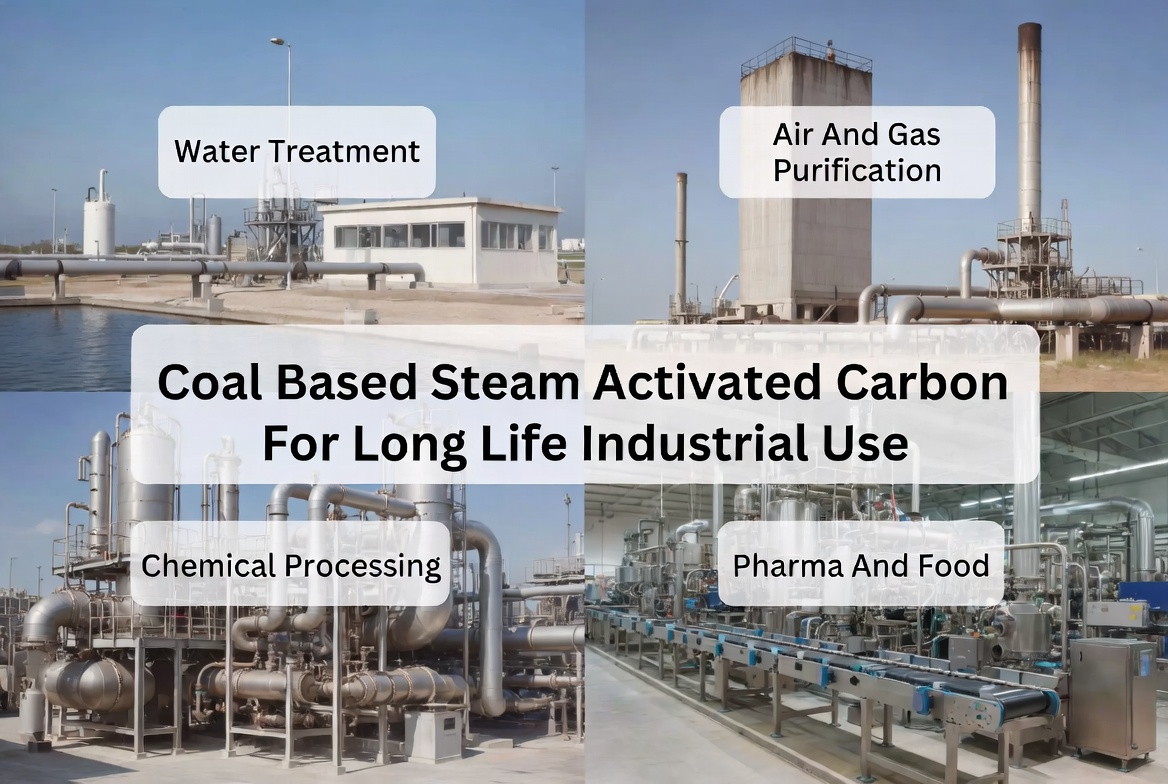
Coal-based steam activated carbon from Guangdong Tongke Activated Carbon Co., Ltd. can be positioned as a long-life solution for demanding industrial environments, particularly in:
- Municipal and industrial water treatment, where predictable multi-month or multi-year service life and reactivation are essential. [calgoncarbon]
- Air and gas purification, including VOC control, solvent recovery, and odor removal, where strong, low-attrition carbons minimize fines and pressure drop over time. [generalcarbon]
- Chemical and petrochemical processes, where thermal and mechanical stresses demand robust coal-based materials that can be reactivated multiple times. [ijcrt]
By emphasizing lifecycle performance, consistent quality, and application-specific engineering support, Guangdong Tongke can credibly argue that its steam-activated coal-based carbons often outlast chemically activated alternatives in real-world industrial settings.
Actionable Takeaways for Buyers and Engineers
- If your priority is maximum service life and regenerability in continuous water, air, or gas treatment systems, coal-based steam-activated carbon is likely to be the stronger candidate. [xingsencarbon]
- If your priority is maximum adsorption capacity for specific molecules in batch or high-purity processes, carefully selected chemically activated carbons may offer better per-cycle performance, although total lifecycle may be shorter. [sciencedirect]
- For many industrial applications, the practical answer to "which lasts longer" is not a universal rule but an engineering decision grounded in contaminant profile, regeneration strategy, and cost structure. [epa]
Call to Action: Optimize Your Carbon's Service Life with Guangdong Tongke
If you operate water treatment, air purification, chemical processing, or pharmaceutical systems and need to extend the service life of your activated carbon beds, Guangdong Tongke Activated Carbon Co., Ltd. can provide application-engineered coal-based steam activated carbon solutions tailored to your operating conditions. By combining high-strength coal-based products with expert guidance on bed design, pretreatment, and regeneration strategies, our team can help you significantly increase carbon longevity and reduce lifecycle cost.
Contact our engineering team to share your current operating data (contaminant load, contact time, regeneration method), and we will help you select or customize a steam-activated coal-based carbon grade that balances adsorption performance with long-term durability.
Frequently Asked Questions (FAQ)
1. Does steam-activated carbon always last longer than chemically activated carbon?
Not always; steam-activated coal-based carbons often deliver longer mechanical and regenerative lifetimes in continuous industrial systems, but chemically activated carbons can outperform in tightly defined, high-purity batch processes. [xingsencarbon]
2. How often should I replace granular activated carbon in a water treatment system?
Many systems replace GAC every 6–12 months, but well-designed and well-protected beds can operate for several years before full replacement, especially when regeneration is used. [carbontech.net]
3. Can chemically activated carbon be regenerated?
Yes, chemically activated carbons can be regenerated, but the number of effective cycles and retention of structural integrity depend strongly on feedstock, activation conditions, and regeneration method. [epa]
4. What factors most reduce activated carbon life in industrial systems?
High particulate loading, fouling, oxidizing conditions, improper pH, and inadequate pretreatment all accelerate carbon exhaustion and shorten service life, regardless of activation method. [calgoncarbon]
5. Is steam-activated carbon more environmentally friendly than chemically activated carbon?
Steam-activated carbon avoids chemical activating agents in the primary process and is widely used in environmental applications, while chemically activated carbons may require additional steps to manage residues and effluents. [oransi]
References
1. Xingsen Carbon. "Steam vs Chemical Activated Carbon: Which Is Best for Water Treatment, Air Purification, and More?" Available at: https://www.xingsencarbon.com/steam-vs-chemical-activated-carbon-which-is-best-for-water-treatment-air-purification-and-more/ [xingsencarbon]
2. Carbontech. "What is the Lifespan of Activated Carbon?" Available at: https://carbontech.net.tr/en/haberler/what-is-the-lifespan-of-activated-carbon/ [carbontech.net]
3. IJCRT. "Activated Carbon For Cleaner Air, Water, And A Healthier Environment." Available at: https://www.ijcrt.org/papers/IJCRTBF02042.pdf [ijcrt]
4. US EPA. "Chapter 1 – Carbon Adsorbers (EPA Air Pollution Control Cost Manual)." Available at: https://www.epa.gov/sites/default/files/2018-10/documents/final_carbonadsorberschapter_7thedition.pdf [epa]
5. Oransi. "Your Complete Guide To Activated Carbon." Available at: https://oransi.com/blogs/how-it-works/complete-guide-to-activated-carbon [oransi]
6. ScienceDirect. "Comparison of activated carbon produced from natural precursors and activation methods." Available at: https://www.sciencedirect.com/science/article/abs/pii/S0165237013002532 [sciencedirect]
7. Heycarbons. "Physical Steam vs. Chemical Phosphoric Acid Wood Powder Activated Carbon." Available at: https://heycarbons.com/physical-steam-vs-chemical-phosphoric-acid-wood-powder-activated-carbon/ [heycarbons]
8. General Carbon. "Understanding Activated Carbon for Air Purification." Available at: https://generalcarbon.com/understanding-activated-carbon-for-air-purification/ [generalcarbon]
9. Calgon Carbon. "Activated Carbon Basics." Available at: https://www.calgoncarbon.com/app/uploads/Basics-of-Activated-Carbon-Calgon-Carbon-Chemical-Engineering-Magazine.pdf [calgoncarbon]


