Content Menu
● What Is a CTO Filter and Why Does Carbon Quality Matter?
● What Is CTO Activated Carbon?
● Coal‑Based vs Coconut‑Shell Activated Carbon for CTO
● CTO vs UDF Filters: Structure, Performance and Best Use
>> Structural and Functional Differences
>> How We Recommend Combining CTO and UDF
● Key Technical Parameters When Selecting Activated Carbon for CTO
>> 1. Iodine Value (900–1100 mg/g)
>> 2. CTC (Carbon Tetrachloride) Adsorption ≥ 50%
>> 3. Particle Size Distribution
>> 4. Hardness and Attrition Resistance
>> 5. Ash and Moisture Content
● How CTO Activated Carbon Performs in Real Industrial Applications
>> Municipal Water and Building Systems
>> Food and Beverage Production
>> Chemical and Pharmaceutical Applications
● Practical Steps to Specify the Right Activated Carbon for Your CTO Filters
>> Step 1: Define Your Water Quality and Targets
>> Step 2: Select Core Carbon Parameters
>> Step 3: Align Block Design with Performance
>> Step 4: Field Testing and Feedback
● How a Chinese Coal‑Based Activated Carbon Manufacturer Supports Global CTO Projects
● Common Mistakes OEMs Make When Choosing CTO Activated Carbon
● When to Use CTO Filters vs Other Technologies
● Call to Action: Discuss Your CTO Carbon Requirements with Our Technical Team
● FAQs About Activated Carbon for CTO Filters
● References
As a coal-based activated carbon manufacturer exporting globally, I have seen how the right carbon grade can make or break the performance of CTO (Chlorine, Taste, Odor) carbon block filters in real‑world water treatment systems. This guide combines hands‑on production experience with current industry best practices to help OEMs, filter assemblers, and engineering teams choose and optimize activated carbon for CTO filters with confidence. [blog.saleslayer]
What Is a CTO Filter and Why Does Carbon Quality Matter?
A CTO filter is a compressed activated carbon block designed primarily to remove chlorine, taste and odor, along with many dissolved organic compounds in municipal and industrial water. Instead of loose granules, the carbon is formed into a dense block with microscopic pores, providing both adsorption and fine particulate filtration in one element. [consider]
From a manufacturer's perspective, three factors determine CTO performance in the field: raw material (coal or coconut), pore structure, and block density / binder system. When these are optimized, end‑users notice clear, better‑tasting water, stable flow rate, and longer service life. [blog.saleslayer]
What Is CTO Activated Carbon?
CTO activated carbon is a specifically engineered activated carbon grade used as the core adsorption medium in a CTO block. It is usually produced from high‑quality coal or coconut shell through carefully controlled carbonization and activation to create a large internal surface area and a tailored pore size distribution. [consider]
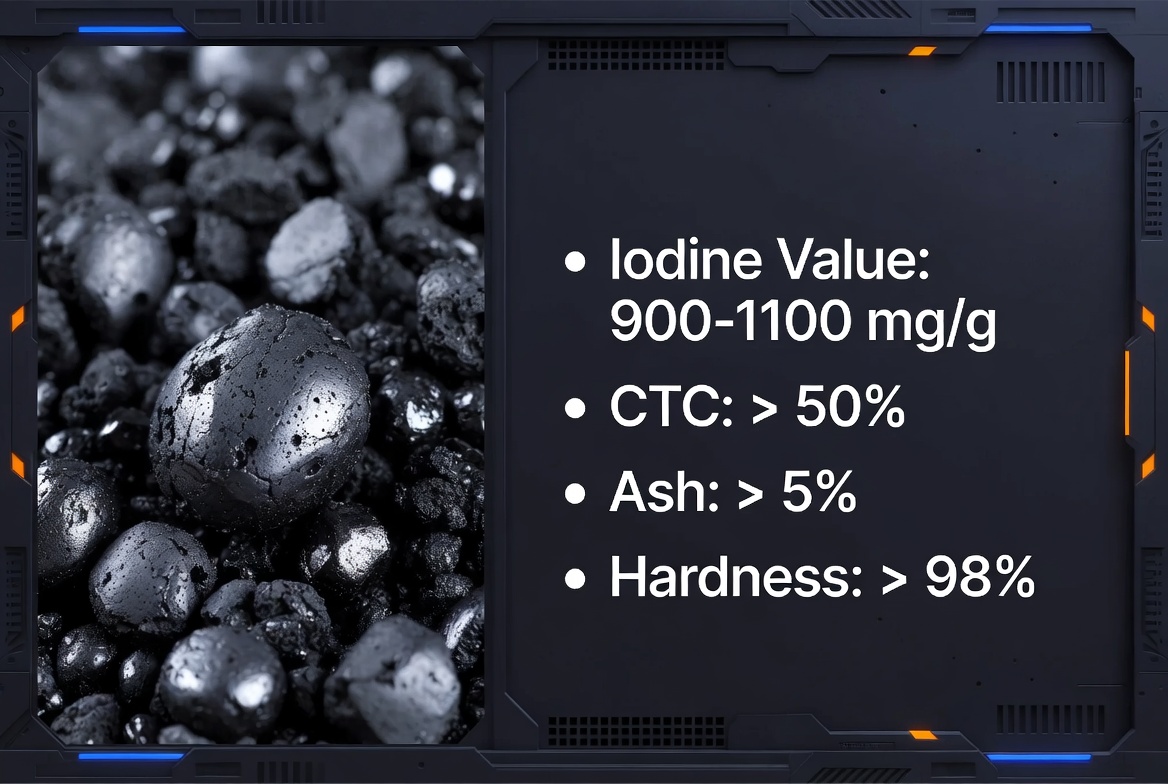
At Guangdong Tongke Activated Carbon Co., Ltd., our coal‑based activated carbon for CTO applications typically features the following key parameters: [consider]
These metrics matter because they directly influence chlorine removal efficiency, organic adsorption capacity, dust generation, and mechanical stability during block forming and service. [blog.saleslayer]
Coal‑Based vs Coconut‑Shell Activated Carbon for CTO
Both coal‑based and coconut‑shell activated carbon are widely used for CTO blocks, and each has advantages depending on the target market and performance requirements. [blog.saleslayer]
| Aspect | Coal‑based CTO Carbon | Coconut‑shell CTO Carbon |
| Raw material availability | Stable, scalable supply in China (zhulincarbon) | Strong supply in tropical regions |
| Typical pore structure | Balanced micro + mesopores | Micro‑pore dominant |
| Chlorine removal | Very good with proper activation | Excellent with high iodine values |
| Organic removal (larger molecules) | Strong due to mesopores (consider) | Sometimes limited for larger organics |
| Cost‑effectiveness | Often more competitive for industrial OEMs | Sometimes higher raw material cost |
| Application focus | Industrial, commercial, pre‑RO, process water | Residential, POU/POE, premium cartridges |
In many OEM projects, we see customers combining coal‑based CTO blocks as pre‑filters and coconut‑shell blocks as polishing filters to balance cost and performance across the treatment train. [consider]
CTO vs UDF Filters: Structure, Performance and Best Use
You will often see CTO blocks used together with UDF (Granular Activated Carbon) cartridges in one system. Understanding the difference helps you design a more robust treatment line.
Structural and Functional Differences
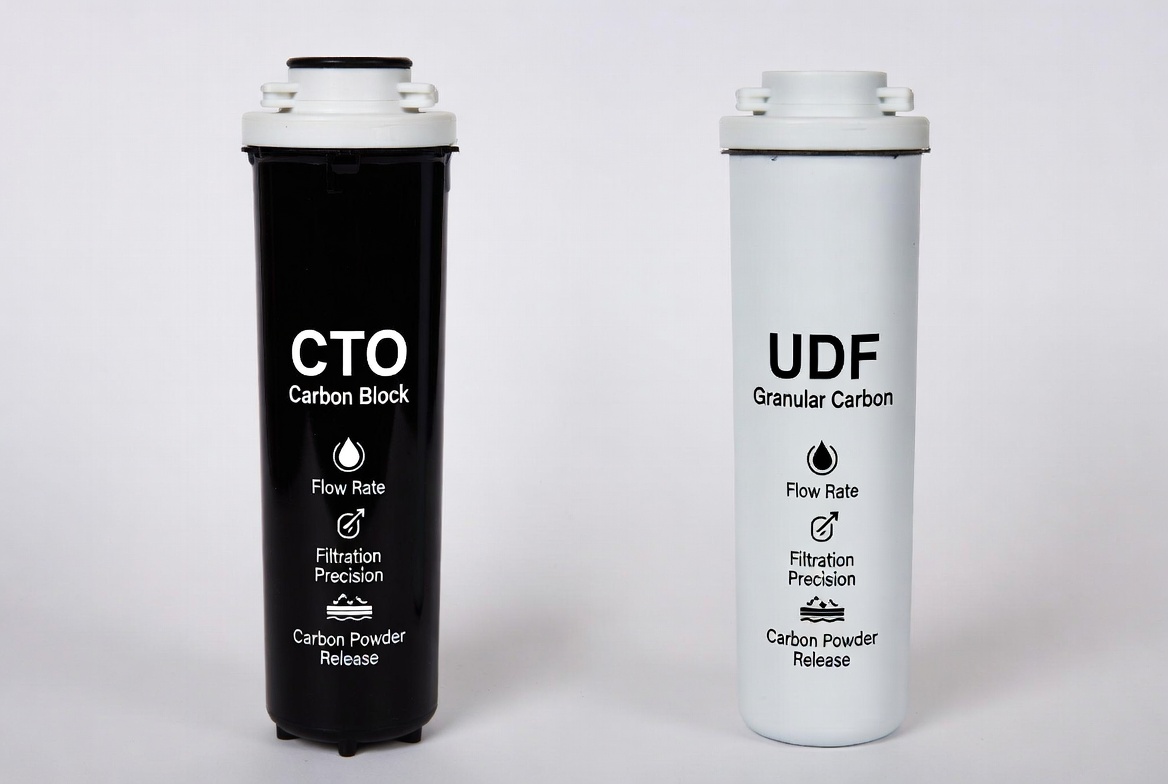
| Feature | UDF Filter | CTO Filter |
| Carbon form | Granular activated carbon | Compressed carbon block |
| Flow rate | Higher flow | Lower flow (≈50% of UDF) (consider) |
| Filtration accuracy | Lower; mainly adsorption | Higher; adsorption + fine filtration (consider) |
| Carbon powder release | May release fines | Minimal powder release (consider) |
| Adsorption capacity | Large bed volume, long contact time | Capacity limited by block thickness |
| Typical position | Secondary filtration / polishing | Pre‑filtration or main CTO stage (consider) |
UDF filters use loose granules, so water passes through a deep bed, enabling longer contact time and higher overall adsorption capacity for some applications. CTO blocks, by contrast, provide tighter filtration and more stable structure, which is important when you want to protect downstream membranes or prevent carbon fines from entering the process. [consider]
How We Recommend Combining CTO and UDF
From real projects with industrial clients, a typical configuration looks like this:
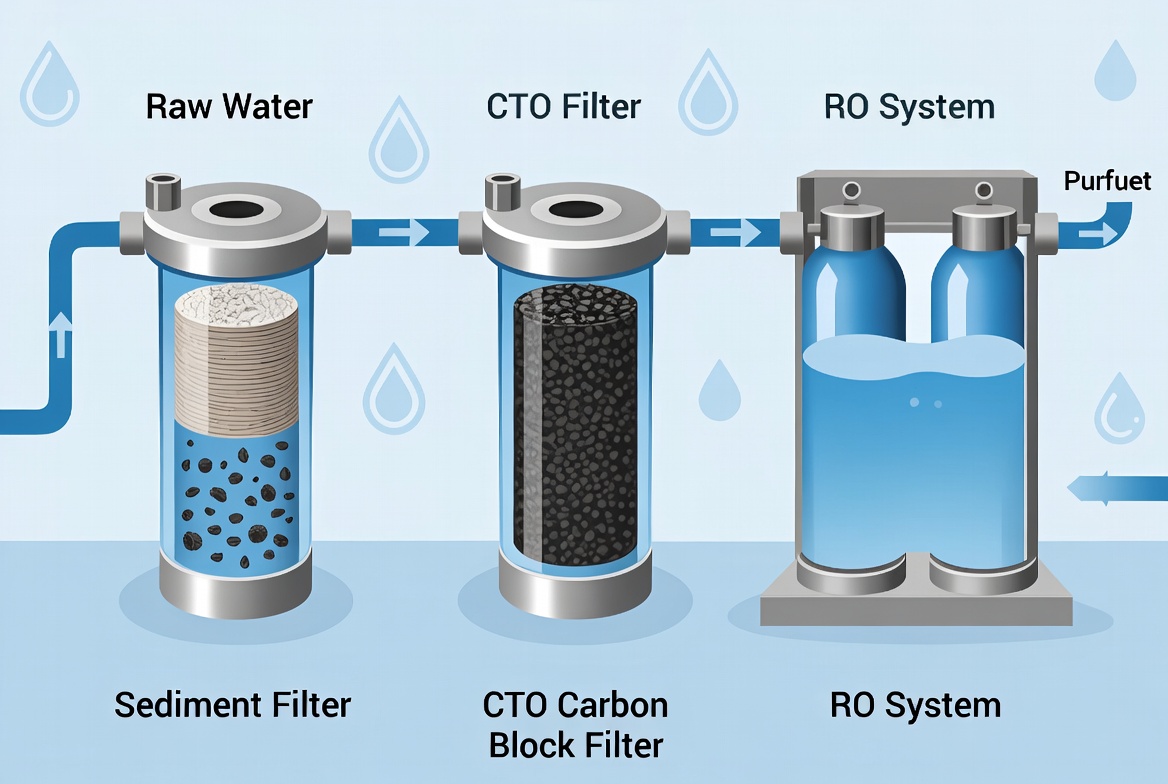
1. Sediment filter: Removes suspended solids to protect carbon.
2. CTO block filter: Removes chlorine, taste, odor, and fine particulates, protecting RO or UF membranes.
3. UDF filter (optional): Provides additional contact time for organics removal and taste polishing.
This layered approach allows OEMs and engineering teams to tune flow, capacity, and cost to their market, while maintaining stable quality over the cartridge life. [blog.saleslayer]
Key Technical Parameters When Selecting Activated Carbon for CTO
When we work with overseas OEMs, we always start by clarifying their performance targets and local water quality. Here are the parameters we focus on when recommending a CTO carbon grade.
1. Iodine Value (900–1100 mg/g)
Iodine value is a widely used indicator of the internal surface area of activated carbon and correlates with its ability to adsorb small organic molecules. For CTO blocks, an iodine value of 900–1100 mg/g offers a strong balance between adsorption efficiency and cost. [sciencedirect]
2. CTC (Carbon Tetrachloride) Adsorption ≥ 50%
CTC is another index related to pore volume, especially for mid‑size organics and VOCs. A CTC ≥ 50% indicates a well‑developed pore structure suitable for challenging applications beyond simple chlorine removal. [sciencedirect]
3. Particle Size Distribution
Typical CTO carbon particle sizes include 200 mesh, 50–70 mesh, and 30–80 mesh. Finer particles can form denser blocks with higher filtration precision but may increase pressure drop. Coarser particles improve flow but may reduce contact efficiency. [consider]
4. Hardness and Attrition Resistance
With hardness ≥ 98%, our coal‑based CTO carbons maintain granule integrity during block mixing, molding, and service. High hardness reduces dust, improves mechanical strength, and helps you achieve consistent block density in production. [consider]
5. Ash and Moisture Content
We keep ash and moisture both at or below 5%, which reduces the risk of unwanted mineral leaching and supports stable block curing and pressing conditions. For OEMs, lower ash also means less interference in applications such as food, beverage, and pharmaceutical water. [consider]
How CTO Activated Carbon Performs in Real Industrial Applications
CTO blocks are no longer limited to home kitchen filters. Over the last decade, we have seen strong demand from industrial and commercial water treatment lines worldwide. Below are some typical use cases. [blog.saleslayer]
Municipal Water and Building Systems
- Pre‑filtration before RO membranes in office buildings and hotels
- Point‑of‑entry (POE) systems in residential complexes
- Protection of plumbing fixtures from chlorine‑induced corrosion
In these cases, the priority is reliable chlorine removal and stable flow, which our coal‑based CTO carbon supports with high iodine value and robust hardness. [consider]
Food and Beverage Production
- Process water for beverage blending and bottling
- Ingredient water for breweries and dairies
- Utility water where off‑flavors must be strictly controlled
Here, OEMs typically combine low‑ash, high‑purity carbon with strict production control to meet food‑grade expectations, supported by documentation and batch traceability. [toprankmarketing]
Chemical and Pharmaceutical Applications
- Pre‑treatment of process water feeding reactors and cleaning systems
- Protection of downstream ion exchange or membrane units
- Removal of trace organics that affect reaction selectivity
For these sectors, users value predictable adsorption performance and reliable global supply, which are core advantages of large‑scale coal‑based activated carbon production in China. [zhulincarbon]
Practical Steps to Specify the Right Activated Carbon for Your CTO Filters
To help engineers and sourcing teams make faster, lower‑risk decisions, we recommend a simple, structured approach.
Step 1: Define Your Water Quality and Targets
- Raw water source (municipal, surface, well, process)
- Inlet chlorine level and target residual chlorine
- Expected organic loading (TOC, specific contaminants if known)
- Required flow rate and pressure drop limits
Step 2: Select Core Carbon Parameters
- Iodine value range (e.g., 900–1100 mg/g for industrial CTO) [consider]
- CTC requirement (≥ 50% for broader organic removal) [consider]
- Maximum ash content (often ≤ 5% for most industrial uses) [consider]
- Preferred particle size distribution based on block design
Step 3: Align Block Design with Performance
- Target block density and wall thickness
- Required micron rating / particle removal level
- Overall cartridge dimensions and compatible housings
At this stage, our engineering team usually provides sample lots for small‑scale block trials, so your R&D team can validate pressing conditions, curing parameters, and performance before scaling up. [blog.saleslayer]
Step 4: Field Testing and Feedback
Once lab results are confirmed, we recommend installing trial units on real lines and monitoring:
- Chlorine breakthrough curves
- Taste and odor feedback from operators or consumers
- Pressure drop over time
These practical results often reveal optimization opportunities that pure lab data cannot show, such as fouling tendencies, pre‑filter requirements, and realistic cartridge life. [blog.saleslayer]
How a Chinese Coal‑Based Activated Carbon Manufacturer Supports Global CTO Projects
As a Chinese manufacturer specializing in coal activated carbon and other activated carbon products, we understand the practical challenges global OEMs face: cost pressure, regulatory compliance, and the need for stable long‑term supply. [zhulincarbon]
From an E‑E‑A‑T perspective, we focus on several aspects:
- Experience: Years of exporting activated carbon for water treatment, air and gas purification, food and beverage, chemical and pharmaceutical industries, and more. [zhulincarbon]
- Expertise: In‑house technical teams who understand both carbon production and downstream CTO block manufacturing requirements. [blog.saleslayer]
- Authority: Continuous collaboration with international customers, quality audits, and third‑party test reports on iodine value, CTC, ash, hardness, and microbiological safety. [mariehaynes]
- Trust: Transparent specification sheets, batch traceability, and responsive technical support for OEMs and distributors. [toprankmarketing]
This combination helps overseas customers reduce project risk and accelerate time‑to‑market when launching new CTO product lines.
Common Mistakes OEMs Make When Choosing CTO Activated Carbon
From real customer feedback, a few recurring issues stand out.
- Choosing carbon solely on price, which can lead to unstable block quality, excessive fines, or poor chlorine removal.
- Ignoring particle size distribution, resulting in pressing difficulties or inconsistent density.
- Underestimating the importance of hardness, causing elevated dust levels and lower final block strength.
- Skipping meaningful pilot testing, which makes it hard to predict actual service life in different regions.
Avoiding these mistakes can significantly improve the long‑term performance and reputation of your CTO filter products. [toprankmarketing]
When to Use CTO Filters vs Other Technologies
CTO filters are powerful, but they are not a universal solution. As an industrial buyer or designer, you should consider the role of CTO blocks in a broader treatment strategy.
- Use CTO filters when your goal is primarily chlorine, taste, odor, and light organic removal at moderate flow rates.
- Combine CTO with sediment filtration to avoid premature fouling and pressure drop.
- Place CTO upstream of RO or UF membranes to protect against oxidant damage.
- For heavy metal removal, specific ions, or high salinity, consider specialty media or membranes alongside CTO, not as a replacement.
Positioning CTO accurately in your process flow is one of the most effective ways to deliver consistent water quality with a reasonable operating cost. [blog.saleslayer]
Call to Action: Discuss Your CTO Carbon Requirements with Our Technical Team
If you are developing or upgrading a CTO filter line and need reliable coal‑based activated carbon from a Chinese manufacturer, our team at Guangdong Tongke Activated Carbon Co., Ltd. can support you from initial specification to mass production. [zhulincarbon]
We can:
- Recommend suitable carbon grades based on your target markets and certifications
- Provide detailed technical data sheets and third‑party test reports
- Supply pilot lots for block production trials and help interpret test results
- Offer stable long‑term supply plans for OEM and private‑label projects
Contact our technical sales team today to share your requirements and request tailored samples for your next CTO filter project. [toprankmarketing]
FAQs About Activated Carbon for CTO Filters
1. What is the main function of activated carbon in a CTO filter?
The activated carbon in a CTO filter primarily removes chlorine, taste, odor, and many dissolved organic compounds from water, while the block structure provides fine particulate filtration. [consider]
2. Why do iodine value and CTC matter for CTO applications?
Iodine value reflects the internal surface area for small organics, while CTC is related to the pore volume for mid‑size organics and VOCs, so together they indicate overall adsorption capacity for CTO service. [sciencedirect]
3. Is coal‑based activated carbon suitable for food and beverage water?
Yes, properly produced coal‑based activated carbon with controlled ash, moisture, and impurities can be used in many food and beverage water applications, especially when supported by appropriate quality documentation and testing. [blog.saleslayer]
4. How long does a CTO filter typically last in industrial use?
Service life depends on inlet water quality, chlorine level, flow rate, and system configuration, but many industrial users design CTO cartridges for several months of operation before replacement, confirmed through local pilot testing. [blog.saleslayer]
5. Can CTO filters remove heavy metals or high TDS?
Standard CTO filters are not designed as primary solutions for heavy metals or high dissolved solids; they mainly target chlorine and organics and should be combined with technologies such as ion exchange, specialty media, or RO when those contaminants are present. [blog.saleslayer]
References
1. Zhulin Carbon. "Activated Carbon for CTO." (Accessed 2026). [https://www.zhulincarbon.com/application/activated-carbon/activated-carbon-for-cto.html] [consider]
2. Zhulin Carbon. "Activated Carbon Applications." (Accessed 2026). [https://www.zhulincarbon.com/zh-CN/application/activated-carbon/] [zhulincarbon]
3. Zhulin Carbon. "Activated Carbon Manufacturer and Supplier in China." (Accessed 2026). [https://www.zhulincarbon.com/zh-CN/] [zhulincarbon]
4. ScienceDirect. "Conversion mechanism of selenium on activated carbon." (Accessed 2026). [https://www.sciencedirect.com/science/article/abs/pii/S030438942301765X] [sciencedirect]
5. Sales Layer. "SEO for Manufacturing Companies: The 2026 Strategy Guide." (2026‑04‑21). [https://blog.saleslayer.com/seo-for-manufacturing-companies] [blog.saleslayer]
6. TopRank Marketing. "E‑E‑A‑T and SEO: Optimizing for Google's Guidelines." (2025‑02‑25). [https://www.toprankmarketing.com/blog/eeat-seo-google-guidelines-experience-expertise-authority-trust/] [toprankmarketing]
7. Stellar Content. "The Complete Guide to Google E‑E‑A‑T." (Accessed 2026). [https://www.stellarcontent.com/blog/seo/the-complete-guide-to-google-e-a-t-what-is-it-why-is-it-and-how-do-you-create-it/] [stellarcontent]
8. Marie Haynes Consulting. "E‑E‑A‑T and SEO: A Comprehensive Guide (2025 Update)." (2025‑04‑29). [https://www.mariehaynes.com/resources/eat/] [mariehaynes]


