Content Menu
● Key Definitions – Density vs Adsorption Capacity
>> What Is Activated Carbon Density?
>> What Is Adsorption Capacity?
● How Wood Activated Carbon Fits In Modern Industrial Applications
>> Why Wood Activated Carbon Is Different
● The Real Relationship Between Density and Adsorption Capacity
>> Why Higher Density ≠ Higher Capacity
>> When Density Still Matters for Engineering Design
● Technical Comparison – Density vs Adsorption Capacity in Practice
>> Design and Performance Implications
● Industry Case Insight – When Buyers Misread Density Data
>> A Common Procurement Scenario
>> How Expert Suppliers Approach This Problem
● Practical Selection Framework for Industrial Buyers
>> Step‑by‑Step Selection Checklist
>> Key Factors Beyond Density and Capacity
● Expert Insights on Wood Activated Carbon Optimization
>> New Trends in Capacity Improvement
>> Why Customized Solutions Outperform Catalog Products
● How Guangdong Tongke Activated Carbon Co., Ltd. Supports Global Buyers
>> Typical Application Areas for Wood Activated Carbon
>> What You Should Ask Your Supplier
● Summary – What Buyers Often Misunderstand
● Clear Next Step – Talk to a Technical Team, Not Just a Sales Rep
● FAQs
● References
Activated carbon density and adsorption capacity are related but fundamentally different properties, and many industrial buyers confuse them when evaluating wood activated carbon and other grades. This confusion often leads to overpaying for "high density" products that do not actually deliver better purification performance in real systems. [qizhongcarbon]
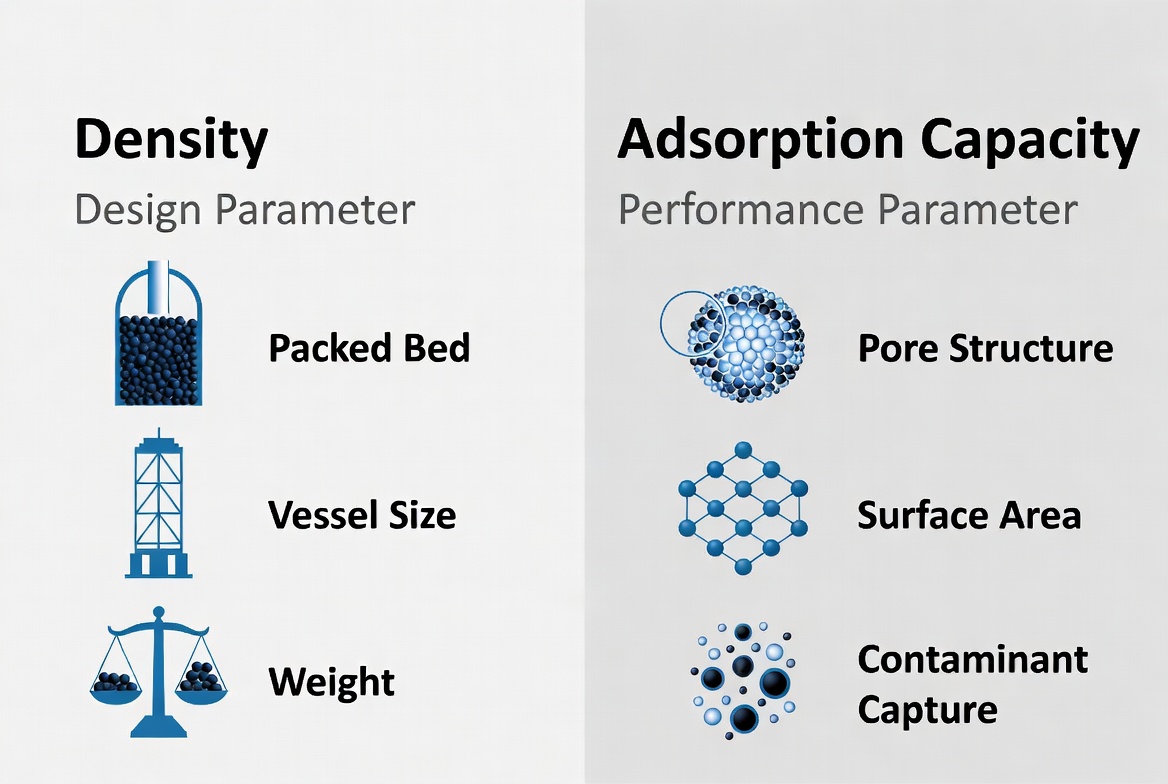
As working in this field for over years, I see the same misunderstanding again and again: buyers assume that a higher activated carbon density automatically means higher adsorption capacity and longer service life. In reality, density is a packaging and system design parameter, while adsorption capacity is a performance parameter that depends far more on surface area, pore structure, and surface chemistry than on how "heavy" the product feels in a bag. [heycarbons]
Key Definitions – Density vs Adsorption Capacity
What Is Activated Carbon Density?
Activated carbon density usually refers to bulk density (apparent density): the mass of carbon per unit volume, including the voids between particles when they are poured naturally into a container. Typical bulk densities are: [qizhongcarbon]
- Granular activated carbon (GAC): about 0.40–0.60 g/cm³
- Powdered activated carbon (PAC): about 0.38–0.45 g/cm³
- Extruded/pellet carbon: about 0.45–0.65 g/cm³
These ranges vary with raw material and forming method, but they show that different product forms occupy different volumes for the same weight. For design engineers, density affects vessel size, pressure drop, and the weight of carbon needed to fill a filter, not directly the adsorption performance per kilogram. [qizhongcarbon]
What Is Adsorption Capacity?
Adsorption capacity describes how much contaminant an activated carbon can hold, usually expressed as mg of adsorbate per g of carbon in lab tests such as iodine number, methylene blue number, or equilibrium isotherms. It depends mainly on: [pmc.ncbi.nlm.nih]
- Specific surface area (often 500–2000 m²/g)
- Pore size distribution (micropores, mesopores, macropores)
- Surface functional groups and chemistry
For example, studies on steam-activated coconut shell carbon show that controlled oxidative treatment can increase adsorption capacity by up to 2.8 times without changing the basic carbon type, highlighting how surface chemistry can be more decisive than density alone. In real projects, capacity determines filter run time, carbon replacement frequency, and total operating cost. [pmc.ncbi.nlm.nih]
How Wood Activated Carbon Fits In Modern Industrial Applications
Why Wood Activated Carbon Is Different
Wood activated carbon is produced from renewable biomass such as sawdust or wood chips and typically develops a highly developed microporous and mesoporous structure, which is ideal for many liquid-phase applications and color removal tasks. Its relatively low ash content and tunable pore structure make it attractive for food and beverage decolorization, pharmaceutical intermediates, and specialty chemical purification where purity is critical. [sciencedirect]
From an industry standpoint, the global wood activated carbon market has been growing steadily, driven by tightening environmental regulations and increased demand for advanced water and air treatment across regions. Buyers use wood-based grades not only for their performance, but also to support sustainability and lower the overall environmental footprint of treatment systems. [credenceresearch]

The Real Relationship Between Density and Adsorption Capacity
Why Higher Density ≠ Higher Capacity
A common assumption among procurement teams is: "If I buy a higher density activated carbon, I get more adsorption sites per unit volume, so performance must be better." On a purely volumetric basis, more mass per liter *can* mean more surface area per liter, but only if the internal pore structure is optimized. In practice, two carbons with similar densities can perform very differently because one has more micropores targeting specific contaminants, while the other has poorly developed or blocked pores. [heycarbons]
Several factors break the simplistic link between density and capacity:
- A denser carbon may have more non‑porous "dead" mass that does not contribute to adsorption
- Overly compact pellets may reduce external surface area and slow down mass transfer
- Aggressive forming or binder use can partially collapse micropores
Industrial studies on activated carbons show that optimizing surface functional groups and pore architecture – not just packing more material into the same volume – is what truly raises adsorption capacity for dyes, organics, and gas-phase contaminants. [pmc.ncbi.nlm.nih]
When Density Still Matters for Engineering Design
From the perspective of system designers, density is still a critical engineering input: it determines how much carbon (in kg) you can load into a vessel of a given volume and directly influences pressure drop and hydraulic performance. In column design, knowing bulk density allows you to calculate media weight, structural load, and required bed depth to meet contact time and breakthrough targets. [heycarbons]
This is why experienced manufacturers like Guangdong Tongke Activated Carbon Co., Ltd. specify density ranges alongside iodine number, surface area, and other performance indicators. Matching density to system design avoids problems like underfilling beds, unexpected pressure drop, and non-uniform flow distribution. [qizhongcarbon]
Technical Comparison – Density vs Adsorption Capacity in Practice
Design and Performance Implications
The table below summarizes how density and adsorption capacity affect different aspects of industrial projects:
| Aspect | Density (Bulk) – Role and Impact | Adsorption Capacity – Role and Impact |
| Design parameter | Vessel sizing, bed height, structural load (qizhongcarbon) | Required bed volume and service life (heycarbons) |
| Performance per kg | Minor influence if pore structure is similar (qizhongcarbon) | Direct determinant of contaminant loading (pmc.ncbi.nlm.nih) |
| Performance per liter | Linked to how much effective carbon mass fits into volume (qizhongcarbon) | Dependent on both mass and pore efficiency (pmc.ncbi.nlm.nih) |
| Operating cost | Affects shipping and handling costs (qizhongcarbon) | Affects replacement frequency and total lifecycle cost (pmc.ncbi.nlm.nih) |
| Product selection criteria | Secondary for buyers optimizing performance (qizhongcarbon) | Primary for performance-driven applications (pmc.ncbi.nlm.nih) |
In wood activated carbon for liquid-phase adsorption, surface area and pore size distribution tend to dominate performance, while density is used mainly to calculate dosage and reactor dimensions. When you treat high-value streams (pharma, specialty chemicals), even small improvements in adsorption capacity can outweigh density differences in total cost of ownership. [sciencedirect]
Industry Case Insight – When Buyers Misread Density Data
A Common Procurement Scenario
In many tenders I have reviewed for industrial clients, the RFQ lists parameters such as "bulk density 0.50–0.55 g/cm³; iodine number ≥ 900 mg/g." Internally, some buyers prioritize the density field, assuming that matching density between suppliers guarantees similar performance in existing vessels. The result is that they overlook more meaningful indicators like surface area, pore volume distribution, and adsorption test data for the target contaminant. [heycarbons]
Published work on activated carbon performance shows that carbons optimized by thermal or oxidative post-treatment can massively boost adsorption capacity without necessarily increasing bulk density, disproving the idea that "heavier is always better." For industrial buyers, this means that insisting on density alone can lead to choosing a technically inferior product that consumes budget without delivering better removal rates or longer bed life. [pmc.ncbi.nlm.nih]
How Expert Suppliers Approach This Problem
Experienced manufacturers now position density as part of a package of parameters, not the headline promise. For example, suppliers publishing wood activated carbon data emphasize surface area, pore size distribution, ash content, and specific case studies showing removal of CO₂, odors, or organic pollutants under defined conditions. [desotec]
A supplier-focused application note on liquid-phase adsorption stresses that the amount of activated carbon, surface area, pore structure, and contact time are the key levers for performance, while density is treated as a factor in dosage and system design rather than as a proxy for capacity. This is the approach companies like Guangdong Tongke Activated Carbon Co., Ltd. use when co‑engineering solutions with global buyers in water, air, and process purification. [desotec]
Practical Selection Framework for Industrial Buyers
Step‑by‑Step Selection Checklist
From a UX and engineering perspective, here is a simple framework you can apply when comparing wood activated carbon offers:
1. Define the target contaminant and phase. Identify whether you are removing color, odor compounds, VOCs, metals, or specific organics in liquid or gas phase; pore size and surface chemistry must match this profile. [desotec]
2. Prioritize adsorption capacity metrics. Focus on iodine number, methylene blue number, or application-specific isotherm data provided by the manufacturer rather than density alone. [pmc.ncbi.nlm.nih]
3. Check surface area and pore structure. Look for surface area values and pore volume distributions that align with molecule size and required kinetics. [heycarbons]
4. Use density for system compatibility. Ensure bulk density and particle size match your vessel design, bed depth, and pressure drop constraints. [qizhongcarbon]
5. Validate with pilot tests. Request small-scale tests or column trials using your real feed, comparing breakthrough curves and regeneration behavior between grades. [pmc.ncbi.nlm.nih]
This framework is especially important when moving from other raw materials to wood activated carbon, where differences in pore structure can significantly impact both performance and backwashing behavior. [sciencedirect]
Key Factors Beyond Density and Capacity
To choose the right grade for long-term performance and compliance, also consider:
- Particle size distribution and hardness (affect attrition and pressure drop) [heycarbons]
- Ash content and impurities (important for food and pharma applications) [sciencedirect]
- Regeneration behavior and thermal stability (impact lifecycle cost and sustainability) [pmc.ncbi.nlm.nih]
- Certification and regulatory compliance in target markets
Academic and industrial literature shows that regenerable carbons with carefully tuned surface chemistry can be reused several cycles with minimal loss in capacity, which often yields more value than marginal density differences. For large industrial plants, these lifecycle effects are far more important than the simple "kg per m³" comparison in the purchasing spreadsheet. [heycarbons]
Expert Insights on Wood Activated Carbon Optimization
New Trends in Capacity Improvement
Recent studies on activated carbons derived from biomass and wood-based precursors focus on increasing adsorption capacity through controlled activation and post-treatment techniques rather than manipulating density. For example, one study on steam-activated coconut shell carbon demonstrated that moderate thermal air oxidation significantly increased the number of oxygen-containing functional groups, boosting adsorption capacity by around 2.8 times while maintaining structural integrity. [sciencedirect]
Research on wood-derived activated carbon for gas-phase CO or CO₂ capture highlights that optimizing pore structure and surface chemistry can produce highly efficient adsorbents for vehicle emissions and other gas streams. These findings reinforce a key principle: engineering the internal surface is where performance is won, while density is simply the external consequence of how the carbon is formed and packed. [sciencedirect]
Why Customized Solutions Outperform Catalog Products
For global industrial buyers, off‑the‑shelf products often miss opportunities for optimization around specific feed compositions, temperature, pH, and flow regimes. Technical guidance on liquid-phase adsorption emphasizes that tailoring surface area, pore size distribution, and dosage to the real operating conditions unlocks the best performance and cost balance. [heycarbons]
Manufacturers with application engineering teams can adjust activation conditions, particle size, and even surface functionalization to align with your project's target molecules and system constraints. This is where a supplier like Guangdong Tongke Activated Carbon Co., Ltd. can co‑develop wood activated carbon grades tuned for your water treatment, air purification, or process stream, instead of forcing your process to adapt to a generic product. [desotec]
How Guangdong Tongke Activated Carbon Co., Ltd. Supports Global Buyers
Typical Application Areas for Wood Activated Carbon
Drawing on international market analysis and application notes, wood activated carbon plays a strong role in:
- Water treatment (color removal, dissolved organics, taste and odor control) [desotec]
- Air and gas purification (VOC and odor removal, industrial emission polishing) [desotec]
- Food and beverage (decolorization and impurity removal in sugar, oils, beverages) [sciencedirect]
- Chemicals and pharmaceuticals (purification of intermediates, removal of trace organics) [sciencedirect]
As regulations tighten and the global wood activated carbon market is projected to grow steadily, industrial users increasingly expect not just raw materials but integrated solutions with technical support and data-backed performance claims. [techsciresearch]
What You Should Ask Your Supplier
When you evaluate offers – including from Guangdong Tongke Activated Carbon Co., Ltd. – consider asking:
- Can you provide adsorption isotherm or breakthrough data for my specific contaminant? [pmc.ncbi.nlm.nih]
- How does this grade's surface area and pore size distribution compare to alternatives? [heycarbons]
- What is the bulk density range, and how should I adjust bed design or dosage? [qizhongcarbon]
- Do you have documented case studies for similar industries or feed compositions? [desotec]
These questions help re‑center the conversation from simple density numbers to real-world performance, risk reduction, and lifecycle cost. [pmc.ncbi.nlm.nih]
Summary – What Buyers Often Misunderstand
Many buyers still treat activated carbon density as a shortcut indicator of quality, assuming that a denser product guarantees higher performance and longer service life. However, research and industrial experience show that adsorption capacity, driven by surface area, pore structure, and surface chemistry, is what determines how much contaminant your carbon actually removes. [qizhongcarbon]
Density remains important for vessel sizing, bed design, and logistics, but it should not be your primary decision factor when comparing wood activated carbon grades for demanding industrial applications. The most effective strategy is to evaluate both parameters together, supported by application-specific test data and technical guidance from a specialist manufacturer. [qizhongcarbon]
Clear Next Step – Talk to a Technical Team, Not Just a Sales Rep
If you are currently comparing wood activated carbon offers or planning to upgrade a water, air, or process purification line, the most impactful move is to speak directly with a technical engineer from your supplier. Provide real feed data, performance targets, and system constraints, and ask them to recommend a grade and density range with proven adsorption capacity for your application. [desotec]
Guangdong Tongke Activated Carbon Co., Ltd. can work with your engineering and procurement teams to:
- Analyze your process requirements
- Specify a wood activated carbon grade with the right adsorption capacity profile
- Align density, particle size, and dosage with your existing or planned equipment
Reach out with your project details to request a tailored recommendation or a small-scale trial proposal.
FAQs
Q1: Is higher activated carbon density always better?
No. Higher density means more mass per unit volume, but it does not guarantee more effective pores or higher adsorption capacity, which are the real performance drivers. [qizhongcarbon]
Q2: How can I quickly compare adsorption capacity between products?
Use standardized metrics such as iodine number, methylene blue number, or application-specific isotherm data, and ideally compare breakthrough curves from column tests under similar conditions. [pmc.ncbi.nlm.nih]
Q3: When should I prioritize density in my specification?
Density is especially important when retrofitting existing vessels, where bed volume and pressure drop are fixed; you need compatible bulk density to avoid underfilling and hydraulic issues. [qizhongcarbon]
Q4: Why choose wood activated carbon over coal-based carbons?
Wood activated carbon offers favorable pore structures for many liquid-phase applications, can have lower ash content, and supports renewable sourcing goals, with competitive adsorption performance when properly engineered. [credenceresearch]
Q5: How do I know if a supplier understands my application?
Look for suppliers who can provide case studies, application notes, and specific test data for your contaminants, and who are willing to discuss pore structure, surface chemistry, and operating conditions, not just catalog specs. [desotec]
References
1. QiZhong Chemical. "Density of Activated Carbon – Definition and Typical Values." [1]
2. Heycarbons. "Key Factors Influencing Liquid Phase Adsorption on Activated Carbon." [2]
3. PMC (NIH). "Enhanced adsorption capacity of activated carbon over ..." [3]
4. ScienceDirect. "CO adsorption performance of rubber wood activated carbon." [4]
5. DESOTEC. "Activated carbon adsorption for the removal of industrial odours." [5]
6. Credence Research. "Wood Activated Carbon Market Size, Growth and Forecast." [6]
7. TechSci Research. "Wood Activated Carbon Market Size and Outlook 2031." [7]


