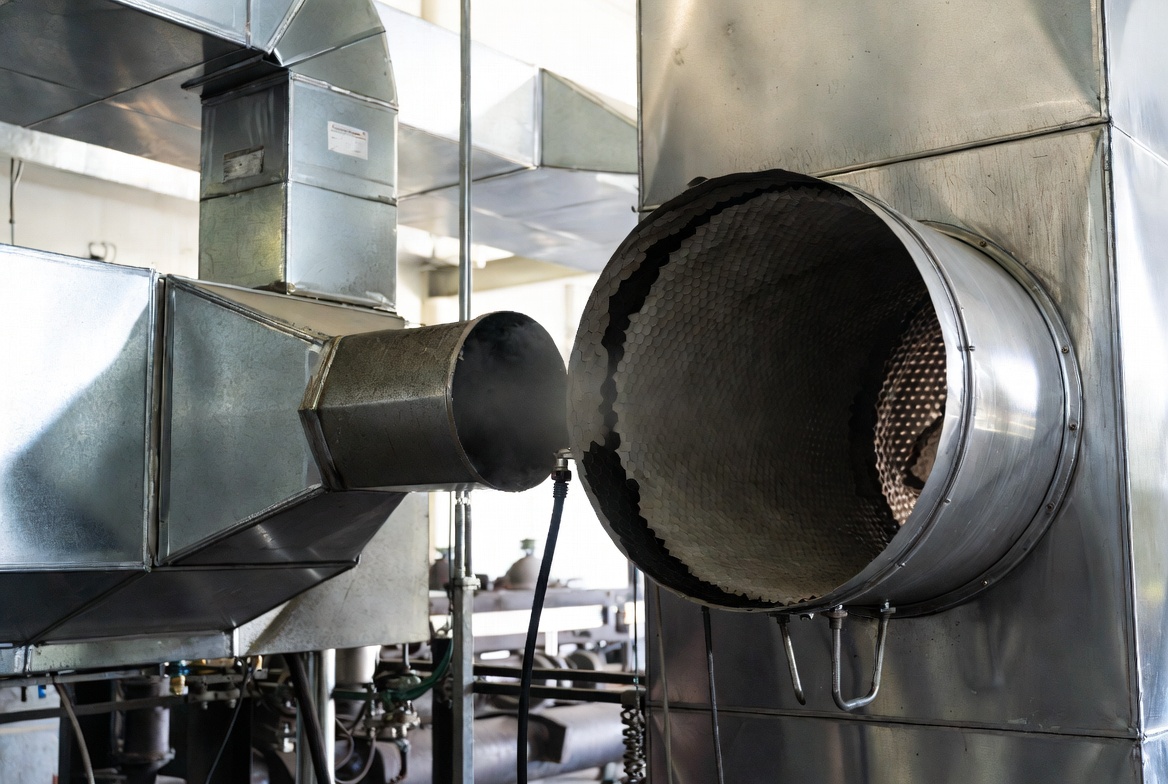
This article provides a practical, expert-level guide to selecting and replacing activated carbon for optimal industrial exhaust gas treatment, with a special focus on coal-based and honeycomb activated carbon solutions for real-world plants. It draws on hands-on experience from Guangdong Tongke Activated Carbon Co., Ltd. and current industry insights to help engineers, EHS managers, and plant operators make confident, data-driven decisions. [carbon-solutions.kuraray]
Understanding Industrial Exhaust Gas Treatment with Activated Carbon
In modern industrial facilities, activated carbon adsorption remains one of the most reliable and flexible technologies for controlling volatile organic compounds (VOCs), odorous gases, and hazardous pollutants in exhaust streams. With the right product selection and replacement strategy, plants can achieve stable emissions compliance while controlling operating costs and minimizing unplanned downtime. [desotec]
Key takeaway: The quality and suitability of your coal-based or honeycomb activated carbon directly determine how long your system will stay compliant, how often you must replace adsorbent, and how predictable your maintenance schedule will be. [tkcarbon.en.made-in-china]
How Activated Carbon Adsorption Works in Exhaust Systems
At its core, activated carbon works by adsorbing gas molecules onto an extremely porous network of internal pores, delivering very high surface area per unit mass. When industrial exhaust gas passes through a carbon bed or honeycomb block, VOCs and odorous compounds diffuse into these pores and are trapped until the carbon becomes saturated. [sciencedirect]
For industrial exhaust gas treatment, this mechanism is particularly effective for:
- VOCs (solvents, aromatics, hydrocarbons). [tingyuancarbon]
- Odorous compounds such as hydrogen sulfide, ammonia, and thiols. [desotec]
- Acidic or basic gases, when using impregnated or modified activated carbon grades. [sciencedirect]
By stabilizing pore structure and optimizing particle size distribution, high-quality coal-based and honeycomb activated carbon offer a well-balanced combination of pressure drop, adsorption efficiency, and service life. [tkcarbon.en.made-in-china]
Main Types of Activated Carbon for Exhaust Gas Treatment
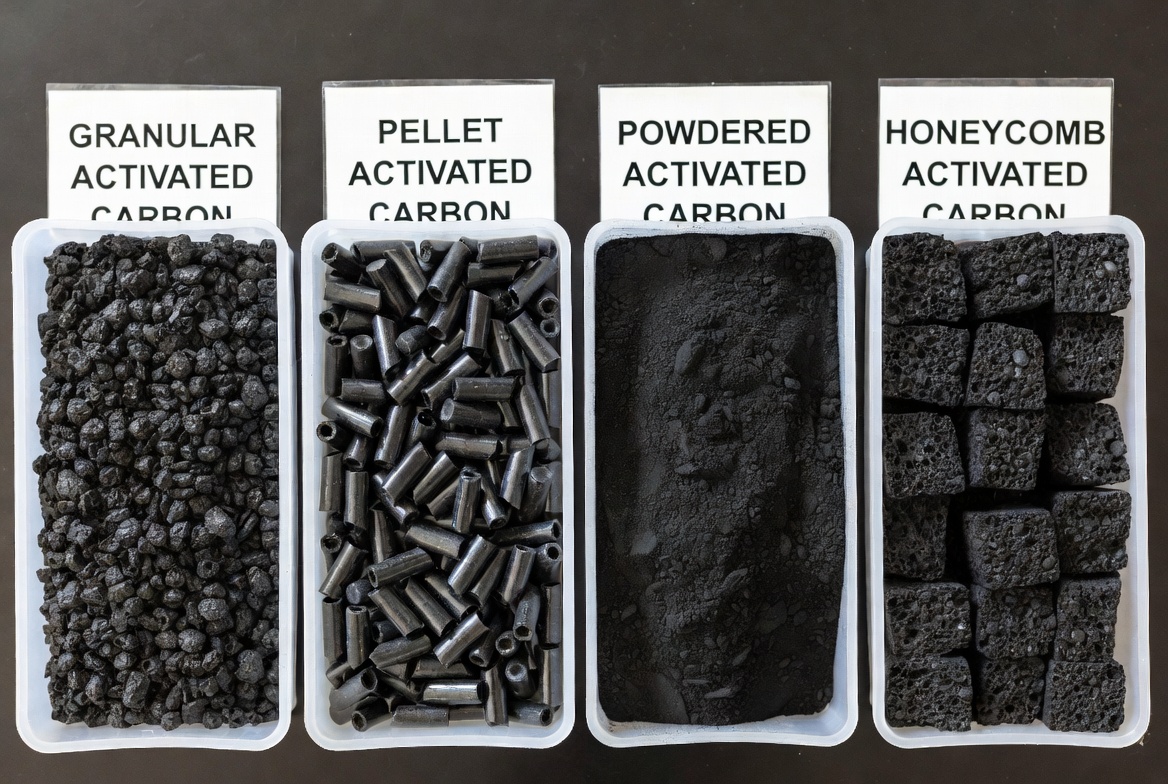
Different activated carbon formats are used depending on process conditions, emission limits, and equipment design. [carbon-solutions.kuraray]
Common Industrial Formats
- Granular activated carbon (GAC) – irregular or spherical granules for fixed-bed adsorbers, moderate pressure drop, suitable for large stationary filters. [carbon-solutions.kuraray]
- Pelletized activated carbon – cylindrical pellets with high density, excellent mechanical strength, and very good flow properties, widely used for VOC removal and industrial exhaust gas treatment. [tingyuancarbon]
- Powdered activated carbon (PAC) – fine powder used in injection systems or combined with filters, valuable where short contact times or variable flow conditions exist. [tongkeac]
- Honeycomb activated carbon – monolithic blocks with parallel channels, combining high geometric surface area with low pressure drop, widely used in air and gas purification systems. [marketresearchcommunity]
These formats can be produced from coal, wood, coconut shell, or other carbonaceous raw materials, with coal-based grades often preferred for industrial exhaust gas due to their mechanical strength and stable pore structure. [tkcarbon.en.made-in-china]
Why Honeycomb Activated Carbon Is Growing
Honeycomb activated carbon has gained market share in air purification and exhaust gas treatment because it offers:
- Large contact area in a compact volume. [marketresearchcommunity]
- Uniform gas distribution with low pressure drop, which helps reduce fan energy consumption. [marketresearchcommunity]
- Modular design that simplifies installation, inspection, and replacement. [tingyuancarbon]
Recent market analyses indicate that demand for honeycomb activated carbon is rising steadily, supported by stricter air quality regulations and the expansion of centralized air treatment systems. [linkedin]
Matching Activated Carbon Type with Exhaust Gas Characteristics
Selecting the right activated carbon starts from understanding the gas stream:
- Pollutant type and concentration – VOC profile, odorous compounds, acid and basic gases. [desotec]
- Temperature and humidity – high temperature and humidity can reduce adsorption capacity and may require specialized grades. [carbon-solutions.kuraray]
- Presence of particulates or aerosols – solids can clog pores and channels, reducing service life if pre-filtration is inadequate. [tongkeac]
For example:
- A paint line exhaust rich in aromatic solvents often benefits from pelletized or honeycomb coal-based activated carbon, balancing high adsorption capacity with low pressure drop. [tingyuancarbon]
- Waste gas from food processing that contains odorous compounds like hydrogen sulfide may be treated with impregnated activated carbon designed for odor and sulfur removal. [desotec]
- High-humidity exhaust from chemical processes may require hydrophobic or specially treated carbons to maintain performance. [sciencedirect]
Expert tip: Always verify compatibility between the gas composition and the selected carbon type to avoid early saturation, chemical attack on the carbon, or unexpected exothermic reactions. [sciencedirect]
Key Selection Criteria for Coal-Based and Honeycomb Activated Carbon
When designing or upgrading an industrial exhaust gas treatment system, engineers should evaluate several technical parameters to identify the most suitable coal-based or honeycomb activated carbon. [tkcarbon.en.made-in-china]
Technical Parameters to Evaluate
- Iodine number or specific surface area – indicators of overall adsorption capacity. [qingke.en.made-in-china]
- Pore size distribution – balance of micro-, meso-, and macropores to match molecule size of target pollutants. [sciencedirect]
- Bulk density and hardness – critical for system weight, bed volume, and resistance to abrasion. [tkcarbon.en.made-in-china]
- Pressure drop – especially important in honeycomb and pelletized systems, directly affecting fan power and energy consumption. [carbon-solutions.kuraray]
- Moisture and ash content – can influence effective capacity, stability, and compatibility with certain gases. [carbon-solutions.kuraray]
Practical Design Considerations
- Bed depth and contact time must be sized to achieve desired outlet concentrations under peak conditions. [carbon-solutions.kuraray]
- Modular honeycomb blocks can be arranged in multiple layers to increase contact time while maintaining manageable pressure drop. [marketresearchcommunity]
- Safety margins should be incorporated to account for variation in pollutant load, humidity, and temperature, ensuring consistent performance over the service life. [tongkeac]
By combining laboratory data with field experience, manufacturers like Guangdong Tongke Activated Carbon Co., Ltd. help customers tune these parameters to specific processes. [tkcarbon.en.made-in-china]
Step-by-Step Process for Selecting Industrial Exhaust Gas Activated Carbon
From an application engineer's perspective, a robust selection process typically follows these steps:
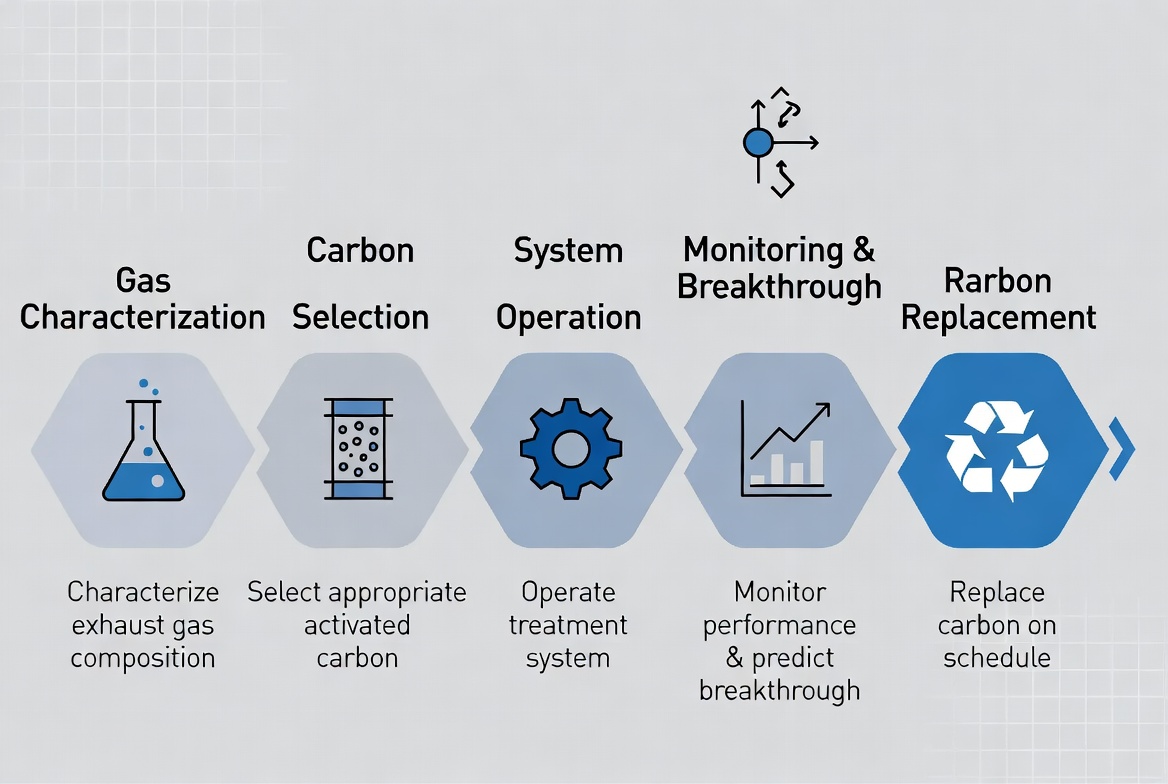
1. Characterize the exhaust gas
Measure flow rate, temperature, relative humidity, and pollutant profile (compounds, concentrations, variability). [desotec]
2. Define performance targets
Set inlet–outlet concentration limits, emission standards, and minimum desired service life based on regulations and plant objectives. [tingyuancarbon]
3. Screen suitable carbon types
Compare coal-based granular, pelletized, powdered, and honeycomb options, including specialty or impregnated grades when needed. [tongkeac]
4. Simulate adsorption performance
Use isotherm data, breakthrough curves, or vendor tools to estimate bed depth, contact time, and replacement intervals. [sciencedirect]
5. Check mechanical and operational constraints
Verify available space, allowable pressure drop, existing ductwork, and retrofit requirements. [tingyuancarbon]
6. Pilot test or staged implementation
For critical applications, run pilot-scale tests or phased rollouts to validate performance under real operating conditions. [desotec]
7. Finalize specification with vendor support
Collaborate with an experienced supplier to confirm grade selection, packaging, and delivery schedule, reducing the risk of mis-specification. [tkcarbon.en.made-in-china]
When and How to Replace Activated Carbon in Exhaust Gas Systems
Even a perfectly selected activated carbon will eventually reach saturation and must be replaced to maintain compliance. Proper replacement planning avoids both untreated emissions and unnecessary early change-outs. [desotec]
Indicators That Replacement Is Due
Operators should monitor:
- Outlet gas concentration – rising VOCs or odor levels indicate breakthrough and reduced adsorption capacity. [desotec]
- Pressure drop across the bed – a steady increase may signal clogging by particulates, condensation, or compaction. [tingyuancarbon]
- Operating temperature trends – unusual temperature rises can occur if reactions inside the bed become more intense near saturation. [sciencedirect]
In many plants, scheduled laboratory analysis of spent carbon samples or continuous gas monitoring are used to predict the end of service life before full breakthrough occurs. [carbon-solutions.kuraray]
Practical Replacement Strategy
- Establish inspection and sampling intervals based on pollutant load and historical trends. [desotec]
- Coordinate replacement with planned shutdowns whenever possible to minimize production interruptions. [carbon-solutions.kuraray]
- For honeycomb systems, replace modules or blocks in stages to keep part of the system online while maintaining adequate performance. [marketresearchcommunity]
A data-driven approach helps strike the right balance between safety, compliance, and lifecycle cost.
Best Practices for Extending Activated Carbon Service Life
From field experience and industry guidance, several best practices significantly extend the service life of activated carbon in industrial exhaust gas treatment systems. [tongkeac]
- Ensure adequate pre-filtration to remove dust and aerosols before they reach the carbon bed, reducing clogging. [tongkeac]
- Control inlet gas temperature to stay within the design range of the carbon and housing, avoiding thermal damage. [sciencedirect]
- Manage humidity and condensation, especially in low-temperature sections where water may condense inside honeycomb channels. [desotec]
- Avoid sudden process changes that dramatically increase pollutant load without adjusting operational parameters. [tingyuancarbon]
- Schedule regular inspections of housings, seals, and gaskets to prevent bypass and ensure all gas contacts the carbon. [carbon-solutions.kuraray]
By following these steps, many facilities achieve stable multi-year service lives for their exhaust gas treatment systems while maintaining regulatory compliance. [desotec]
Real-World Industrial Applications and Case Insights
Across sectors, activated carbon–based exhaust gas treatment delivers reliable performance where other technologies alone may be insufficient. [carbon-solutions.kuraray]
Typical applications include:
- Paint shops and coating lines – removal of organic solvents from exhaust streams. [tingyuancarbon]
- Chemical manufacturing and pharmaceuticals – control of VOCs, odorous gases, and hazardous air pollutants. [desotec]
- Food and beverage industry – odor management and gas purification around drying, frying, or flavoring operations. [tongkeac]
- Waste incineration and thermal processes – capturing dioxins, furans, and other pollutants via injection or fixed-bed systems. [qingke.en.made-in-china]
Suppliers like Guangdong Tongke Activated Carbon Co., Ltd. support these sectors with application-specific coal-based and honeycomb activated carbon solutions, helping customers meet local and international emission standards. [tkcarbon.en.made-in-china]
Expert Perspective: Emerging Trends in Industrial Gas Adsorption
From an expert standpoint, several emerging trends are reshaping how activated carbon is used in industrial exhaust gas treatment. [linkedin]
- Surface modification and impregnation – advanced impregnation techniques improve selectivity for specific gases, such as acid gases or mercury. [sciencedirect]
- Regenerative adsorption systems – integrated designs that combine activated carbon with thermal or catalytic regeneration for long-term operation. [carbon-solutions.kuraray]
- Growing adoption of honeycomb structures – driven by the need for compact, low-pressure-drop solutions in modern VOC treatment systems. [linkedin]
- Data-driven maintenance – using continuous monitoring and predictive analytics to optimize replacement schedules and inventory. [desotec]
These developments offer new opportunities to enhance performance, reduce operating costs, and improve safety in industrial gas treatment applications.
Why Work with a Specialized Activated Carbon Manufacturer
Selecting and replacing activated carbon for industrial exhaust gas treatment is rarely a one-time decision; it requires long-term partnership and technical support. [tkcarbon.en.made-in-china]
Working with a specialized manufacturer like Guangdong Tongke Activated Carbon Co., Ltd. offers several benefits:
- Broad product portfolio – coal-based, honeycomb, powdered, granular, and pelletized activated carbon for multiple industrial applications. [tkcarbon.en.made-in-china]
- Application engineering support – assistance with gas characterization, product selection, system sizing, and performance troubleshooting. [tongkeac]
- Consistent quality and supply – integrated production, quality control, and logistics tailored to industrial customers. [tkcarbon.en.made-in-china]
For global buyers and plant operators, this translates into lower technical risk and more predictable total cost of ownership for exhaust gas treatment systems. [tkcarbon.en.made-in-china]
Talk to an Activated Carbon Specialist
Need help selecting or replacing activated carbon for your industrial exhaust gas system?
Contact our engineering team at Guangdong Tongke Activated Carbon Co., Ltd. for a tailored solution based on your gas composition, emission limits, and budget. [tongkeac]
Table: Typical Activated Carbon Options for Industrial Exhaust Gas
| Application scenario | Recommended carbon type | Key benefits |
| VOCs from paint and coating lines | Coal-based pelletized or honeycomb carbon | High adsorption capacity, low pressure drop, easy replacement. carbon-solutions.kuraray |
| Odorous gases (H₂S, ammonia, thiols) | Impregnated granular or honeycomb carbon | Targeted removal of odor compounds, improved selectivity. carbon-solutions.kuraray |
| Chemical and pharmaceutical exhaust | Coal-based granular or pelletized carbon | Robust against variable load, good mechanical strength. carbon-solutions.kuraray |
| Food and beverage processing odors | Specialized granular or powdered carbon | Effective odor control, flexible dosing or filter integration. desotec |
| Waste incineration and thermal processes | Powdered or granular injection grades | Suitable for dioxin and pollutant capture in high-temperature flue gas. qingke.en.made-in-china |
Frequently Asked Questions (FAQ)
1. How often should industrial activated carbon be replaced in exhaust gas treatment systems?
Replacement frequency depends on pollutant load, gas conditions, carbon type, and system design; many facilities combine gas monitoring with scheduled sampling to predict replacement before breakthrough. As a guideline, some systems operate for several months to multiple years before full carbon replacement, but this must be validated under site-specific conditions. [carbon-solutions.kuraray]
2. What is the main advantage of honeycomb activated carbon over traditional granular carbon?
Honeycomb activated carbon offers a large geometric surface area with low pressure drop, which can reduce fan energy consumption and allow more compact system designs. Its modular block structure also simplifies installation and replacement in industrial exhaust gas treatment units. [marketresearchcommunity]
3. Can the same activated carbon be used for both water and exhaust gas treatment?
While some carbon grades can serve multiple purposes, optimal performance typically requires products tailored to either gas or liquid phase, with different pore structures and mechanical properties. For industrial exhaust gas treatment, gas-phase carbons with appropriate hardness, particle size, and pressure drop characteristics are usually preferred. [tongkeac]
4. How do temperature and humidity affect activated carbon performance in exhaust gas applications?
High temperature can reduce adsorption capacity and may accelerate aging of the carbon, while excessive humidity can compete with pollutants for adsorption sites or cause condensation that blocks pores. Designing within the recommended operating window and managing humidity helps maintain stable performance and service life. [sciencedirect]
5. Why is supplier expertise important when selecting activated carbon for exhaust gas treatment?
A knowledgeable supplier provides application engineering support, laboratory testing, and field experience that help match carbon type to gas composition, system design, and regulatory requirements. This reduces the risk of underperformance, unexpected maintenance issues, or non-compliance with emission limits. [tkcarbon.en.made-in-china]
References
1. Kuraray – Activated Carbon, Environmental Solutions Division. Available at: https://carbon-solutions.kuraray.com/en/products/activated-carbon/ [carbon-solutions.kuraray]
2. MarketResearchCommunity – Honeycomb Activated Carbon Market Trends. Available at: https://marketresearchcommunity.com/honeycomb-activated-carbon-market/ [marketresearchcommunity]
3. Guangdong Tongke Activated Carbon Co., Ltd. – Company and product overview. Available at: https://tkcarbon.en.made-in-china.com [tkcarbon.en.made-in-china]
4. Guangdong Tongke Activated Carbon Co., Ltd. – Powdered Activated Carbon applications. Available at: https://www.tongkeac.com/powdered-activated-carbon.html [tongkeac]
5. DESOTEC – Activated carbon adsorption for industrial odour removal. Available at: https://www.desotec.com/en/knowledge-hub/article/activated-carbon-adsorption-for-the-removal-of-industrial-odours [desotec]
6. ScienceDirect – Recent trends in surface impregnation techniques on activated carbon. Available at: https://www.sciencedirect.com/science/article/pii/S1944398624005964 [sciencedirect]
7. Tingyuan Carbon – Pelleted activated carbon for industrial use. Available at: https://tingyuancarbon.com/the-complete-guide-to-pellet-activated-carbon/ [tingyuancarbon]
8. Honeycomb Activated Carbon Market Forecast (North America). LinkedIn article. Available at: https://www.linkedin.com/pulse/forecasting-north-america-honeycomb-activated-carbon-mojbe [linkedin]
9. Honeycomb Activated Carbon for industrial waste incineration exhaust gas and wastewater treatment. Available at: https://qingke.en.made-in-china.com/product/LxkrTegCYyUD [qingke.en.made-in-china]
10. Guangdong Tongke Activated Carbon Co., Ltd. – Application and contact details. Available at: https://www.tongkeac.com/Application.html [tongkeac]


