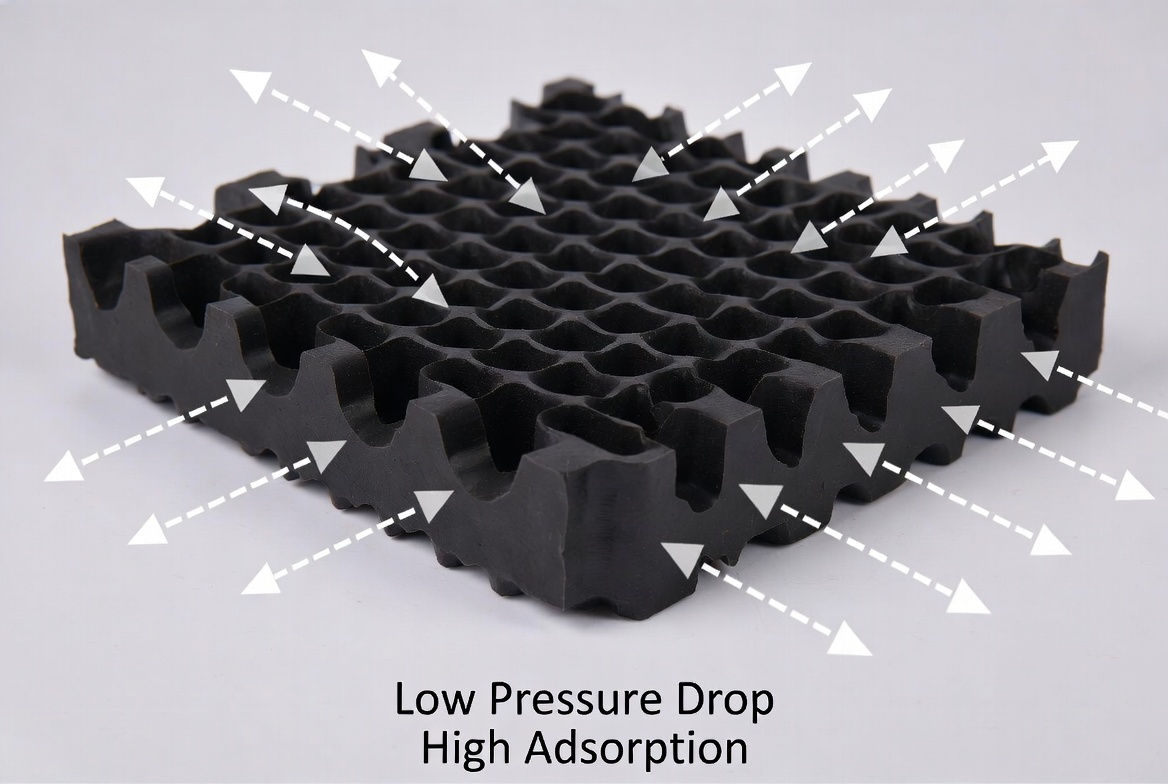
Honeycomb activated carbon is a highly efficient, low-pressure-drop adsorbent that, when used correctly, can dramatically improve industrial air and water purification performance while extending system life and reducing operating cost. This guide combines practical field experience with current industry best practices to help engineers, EHS managers and plant operators deploy honeycomb activated carbon safely, efficiently and with confidence. [xuyeequipment]
What Is Honeycomb Activated Carbon?
Honeycomb activated carbon is a monolithic adsorbent block, extruded or molded into a regular honeycomb structure (typically 50–400 cells per square inch) with thousands of parallel channels. Compared with granular or powdered carbon, it offers a much larger geometric surface area, uniform flow paths and significantly lower air or gas pressure drop at a similar adsorption capacity. [heycarbons]
In practice, this means air or gas streams can pass through the square channels, fully contacting the carbon surface while maintaining stable flow and fan energy consumption. Honeycomb blocks are widely used as core media in industrial exhaust treatment systems, VOC recovery, odor control and high-volume air filtration units. [activatedcarbon]
Key Industrial Applications
VOCs and Industrial Exhaust Gas Treatment (Air Phase)
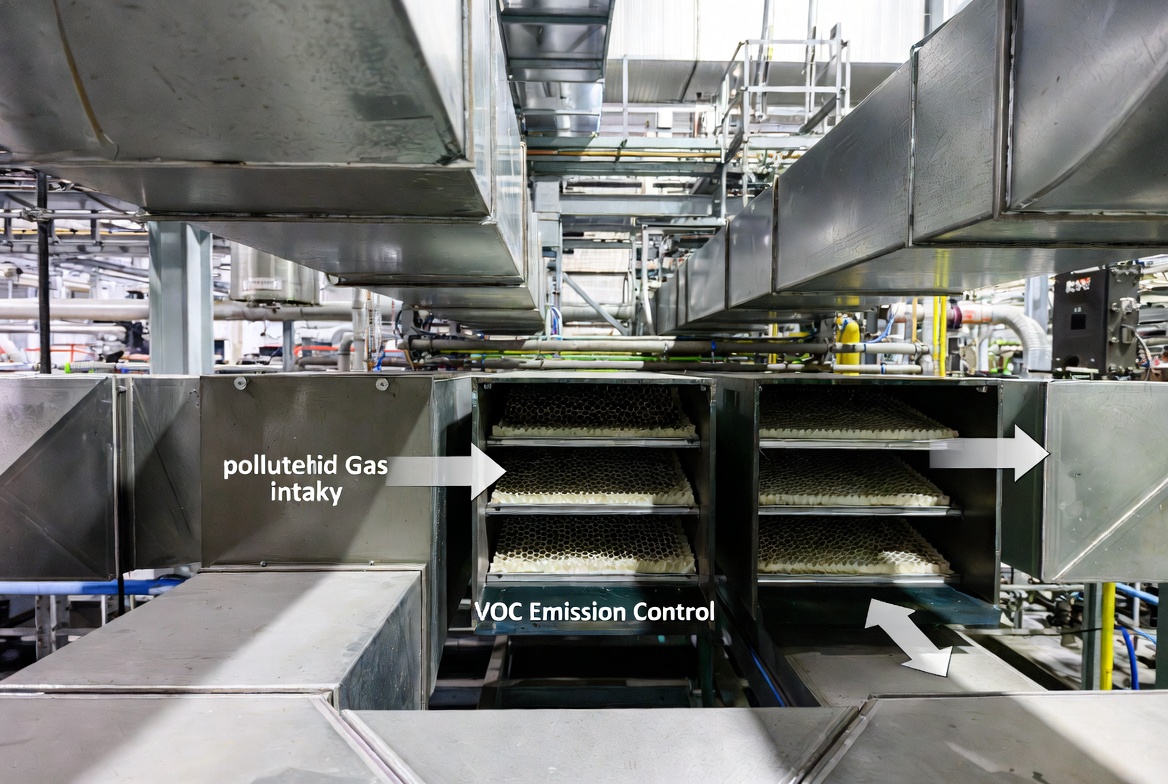
In industrial VOC control, honeycomb activated carbon is commonly installed in purification cabinets or adsorption beds handling low-concentration, large-air-volume organic waste gas. Typical pollutants include benzene, toluene, xylene, ketones, esters, petroleum solvents and odorous organics from coating, printing, chemical and electronics plants. [slideshare]
Because of its high geometric surface area and optimized pore structure (micro- and mesopores), honeycomb carbon can achieve adsorption efficiencies reported around 60–70% in appropriate designs, while keeping system resistance relatively low. In systems configured with dual beds, one bed adsorbs while the other is regenerated, enabling continuous VOC treatment for continuous production lines. [cdffu]
Air Purification and Odor Control
Honeycomb activated carbon is widely used in air purification equipment for indoor environments, underground sites, public facilities and odor-sensitive areas. It effectively adsorbs VOCs, ammonia, sulfides and other odorous gases, and is often incorporated into air filters, HVAC cassettes, kitchen fume treatment units and restaurant exhaust systems. [heycarbons]
In these applications, the low-pressure-drop characteristic is critical, because it allows higher airflow and quieter operation without oversizing fans or blowers. Honeycomb blocks can also be combined with HEPA or pre-filter stages to form multi-stage purification units that handle both particulates and gases. [xuyeequipment]
Water and Wastewater Treatment
Although honeycomb activated carbon is more commonly discussed for gas-phase adsorption, it is also used in certain water treatment and wastewater polishing scenarios. It can adsorb organic pollutants, residual color and odor compounds in drinking water preparation and sewage treatment polishing stages. [activatedcarbon]
Due to its monolithic structure, honeycomb carbon can reduce channeling and dead zones often seen with granular media, creating a more uniform contact flow path in specially designed columns or modular cartridges. In some designs, honeycomb modules are used as replaceable polishing units downstream of conventional granular activated carbon filters. [heycarbons]
Catalyst Support and Special Chemical Processes
In chemical processing, honeycomb activated carbon can act as a catalyst or catalyst carrier for gas-phase reactions. It is used in gas purification, gas separation, flue gas desulfurization and solvent recovery systems where both adsorption and catalytic reaction must occur under controlled conditions. [activatedcarbon]
Its uniform structure and high mechanical strength make it suitable for fixed-bed reactors subject to thermal cycling and repeated regeneration. Proper material selection (e.g., coal-based vs. wood-based carbon) and channel density selection are important to match the process requirements. [tkcarbon.en.made-in-china]
Step‑by‑Step Usage Instructions for Honeycomb Activated Carbon
From an industrial operations perspective, correct installation and use are crucial to achieving stable adsorption performance and long service life. The following step-by-step guidelines reflect both manufacturer recommendations and typical field practice. [cdffu]
1. Installation and System Configuration
1. Confirm design airflow, VOC concentration, gas temperature and humidity, and select honeycomb size and bed volume accordingly. [xuyeequipment]
2. Install honeycomb blocks tightly packed in purification cabinets or adsorption beds to avoid bypass gaps and uneven flow. [cdffu]
3. For high-emission or continuous processes, configure two cabinets or beds in rotation: one in adsorption mode, the other in desorption/regeneration mode. [xuyeequipment]
4. Ensure proper sealing, structural support and access doors for inspection, sampling and replacement. [cdffu]
2. Operating Temperature Control
Adsorption capacity of activated carbon decreases as temperature rises, so temperature control is essential. Many industrial honeycomb carbons are specified for operating temperatures below about 400 °C, but optimal adsorption is typically at much lower temperatures, depending on VOC type and process design. [activatedcarbon]
- Avoid exposing honeycomb carbon to unnecessary high temperatures in the adsorption phase, especially where exhaust gas is freshly discharged from ovens or reactors. [xuyeequipment]
- Where high-temperature gas is unavoidable, install heat exchangers or mixing zones to reduce temperature before the gas enters the adsorption bed. [cdffu]
3. Dust and Oil Mist Management
High levels of dust, tar or oil mist can clog the fine pores and channels of honeycomb carbon, increasing pressure drop and sharply reducing adsorption efficiency. This is one of the most common failure modes seen in real projects. [activatedcarbon]
- Always install suitable pre-filters, cyclone separators or demisters upstream if the process gas contains particulate matter, aerosols or tar. [xuyeequipment]
- Monitor differential pressure across the bed; a rapid increase often indicates dust or tar fouling and may require pre-filter optimization or carbon replacement. [cdffu]
4. Intermittent vs Continuous Operation
Honeycomb activated carbon can be used for both intermittent exhaust and continuous exhaust treatment when the system is properly designed. [activatedcarbon]
- In intermittent systems (e.g., batch processes), the bed typically adsorbs during operation and then rests, which can prolong service life if concentration and humidity are controlled. [cdffu]
- In continuous systems, use dual beds in parallel: one adsorbs while the other is desorbed and regenerated, often with hot air or steam and catalytic combustion of desorbed pollutants. [activatedcarbon]
Expert Tips to Maximize Performance and Service Life
Match Cell Density and Bed Depth to Your Process
Higher cell density (CPSI) and deeper beds generally deliver higher adsorption efficiency but also higher pressure drop. Conversely, lower density and shallower beds reduce resistance but may allow breakthrough at higher loadings. [qizhongcarbon]
In practice, many VOC treatment designs find a balance between these factors based on fan capacity, emission standards and energy cost per unit of exhaust treated. Working with a manufacturer that can model or test different density and bed depth combinations is an effective way to optimize performance. [tkcarbon.en.made-in-china]
Control Humidity and Condensation
High humidity can compete with organic molecules for adsorption sites, and condensation inside channels can rapidly plug the structure. Where exhaust streams contain significant moisture, ensure that gas temperature stays above dew point but within the acceptable range for the carbon. [carbonyihang]
In some designs, pre-dehumidification or reheating stages are added before the honeycomb bed to stabilize moisture levels. Regular inspection for signs of condensation or corrosion inside housings is also recommended. [carbonyihang]
Implement Monitoring and Preventive Maintenance
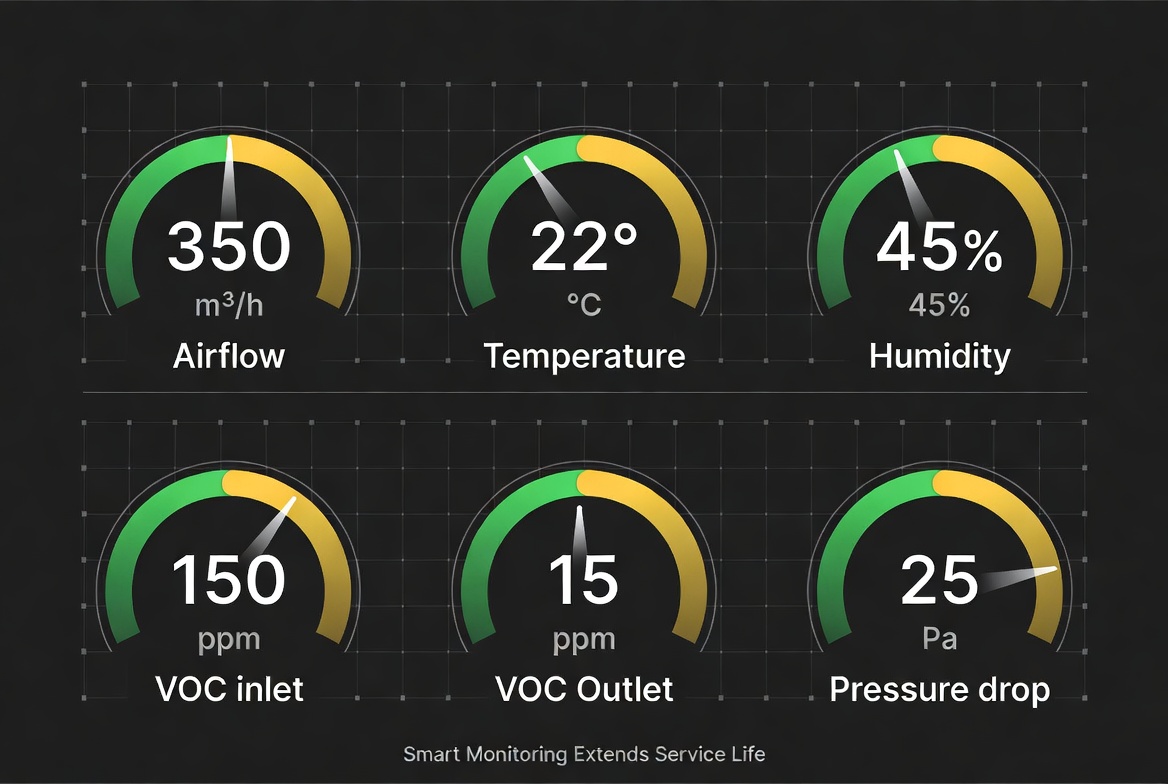
To maintain consistent performance, treat honeycomb activated carbon beds as critical process equipment rather than passive components. [xuyeequipment]
- Track inlet and outlet VOC concentration (where practical) to identify breakthrough trends.
- Monitor pressure drop to detect fouling or structural issues.
- Record operating temperature and humidity for root-cause analysis when performance drifts.
A simple maintenance log combining these parameters often helps plants extend bed life and schedule replacements just before adsorption capacity is exhausted, reducing risk and cost. [xuyeequipment]
Typical Specifications and Design Parameters
Below is an example of commonly used specification ranges for industrial honeycomb activated carbon blocks. Exact values should be confirmed against the technical datasheet of your chosen grade. [heycarbons]
| Parameter | Typical Range / Example value |
| Cell density (CPSI) | 50–400 cells per square inch heycarbons |
| Common block dimensions | 50×50×100 mm, 100×100×100 mm, custom sizes cdffu |
| Operating temperature (adsorption) | Often designed for < 400 °C, lower preferred cdffu |
| Key applications | VOCs, odors, air filtration, wastewater polishing heycarbons |
| Adsorption mechanism | Physical adsorption in micro/mesopores heycarbons |
| Regeneration methods | Hot air/steam desorption, catalytic combustion cdffu |
| Main advantages | High surface area, low pressure drop, high strength xuyeequipment |
For specialized industries such as pharmaceuticals, food and beverage or nuclear power, stricter purity, certification and traceability requirements may apply. In those cases, always work with a supplier that can provide full documentation and application-specific support. [tkcarbon.en.made-in-china]
Why Work With a Specialized Honeycomb Activated Carbon Manufacturer
A manufacturer that integrates research, production and application support can significantly reduce risk in critical air and water treatment projects. Guangdong Tongke Activated Carbon, for example, focuses on activated carbon solutions across wood-based, coal-based, coconut shell and honeycomb products for applications from air purification and water treatment to solvent recovery and power generation auxiliaries. [xmtkhxt]
Such suppliers typically offer technical consultation, customized formulations and shapes, and real-time quality control according to relevant national or industry standards. With large-scale production capacity and multi-base inventory, they can also secure continuity of supply for long-term industrial users. [tkcarbon.en.made-in-china]
Common Mistakes to Avoid (From Field Experience)
Based on industry practice, several recurring mistakes can seriously compromise honeycomb activated carbon performance: [slideshare]
- Selecting a bed volume that is too small for peak VOC load, leading to premature breakthrough.
- Running at excessively high exhaust temperature without cooling, drastically reducing adsorption capacity.
- Ignoring dust/oil pretreatment, causing rapid pore clogging and increased pressure drop.
- Operating near or below dew point, resulting in condensation and channel plugging.
- Treating the bed as "fit and forget" equipment, with no monitoring of concentration or pressure drop.
By proactively addressing these points at the design and commissioning stage, plants can avoid most unplanned shutdowns or early media replacement. [slideshare]
Practical Case Insight: VOC Treatment in Coating Line
In a typical metal coating line, large-volume exhaust gas contains low to medium concentration of solvent-based VOCs such as toluene and xylene. Honeycomb activated carbon is often chosen because its low pressure drop allows integration into existing exhaust systems without major fan upgrades. [slideshare]
The system may use two honeycomb beds: one adsorbs VOCs during coating and drying, while the other is regenerated with hot air and catalytic combustion of desorbed solvent. With proper pretreatment, monitoring and regeneration control, such systems can operate continuously, achieving stable emission control with energy recovery from the solvent-rich regeneration stream. [heycarbons]
Safety and Regulatory Considerations
From a compliance perspective, honeycomb activated carbon systems must be designed not only for efficiency but also for safety and regulatory alignment. Flammable VOC mixtures, high-temperature operation and the presence of oxygen require proper explosion-proof design, grounding, and monitoring of LEL (lower explosive limit) where applicable. [carbonyihang]
Moreover, spent activated carbon, especially from hazardous chemical processes, may fall under specific waste codes and require controlled handling, transport and disposal or regeneration via licensed facilities. Collaboration between plant environmental, safety and procurement teams is essential to define responsibilities and documentation flow throughout the media life cycle. [carbonyihang]
When to Consult an Expert
If you are unsure about any of the following, it is wise to consult a honeycomb activated carbon specialist or system integrator early in the project: [tkcarbon.en.made-in-china]
- Correct bed size and cell density for your exact VOC and airflow conditions
- Expected breakthrough time and regeneration cycle design
- Integration with existing fans, ducts and control systems
- Material compatibility, corrosion risks and condensation control
An experienced supplier can provide adsorption calculations, pilot testing or on-site evaluation to ensure that the final solution is robust, compliant and cost-effective over the full life cycle. [heycarbons]
Call to Action
If you are planning or upgrading an air or water purification system and want to maximize performance with honeycomb activated carbon, consider partnering with a specialized manufacturer that can provide both high-quality media and engineering support throughout the project life cycle. By sharing your process data (airflow, VOC type, temperature, humidity and emission targets), you can receive a tailored solution that optimizes adsorption efficiency, operating cost and long-term reliability. [tkcarbon.en.made-in-china]
FAQs About Honeycomb Activated Carbon
1. How often should honeycomb activated carbon be replaced or regenerated?
Replacement or regeneration frequency depends on VOC loading, operating temperature, humidity and whether pre-filtration is effective. In industrial practice, service life can range from several months to multiple years when systems are properly designed and maintained. [slideshare]
2. Can honeycomb activated carbon be used for both air and water treatment?
Yes, it is widely used for air and gas purification, and can also be employed in specific water and wastewater polishing applications when the system design matches its monolithic structure. However, many water treatment projects still prefer granular carbon for bulk adsorption beds, with honeycomb modules acting as specialized polishing stages. [heycarbons]
3. What is the difference between honeycomb and granular activated carbon in VOC systems?
Honeycomb carbon offers lower pressure drop and more uniform flow, which is beneficial for large air volumes and energy-sensitive systems. Granular carbon, by contrast, is more flexible for retrofitting small vessels but can be more prone to channeling and higher fan energy consumption at similar performance. [heycarbons]
4. How do I know if my honeycomb bed is saturated?
Indicators include rising outlet VOC concentration (breakthrough), reduced removal efficiency and, in some cases, significant temperature changes inside the bed. Regular sampling or online monitoring combined with historical data will help predict saturation before emissions exceed permitted limits. [cdffu]
5. Is honeycomb activated carbon suitable for food and pharmaceutical environments?
It can be used in food and pharma-related applications, such as odor control, off-gas treatment and certain purification steps, provided that the grade meets relevant purity and regulatory requirements. Always confirm certifications, testing data and traceability documentation with your supplier before specifying the product. [tkcarbon.en.made-in-china]
References
1. Honeycomb Activated Carbon usage information and typical operating cautions (dust, temperature, dual-bed operation) – [Xuye Equipment – Honeycomb Activated Carbon]. [xuyeequipment]
2. Structural features, advantages and application fields of honeycomb activated carbon – [Heycarbons – Honeycomb Activated Carbon]. [heycarbons]
3. Company profile, product range and technical service capabilities for a multi-base activated carbon manufacturer – [Guangdong Tongke Activated Carbon Co., Ltd.]. [tkcarbon.en.made-in-china]
4. General definition, manufacturing overview and application summary of honeycomb activated carbon – [ActivatedCarbon.net – What Is Honeycomb Activated Carbon?]. [activatedcarbon]
5. Example specifications and usage notes (dimensions, operating temperature, dual adsorbents) for honeycomb activated carbon filters – [Chengdu FFU – Honeycomb Activated Carbon Filter]. [cdffu]
6. Overview of activated carbon mechanisms in air and water purification and impact of pore structure and pollutants – [Carbonyihang – How Activated Carbon Improves Air and Water Purification Results]. [carbonyihang]
7. Additional industrial application context and service life considerations for honeycomb filters – [Slideshare – Honeycomb Activated Carbon Applications]. [slideshare]


