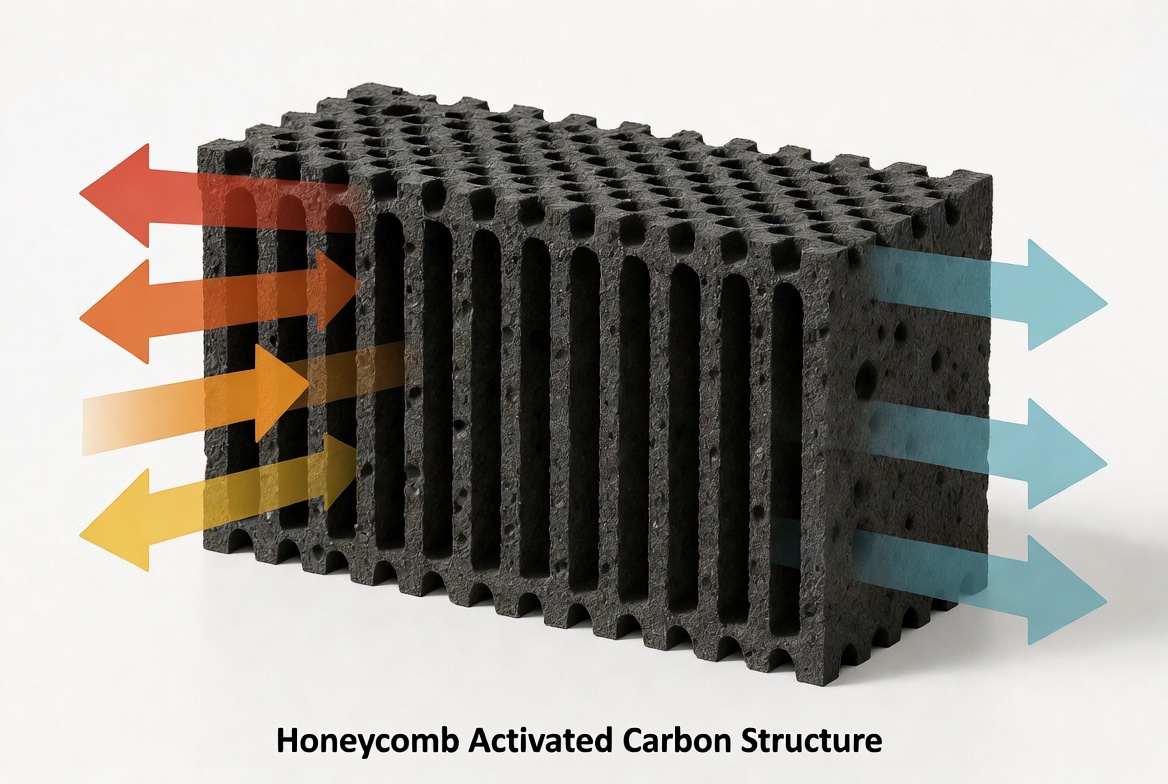
Honeycomb activated carbon with high CTC value has become one of the most efficient and cost-effective solutions for VOC adsorption in industrial exhaust and process gas streams, especially when designed and manufactured by specialized suppliers like Guangdong Tongke Activated Carbon Co., Ltd. In this guide, I will walk you through how honeycomb activated carbon works, why CTC value matters, and how to select and operate the right VOC adsorption system for your plant based on field experience and current market data. [huameicarbon]
What Is Honeycomb Activated Carbon?
Honeycomb activated carbon is a structured adsorbent made from coal or wood-based activated carbon formed into a honeycomb or cube shape with multiple channels running through the block. These channels create a large contact area with low pressure drop, allowing high-volume air or gas to pass through while volatile organic compounds (VOCs) are efficiently adsorbed on the internal pore structure. [huameicarbon]
Typical industrial honeycomb blocks:
- Are made from coal-based activated carbon with high specific surface area (usually 400–800 m²/g). [tkcarbon.en.made-in-china]
- Come in standard sizes such as 100 × 100 × 100 mm, 100 × 100 × 50 mm, or customized dimensions for OEM systems. [tkcarbon.en.made-in-china]
- Feature straight channels that balance high adsorption efficiency and low pressure drop in continuous exhaust systems. [watertechsh]
Why CTC Value Matters for VOC Adsorption
When you evaluate honeycomb activated carbon for VOC control, CTC value (Carbon Tetrachloride Activity, often written as CTC%) is one of the most critical performance indicators. [cdn.ez-pdh]
Understanding CTC Value
CTC value measures how much carbon tetrachloride vapor a certain mass of activated carbon can adsorb under standard conditions. In practice, a higher CTC value generally means: [cdn.ez-pdh]
- Higher micropore volume
- Greater adsorption capacity for many VOCs
- Better overall performance in VOC removal systems [huameicarbon]
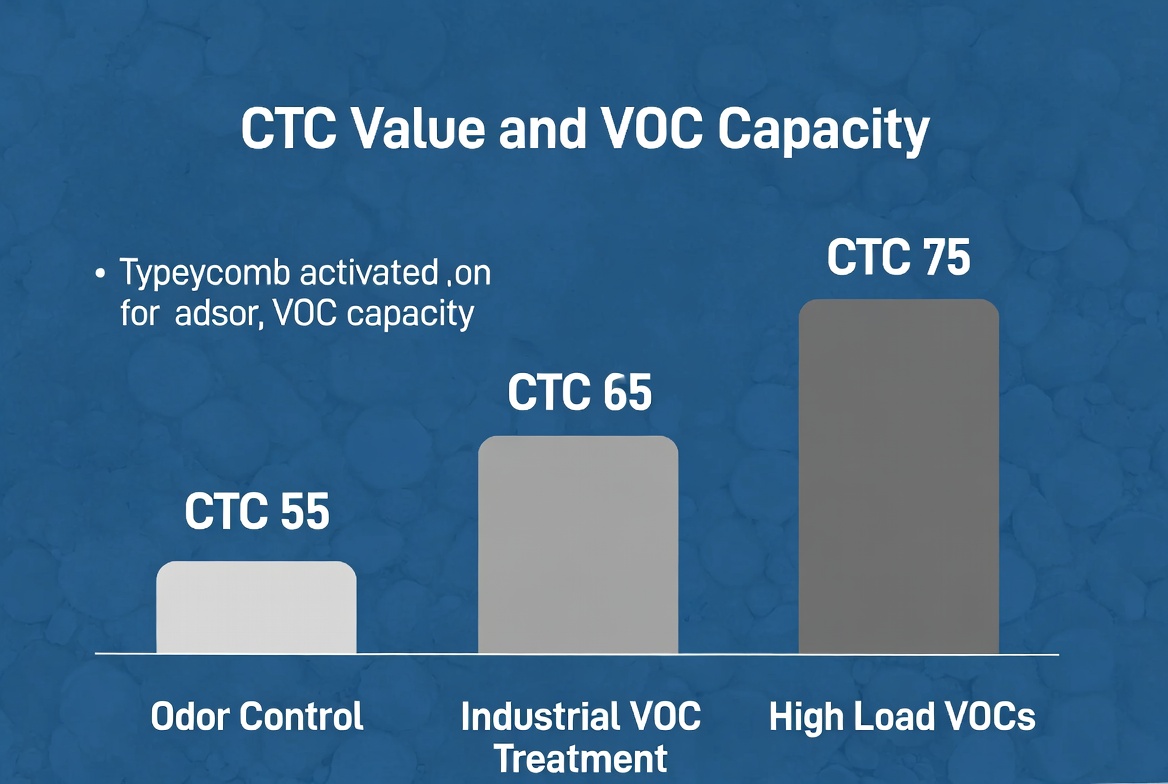
For industrial honeycomb activated carbon used in VOC adsorption, typical CTC ranges are:
- CTC 50–60%: Suitable for general odor control and low VOC loading. [huameicarbon]
- CTC 60–70%: Used in most standard industrial VOC treatment applications. [tkcarbon.en.made-in-china]
- CTC ≥ 70%: Selected for demanding applications with high VOC concentration or strict outlet limits (e.g., solvent recovery, chemical plants). [tkcarbon.en.made-in-china]
As a rule of thumb, if you are dealing with continuous exhaust with mixed VOCs (e.g., printing, coating, electronics), CTC 60–70% is often a good balance between performance and cost. [tkcarbon.en.made-in-china]
Key Applications of Honeycomb Activated Carbon for VOC Adsorption
Honeycomb activated carbon CTC is widely used in air and gas purification systems across many industries because of its robust performance and ease of installation. [tongkeac]
Typical Industrial Sectors
- Chemical and petrochemical plants – VOC removal from process vents, storage tanks, and solvent recovery systems. [huameicarbon]
- Coating, painting and printing lines – Adsorption of aromatic hydrocarbons, alcohols, and ketones from exhaust gas to meet emission limits. [huameicarbon]
- Electronics and semiconductor manufacturing – Odor and VOC control in cleanroom ventilation and process exhaust. [xingsencarbon]
- Food and beverage – Odor control and removal of organic vapors in processing and packaging. [tongkeac]
- Pharmaceutical manufacturing – VOC removal from reactors and drying equipment to protect workers and meet environmental regulations. [tongkeac]
In many of these sectors, honeycomb blocks are installed in modular filter housings or packed towers, making replacement and maintenance straightforward while keeping pressure drop low. [xingsencarbon]
How Honeycomb Activated Carbon Works for VOC Removal
Understanding the basic adsorption mechanism helps you design and operate your system more effectively.
Adsorption Mechanism
- VOC molecules diffuse into the micropores and mesopores of the activated carbon. [huameicarbon]
- Van der Waals forces and specific interactions cause VOC molecules to bind to the carbon surface. [cdn.ez-pdh]
- The honeycomb structure ensures uniform flow distribution and high contact time while minimizing channeling and pressure loss. [huameicarbon]
When the carbon becomes saturated, you can either replace the blocks or apply thermal or steam regeneration, depending on your system design and local regulations. [cdn.ez-pdh]
Advantages of Honeycomb Activated Carbon vs. Granular Carbon
From an engineer's perspective, choosing between honeycomb and granular activated carbon (GAC) is not just a lab decision; it has direct impact on system pressure drop, maintenance downtime, and operating cost.
Practical Advantages
- Lower pressure drop: Straight channels reduce resistance, making honeycomb ideal for high air volumes or retrofits to existing fans. [watertechsh]
- Compact design: Higher packing density and structured geometry allow more adsorption capacity in a smaller footprint. [huameicarbon]
- Easy replacement: Blocks can be replaced module by module without removing loose media, simplifying maintenance workflows. [xingsencarbon]
- Stable performance: Uniform flow distribution minimizes dead zones and channeling compared to loosely packed GAC beds. [watertechsh]
However, honeycomb carbon must be carefully selected and regularly monitored; its performance will decline when the adsorption capacity is exhausted, especially in high VOC load applications. [watertechsh]
Global Market Trends for VOC Adsorption and Activated Carbon
To justify investment in high-CTC honeycomb carbon, many decision-makers want to see where the market is heading.
- The global activated carbon market is projected to grow from around USD 5.90 billion in 2026 to about USD 11.47 billion by 2033, driven by stricter environmental regulations and increased adoption in gas and water treatment. [coherentmarketinsights]
- Market research indicates steady growth in honeycomb and structured carbons for industrial exhaust and VOC control in Europe and Asia, supported by energy-efficient air pollution control solutions. [linkedin]
- Regulatory pressure on VOC emissions in manufacturing, coatings, chemicals and electronics remains a key driver for upgrading from simple filters to high-performance honeycomb carbon systems. [grandviewresearch]
These trends confirm that investing in efficient VOC adsorption is not only about compliance but also about staying competitive in export markets with stricter environmental standards. [coherentmarketinsights]
Product Features of Tongke Honeycomb Activated Carbon (CTC)
As a Chinese manufacturer with integrated R&D, production and international export operations, Guangdong Tongke Activated Carbon Co., Ltd. offers honeycomb activated carbon solutions tailored to industrial VOC treatment projects worldwide. [tkcarbon.en.made-in-china]
Typical Technical Features
- Base material: Coal-based activated carbon with high mechanical strength and excellent pore structure. [tkcarbon.en.made-in-china]
- CTC value: Commonly in the 60–80% range, depending on the VOC application and project requirements. [tkcarbon.en.made-in-china]
- Surface area: Typically 400–800 m²/g to ensure high adsorption capacity. [tkcarbon.en.made-in-china]
- Ash content: Usually controlled at 10–15% to balance cost and performance. [tkcarbon.en.made-in-china]
- Block dimensions: Standard 10 × 10 × 10 cm and 10 × 10 × 5 cm blocks, with custom sizes available for OEM systems. [tkcarbon.en.made-in-china]
- Applications: Chemical, power, environmental protection, food, gold, petrochemical, gas purification and other VOC-intensive industries. [tongkeac]
Tongke also provides professional customization based on national standards or customer-specific specifications, enabling you to match carbon properties with your VOC composition and process conditions. [tkcarbon.en.made-in-china]
Typical Specifications Table (Example)
Below is an example of how honeycomb activated carbon CTC for VOC adsorption is typically specified in industrial projects. [tkcarbon.en.made-in-china]
Use this table as a starting point when preparing technical specifications, RFQs, or internal approval documents for your VOC treatment system.
How to Select the Right Honeycomb Activated Carbon CTC Grade
From a practical engineering standpoint, selecting the right carbon is a step-by-step process rather than a one-line decision.
Step 1: Identify Your VOC Profile
- List major VOCs (e.g., toluene, xylene, alcohols, ketones). [cdn.ez-pdh]
- Determine concentration range (mg/m³ or ppm) and flow rate. [cdn.ez-pdh]
- Check whether the VOC mixture is hydrophilic, hydrophobic, or mixed, as this influences adsorption behavior. [huameicarbon]
Step 2: Define Performance Targets
- Emission limit at outlet (e.g., mg/m³ or ppm).
- Allowable pressure drop for the system.
- Required service life before replacement or regeneration (e.g., months of operation). [watertechsh]
Step 3: Choose CTC Range and Block Design
- For low to medium VOC loads and general odor control, CTC 50–60% may be sufficient. [huameicarbon]
- For industrial VOC control with strict regulations, CTC 60–70% is often recommended. [tkcarbon.en.made-in-china]
- For heavy-duty or high-value solvent recovery, CTC ≥ 70% should be considered. [tkcarbon.en.made-in-china]
At this stage, many plant engineers work closely with vendors like Tongke to simulate breakthrough curves and estimate bed life using their actual process data. [tkcarbon.en.made-in-china]
Best Practices for Operating Honeycomb Activated Carbon VOC Systems
Operating your honeycomb carbon system correctly extends service life and ensures compliance.
Installation and Start-Up
- Ensure even airflow distribution across the honeycomb blocks to avoid localized overloading. [xingsencarbon]
- Install pre-filters to remove dust and aerosols that can block pores or cause fouling. [huameicarbon]
- Avoid temperature spikes above the design limit, as high temperature reduces adsorption capacity. [cdn.ez-pdh]
Monitoring and Maintenance
- Periodically monitor inlet and outlet VOC concentration to detect breakthrough. [cdn.ez-pdh]
- Check pressure drop across the bed; a rising pressure drop may indicate clogging or fouling. [xingsencarbon]
- Implement a replacement or regeneration schedule based on operation hours, VOC load and monitoring data instead of waiting for compliance failures. [cdn.ez-pdh]
Many successful users integrate online VOC analyzers or periodic sampling campaigns with their environmental management systems, especially in export-oriented factories subject to audits. [grandviewresearch]
Real-World Example: VOC Control in a Coating Line
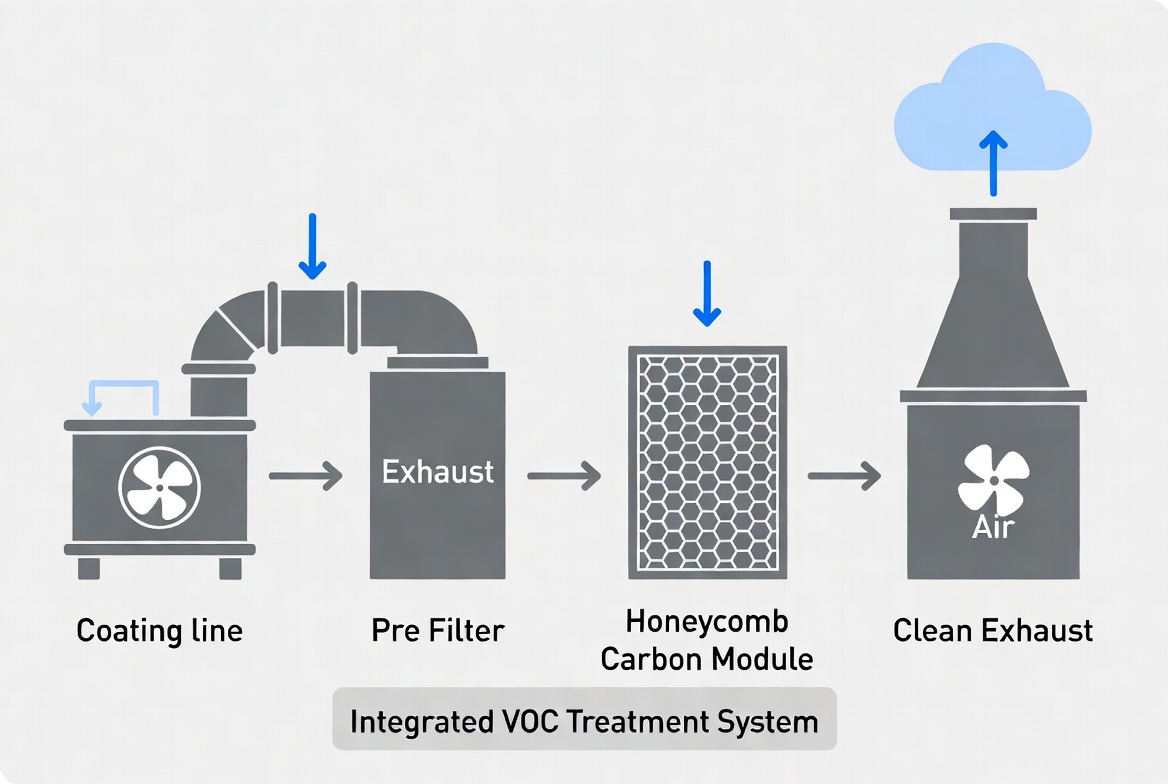
In a typical automotive or metal coating plant, exhaust gas from the drying oven carries a mixture of aromatic hydrocarbons and oxygenated VOCs. A common solution uses a honeycomb activated carbon module with: [huameicarbon]
- Flow rates in the range of 10,000–50,000 m³/h.
- CTC 60–70% honeycomb carbon blocks arranged in multiple layers. [tkcarbon.en.made-in-china]
- Target outlet VOC concentration below local emission limits. [huameicarbon]
By choosing the right carbon grade, optimizing airflow and installing proper pre-filters, operators often achieve significant VOC reduction with reasonable replacement intervals and controlled operating costs. [tkcarbon.en.made-in-china]
Why Work with Guangdong Tongke Activated Carbon Co., Ltd.
From an export buyer's perspective, choosing a partner is as important as selecting a material.
Company Strengths
- Integrated R&D and production: Tongke operates manufacturing bases in Guangdong and other provinces, supplying multiple types of activated carbon (powder, granular, pellet, honeycomb, wood-based, coconut shell). [tkcarbon.en.made-in-china]
- Industrial focus: Products are used in air purification, water treatment, food processing, solvent recovery, thermoelectric and nuclear power, and many other industrial sectors. [tkcarbon.en.made-in-china]
- Customization and on-time delivery: The company emphasizes customized services and maintains around 30,000 tons production capacity and multiple stock bases, supporting stable and sustainable supply for global clients. [tkcarbon.en.made-in-china]
For international buyers, having a manufacturer that can co-design VOC adsorption solutions, handle OEM specifications and support documentation helps streamline project execution and compliance audits. [tongkeac]
Call to Action: Request a Tailored VOC Adsorption Solution
If you are planning a new VOC treatment system or upgrading an existing one, working with a specialized honeycomb activated carbon manufacturer can significantly reduce your technical and compliance risk. [tongkeac]
Contact Guangdong Tongke Activated Carbon Co., Ltd. for:
- Application-specific CTC grade recommendations based on your VOC profile. [tkcarbon.en.made-in-china]
- Customized block sizes and module designs to fit your existing equipment. [tkcarbon.en.made-in-china]
- Technical support on system design, performance estimation and lifecycle cost analysis. [tongkeac]
You can reach Tongke via their published contact channels (phone, email, WhatsApp) to discuss your project data and get a tailored proposal. [tongkeac]
Frequently Asked Questions (FAQ)
1. What CTC value should I choose for general VOC adsorption?
For most industrial VOC applications with moderate concentrations and typical emission limits, a CTC value between 60% and 70% offers a good balance between performance and cost. For high VOC loads or strict outlet limits, higher CTC grades may be required. [tkcarbon.en.made-in-china]
2. How long does honeycomb activated carbon last in VOC service?
Service life depends on VOC concentration, airflow, operating hours and temperature, but many plants operate honeycomb carbon modules for several months before replacement or regeneration. Monitoring outlet VOC levels and pressure drop is the most reliable way to determine replacement intervals. [watertechsh]
3. Can honeycomb activated carbon be regenerated?
Yes, honeycomb activated carbon can often be regenerated using thermal or steam processes, depending on VOC type and system design. However, regeneration feasibility and cost should be evaluated case by case, considering safety, regulations and energy consumption. [cdn.ez-pdh]
4. What are the main limitations of honeycomb activated carbon for VOC control?
Key limitations include reduced adsorption capacity at high temperatures, eventual saturation of pores and sensitivity to dust or aerosols that can block channels. Proper pre-filtration, design and maintenance can significantly mitigate these issues. [watertechsh]
5. How is honeycomb activated carbon different from granular activated carbon in VOC systems?
Honeycomb activated carbon offers lower pressure drop, more compact installation and easier module replacement compared to granular beds, which are usually packed in deep layers. Granular beds can be flexible in non-structured systems, but are more prone to channeling and may require more complex maintenance. [huameicarbon]
References
1. Huamei Carbon – "What is Honeycomb Activated Carbon?" [huameicarbon]
https://www.huameicarbon.com/what-is-honeycomb-activated-carbon/
2. Huamei Carbon – "Activated Carbon for VOC Removal" [huameicarbon]
https://www.huameicarbon.com/activated-carbon-for-voc-removal/
3. Coherent Market Insights – "Activated Carbon Market Size, Share and Forecast 2026–2033" [coherentmarketinsights]
https://www.coherentmarketinsights.com/industry-reports/activated-carbon-market
4. Grand View Research – "Activated Carbon Market Size & Share" [grandviewresearch]
https://www.grandviewresearch.com/industry-analysis/activated-carbon-market
5. WaterTech SH – "Should Honeycomb Activated Carbon Be Eliminated for VOC Treatment?" [watertechsh]
https://www.watertechsh.com/should-honeycomb-activated-carbon-be-eliminated-for-voc-treatment/
6. Guangdong Tongke Activated Carbon Co., Ltd. – Company Introduction & Product Pages [tkcarbon.en.made-in-china]
https://tkcarbon.en.made-in-china.com
https://www.tongkeac.com/Application.html
7. Carbon Adsorption of Volatile Organic Compounds (VOCs) – Technical PDF [cdn.ez-pdh]
https://cdn.ez-pdh.com/course-material/AP203-Carbon-Absorption-of-Volatile-Organic-CompoundsVOCs1.pdf
8. Xingsen Carbon – "Honeycomb Activated Carbon – High-Efficiency Industrial Waste Gas" [xingsencarbon]
https://www.xingsencarbon.com/products/honeycomb-activated-carbon/


