Content Menu
● Why Coconut Shell Activated Carbon Leads Gold Recovery
● How Coconut Shell Activated Carbon Works in CIP, CIL and CIC
>> Core cyanidation and adsorption mechanism
>> CIP – Carbon-in-Pulp
>> CIL – Carbon-in-Leach
>> CIC – Carbon-in-Column
● Key Performance Parameters: K-Value, R-Value and Hardness
>> K-value – Equilibrium loading capacity
>> R-value – Adsorption rate
>> Hardness and attrition resistance
● Step-by-Step View of Gold Recovery with Coconut Shell Carbon
>> 1. Ore preparation and leaching
>> 2. Adsorption onto activated carbon
>> 3. Separation, elution and regeneration
● Practical Quality Checklist When Sourcing Coconut Shell Carbon
● Reducing Operational Risk: Common Problems and Plant Responses
>> Excessive carbon attrition and gold losses
>> Low adsorption efficiency or high tails solution grades
>> Inconsistent carbon activity after regeneration
● Sustainability and Regulatory Considerations
● Real-World Application: How Optimized Coconut Shell Carbon Transforms Gold Plants
● How Process Engineers Can Improve Existing Circuits
● FAQs on Coconut Shell Activated Carbon for Gold Recovery
● References
Coconut shell activated carbon has become the silent workhorse behind modern gold recovery, delivering high gold-loading capacity and robust performance in demanding CIP, CIL, and CIC circuits. From day-to-day discussions with plant engineers and carbon specialists, it is clear that treating carbon as a precision tool—not a generic consumable—consistently leads to higher yield, lower losses, and more predictable operating costs.
In gold plants worldwide, coconut shell activated carbon is now the dominant adsorbent for cyanide-leach solutions thanks to its high hardness, highly developed microporous structure, and strong resistance to attrition. When properly selected, operated, and regenerated, it can significantly improve gold loading, reduce tails losses, and cut make-up carbon costs in both new and existing operations.
Why Coconut Shell Activated Carbon Leads Gold Recovery
Coconut shell-based carbons have steadily displaced coal and wood-derived carbons for precious metal recovery. This shift is driven by performance advantages that translate directly into improved plant economics.
- Microporous structure: Coconut shell carbon has a high proportion of micropores in the 1–2 nm range, closely matching the size of Au(CN)2- complexes and enhancing loading capacity.
- High hardness and low attrition: The strong mechanical structure withstands agitation, pumping, and screening with minimal fines generation, preserving gold-bearing carbon inventory.
- Consistent particle size: Well-controlled granule sizes, often 6×12 or 8×16 mesh, maintain predictable kinetics and hydraulic performance in CIP, CIL, and CIC systems.
Feedback from operating plants shows that premium coconut shell grades typically deliver stronger equilibrium capacity (K-value) and faster adsorption rate (R-value) than generic carbons, especially under high cyanide and high slurry density conditions.

How Coconut Shell Activated Carbon Works in CIP, CIL and CIC
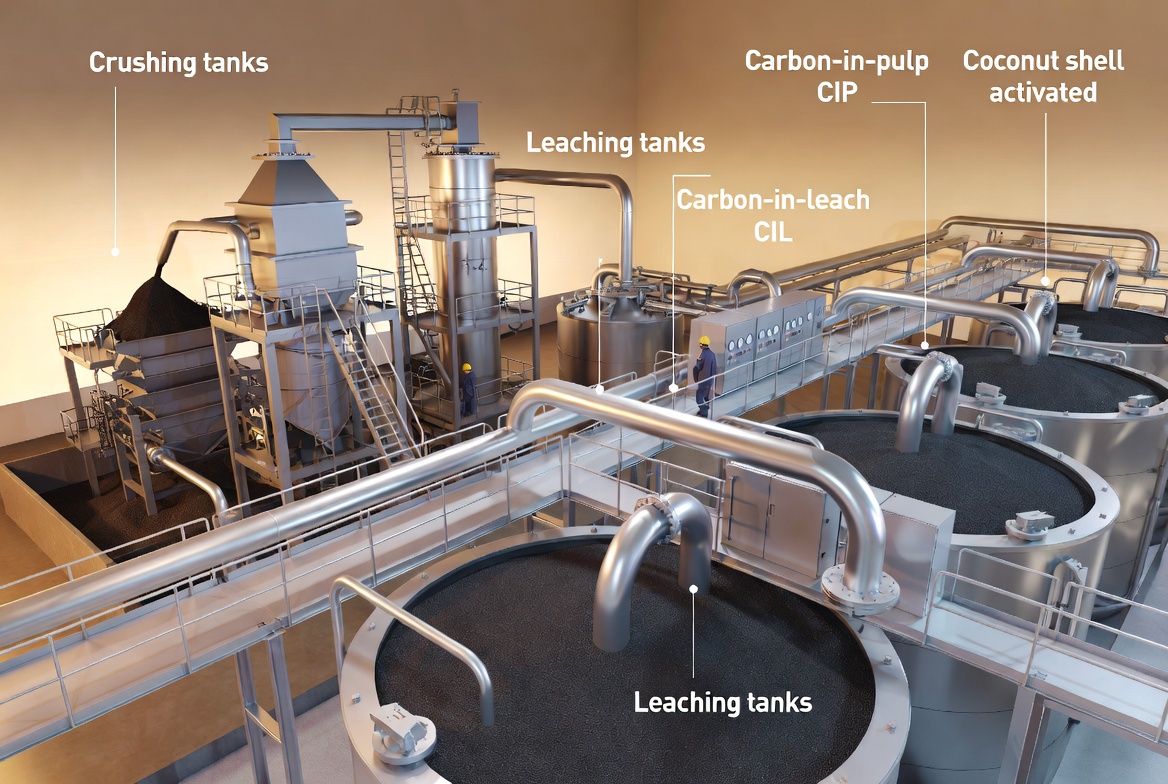
Gold recovery by cyanide leaching follows a broadly similar flow sheet across many mines, but the way carbon is deployed—CIP, CIL or CIC—changes circuit design and operating focus.
Core cyanidation and adsorption mechanism
After crushing and grinding, ore is leached with cyanide solution to form soluble gold-cyanide complexes. Granular coconut shell activated carbon is then introduced to contact this solution so that gold is selectively adsorbed onto the carbon surface and within its micropores.
Key steps include:
1. Leaching – formation of cyanide-gold complexes in slurry or heap solutions.
2. Adsorption – contact between solution and carbon, often across multiple stages for equilibrium loading.
3. Elution and regeneration – stripping gold from loaded carbon and restoring carbon activity for reuse.
CIP – Carbon-in-Pulp
In CIP circuits, leaching and adsorption are separated.
- Leaching tanks produce a gold-rich pulp.
- Carbon is added downstream and moves counter-current to the pulp.
- Strong slurry–carbon mixing is required, while protecting carbon strength.
CIP operators usually place heavy emphasis on mechanical strength, because extended agitation and multiple transfer steps increase attrition risk.
CIL – Carbon-in-Leach
In CIL systems, carbon is introduced directly into the leach tanks, so leaching and adsorption occur simultaneously.
- This can reduce the number of tanks and accelerate overall gold recovery.
- It demands careful control of cyanide concentration, dissolved oxygen, and carbon inventory.
Since gold is adsorbed as it is leached, plants using CIL are particularly sensitive to adsorption rate (R-value), making fast-kinetics coconut carbons a frequent specification.
CIC – Carbon-in-Column
CIC is widely used in heap leach operations where a relatively clear pregnant solution is collected and passed through packed carbon columns.
- Fixed-bed columns are filled with granular carbon.
- Pregnant solution flows through the bed, allowing gold adsorption without agitation.
In CIC, uniform particle size and low pressure drop are critical, while hardness still matters to prevent fines that can cause channeling and column plugging.
Key Performance Parameters: K-Value, R-Value and Hardness
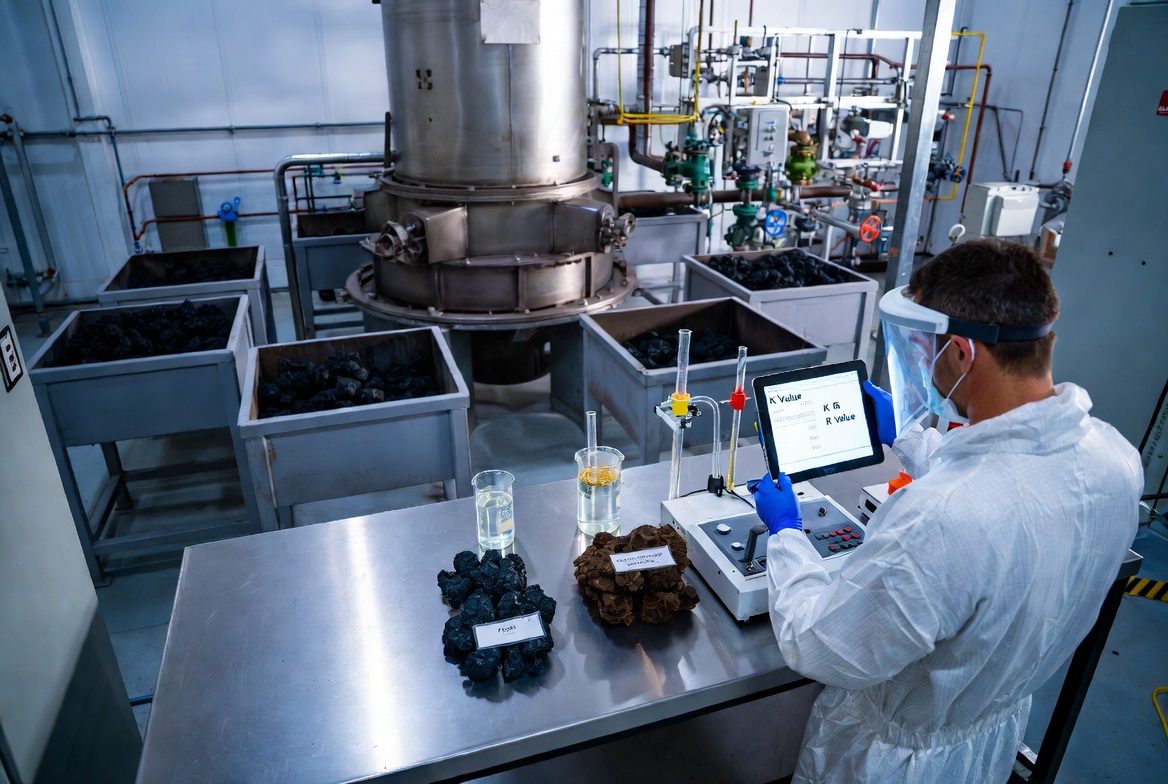
Gold plants that treat carbon performance as a measurable variable rather than a fixed assumption often unlock quick gains. K-value, R-value and hardness are three metrics that directly influence recovery and cost.
K-value – Equilibrium loading capacity
K-value describes how much gold a carbon can hold at equilibrium under defined conditions.
- Higher K-values mean more grams of gold per kilogram of carbon at similar solution grades.
- This allows plants to run higher loaded carbon levels before transfer, reducing carbon movement and handling costs.
Coconut shell carbons engineered for gold recovery typically show superior K-values compared with general-purpose carbons due to their optimized micropore structure.
R-value – Adsorption rate
R-value reflects how quickly gold is adsorbed from solution.
- Fast kinetics are vital in CIL and CIP where contact time is limited by tank residence time.
- Higher R-values allow fewer tanks, shorter contact time, or improved recovery at existing throughput.
Sites with elevated tailings solution grades often discover that upgrading to high-R-value coconut shell carbon, combined with better mixing, can noticeably reduce soluble gold losses.
Hardness and attrition resistance
Mechanical strength affects how well carbon survives real operating conditions.
- Strong carbon produces fewer fines in pumps, screens, and tanks.
- Lower fines reduce gold losses via carbon-in-tailings and maintain a stable carbon inventory.
Monitoring carbon activity, attrition rate, and loaded gold distribution across size fractions gives plant teams an early signal when carbon quality drifts and regeneration or replacement is required.
Step-by-Step View of Gold Recovery with Coconut Shell Carbon
From an operator's standpoint, gold recovery with coconut shell activated carbon can be broken into clear, controllable stages.
1. Ore preparation and leaching
- Crush and grind ore to target particle size to liberate gold.
- Prepare slurry with process water and set solids density.
- Add cyanide and control pH, dissolved oxygen, and residence time to maximize gold dissolution.
2. Adsorption onto activated carbon
- Introduce coconut shell activated carbon into CIP or CIL tanks, or into columns for CIC.
- Promote efficient mixing or controlled flow to maximize solution–carbon contact.
- Track solution grades between stages to confirm that adsorption is performing as expected.
3. Separation, elution and regeneration
- Screen or separate gold-bearing carbon from slurry or column beds.
- Strip gold using thermal or chemical elution; the resulting eluate feeds electrowinning or other refining steps.
- Regenerate carbon, commonly in rotary kilns at high temperature, to burn off organics and restore activity before returning it to the circuit.
A disciplined approach to each step gives plants a structured method to troubleshoot recovery issues, instead of treating poor performance as an unavoidable ore limitation.
Practical Quality Checklist When Sourcing Coconut Shell Carbon
Mines and carbon manufacturers who achieve the most stable performance usually follow a structured checklist instead of buying purely on unit price.
| Parameter | Why it matters for gold plants |
| Iodine number / CTC | Indicates overall adsorption capacity and pore development. |
| K-value and R-value | Direct indicators of gold loading and adsorption speed. |
| Hardness / abrasion number | Predicts attrition rate and carbon fines losses. |
| Particle size (e.g., 6×12) | Balances kinetics with hydraulic behavior and screening. |
| Ash and moisture content | Affect regeneration, handling and effective capacity. |
Standardizing these parameters in technical specifications helps reduce unplanned carbon changes and supports more stable gold recovery over time.
Reducing Operational Risk: Common Problems and Plant Responses
Even high-quality coconut shell activated carbon can underperform if the circuit is not tuned around its characteristics. Across different sites, operators report a similar set of challenges.
Excessive carbon attrition and gold losses
Typical symptoms are high carbon fines in tailings, increased make-up carbon consumption, and lower loaded carbon grades.
Practical responses include:
- Selecting carbon with higher abrasion resistance and hardness.
- Minimizing unnecessary pumping and high-shear agitation.
- Optimizing screen design and maintenance to reduce mechanical damage.
Low adsorption efficiency or high tails solution grades
Where dissolved gold grades in tailings stay high, plants often face a combination of process and material factors.
Common improvement actions:
- Upgrading to faster-kinetics coconut shell carbon.
- Increasing carbon concentration or number of adsorption stages.
- Tightening control of pH, cyanide concentration, and dissolved oxygen in leach and adsorption stages.
Inconsistent carbon activity after regeneration
Regeneration aims to restore capacity; if poorly controlled, it can damage the carbon or leave residual organics.
Operators can adjust by:
- Fine-tuning kiln temperature and residence time to avoid over- or under-burning.
- Managing feed moisture and avoiding contamination with tramp metals or lubricants.
- Periodically benchmarking regenerated carbon against fresh carbon samples.
Sustainability and Regulatory Considerations
Coconut shell activated carbon supports more responsible mining because it can be reused over many cycles and is derived from a renewable agricultural by-product. At the same time, regulators and communities expect transparent handling of cyanide solutions and carbon waste streams.
- Regeneration reduces the need for fresh carbon and minimizes solid waste volumes.
- Effective screening and fines control lower the risk that gold-bearing carbon leaves the site in tailings or carbon-in-leach residues.
- Robust cyanide destruction and water treatment protect downstream ecosystems and support long-term operating licenses.
Documenting these practices and tracking metrics such as regeneration efficiency, carbon losses and cyanide destruction rates makes it easier to demonstrate responsible performance.
Real-World Application: How Optimized Coconut Shell Carbon Transforms Gold Plants
Recent industry case discussions show that mid-scale CIP and CIL operations switching from generic carbon to engineered coconut shell activated carbon can achieve both metallurgical and financial benefits.
Reported outcomes include:
- Higher average loaded carbon grades, allowing less frequent carbon transfer.
- Reduced tails solution gold grades after optimizing carbon kinetics and inventory.
- Lower make-up carbon demand following a move to higher-hardness, low-attrition grades and better-controlled regeneration.
Every orebody behaves differently, but a clear pattern emerges: when gold plants treat carbon quality and operation as core design variables, they often unlock meaningful upside without major changes to the overall flow sheet.
How Process Engineers Can Improve Existing Circuits
Even without large capital projects, plant teams can extract more value from coconut shell activated carbon through targeted actions.
- Benchmark current carbon: Test K-value, R-value, hardness and activity after regeneration versus fresh material.
- Map adsorption profile: Track solution and carbon grades tank by tank to reveal bottlenecks and underutilized stages.
- Tighten operating windows: Maintain stable pH, cyanide concentration, dissolved oxygen and carbon inventory, and log deviations over time.
Often, modest changes—such as resizing carbon, upgrading screens, or adjusting kiln settings—deliver a strong return compared with their implementation cost.
FAQs on Coconut Shell Activated Carbon for Gold Recovery
Q1: Why is coconut shell activated carbon often preferred over coal-based carbon?
Coconut shell carbon offers higher hardness, stronger resistance to attrition and a more microporous structure that matches the size of gold-cyanide complexes, enabling higher loading and longer service life in CIP, CIL and CIC circuits.
Q2: How often should plants regenerate coconut shell activated carbon?
Regeneration frequency depends on ore characteristics, organic loading and operating conditions, but many plants regenerate carbon every few cycles to maintain activity, using kiln temperature and activity tests to refine the schedule.
Q3: Can the same coconut shell activated carbon be used for both CIP and CIC?
It can be used in both, but CIP usually demands higher mechanical strength to withstand agitation and transfer, while CIC requires highly uniform particle size and low pressure drop, so many suppliers offer tailored grades for each application.
Q4: What are early warning signs that activated carbon performance is declining?
Typical indicators include rising gold grades in tailings solution, lower loaded carbon assays at similar operating conditions, increased carbon fines in tailings, and higher make-up carbon consumption despite steady throughput.
Q5: How does carbon quality affect environmental performance?
High-strength, low-attrition coconut shell carbon reduces the amount of gold-bearing fines that escape with tailings, while efficient regeneration limits waste, both of which support stronger environmental performance and smoother compliance with regulatory requirements.
References
1. Hey Carbons — The Role of Coconut Shell Activated Carbon in CIP, CIL and CIC Gold Recovery https://heycarbons.com/gold-recovery-the-role-of-coconut-shell-activated-carbon/
2. Sinotech Carbon — Activated Carbon for Gold Recovery https://www.sinotechcarbon.com/application2/gold-recovery/
3. Qizhong Carbon — What Is Coconut Shell Activated Carbon? The Complete Guide https://qizhongcarbon.com/blog/coconut-shell-activated-carbon-guide/
4. United Chemical — Premium Coconut Shell Activated Carbon for Gold Recovery https://www.unitedchemicalcn.com/company-news/premium-coconut-shell-activated-carbon-gold-recovery.html
5. Adam Carbons — AC Gold Recovery Activated Carbon Series Data Sheet https://www.adamcarbons.com/wp-content/uploads/2024/02/Data-Sheet-Ac-Gold-Recovery-Activated-Carbons-Series.pdf
6. Zhulin Carbon — 6*12mesh Activated Carbon for Gold Recovery https://www.zhulincarbon.com/products/granular-activated-carbon/activated-carbon-gold-recovery.html
7. AusIMM — CIP/CIL Modelling https://www.ausimm.com/globalassets/communities/branches/kalgoorlie/kalgoorlie_sgs_cip_czerny.pdf


