Content Menu
● Understanding the Two Technologies
>> What GAC Filtration Does Best
>> What Resin Filtration Does Best
● Head-to-Head Comparison
● Which Removes Organic Contaminants Better?
>> For Broad Organic Removal, GAC Usually Wins
>> For Targeted Ionic Organics, Resin Can Be Better
● Performance Depends on Water Chemistry
>> Background Organics Matter
>> Contact Time Is Critical for GAC
● Industry Use Cases
>> Drinking Water Treatment
>> Industrial Process Water
>> Food, Beverage, and Pharma
● Latest Insights from Comparative Research
● Practical Selection Guide
>> Choose GAC When You Need:
>> Choose Resin When You Need:
>> Use Both When Needed
● Expert View from an Activated Carbon Manufacturer
● How to Improve System Performance
● Final Verdict for Buyers
● FAQ
>> 1. Is GAC better than resin for removing organic contaminants?
>> 2. Can resin remove PFAS better than GAC?
>> 3. Does GAC remove all organic contaminants?
>> 4. Which system is easier to operate?
>> 5. Should I use GAC and resin together?
● References
When water systems need to remove organic contaminants, two media often enter the conversation: GAC filtration and resin filtration. The right choice depends on what you are removing, how your system is designed, and whether your priority is broad-spectrum organic reduction, selective contaminant capture, or long-term operating efficiency.
For manufacturers, plant operators, and procurement teams, this is not just a technical comparison. It is a practical decision that affects water quality, maintenance frequency, media life, and total treatment cost.
Understanding the Two Technologies
What GAC Filtration Does Best
Granular activated carbon (GAC) is a porous adsorption media with a very large internal surface area, which makes it highly effective for capturing many dissolved organic compounds. It is widely used for removing taste, odor, natural organic matter, synthetic organic chemicals, and many volatile organic compounds in water treatment.
In practical terms, GAC works best when the target contaminants are organic, non-ionic, and present in low to moderate concentrations. It is also valued because it can be deployed in fixed-bed systems and regenerated in many industrial settings, depending on the system design and carbon grade.
What Resin Filtration Does Best
Ion exchange resin, especially anion exchange resin, is designed to remove contaminants through ion exchange rather than simple adsorption. It is highly efficient for ionic contaminants, including selected organic acids and certain PFAS molecules, and it is often used where selectivity and high capacity are important.
Unlike GAC, resin is not primarily a broad organic adsorbent. It is a more selective tool, which makes it powerful in the right application but less universal than carbon when the water contains a mixed organic load.
Head-to-Head Comparison
| Factor | GAC Filtration | Resin Filtration |
| Primary mechanism | Adsorption | Ion exchange |
| Best for | Broad organic contaminants, taste, odor, VOCs, many synthetic organics | Ionic contaminants, selected PFAS, demineralization-related targets |
| Organic contaminant performance | Strong for a wide range of organics | Strong only for specific organic compounds with ionic behavior |
| Selectivity | Lower selectivity, broader treatment scope | High selectivity |
| Maintenance | Requires monitoring of breakthrough and media exhaustion | May require regeneration or replacement depending on resin type |
| Operational complexity | Often simpler | Often more application-specific |
| Best-fit use case | General organic contaminant reduction | Targeted contaminant removal and high-selectivity systems |
This comparison is important because "better" does not always mean "stronger." It means better matched to the contaminant profile and the operating goal.
Which Removes Organic Contaminants Better?
For Broad Organic Removal, GAC Usually Wins
If the objective is to reduce a wide range of organic contaminants, GAC is usually the stronger first choice. EPA materials describe activated carbon as a well-studied treatment for PFAS and as a common solution for natural organic compounds, taste and odor compounds, and synthetic organic chemicals.
Independent technical references also describe GAC as the best available technology for many synthetic organic chemical removal applications, especially when sufficient empty bed contact time is provided. In other words, GAC is often the more versatile tool for mixed-organic water streams.
For Targeted Ionic Organics, Resin Can Be Better
Resin can outperform GAC when the contaminant is ionic, highly specific, or better suited to ion exchange chemistry. This is especially relevant in systems where the target is not just "organic matter" in general, but a defined molecule family with predictable charge behavior.
Recent comparative research on PFAS has shown that both GAC and resin can be effective, but the performance balance changes depending on chain length, water chemistry, and operating conditions. In some cases, resin offers better economics or higher selectivity for specific PFAS profiles.
Performance Depends on Water Chemistry
Background Organics Matter
One of the biggest reasons GAC and resin behave differently is the influence of background water quality. Natural organic matter, competing ions, pH, and temperature can all affect how well the media performs.
For GAC, competing organic load can reduce available adsorption sites and shorten media life. For resin, competing ions can reduce selectivity or increase the need for careful system design. This is why laboratory testing and pilot trials are often essential before full-scale deployment.
Contact Time Is Critical for GAC
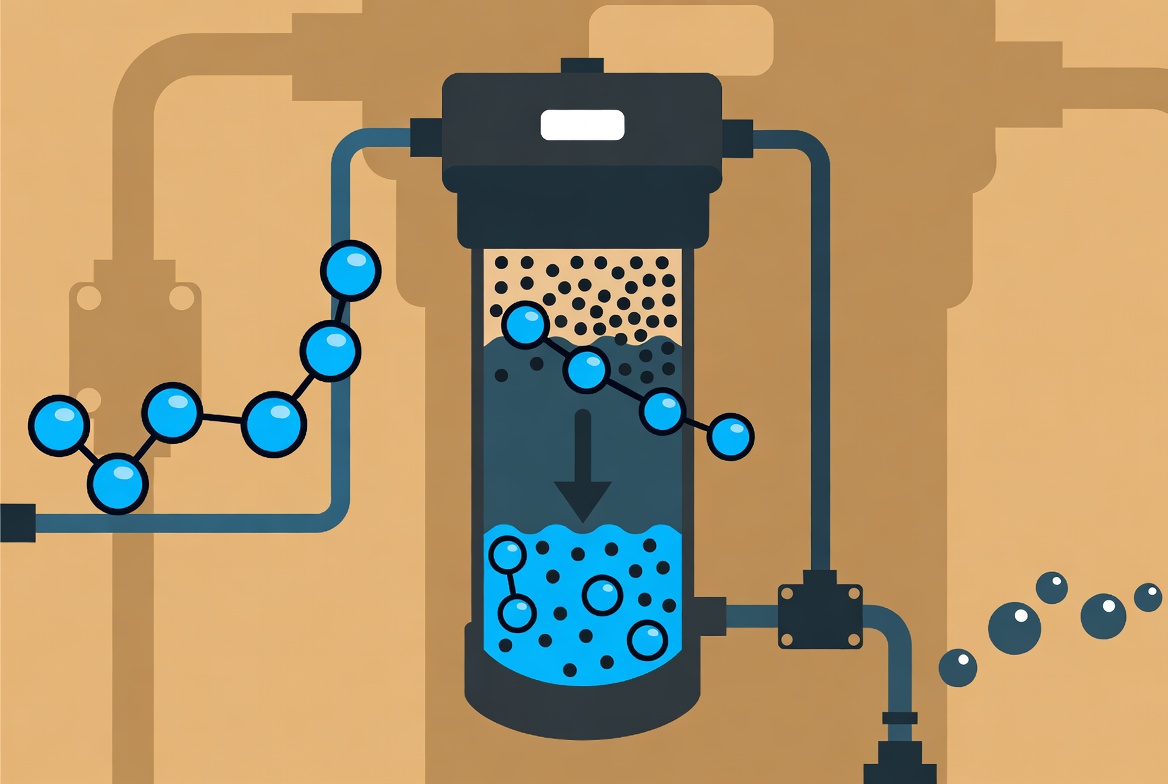
For GAC systems, empty bed contact time (EBCT) is one of the most important design variables. Technical references indicate that adequate organic removal often requires about 10 minutes of EBCT, and lower contact times may lead to weak performance or early breakthrough.
That matters in industrial systems because a well-designed carbon bed can dramatically outperform a poorly sized one. Even high-quality GAC cannot compensate for inadequate hydraulic design.
Industry Use Cases
Drinking Water Treatment
In municipal and commercial drinking water systems, GAC is often the most practical solution for reducing natural organics, chlorine-related taste issues, pesticides, and VOCs. It is also one of the most studied technologies for PFAS reduction in flow-through filtration mode.
Resin has a stronger role when the water contains ionic contaminants that need a more selective approach. It is especially attractive where a utility wants targeted removal rather than broad adsorption of mixed organics.
Industrial Process Water
In industrial applications, the choice usually depends on what affects the downstream process. If the issue is odor, discoloration, dissolved organics, or trace solvents, GAC is often the first line of defense.
If the challenge involves highly defined ionic contaminants or a need for a bolt-on polishing step, resin may be more suitable. This is why many plants use a multi-stage treatment train instead of relying on one medium alone.
Food, Beverage, and Pharma
Food, beverage, and pharmaceutical manufacturers usually prioritize consistent water quality, low taste impact, and stable operation. GAC is commonly favored for dechlorination and organic polishing, while resin is used more selectively where ion-specific control is necessary.
For these sectors, the best result often comes from matching media to the exact contamination risk rather than choosing based on general reputation alone.
Latest Insights from Comparative Research
One useful trend from recent studies is that the gap between GAC and resin is not fixed. It changes with contaminant type, chain length, contact time, and background water composition. In pilot-scale testing, GAC showed stronger reduction for many non-PFAS contaminants, while resin could be more cost-effective in certain PFAS scenarios.
Another important insight is that operating economics matter as much as removal percentage. A media that removes slightly more contaminant but requires more frequent replacement, more complex handling, or higher disposal costs may not be the better business decision.
Practical Selection Guide
Choose GAC When You Need:
- Broad reduction of organic contaminants.
- Better taste and odor control.
- VOC and synthetic organic chemical removal.
- A proven, flexible solution for mixed water quality.
Choose Resin When You Need:
- Higher selectivity for specific ionic contaminants.
- Strong performance in targeted PFAS scenarios.
- A polishing step in a more complex treatment train.
- Application-specific removal rather than broad adsorption.
Use Both When Needed
In real-world industrial systems, the strongest solution is often a combined train. GAC can serve as the broad first-stage adsorbent, while resin can provide a selective polishing step where required. This hybrid approach is especially useful when influent quality varies or when regulatory limits are strict.
Expert View from an Activated Carbon Manufacturer
From a manufacturer's perspective, the most common mistake is treating all "organic contaminants" as one category. They are not. Some organics are best captured by adsorption, while others are better handled through ion exchange chemistry.
That is why carbon grade, pore structure, iodine value, particle size, hardness, and regeneration behavior all matter in GAC selection. For industrial buyers, the right supplier should not just sell media; they should help match the media to the water profile, flow rate, target compounds, and lifecycle cost.
How to Improve System Performance
1. Identify the target contaminants precisely.
2. Measure influent water chemistry, including pH and background organics.
3. Define the required effluent quality and regulatory target.
4. Size the bed correctly, especially EBCT for GAC systems.
5. Run pilot testing before scaling up.
6. Compare media life, replacement cost, and disposal burden, not just removal rate.
Final Verdict for Buyers
If your question is which reduces organic contaminants better, the short answer is that GAC is usually better for broad organic contaminant reduction, while resin is better for targeted ionic compounds and select applications.
For most industrial water treatment buyers, the smartest approach is not to ask which media is universally superior. It is to ask which one is better for your contaminant profile, operating conditions, and total cost of ownership.
If you are selecting media for water treatment, air purification, or industrial process protection, request a contaminant profile review and a customized media recommendation before making a purchase decision.
FAQ
1. Is GAC better than resin for removing organic contaminants?
Yes, for broad organic contaminant removal, GAC is usually better because it adsorbs a wider range of organics. Resin is more selective and works best for certain ionic contaminants.
2. Can resin remove PFAS better than GAC?
In some cases, yes. Resin can perform very well for specific PFAS profiles, especially where selectivity and capacity are important, but performance depends on water chemistry and system design.
3. Does GAC remove all organic contaminants?
No. GAC removes many organics effectively, but performance depends on contaminant type, concentration, and contact time. Some compounds may require different technologies or a multi-stage approach.
4. Which system is easier to operate?
GAC systems are often simpler to operate in broad filtration use cases. Resin systems can be highly effective but are usually more application-specific and may involve regeneration or more precise operational control.
5. Should I use GAC and resin together?
Yes, in many industrial systems a combined treatment train gives the best result. GAC can remove broad organics first, and resin can polish specific remaining contaminants.
References
- [EPA: Reducing PFAS in Drinking Water with Treatment Technologies] [epa]
- [U.S. EPA / technical overview on GAC organic removal] [actat.wvu]
- [Granular Activated Carbon basics and uses] [wwdmag]
- [Ion Exchange Resins – Use in Water Treatment] [grupomathiesen]
- [Comparative investigation of PFAS adsorption onto activated carbon and ion exchange resin] [pmc.ncbi.nlm.nih]
- [Comparing chain length, empty bed contact time, and cost for GAC and IX] [sciencedirect]
- [GAC organic removal and EBCT guidance] [urbansaqua]


