Content Menu
● Understanding VOCs and Why Carbon Matters
● Coconut vs Coal: How the Pore Structure Impacts VOC Removal
● Key Performance Comparison for VOC Removal
● Application Scenarios: Where Each Carbon Type Excels
● Real-World Example: Indoor VOC Reduction with Carbon Filters
● Sustainability and ESG Considerations in Carbon Selection
● Practical Selection Framework for VOC Removal Projects
● Expert Insight: How a Specialist Manufacturer Adds Value
● Latest Trends: VOC Regulations and Carbon Technology
● How to Work with a Supplier for Custom VOC Solutions
● When to Choose Coconut vs Coal for VOCs: A Quick Decision Guide
● Call to Action: Design Your VOC Carbon Strategy
● FAQs
● References
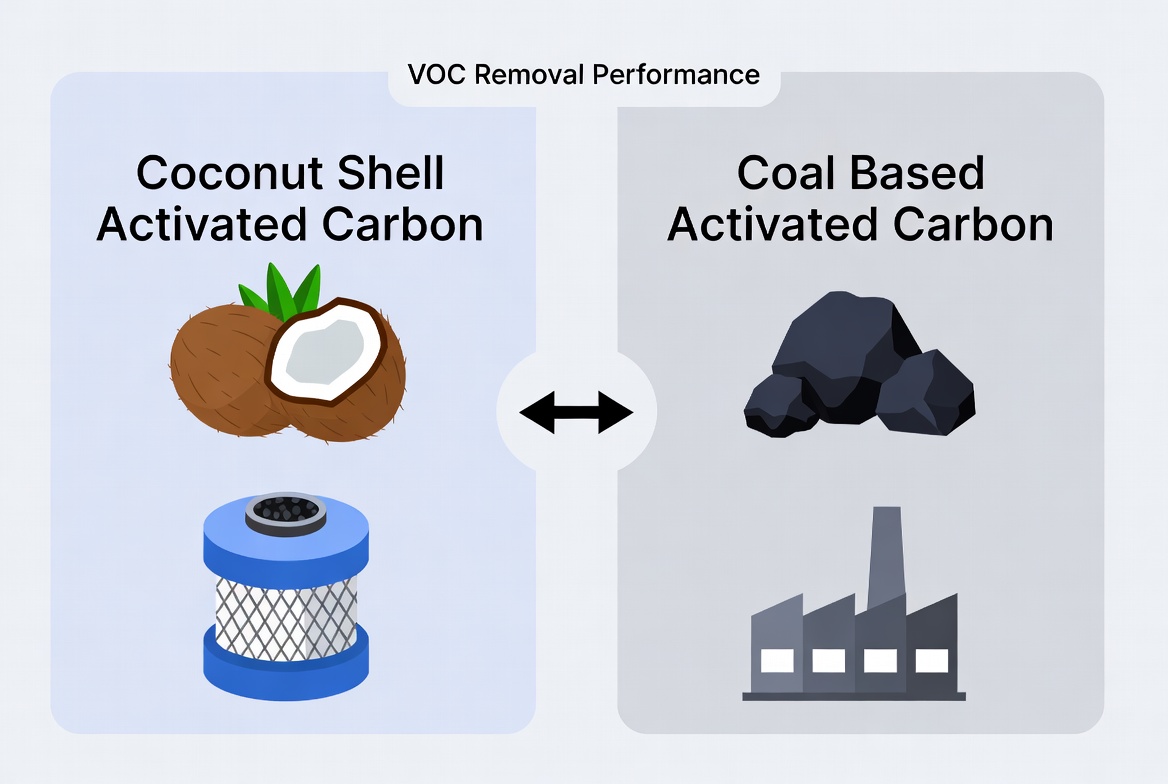
Coconut shell activated carbon generally delivers higher efficiency, better sustainability, and cleaner performance for most volatile organic compound (VOC) removal applications, while coal-based activated carbon remains a strong, cost-effective choice for certain high‑load industrial systems where budget and broad-spectrum adsorption dominate. [aircleansystems]
Understanding VOCs and Why Carbon Matters
Volatile organic compounds (VOCs) are small organic molecules that easily evaporate at room temperature and are commonly released from paints, solvents, coatings, adhesives, fuels, and many industrial processes. These compounds contribute to indoor air quality problems, occupational exposure risks, and regulatory compliance pressures in industries such as coatings, chemicals, electronics, and pharmaceuticals. [smartairfilters]
Activated carbon is one of the most widely used adsorbents for VOC control because of its high surface area, tunable pore structure, and relative ease of integration into filters, packed beds, and canister systems. In practice, the choice between coconut shell activated carbon and coal-based activated carbon directly affects removal efficiency, filter life, energy costs, and ESG performance metrics. [karbonous]
Coconut vs Coal: How the Pore Structure Impacts VOC Removal
Activated carbon performance is heavily driven by its pore size distribution and surface chemistry, especially for VOCs, which are typically small to mid‑sized molecules. [getpuroair]
- Coconut shell activated carbon tends to have very high microporosity, with over 80% of pores in the micropore range. [getpuroair]
- Studies show coconut shell activated carbon can have around 50% more micropores than bituminous coal-based activated carbon, improving capacity for small VOC molecules such as benzene and other aromatics. [karbonous]
- In benzene adsorption tests (a common VOC surrogate), coconut shell carbon has demonstrated nearly double the saturation capacity compared with coal-based carbon (11 mg/g vs 6 mg/g). [karbonous]
Coal-based activated carbon, by contrast, typically exhibits a wider distribution of mesopores and macropores, which can be advantageous for larger organics and mixed industrial contaminants but less optimized for small-molecule VOCs. This structural difference explains why coconut shell carbon often outperforms coal-based carbon in VOC-oriented filtration systems, especially at lower concentrations and in indoor or process-air environments. [activatedcarbonfactory]

Key Performance Comparison for VOC Removal
The table below summarizes core performance dimensions for VOC control.
| Dimension | Coconut Shell Activated Carbon | Coal-Based Activated Carbon |
| Typical pore profile | Dominantly microporous, >80% micropores, high surface area for small VOCs (getpuroair) | Higher share of meso/macropores, better for larger organic molecules and mixed contaminants (aircleansystems) |
| VOC adsorption capacity | Higher capacity for small VOCs like benzene, with up to ~2× saturation capacity vs coal in tests (karbonous) | Good general adsorption, but often lower small-VOC capacity compared with coconut shell (aircleansystems) |
| Filter life / dust | Higher hardness, less dust generation, more stable physical structure in repeated cycles (getpuroair) | Slightly lower hardness, more dust and fines, which can affect pressure drop and handling (karbonous) |
| Purity and ash content | Lower ash and leachables, favored for food, beverage, and pharma-grade air handling (getpuroair) | Higher ash content; acceptable for many industrial applications but less ideal for high-purity uses (aircleansystems) |
| Sustainability | Renewable resource (discarded coconut shells), lower lifecycle footprint, supports circular economy (getpuroair) | Derived from fossil fuels, higher embodied carbon, weaker sustainability profile (aircleansystems) |
| Cost positioning | Slightly higher unit price in some markets, but often better total cost of ownership via longer life and capacity (karbonous) | Generally lower upfront cost per kg, attractive for very large volumes or single-use industrial systems (activatedcarbonfactory) |
Application Scenarios: Where Each Carbon Type Excels
From a practical, project-level perspective, the "best" carbon depends on your VOC profile, operating conditions, and budget priorities. [sciencedirect]
Coconut shell activated carbon is typically preferred when:
- Target VOCs are small molecules (molecular weight < 300), such as many solvents, aromatics, and indoor-air VOCs. [activatedcarbonfactory]
- The system is recirculating or indoor, with a focus on occupational exposure and odor control. [smartairfilters]
- The application supports regeneration or frequent cycling, where hardness and resistance to attrition are critical. [getpuroair]
- You require food-grade, pharmaceutical, or high-purity air for processes or cleanrooms. [activatedcarbonfactory]
- Sustainability and ESG reporting are important; renewable feedstock is a clear advantage. [getpuroair]
Coal-based activated carbon remains a strong choice when:
- VOCs are mixed with larger organics or heavy hydrocarbons, where more mesopores add value. [aircleansystems]
- The system handles high VOC loads or industrial off-gas, and sorbent will be single-use and then disposed. [sciencedirect]
- The primary constraint is unit cost and the application is not food, pharma, or drinking-air related. [carbonblocktech]
- You need specific pelletized forms or large fixed beds for industrial exhaust treatment. [carbonblocktech]
Real-World Example: Indoor VOC Reduction with Carbon Filters
Field and lab tests on activated carbon filters show how quickly VOCs can be reduced in indoor environments. [smartairfilters]
- In controlled experiments with composite activated carbon filters, formaldehyde levels (a common VOC) dropped to about 50% of the peak concentration within 15 minutes, and near zero within 25 minutes compared with a fan-only baseline. [smartairfilters]
- Performance modeling for typical indoor environments suggests that maintaining low VOC levels over a 30-day period can require hundreds of grams to over 1 kg of activated carbon, depending on pollutant loads. [sciencedirect]
When such filters use high-micropore coconut shell carbon, operators typically see higher capacity per unit mass, meaning longer change-out intervals or smaller filter footprints to reach the same VOC reduction. In industrial settings where filters must manage both odors and toxic VOCs, this translates into measurable savings in consumables and downtime. [karbonous]
Sustainability and ESG Considerations in Carbon Selection
For global buyers and multinational manufacturers, carbon selection is no longer just a technical decision; it is also a sustainability and ESG decision. [getpuroair]
- Coconut shell activated carbon is produced from renewable agricultural byproducts, typically discarded shells from the coconut industry, which supports a circular economy and reduces waste. [karbonous]
- Lifecycle comparisons show that coconut shell carbon has a lower carbon footprint per unit of adsorption capacity than coal-based carbon, particularly when regeneration and long service life are considered. [getpuroair]
- Coal-based carbon, while technically robust, draws on fossil fuel resources and often carries higher embodied emissions and ash content, which can influence waste classification and disposal costs. [aircleansystems]
For manufacturers aligning with ISO 14001, corporate climate targets, or customer-driven sustainability scorecards, these factors often tip the balance toward coconut shell solutions when technical performance is comparable or better. [karbonous]
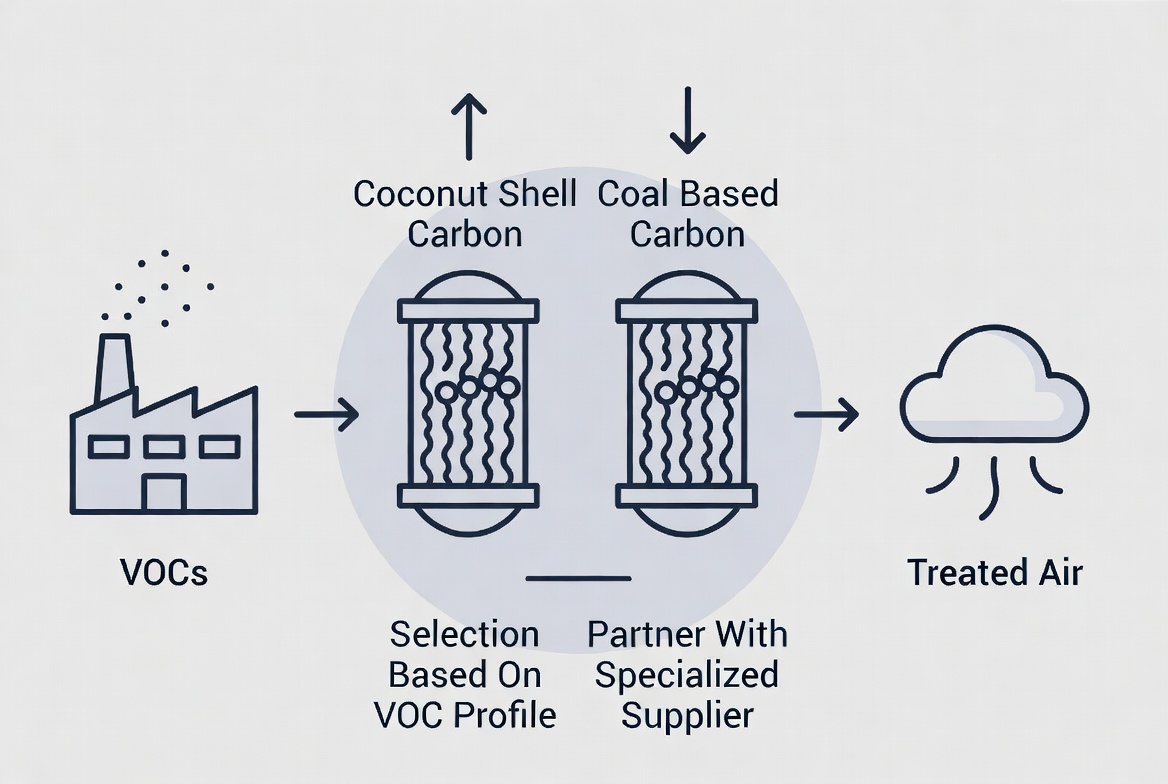
Practical Selection Framework for VOC Removal Projects
From a VOC-focused engineering and procurement perspective, it is helpful to apply a simple stepwise selection framework. [activatedcarbonfactory]
Step 1: Define your target VOCs and operating conditions
1. List key VOC species (e.g., ketones, aromatics, chlorinated solvents) and estimate their concentration range. [sciencedirect]
2. Determine whether the system is once-through exhaust or recirculating air. [smartairfilters]
3. Record temperature, humidity, and airflow/space velocity, which impact adsorption kinetics. [sciencedirect]
Step 2: Match carbon type to molecule size and purity requirements
- If most VOCs are small, low–molecular-weight species and air purity is critical, prioritize coconut shell activated carbon due to its high microporosity, hardness, and low ash content. [activatedcarbonfactory]
- If the stream carries large organics, tars, or mixed pollutants, and the primary goal is mass removal at low cost, coal-based carbon may be the more economical starting point. [aircleansystems]
Step 3: Evaluate lifecycle cost rather than unit price
- Compare not just kg price, but adsorption capacity (mg VOC per g carbon) and expected change-out interval, using vendor data or bench tests. [activatedcarbonfactory]
- Consider handling, dust generation, and waste classification costs, which often favor high-hardness coconut shell carbon in VOC-focused systems. [getpuroair]
Step 4: Validate with bench-scale or pilot trials
Even with a clear theoretical preference, bench-scale testing with your actual VOC mixture remains best practice, especially for critical systems. Short pilot trials can confirm capacity, breakthrough times, and pressure drop before large-scale deployment. [sciencedirect]
Expert Insight: How a Specialist Manufacturer Adds Value
As a specialized activated carbon manufacturer and exporter, a supplier like Guangdong Tongke Activated Carbon Co., Ltd. can significantly de-risk carbon selection for VOC projects by combining application engineering with custom product design. (Company description from user.)
Key value levers for VOC removal clients include:
- Tailored pore structure design: By tuning activation conditions and raw material selection, manufacturers can supply coconut shell and coal-based carbons with specific micropore/mesopore ratios aligned with the VOC profile and process constraints. [carbonblocktech]
- Multi-industry experience: Experience across water treatment, gas purification, food and beverage, and pharmaceuticals provides a strong reference base for VOC and odor control in coating lines, chemical plants, and cleanroom environments. [carbonblocktech]
- Form factor customization: From granular and powdered carbons to extruded pellets and carbon blocks, the right form factor supports optimal pressure drop, contact time, and retrofit compatibility. [carbonblocktech]
Working directly with such a manufacturer allows industrial buyers to integrate technical evaluation, sampling, and supply logistics into a single, application-focused VOC mitigation plan rather than purchasing carbon as a generic commodity. [carbonblocktech]
Latest Trends: VOC Regulations and Carbon Technology
Growing regulatory pressure and corporate sustainability goals are reshaping VOC control strategies globally. [smartairfilters]
- Indoor air standards and occupational exposure limits increasingly incentivize high-performance carbon filters, sometimes used alongside HEPA and other media. [smartairfilters]
- Hybrid systems combining activated carbon with other technologies, such as catalytic oxidation or advanced oxidants, are being adopted for challenging VOC profiles, but carbon remains a core "polishing" step. [sciencedirect]
- On the technology side, researchers continue to optimize activation processes for coconut shell-based carbons, enhancing surface area and tailoring surface chemistry to target specific VOC classes. [sciencedirect]
These trends make it even more important to partner with suppliers capable of ongoing product development and data-backed performance validation, rather than relying solely on off-the-shelf solutions. [sciencedirect]
How to Work with a Supplier for Custom VOC Solutions
For buyers and engineers in industries such as coatings, chemicals, and pharmaceuticals, the most efficient path to a robust solution is to treat carbon selection as a collaborative engineering project.
When engaging a manufacturer like Guangdong Tongke Activated Carbon Co., Ltd., you can:
- Share detailed process data: VOC species, concentration ranges, airflow rates, target breakthrough time, and regeneration or replacement schedule. [sciencedirect]
- Request comparative test data for coconut and coal-based carbons relevant to your VOC mix (e.g., benzene, toluene, formaldehyde). [karbonous]
- Start with small-scale trials using candidate carbons in simulated or real conditions, followed by performance and cost evaluation over a defined timeframe. [activatedcarbonfactory]
This approach allows you to leverage the manufacturer's knowledge in materials science and industrial applications while still maintaining internal control over risk, compliance, and economic outcomes. [carbonblocktech]
When to Choose Coconut vs Coal for VOCs: A Quick Decision Guide
To simplify decision-making for busy engineers and procurement teams, the following quick guide can be used during early project scoping. [aircleansystems]
- Choose Coconut Shell Activated Carbon if:
- You are targeting small-molecule VOCs and odors in air or gas streams. [aircleansystems]
- Product purity, low ash, and minimal leachables are priorities. [getpuroair]
- Long filter life, lower dust, and higher hardness are important. [karbonous]
- Sustainability and renewable feedstocks support your ESG strategy. [getpuroair]
- Choose Coal-Based Activated Carbon if:
- The process involves mixed or larger organic compounds and cost is the primary driver. [aircleansystems]
- The carbon will be single-use in large industrial systems with limited regeneration. [activatedcarbonfactory]
- You need specific pellet forms or bed configurations well established for coal-based products. [carbonblocktech]
In many cases, the optimal solution is not an either/or choice but a hybrid approach, where coconut shell carbon is used in polishing stages and coal-based carbon handles earlier, high-load steps. [activatedcarbonfactory]
Call to Action: Design Your VOC Carbon Strategy
If you are planning or upgrading a VOC control system for water treatment, air and gas purification, food and beverage, chemical processing, or pharmaceuticals, now is the right time to reassess your activated carbon strategy.
By working with a specialized manufacturer like Guangdong Tongke Activated Carbon Co., Ltd., you can:
- Benchmark coconut shell vs coal-based activated carbon for your specific VOC profile.
- Optimize adsorption performance, filter life, and lifecycle cost instead of focusing only on price per kilogram.
- Align your VOC control solution with regulatory compliance, ESG goals, and brand positioning in global markets.
You can prepare your VOC data and system requirements, then contact the technical team to request custom recommendations, samples, and pilot support tailored to your industrial application and regional standards.
FAQs
1. Which is generally better for VOC removal, coconut shell or coal-based activated carbon?
For most small-molecule VOCs and indoor or process-air applications, coconut shell activated carbon offers higher adsorption capacity, greater hardness, and better sustainability than coal-based carbon. [aircleansystems]
2. Are there cases where coal-based carbon is the better option?
Yes. Coal-based carbon is often preferred for high-load industrial exhaust, larger organic molecules, and single-use systems where cost per kilogram is the dominant factor and purity requirements are moderate. [aircleansystems]
3. How important is microporosity for VOC removal?
Microporosity is critical because many VOCs are small molecules that fit into micropores, so a carbon with high micropore volume—like coconut shell-based material—typically delivers higher VOC capacity per gram. [karbonous]
4. Do activated carbon filters work for all VOCs?
Activated carbon is highly effective for many VOCs, including formaldehyde, benzene, and other common indoor pollutants, but performance varies with molecule type, humidity, and operating conditions, which is why application-specific testing is recommended. [smartairfilters]
5. How can I estimate how much activated carbon I need for a VOC application?
Research indicates that maintaining low indoor VOC levels over 30 days can require anywhere from 190–370 g of carbon for low loads up to 1.1 kg or more for higher loads, but actual requirements depend on your specific emission profile and target lifetime. [sciencedirect]
References
1. AirClean Systems. "Which Carbon is Better: Coal-Based or Coconut Shell Carbon?" [https://aircleansystems.com/news/which-carbon-is-better-coal-or-coconut-shell-carbon] [aircleansystems]
2. Puro Air. "How Coconut Shell Carbon Filters Improve Indoor Air Quality." [https://getpuroair.com/blogs/news/how-coconut-shell-carbon-filters-improve-indoor-air-quality] [getpuroair]
3. Smart Air. "Does Activated Carbon and HEPA Filter Remove VOCs?" [https://smartairfilters.com/en/blog/activated-carbon-formaldehyde-filter-remove-vocs/] [smartairfilters]
4. Karbonous. "Comparison of Bituminous and Coconut Shell Activated Carbon." [https://www.karbonous.com/blog/comparison-bituminous-and-coconut-activated-carbon/] [karbonous]
5. Activated Carbon Factory. "Coconut Shell vs Coal-Based Activated Carbon: Which One?" [https://activatedcarbonfactory.com/blog/coconut-shell-vs-coal-activated-carbon] [activatedcarbonfactory]
6. CB Tech. "Coal vs. Wood vs. Coconut Carbon Filters." [https://carbonblocktech.com/coconut-wood-coal-filters/] [carbonblocktech]
7. Scientific study on VOC sorbent performance. "Performance evaluation of activated carbon sorbents for indoor VOC control." ScienceDirect. [https://www.sciencedirect.com/science/article/abs/pii/S0045653522018070] [sciencedirect]
8. Coconut shell activated carbon fabrication study. "Fabrication and characterization of coconut shell activated carbon." ScienceDirect. [https://www.sciencedirect.com/science/article/pii/S2211715622000108] [sciencedirect]


