Content Menu
● What This Guide Covers
● Key Terms: Bulk, Apparent, and True Density
● Bulk Density of Activated Carbon
>> What Bulk Density Means in Practice
>> How Bulk Density Is Measured
>> Why Bulk Density Matters for Engineering and Cost
● Apparent Density of Activated Carbon
>> Apparent Density Definition and Range
>> Test Methods for Apparent Density
>> Apparent Density and Adsorption Performance
● True Density of Activated Carbon
>> What True Density Represents
>> Measurement and Interpretation
● Bulk Density vs Apparent Density vs True Density
>> Density Types at a Glance
● How Density Influences Industrial Applications
>> Water and Wastewater Treatment
>> Air and Gas Purification
>> Food, Beverage, Chemical, and Pharmaceutical Processes
● How We Use Density Data in Custom Carbon Design
>> Matching Density to Application Requirements
>> Balancing Performance and Total Cost of Ownership
● Practical Steps for Engineers and Buyers
● When to Contact a Manufacturer for Support
● Call to Action: Get a Tailored Density Profile for Your Application
● Frequently Asked Questions (FAQ)
● References
Apparent density and bulk density are two of the most important physical parameters engineers use when they design, purchase, and operate activated carbon systems in real industrial environments. Understanding how these densities differ—and how they relate to adsorption performance, reactor sizing, and operating cost—helps you make better technical and commercial decisions for water, air, and process applications. [heycarbons]
What This Guide Covers
In this article, I will explain bulk density, apparent density, and true density of activated carbon from a practical engineer's perspective, then connect each concept to real-world design decisions and purchasing criteria. I will also share field lessons from projects in water treatment, air and gas purification, food and beverage, and chemical/pharmaceutical production, based on our experience at Guangdong Tongke Activated Carbon Co., Ltd. supplying customized carbon solutions to global industrial users. [tongkeac]
Key Terms: Bulk, Apparent, and True Density
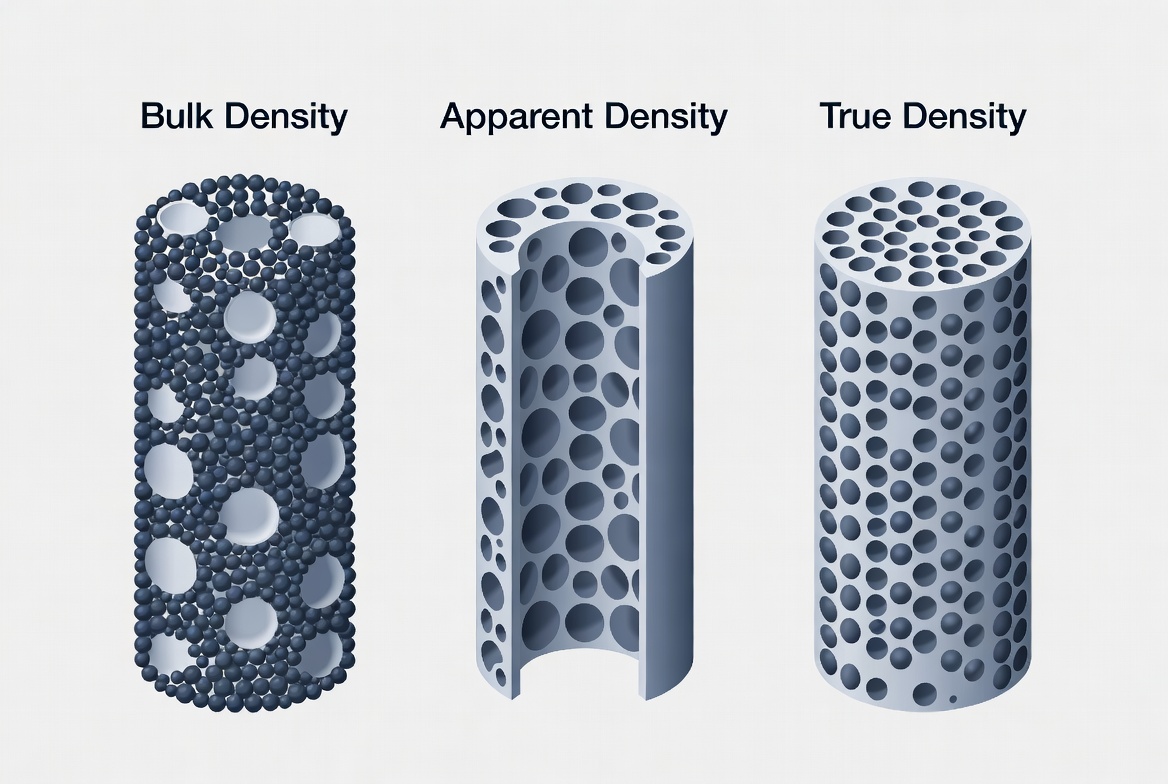
For most process engineers and buyers, "density" looks like a single number on a datasheet, but in activated carbon you actually deal with three different densities. [sinoucarbon]
- Bulk density: Mass of carbon in a loosely packed bed, divided by the total bed volume, including pores and voids between particles. [heycarbons]
- Apparent density (particle density): Mass of carbon particles per unit volume, including the internal pores but excluding the spaces between particles. [publications.usace.army]
- True density (skeleton density): Density of the carbon solid matrix itself, excluding both internal pores and interparticle voids. [publications.usace.army]
Typical ranges for industrial activated carbon are: bulk density around 0.2–0.6 g/cm³, apparent density around 0.3–0.9 g/cm³, and true density around 2.0–2.2 g/cm³, depending on raw material and activation process. [sinoucarbon]
Bulk Density of Activated Carbon
What Bulk Density Means in Practice
Bulk density is defined as the mass of activated carbon in a loosely packed state per unit volume, including internal pores and the voids between particles. It is usually expressed in g/cm³ or kg/m³, and is a primary design input for shipping, storage, and vessel sizing. [heycarbons]
- Typical granular activated carbon (GAC) bulk density: 0.4–0.6 g/cm³. [sinoucarbon]
- Powdered activated carbon (PAC) bulk density: often slightly lower, around 0.38–0.45 g/cm³. [heycarbons]
- Pelletized or extruded carbon: usually 0.45–0.65 g/cm³, similar to many GAC products. [sinoucarbon]
In many industrial datasheets, bulk density is also reported as 200–600 kg/m³, which is the same range expressed in SI units. [heycarbons]
How Bulk Density Is Measured
In industrial practice, bulk density is often measured using a free stacking method. [sinoucarbon]
1. Pour a known mass of activated carbon into a graduated cylinder or standard volume container without vibration. [heycarbons]
2. Level the surface without compacting the bed. [sinoucarbon]
3. Measure the total volume and calculate mass per volume. [heycarbons]
Many plant labs use simplified versions of this approach, while test standards (such as certain ASTM methods) define detailed procedures and apparatus for repeatable bulk density measurements. [store.astm]
Why Bulk Density Matters for Engineering and Cost
From an engineering and commercial standpoint, bulk density influences several critical aspects: [publications.usace.army]
- Reactor design and vessel volume:
A lower bulk density means more volume is required for the same carbon mass, directly impacting column diameter, bed height, and civil costs. [publications.usace.army]
- Packaging and shipping:
Lower bulk density products require more container or silo volume for the same tonnage, which affects freight cost per ton and logistics planning. [sinoucarbon]
- Bed hydraulics:
Bulk density interacts with particle size distribution and porosity to influence pressure drop in liquid and gas-phase adsorbers. [publications.usace.army]
- Refill and replacement planning:
Many plant operators estimate bed refills, warehouse space, and long-term opex using bulk density and bed volume rather than just mass. [publications.usace.army]
In practical terms, when an engineering team asks, "How many cubic meters of carbon do we need to fill this filter?", they are essentially working with bulk density. [publications.usace.army]
Apparent Density of Activated Carbon
Apparent Density Definition and Range
Apparent density, also called particle density, refers to the mass of activated carbon particles per unit volume including their internal pores, but excluding the voids between particles in a bed. It is typically expressed in g/cm³ or kg/m³, similar to bulk density. [heycarbons]
In many industrial carbons, apparent density values are intermediate between bulk and true density; for example, around 0.3–0.9 g/cm³ depending on raw material and activation level. [sinoucarbon]
A key practical interpretation is:
- Lower apparent density generally indicates higher porosity, which often correlates with higher adsorption capacity for certain contaminants. [heycarbons]
Test Methods for Apparent Density
Common methods to determine apparent density include: [store.astm]
- Mercury displacement method:
Mercury does not penetrate micropores under normal pressure but fills the voids around particles, allowing calculation of particle volume and thus apparent density. [publications.usace.army]
- Vibration compaction method:
The carbon is vibrated to minimize interparticle voids, and the volume in this compacted state is used to determine apparent density. [heycarbons]
- Helium specific gravity / helium displacement methods:
Helium can access very fine pores and allows precise determination of particle volume or true volume, which can be used to derive apparent density metrics. [publications.usace.army]
In formal settings, standards such as ASTM D2854 define test methods for apparent density of activated carbon, especially for granular products used in industrial adsorbers. [store.astm]
Apparent Density and Adsorption Performance
Apparent density plays a central role in evaluating pore development and adsorption performance. [sinoucarbon]
- A lower apparent density typically indicates a more highly developed microporous structure, often reflected in higher iodine numbers or methylene blue adsorption capacity. [sinoucarbon]
- Engineers use apparent density alongside specific surface area and pore size distribution to compare carbons for high-value applications such as VOC capture, solvent recovery, and pharmaceutical decolorization. [jingdacarbon]
- In liquid-phase systems, apparent density, together with specific surface area, helps estimate bed life and breakthrough curves when carbon usage rates are expressed in volumetric terms. [publications.usace.army]
As a result, apparent density is often the more relevant parameter when the primary objective is maximizing adsorption efficiency per unit bed volume. [heycarbons]
True Density of Activated Carbon
What True Density Represents
True density (or skeleton density) describes the density of the solid carbon matrix itself, after excluding all internal pores and any void volume between particles. For most activated carbons, true density typically lies between 2.0 and 2.2 g/cm³, though the exact value depends on raw material and processing conditions. [publications.usace.army]
True density is influenced by:
- Feedstock (coconut shell, coal, wood, petroleum-based precursors). [jingdacarbon]
- Activation temperature and time, which govern the degree of carbonization and graphitization. [heycarbons]
Measurement and Interpretation
True density is commonly measured via helium displacement methods, in which helium gas penetrates almost all accessible pores and allows accurate determination of the solid volume. Advanced instruments and standardized methods ensure repeatable data for material characterization. [heycarbons]
In practice, true density helps with:
- Material characterization: Differentiating between raw materials, activation regimes, and production lots. [publications.usace.army]
- Mechanical strength assessment: Higher true density often correlates with better compressive strength and attrition resistance, critical for high-flow gas and liquid systems. [heycarbons]
- Purity checks: Unusually high true density can signal ash or mineral contamination, especially in carbons used for food, beverage, and pharmaceutical applications. [sinoucarbon]
While plant engineers rarely design directly based on true density, R&D teams and quality engineers rely on it for product development and long-term performance evaluation. [publications.usace.army]
Bulk Density vs Apparent Density vs True Density
To use density correctly in design and purchasing decisions, it helps to see how these three measures compare. [sinoucarbon]
Density Types at a Glance
| Parameter | Volume Considered | Typical Value Range | Main Use in Industry |
| Bulk density | Particle volume + interparticle voids + internal pores | ≈ 0.2–0.6 g/cm³ | Shipping cost, bed volume, vessel sizing, logistics planning (heycarbons) |
| Apparent density | Particle volume including internal pores, excluding voids | ≈ 0.3–0.9 g/cm³ | Pore structure evaluation, adsorption capacity per volume (heycarbons) |
| True density | Solid carbon skeleton only | ≈ 2.0–2.2 g/cm³ | Material characterization, strength and purity assessment (heycarbons) |
In practical applications, engineers typically: [sinoucarbon]
- Rely on apparent density when they focus on adsorption performance and pore structure.
- Use bulk density when they calculate bed volume, vessel dimensions, and transport costs.
- Use true density mainly in R&D and QA to monitor raw materials, processes, and structural properties.
How Density Influences Industrial Applications
Water and Wastewater Treatment
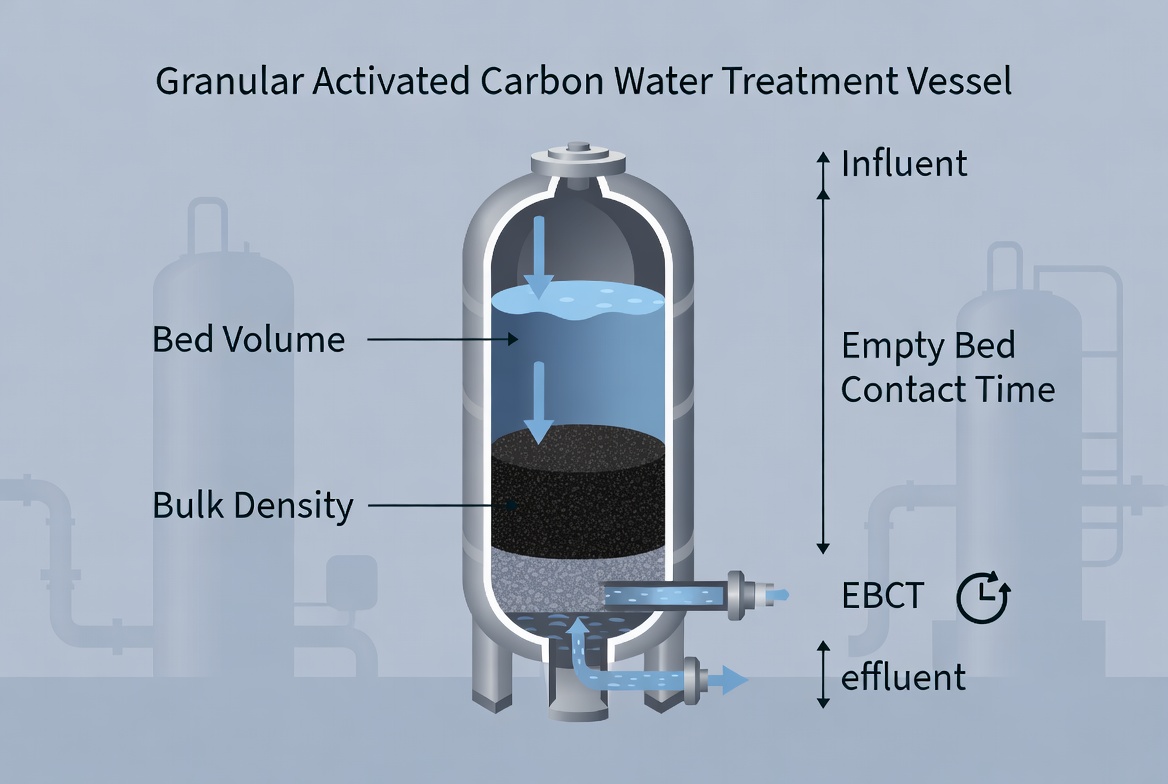
In municipal drinking water, process water, and wastewater polishing, density affects both capital and operating costs: [gremarco]
- Bed sizing and design:
Engineers use bulk density and apparent density to determine bed volume, empty bed contact time (EBCT), and carbon usage rates per m³ of water treated. [heycarbons]
- PAC dosing systems:
For powdered carbon used in coagulation, taste and odor control, or emergency contamination response, knowledge of density supports accurate volumetric dosing from hoppers and feeders. [sinoucarbon]
- Filter refills and backwashing:
Backwashed and drained density data help estimate carbon mass in service and plan replacement intervals. [publications.usace.army]
In one typical case, a water utility selecting GAC for pesticides removal weighed different carbons with similar iodine numbers but different bulk densities; the final choice balanced adsorption efficiency per m³, pressure drop constraints, and total installed bed volume. [sinoucarbon]
Air and Gas Purification
In flue gas treatment, VOC removal, gas phase odor control, and solvent recovery, density parameters are crucial for both performance and safety. [gremarco]
- Fixed-bed adsorbers: Bulk density and particle density influence residence time, mass transfer, and pressure drop. [jingdacarbon]
- Impregnated carbons for specific gases: Apparent density and pore structure must be matched to the target contaminants, such as sulfur compounds, formaldehyde, or hazardous gases. [gremarco]
- Mobile and cartridge filters: In HVAC and automotive cabin filters, density affects filter weight, compactness, and service life. [jingdacarbon]
For example, in a VOC capture system for a chemical plant, the engineering team needed a carbon grade with sufficient pore volume for solvent adsorption, but also with a bulk density that allowed retrofit into existing vessels without major steelwork modifications. [gremarco]
Food, Beverage, Chemical, and Pharmaceutical Processes
In food and beverage decolorization, sugar refining, and pharmaceutical intermediates, density plays a role in meeting both quality and regulatory requirements. [jingdacarbon]
- Consistency and repeatability: Apparent density is used as a control parameter to ensure consistent porosity and adsorption behavior batch-to-batch. [heycarbons]
- Regulated sectors: True density and associated purity checks help confirm that ash and impurities remain within specified limits for sensitive applications. [publications.usace.army]
- Process optimization: Productivity gains often come from optimizing a combination of iodine value, apparent density, and hydraulic behavior. [heycarbons]
When a beverage producer switches carbon suppliers, matching density and pore structure is critical to avoid changes in color, taste, and filtration performance. [gremarco]
How We Use Density Data in Custom Carbon Design
As a manufacturer focused on customized activated carbon solutions, we integrate density measurements into every stage of our product development and application support. [tongkeac]
Matching Density to Application Requirements
For each project, we work with plant engineers and buyers to translate process constraints into density-related specifications: [tongkeac]
- Water and wastewater: Optimize bulk density and particle size to balance contact time, removal efficiency, and backwash behavior.
- Air and gas: Select apparent density and pore structure to achieve required breakthrough times while maintaining acceptable pressure drop and bed mass.
- Food and pharma: Control true density and ash content to align with regulatory expectations and process reproducibility.
In many cases, we propose multiple candidate carbons with different density and pore profiles, then support pilot-scale testing to validate performance under real operating conditions. [tongkeac]
Balancing Performance and Total Cost of Ownership
We also use density data to help customers evaluate total cost of ownership, rather than focusing only on the purchase price per kilogram. [sinoucarbon]
- A carbon with slightly higher bulk density may lead to lower freight and handling costs per unit adsorption capacity, especially on large-scale installations. [publications.usace.army]
- A carbon with lower apparent density and higher porosity may reduce carbon consumption per m³ of treated water or gas, even if the unit price is higher. [heycarbons]
By combining density, iodine value, hardness, and ash content, we help customers choose the most cost-effective solution for their specific duty and regeneration strategy. [sinoucarbon]
Practical Steps for Engineers and Buyers
To make density data truly actionable in your projects, consider the following step-by-step approach when evaluating or specifying activated carbon. [publications.usace.army]
1. Clarify your primary objective
- Maximize adsorption performance per bed volume? Focus on apparent density and porosity.
- Minimize transport and vessel costs? Pay close attention to bulk density and bed volume. [heycarbons]
2. Collect comparable data from suppliers
- Request bulk density, apparent density, true density, and related properties such as iodine value, methylene blue value, hardness, and ash content. [heycarbons]
- Check whether test methods follow recognized standards (e.g., relevant ASTM, GB/T, JIS, or AWWA procedures). [store.astm]
3. Translate density into design parameters
- Convert mass-based usage rates into volumetric carbon usage using bulk or apparent density. [publications.usace.army]
- Use these values to estimate vessel dimensions, bed life, and replacement intervals. [publications.usace.army]
4. Pilot test where possible
- Implement a pilot or trial filter using candidate carbons and monitor breakthrough time, pressure drop, and regeneration behavior. [sinoucarbon]
5. Review operational feedback and refine
- Use actual plant data to refine density, pore structure, and particle size specifications for future purchases. [heycarbons]
A structured process like this transforms density data from a simple datasheet value into a strategic lever for reliability and lifecycle cost optimization. [sinoucarbon]
When to Contact a Manufacturer for Support
Because density interacts with many other carbon properties, it is often helpful to consult directly with a manufacturer experienced in cross-industry applications. [tongkeac]
You should consider reaching out for technical support when:
- You are upgrading or debottlenecking an existing system and need to switch carbon suppliers without changing vessels. [jingdacarbon]
- Your process is sensitive to pressure drop, bed expansion, or fines generation, and you suspect density or particle size distribution is a contributing factor. [heycarbons]
- You are designing a new plant and want to balance capital cost, operating cost, and reliability from day one. [publications.usace.army]
A partner like Guangdong Tongke Activated Carbon Co., Ltd. can help you interpret density data in the context of raw material selection, activation technology, and application-specific testing, ensuring that bulk, apparent, and true density all work together for your performance targets. [tongkeac]
Call to Action: Get a Tailored Density Profile for Your Application
If you are currently evaluating activated carbon for water treatment, air and gas purification, food and beverage, chemical, or pharmaceutical applications, it pays to go beyond generic datasheets and specify density parameters aligned with your process needs. [gremarco]
Contact our technical team with your process conditions, target contaminants, and existing equipment constraints, and we will recommend a customized density and pore structure profile, along with test data and trial support, to help you achieve reliable performance and optimized total cost of ownership. [jingdacarbon]
Frequently Asked Questions (FAQ)
Q1. What is the difference between bulk density and apparent density in activated carbon?
Bulk density includes both the particle volume and the void spaces between particles in a loosely filled bed, while apparent density refers only to the volume of the particles including internal pores but excluding interparticle voids. [sinoucarbon]
Q2. Which density should I use when sizing an activated carbon vessel?
For vessel sizing and bed volume calculations, engineers typically use bulk density, because it reflects how much carbon mass will occupy a given volume under practical loading conditions. [heycarbons]
Q3. How does apparent density relate to adsorption capacity?
Lower apparent density usually indicates a higher degree of porosity, which often correlates with higher adsorption capacity for many contaminants when normalized to bed volume. [sinoucarbon]
Q4. Why is true density important if I rarely use it in design?
True density helps characterize the carbon matrix, assess mechanical strength, and detect ash or impurity contamination, which is particularly important in regulated sectors such as food, beverage, and pharmaceuticals. [publications.usace.army]
Q5. Are there international standards for density testing of activated carbon?
Yes, several standards, including ASTM D2854 and related carbon testing standards, define procedures for measuring apparent density and other properties, and many national standards such as GB/T, JIS, and AWWA also cover density-related tests. [store.astm]
References
1. Heycarbons. “Introduction to Apparent Density, Bulk Density and True Density of Activated Carbon.” https://heycarbons.com/apparent-density-and-bulk-density/
2. ASTM International. “Carbon Standards – Apparent Density of Activated Carbon (ASTM D2854).” https://store.astm.org/products-services/standards-and-publications/standards/carbon-standards.html
3. ASTM International. “Standard Test Method for Apparent Density of Activated Carbon (ASTM D2854-09(2019)).” https://store.astm.org/d2854-09r19.html
4. Guangdong Tongke Activated Carbon Co., Ltd. “About Us.” https://www.tongkeac.com/aboutus.html
5. Sinou Carbon. “The Density of Activated Carbon Is an Important Physical Indicator.” https://www.sinoucarbon.com/news/the-density-of-activated-carbon.html
6. Chengde Jingda Activated Carbon Manufacturing Co., Ltd. “Home – Activated Carbon Products and Applications.” https://jingdacarbon.com
7. Gremarco. “Activated Carbon – Applications of Activated Carbon in Air and Water Treatment.” https://www.gremarco.com/activated-carbon
8. Heycarbons. “Activated Carbon Testing Standards.” https://heycarbons.com/activated-carbon-testing-standards/
9. U.S. Army Corps of Engineers. “Engineer Design Guide DG 1110-1-2 – Activated Carbon Systems.” https://www.publications.usace.army.mil/portals/76/publications/engineerdesignguides/dg_1110-1-2.pdf


