Content Menu
● What Is Activated Carbon Fiber?
● Activated Carbon Fiber Cloth vs Felt
● Activated Carbon Fiber Cloth: Best for Controlled, Flexible Designs
>> Key advantages of activated carbon fiber cloth
>> Limitations of activated carbon fiber cloth
● Activated Carbon Fiber Felt: Best for Higher Media Loading
>> Key advantages of activated carbon fiber felt
>> Limitations of activated carbon fiber felt
● How to Choose the Right ACF Material
>> 1. Define the contaminant
>> 2. Identify the operating medium
>> 3. Calculate available contact area
>> 4. Consider airflow resistance
>> 5. Plan for breakthrough monitoring
● Practical Selection Guide
● Application-Specific Recommendations
>> Air and gas purification
>> Water treatment
>> Solvent recovery
>> Food, beverage, pharmaceutical, and chemical processing
● Expert Insight: Do Not Select by Iodine Number Alone
● Work With a Custom ACF Supplier
● FAQ
>> 1. Is activated carbon fiber cloth better than activated carbon fiber felt?
>> 2. Can activated carbon fiber felt remove VOCs?
>> 3. Can ACF cloth be used for water treatment?
>> 4. How do I know when an ACF filter should be replaced?
>> 5. Can activated carbon fiber be regenerated?
>> 6. Should I use a pre-filter with activated carbon fiber?
>> 7. What information should I provide when requesting a quotation?
● References
Choosing between activated carbon fiber cloth and activated carbon fiber felt is not simply a matter of selecting the material with the highest adsorption value. The right choice depends on your contaminant, airflow or liquid flow, installation geometry, mechanical requirements, regeneration method, and replacement schedule.
At Guangdong Tongke Activated Carbon Co., Ltd., we work with industrial buyers who need activated carbon fiber (ACF) solutions for air purification, VOC control, water treatment, solvent recovery, food processing, pharmaceutical production, and chemical applications. In real projects, the best ACF material is the one that maintains reliable removal performance while fitting the equipment and operating conditions—not merely the one with the highest laboratory specification.
What Is Activated Carbon Fiber?
Activated carbon fiber is a porous adsorbent made by carbonizing and activating fiber-based precursor materials. During activation, a highly developed pore structure is created across the fiber surface. This provides a large contact area for capturing VOCs, odors, organic compounds, residual chlorine, dyes, solvent vapors, and selected chemical pollutants.
Unlike conventional granular media, activated carbon fiber often has micropores directly accessible from the fiber surface. This can shorten diffusion paths and support rapid adsorption and desorption behavior, especially where contact time is limited.
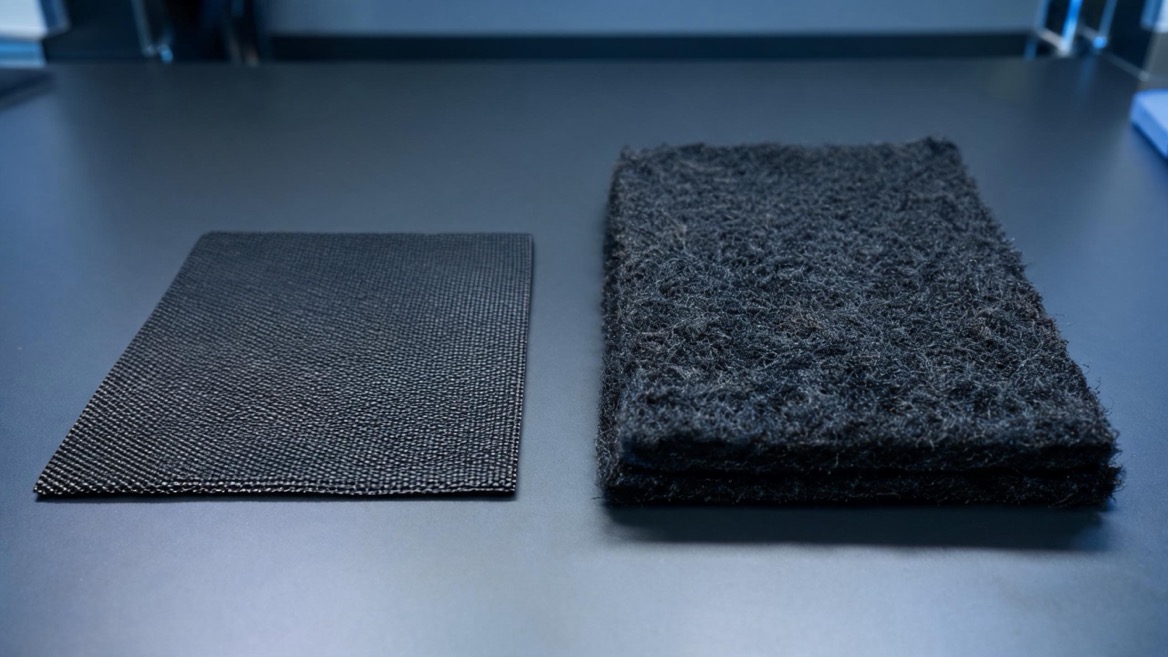
Activated carbon fiber cloth is usually a woven textile structure. Activated carbon fiber felt is typically a non-woven, thicker fiber mat. Both can deliver strong adsorption performance, but their physical structures create very different engineering advantages.
Activated Carbon Fiber Cloth vs Felt
| Comparison factor | Activated carbon fiber cloth | Activated carbon fiber felt |
| Material structure | Woven or knitted fiber fabric | Non-woven fiber web or mat |
| Typical profile | Thin, flexible, uniform | Thicker, softer, bulkier |
| Shape retention | Stronger dimensional stability | Better conformity to irregular surfaces |
| Handling | Easy to cut, stitch, laminate, pleat, and layer | Easy to cut, wrap, stack, and install in pads |
| Airflow resistance | Often lower in thin constructions | Depends strongly on thickness and density |
| Particle holding | Limited unless combined with a pre-filter | Can provide more depth and dust-holding space |
| Adsorption media loading | Often lower per unit area in thin grades | Often higher per unit area because of greater thickness |
| Best for | Precision layers, compact filters, protective products, electrode applications | High-capacity pads, odor filters, air treatment modules, solvent and gas adsorption |
| Mechanical durability | Usually better for repeated flexing and processing | May compress or shed fibers if poorly supported |
| Customization options | Width, weave, thickness, backing, lamination | Thickness, density, basis weight, roll width, multilayer construction |
The table provides a starting point, but it should not replace application testing. Adsorption capacity is affected by the ACF grade, surface chemistry, pore distribution, humidity, pollutant concentration, temperature, residence time, and regeneration history.
Activated Carbon Fiber Cloth: Best for Controlled, Flexible Designs
Activated carbon fiber cloth is usually the better choice when the adsorbent must remain thin, flexible, stable, and easy to convert into a precise component.
Because it has a woven structure, ACF cloth can be processed into filter layers, cartridge wraps, protective inserts, respirator components, pleated structures, and laminated composite materials. It is particularly valuable when a manufacturer needs repeatable dimensions and clean handling during assembly.
Key advantages of activated carbon fiber cloth
- Thin and space-efficient, making it suitable for compact filtration systems
- Flexible but dimensionally stable, especially in converted or sewn products
- Easy to laminate with non-woven support layers, membranes, mesh, or protective fabrics
- Suitable for multilayer filtration designs, where particulate filtration and gas adsorption are separated
- Useful in electrochemical applications, where fabric form and conductivity can be relevant
- Good for shaped products, including masks, protective equipment, compact air filters, and specialty housings
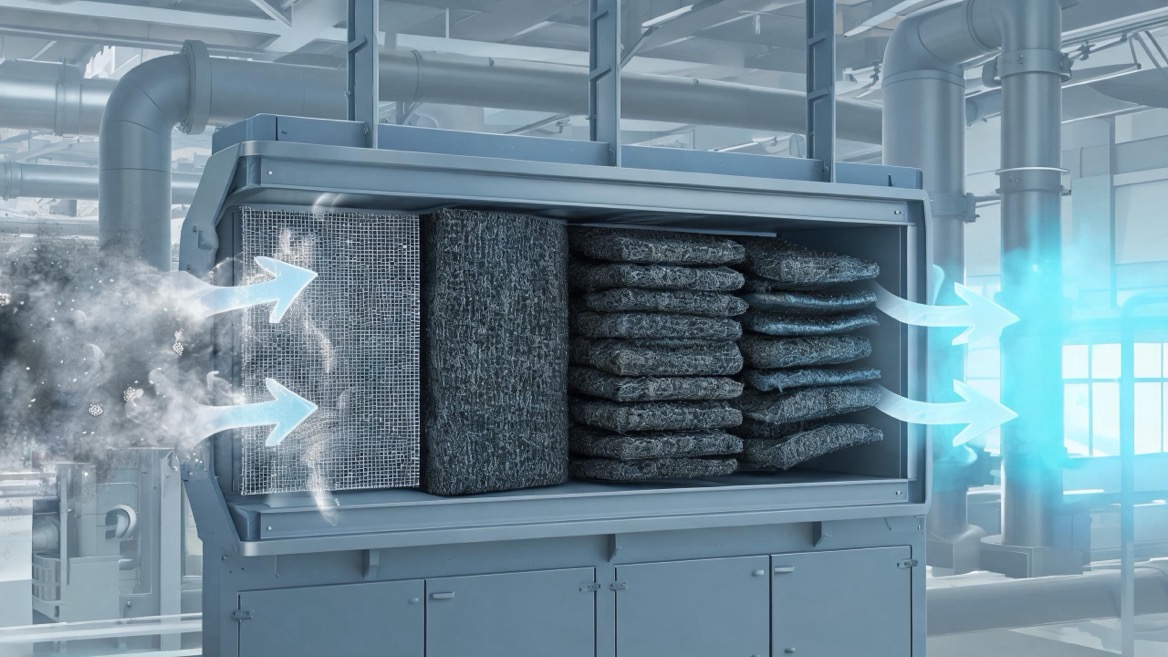
A practical example is a compact air purifier cassette. If the available installation depth is limited, a manufacturer may use activated carbon fiber cloth as the adsorption layer, supported by a particulate pre-filter upstream. This design protects the cloth from dust loading while preserving space for airflow.
Limitations of activated carbon fiber cloth
The thinner structure of cloth can mean lower total adsorbent mass per square meter than a thick felt. If the target pollutant concentration is high or the operating cycle is long, cloth may reach breakthrough earlier unless multiple layers are used.
Cloth also requires careful selection when the system must capture dust, oil mist, sticky aerosols, or condensed contaminants. In many cases, a high-efficiency particulate pre-filter is necessary to protect the ACF cloth and extend its operating life.
Activated Carbon Fiber Felt: Best for Higher Media Loading
Activated carbon fiber felt is generally preferred when the system needs more adsorbent mass, greater thickness, easier conformity, or a higher-capacity adsorption pad. Its non-woven fiber network creates a bulky structure that can be supplied in different densities, thicknesses, and basis weights.
Many activated carbon fiber felt grades are used in air purification, solvent recovery, odor treatment, industrial gas handling, water treatment, respirator filters, and specialty filtration equipment. Commercial ACF felt specifications commonly report surface areas in the approximate range of 950–1,500 m²/g, although actual values must be verified for the selected grade and test method.
Key advantages of activated carbon fiber felt
- Higher media loading per unit area in thicker constructions
- Good conformity around curved surfaces, frames, and irregular housings
- Available in multiple thicknesses and densities
- Useful for odor control and VOC adsorption pads
- Can be stacked in layers to increase capacity without redesigning the entire system
- Suitable for applications needing broad surface contact
- Convenient for custom cutting, rolls, sheets, and filter modules
For example, an industrial exhaust system treating intermittent solvent odors may benefit from activated carbon fiber felt installed in removable panels. The thicker structure allows a higher mass of adsorbent in the same footprint, while the panel format supports maintenance and replacement planning.
Limitations of activated carbon fiber felt
Felt is not automatically better because it is thicker. A dense or overly thick felt can increase pressure drop, especially if dust accumulates upstream. It may also compress under mechanical stress, so proper frame support, mesh backing, and airflow distribution should be considered.
In systems with high particulate concentrations, felt should not be expected to act as the primary dust collector. A staged design remains the safer option: pre-filtration first, adsorption second.
How to Choose the Right ACF Material
Use the following decision process before requesting samples or placing a production order.
1. Define the contaminant
Start with the actual substance to be removed.
- VOCs such as benzene, toluene, xylene, acetone, ethyl acetate, or alcohol vapors
- Odorous compounds
- Residual chlorine and taste-and-odor compounds in water
- Dyes and dissolved organic compounds
- Pharmaceutical or chemical intermediates
- Organic solvent vapors for recovery
- Trace contaminants in process gas
Different molecules interact differently with carbon surfaces. Molecular size, polarity, concentration, humidity, temperature, and competing compounds can all change adsorption results.
2. Identify the operating medium
Ask whether the material will be used in:
- Dry air
- Humid air
- Process gas
- Waste gas
- Drinking water
- Process water
- Wastewater
- Organic liquid streams
For gas treatment, confirm airflow, humidity, temperature, VOC concentration, pressure drop limits, and required outlet concentration. For liquid treatment, confirm pH, flow rate, suspended solids, organic load, and target contaminant concentration.
3. Calculate available contact area
If the installation space is restricted, ACF cloth may provide the best thin-profile adsorption layer. If there is more depth available and longer runtime is required, ACF felt can offer greater media loading per panel.
However, do not rely on thickness alone. Compare:
- Surface area
- Basis weight
- Thickness
- Pressure drop
- Adsorption capacity for the target compound
- Breakthrough time
- Regeneration suitability
- Mechanical support requirements
4. Consider airflow resistance
In air and gas applications, low pressure drop can be just as important as adsorption performance. Higher pressure drop increases fan energy consumption and may reduce total system airflow.
A well-designed system usually places a particulate filter before the activated carbon fiber layer. This protects the microporous structure from dust and prevents premature pressure-drop increases.
5. Plan for breakthrough monitoring
Every adsorption system eventually reaches breakthrough. Breakthrough occurs when pollutant begins to appear at the outlet at a significant level, even though the adsorbent may not be fully saturated.
Operational monitoring should include inlet and outlet contaminant concentration, airflow or flow rate, temperature, humidity, pressure differential, and regeneration conditions where applicable. These are recognized indicators for evaluating activated-carbon-adsorber performance.
Practical Selection Guide
Choose activated carbon fiber cloth when you need:
- A thin adsorption layer
- Precise cutting, pleating, laminating, or sewing
- Strong dimensional stability
- Compact filter assemblies
- Flexible protective products
- A multilayer filter with separate particle and adsorption functions
- Consistent material handling during automated production
Choose activated carbon fiber felt when you need:
- Higher adsorption mass per unit area
- A thicker adsorption pad
- Easy wrapping or conformity around a frame
- Removable air purification panels
- Odor control in larger filter housings
- Layered construction for longer service intervals
- A customizable thickness and density profile
Choose a cloth-and-felt composite when you need:
- A durable outer cloth layer
- A higher-capacity felt adsorption core
- Better handling during installation
- A reinforced structure for reusable filter modules
- A tailored balance of low resistance, capacity, and mechanical strength
Application-Specific Recommendations
Air and gas purification
For low-profile air purifier filters, HVAC cassettes, respirator layers, and compact odor-control devices, activated carbon fiber cloth is often a strong choice. For larger odor panels, industrial ventilation modules, and VOC adsorption systems where more adsorbent mass is needed, felt is often more practical.
Humidity deserves special attention. Water vapor can compete with some contaminants for adsorption sites, and high humidity may reduce performance for certain gas-phase applications. Always test at realistic operating humidity rather than relying only on dry-condition data.
Water treatment
Both cloth and felt can be incorporated into water-treatment systems, but pre-filtration is critical. Suspended solids, oils, biological matter, and scale can block the material surface and reduce adsorption efficiency.
For compact polishing filters or point-of-use devices, cloth may offer convenient layer control. For higher-capacity cartridge or sheet-based systems, felt may provide more adsorption mass. Actual performance must be evaluated using the target water source because natural organic matter and competing solutes can affect capacity.
Solvent recovery
Activated carbon fiber is widely considered for solvent vapor adsorption because its fiber-based pore structure can support rapid adsorption and desorption. ACF suppliers report use in solvent recovery, and one commercial source describes recovery rates of up to 97% under suitable system conditions; this should be treated as application-specific rather than a universal performance guarantee.
For solvent recovery, felt is commonly selected when a larger adsorbent inventory is needed in a panel or bed-like configuration. Cloth can be valuable in compact modules or where rapid thermal response and controlled geometry are priorities.
Food, beverage, pharmaceutical, and chemical processing
For sensitive industries, selection should include more than adsorption capacity. Confirm material purity, ash content, particle shedding risk, packaging cleanliness, traceability, and compatibility with your process requirements.
A customized solution may include a support fabric, protective mesh, sanitary packaging, specified roll width, or a defined cutting format. It may also require third-party testing based on the intended end-use application.
Expert Insight: Do Not Select by Iodine Number Alone
Iodine number is commonly used as a general indicator of micropore development, but it is not a complete predictor of field performance. A material with a high iodine number may still perform poorly if its pore structure, surface chemistry, thickness, contact time, or operating conditions do not match the target contaminant.
For a reliable material comparison, request:
1. Target-contaminant adsorption data, not only general carbon specifications
2. Pressure-drop data at the intended airflow or liquid flow
3. Breakthrough test conditions, including concentration, humidity, temperature, and flow
4. Physical specifications, including thickness, basis weight, tensile strength, and roll dimensions
5. Regeneration guidance, including thermal, vacuum, steam, or inert-gas limitations
6. Quality documentation for batch consistency and application-specific requirements
This approach helps purchasing teams avoid a common mistake: selecting a material based on an attractive specification sheet that does not represent real operating conditions.
Work With a Custom ACF Supplier
Activated carbon fiber cloth and activated carbon fiber felt are both high-value materials, but they solve different filtration problems. Cloth is usually the better fit for thin, stable, precision-engineered filter designs. Felt is often the better fit for higher media loading, conformable panels, and longer adsorption duty.
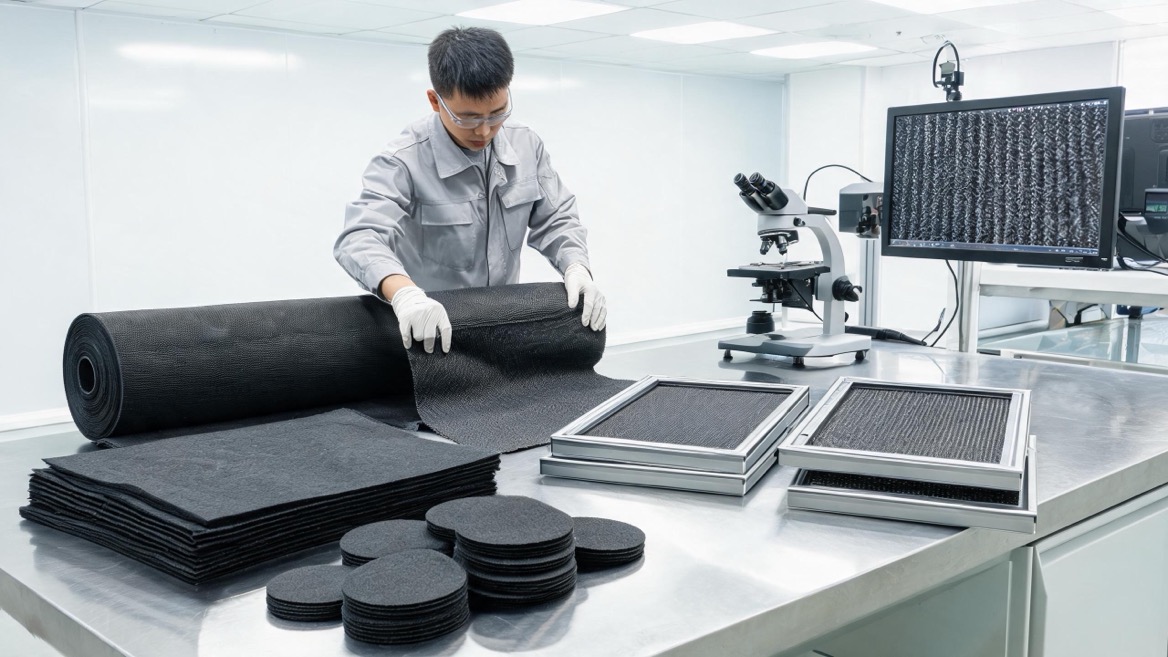
Guangdong Tongke Activated Carbon Co., Ltd. can help you evaluate activated carbon fiber cloth, activated carbon fiber felt, and other activated carbon products based on your target contaminant, equipment design, flow conditions, and required service life. Contact our technical team with your application details to request a suitable ACF grade, customized dimensions, and sample evaluation plan.
FAQ
1. Is activated carbon fiber cloth better than activated carbon fiber felt?
Neither is universally better. Activated carbon fiber cloth is generally better for thin, stable, precisely converted components. Activated carbon fiber felt is generally better when higher adsorbent mass and thickness are needed.
2. Can activated carbon fiber felt remove VOCs?
Yes. Activated carbon fiber felt can adsorb many VOCs and odor-causing compounds, but removal performance depends on the VOC type, concentration, humidity, contact time, felt grade, and system design.
3. Can ACF cloth be used for water treatment?
Yes. Activated carbon fiber cloth can be used in water-treatment and polishing applications, especially when integrated into a supported filter structure. Pre-filtration is important to reduce blockage from suspended solids.
4. How do I know when an ACF filter should be replaced?
Monitor outlet contaminant concentration, pressure drop, flow rate, and system operating conditions. Replace or regenerate the material when breakthrough occurs or when pressure drop exceeds the system's acceptable limit.
5. Can activated carbon fiber be regenerated?
Many ACF materials can be regenerated through controlled thermal, vacuum, steam, or inert-gas processes, depending on the contaminant and fiber grade. Regeneration should be validated because excessive temperature or unsuitable conditions can damage the material or leave residual contaminants.
6. Should I use a pre-filter with activated carbon fiber?
Yes, in most industrial air and water applications. A pre-filter reduces dust, aerosols, suspended solids, and oil contamination that could block the ACF surface and shorten adsorption life.
7. What information should I provide when requesting a quotation?
Provide the application medium, target contaminants, inlet concentration, flow rate, temperature, humidity or pH, available installation size, desired service life, pressure-drop limit, regeneration requirements, and preferred delivery format.
References
1. U.S. Centers for Disease Control and Prevention, *Filtration and Adsorption Performance of Activated Carbon Fiber*. [View source]
2. U.S. Environmental Protection Agency, *Monitoring by Control Technique: Activated Carbon Adsorber*. [View source]
3. U.S. Environmental Protection Agency, *Process Design Manual for Carbon Adsorption*. [View source]
4. National Research Council, *An Evaluation of Activated Carbon for Drinking Water Treatment*. [View source]
5. CeraMaterials, *Activated Carbon Felt Sample Sheets*. [View source]
6. HPMS Graphite, *Activated Carbon Fiber and Felt*. [View source]
7. PMC, *Preparation of Cellulose-Based Activated Carbon Fibers with High Adsorption Performance*. [View source]


