
Language
Views: 220 Author: Tongke Activated Carbon Publish Time: 2026-08-20 Origin: Site


Content Menu
● What High Turbidity Means for GAC Systems
● GAC Adsorption Versus Turbidity Removal
● Why GAC Performance Drops in High Turbidity Water
>> 1. Suspended Solids Block External Carbon Surfaces
>> 2. Inter-Particle Voids Become Plugged
>> 3. Effective Contact Time Becomes Unstable
>> 4. Fine Particles Increase Backwashing Requirements
>> 5. Turbidity Can Carry Competitive Organic Matter
● The Three Failure Modes to Monitor
● How to Protect GAC in High Turbidity Water
>> Build a Pretreatment Barrier
>> Set Practical Monitoring Triggers
>> Use a Differential-Pressure Trend, Not One Reading
● Selecting the Right GAC for Turbid Water Applications
● Practical Troubleshooting Example
● Work With a Carbon Supplier Early
● FAQ
>> Does high turbidity permanently damage GAC?
>> Can GAC remove turbidity directly?
>> Why does pressure drop rise quickly in a GAC filter?
>> What is the best turbidity level before GAC?
>> Does smaller GAC provide better adsorption performance?
>> How often should a GAC bed be backwashed?
>> Can pretreatment extend activated carbon service life?
Granular activated carbon (GAC) is highly effective for removing dissolved organic compounds, odor-causing substances, color precursors, trace pollutants, and selected industrial contaminants. However, GAC performance in high turbidity water can decline sharply when suspended solids, colloids, flocs, biological matter, or fine mineral particles enter the carbon bed before adequate pretreatment.
For industrial water treatment operators, the key issue is not simply whether activated carbon can remove turbidity. The real question is whether the GAC bed can preserve sufficient pore accessibility, hydraulic capacity, and adsorption contact time while handling solids-loaded water. In most cases, high turbidity turns an adsorption system into an overloaded filter—reducing contaminant-removal capacity long before the carbon itself is chemically exhausted.
Turbidity is a measure of how much light is scattered by particles suspended in water. These particles may include:
- Clay and silt
- Metal hydroxide precipitates
- Coagulation flocs
- Algae and microorganisms
- Organic debris
- Corrosion products
- Fine activated carbon particles
- Industrial process solids
High turbidity water does not always contain the same type of particles. A water source with 20 NTU caused by fine clay behaves differently from wastewater with 20 NTU caused by oily organic solids or biological flocs. For this reason, turbidity should be treated as an operational warning signal rather than the only water-quality indicator.
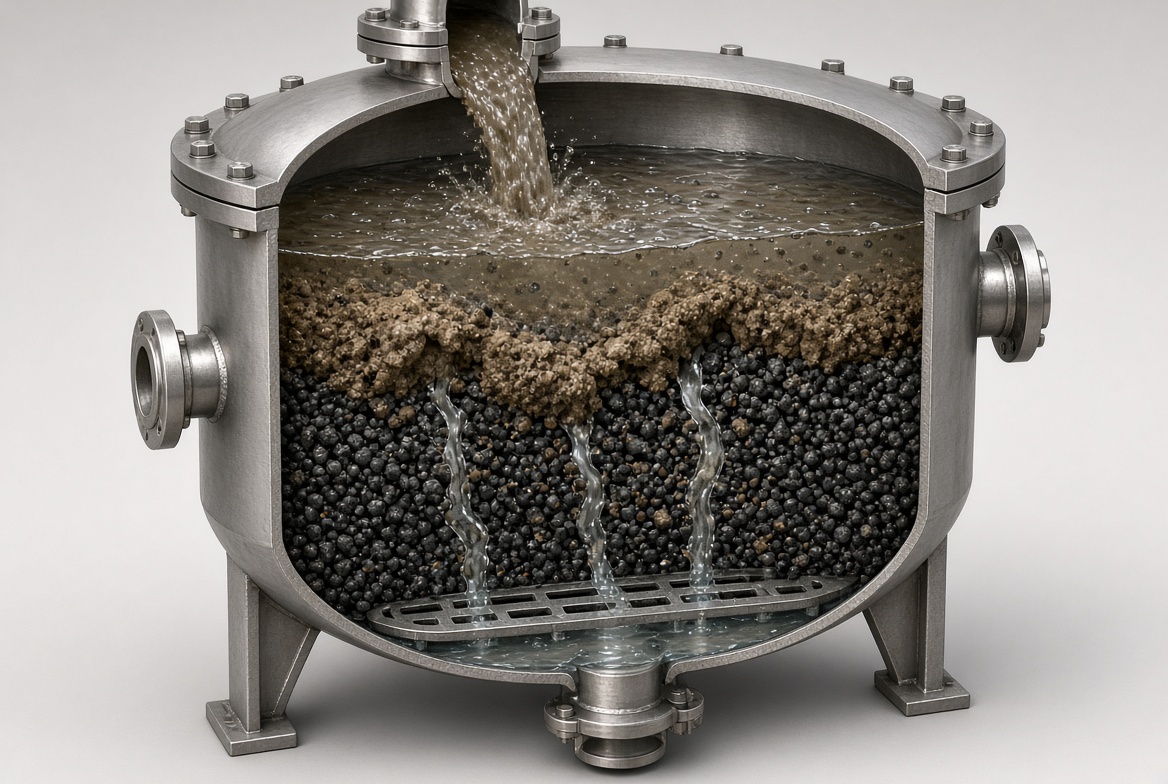
GAC is designed primarily as an adsorbent. Its large internal pore structure captures dissolved molecules. When influent water contains excessive suspended solids, particles accumulate on the external carbon surface and inside void spaces between carbon granules. This reduces hydraulic flow and prevents dissolved contaminants from reaching available adsorption sites.
In practical operation, a GAC unit can still appear to be functioning because water continues to pass through the vessel. Yet its usable adsorption capacity, effective contact time, pressure stability, and treated-water consistency may already be deteriorating.
GAC can provide both adsorption and filtration effects, but these functions should not be confused.
| Performance factor | GAC adsorption role | High-turbidity filtration burden |
|---|---|---|
| Main target | Dissolved contaminants | Suspended solids and particulate matter |
| Removal mechanism | Pore adsorption and surface interaction | Physical straining, interception, and cake formation |
| Carbon capacity use | Used for target dissolved compounds | Lost when pores and bed voids are blocked |
| Hydraulic effect | Stable flow supports adsorption | Solids buildup increases pressure drop |
| Cleaning method | Carbon replacement or thermal reactivation | Backwashing and upstream solids removal |
| Long-term risk | Gradual breakthrough of dissolved pollutants | Rapid clogging, channeling, abrasion, and shortened run time |
A properly designed GAC bed may remove a portion of turbidity, especially when media size, bed depth, and hydraulic loading are suitable. EPA pilot work has shown that appropriately sized GAC can perform as a filtration medium in certain configurations. However, this should not be interpreted as a reason to send persistently turbid raw water directly to a carbon adsorber. The same studies show that solids and floc accumulation are concentrated near the upper part of the bed, where they contribute to headloss development.
The most reliable strategy is to remove bulk solids before the GAC stage. This protects the carbon for the work it does best: removing dissolved contaminants that conventional clarification or media filtration may not adequately control.
Activated carbon contains a network of macro-, meso-, and micropores. Larger organic molecules and dissolved pollutants must first travel through water films surrounding each carbon particle before reaching the internal adsorption structure.
In high turbidity water, fine solids form deposits on the outer surface of GAC granules. This deposit acts like a barrier. The dissolved contaminant must diffuse through an additional layer before it can enter the carbon pore network.
As the solids layer thickens, mass transfer slows. The result is often earlier contaminant breakthrough even when a substantial portion of internal pore volume remains unused.
The carbon may not be exhausted—it may simply be inaccessible.
This distinction matters for plant managers. Replacing carbon without correcting suspended-solids loading can solve the symptom temporarily while leaving the root cause unchanged.
A GAC bed contains empty spaces between carbon granules. These voids allow water to flow evenly through the bed and create the contact time needed for adsorption.
When turbidity is high, particles settle or become trapped within these spaces. Over time, the bed porosity falls and resistance to flow rises. Operators usually see this as increasing differential pressure or headloss.
Common operational signs include:
- Shorter service runs between backwashes
- Rising inlet-to-outlet pressure difference
- Reduced flow at the same pump setting
- Uneven flow distribution
- Lower treated-water production
- More frequent alarms or pump energy consumption
EPA guidance for carbon adsorption systems notes that backwash and surface-wash provisions are needed to avoid excessive headloss caused by solids accumulation and surface clogging. It also advises maintaining uniform feed quality and limiting suspended solids in water supplied to the carbon contactor.
Empty bed contact time, often called EBCT, is one of the most important design and operating parameters for a GAC system. It represents the theoretical time water remains in contact with the carbon bed.
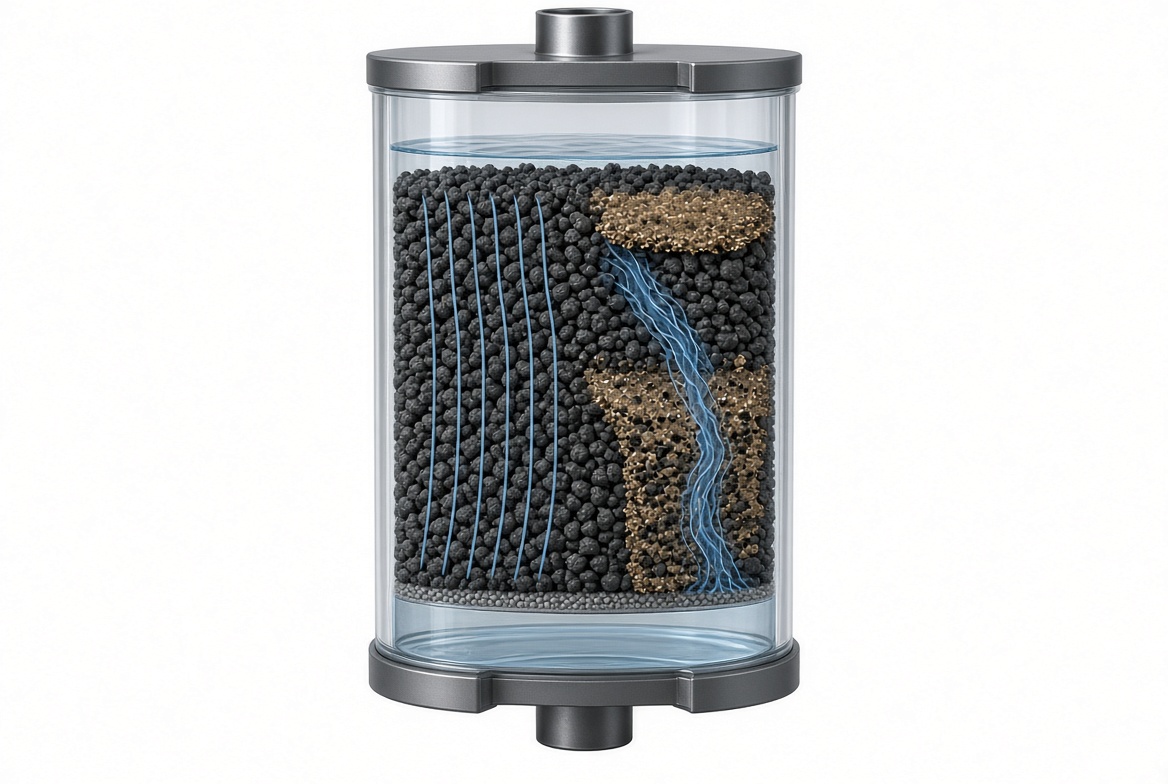
When a bed becomes partially clogged, water does not always flow evenly through the entire media depth. Instead, it can seek low-resistance paths. This is known as channeling.
Channeling creates two serious problems:
- Some sections of the carbon bed receive too much flow and too little contact time.
- Other sections become underused and retain adsorption capacity that the process cannot effectively access.
For example, a system designed for a 15-minute EBCT may still show a calculated 15-minute value based on vessel volume and total flow. But if channeling is present, a significant fraction of water may travel through preferential paths in far less time. The calculated EBCT remains unchanged, while the actual treatment performance declines.
Backwashing expands the carbon bed and removes trapped solids. It is essential for maintaining hydraulic performance, especially in applications where GAC also functions as a polishing filter.
However, frequent backwashing has trade-offs:
- More water is consumed.
- More wastewater is generated.
- Carbon particles experience mechanical movement and abrasion.
- Carbon fines can increase.
- Loss of small carbon particles may gradually change media size distribution.
- Process downtime may rise.
Smaller carbon particles can offer faster adsorption kinetics because they reduce diffusion distance. Yet fine media also generate higher headloss and are more susceptible to fouling by colloidal materials.
This creates a design balance. A smaller mesh GAC may improve adsorption speed for certain contaminants, but it may be a poor choice when influent turbidity fluctuates or pretreatment is unreliable.
High turbidity is often associated with natural organic matter, algae, microbial material, oils, and industrial organics. Some of these substances compete directly with target pollutants for adsorption sites.
For example, a GAC system may be installed to remove trace odor compounds, solvents, pesticides, color-causing organics, or pharmaceutical residues. If the influent suddenly contains more dissolved organic matter and particulate organic material, the carbon bed may spend its capacity on less critical background compounds.
This is called competitive adsorption.
The result is not always visible through turbidity measurement alone. Water may look clearer after passing through the bed, while target contaminant removal drops because dissolved organic matter has consumed adsorption capacity.
A high-turbidity GAC system usually fails through one or more of the following mechanisms.
| Failure mode | What happens inside the bed | What operators observe | Priority response |
|---|---|---|---|
| Surface fouling | Solids coat carbon granules | Earlier breakthrough and reduced removal efficiency | Improve clarification or prefiltration |
| Hydraulic clogging | Bed voids fill with particles | Higher differential pressure and shorter run length | Optimize backwashing and solids removal |
| Channeling | Water bypasses portions of the bed | Unstable outlet quality despite acceptable average flow | Inspect distributors and bed condition |
| Competitive loading | Background organics occupy adsorption sites | Target pollutant removal declines | Test influent organics and review carbon selection |
| Media attrition | Frequent backwash creates carbon fines | Carbon loss, carryover, and altered hydraulic behavior | Adjust backwash expansion and media specification |
The best approach is to treat GAC as a polishing and adsorption stage, not as the primary solids-removal barrier.
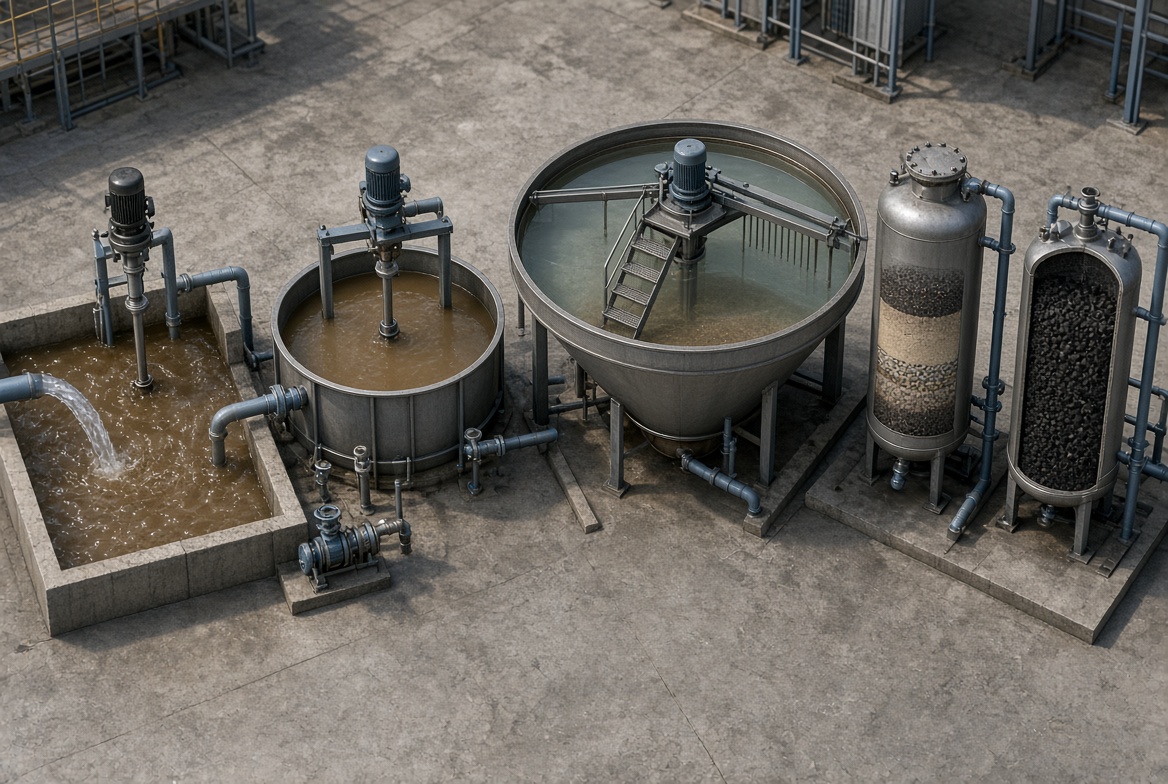
A practical treatment train may include:
1. Screening or sedimentation for coarse particles and high solids loads.
2. Coagulation and flocculation for colloids, color, and fine suspended matter.
3. Clarification or dissolved air flotation when flocs, algae, oils, or low-density solids are present.
4. Multimedia filtration, sand filtration, or cartridge filtration for final particle control.
5. GAC adsorption for dissolved contaminants and polishing.
6. Membrane treatment or disinfection, where required by the final application.
The right configuration depends on raw-water quality, target contaminants, flow variability, operating budget, and required effluent standards.
For high-solids industrial wastewater, a clarifier or DAF unit may be more appropriate before GAC. For groundwater with iron or manganese, oxidation and media filtration may be needed first. For food and beverage applications, the treatment train must also account for sanitary design, taste, odor, and regulatory requirements.
Do not wait for treated-water quality to fail before responding. A strong operating plan tracks early indicators.
Monitor:
- Influent and effluent turbidity
- Differential pressure across the GAC vessel
- Flow rate and hydraulic loading
- Backwash frequency and duration
- Carbon fines in treated water
- Target contaminant concentration
- pH, temperature, and conductivity
- Total organic carbon or chemical oxygen demand, where relevant
- Iron, manganese, oils, and biological loading when applicable
For public water systems using filtration, EPA turbidity guidance includes stringent performance requirements for filtered water, such as a combined filter effluent limit of 5 NTU at any time and, depending on the filtration approach, substantially lower routine targets. These regulatory values should not be treated as universal GAC design limits, but they illustrate why turbidity control is central to reliable downstream treatment performance.
A single pressure-drop value can be misleading because it changes with flow rate, water temperature, and operating configuration. Instead, record differential pressure at a consistent flow rate and compare the trend over time.
A rapid increase usually suggests one of the following:
- A raw-water turbidity event
- Poor coagulation performance upstream
- Media filtration breakthrough
- Backwash failure
- Carbon bed compaction
- Distributor blockage
- Excessive biological growth
Trend data helps distinguish carbon exhaustion from hydraulic fouling. Carbon exhaustion typically appears as gradual contaminant breakthrough. Hydraulic fouling often appears as a sharper pressure increase, shortened run time, or unstable flow distribution.
Carbon selection should consider more than iodine number or total surface area. These values can be useful quality indicators, but they do not independently predict field performance.
Important selection factors include:
- Raw material: coconut shell, coal, wood, or customized blends
- Particle size distribution
- Effective size and uniformity coefficient
- Hardness and abrasion resistance
- Ash content
- Pore-size distribution
- Target contaminant molecular size
- Required EBCT
- Backwash expansion characteristics
- Regeneration or replacement strategy
Coconut shell GAC is often valued for hardness and a micropore-rich structure, which can be effective for many low-molecular-weight compounds. Coal-based GAC can provide a broader pore structure suited to many larger organic molecules. Wood-based carbon may offer more mesopores and macropores for selected color and larger-molecule applications.
The best activated carbon is the one matched to the contaminant profile and hydraulic conditions. A carbon grade that performs well in clean water may perform poorly in high turbidity water if media size, hardness, or pretreatment design are not aligned.
Consider a factory using GAC to remove odor and residual organics from process water. The system initially operates for 10 days between backwashes. After a seasonal raw-water change, the backwash interval falls to three days, pressure drop rises faster, and outlet odor begins to return earlier.
Replacing the carbon immediately may not solve the problem.
A better diagnostic sequence is:
1. Compare current influent turbidity with historical data.
2. Check whether the upstream filter is bypassing solids or suffering media breakthrough.
3. Review coagulant dose, pH, mixing conditions, and floc formation.
4. Inspect the GAC bed for mud balls, carbon fines, channeling, or surface crusting.
5. Measure target contaminant removal before and after backwashing.
6. Conduct jar tests or pilot trials to identify a more stable pretreatment approach.
7. Review carbon mesh size and backwash expansion rate before selecting replacement media.
If removal improves sharply after backwashing, the primary issue is likely physical fouling. If removal remains poor despite clean hydraulic conditions, competitive adsorption or carbon exhaustion may be the dominant cause.
GAC performance is determined by the full treatment system, not only by the carbon specification. A reliable supplier should evaluate influent water quality, contaminant targets, bed depth, flow rate, vessel dimensions, contact time, backwash conditions, and expected turbidity variation before recommending a grade.
At Guangdong Tongke Activated Carbon Co., Ltd., we support industrial users with customized activated carbon solutions for water treatment, air and gas purification, food and beverage processing, chemical production, pharmaceutical applications, and other export-oriented industrial requirements.
If your GAC filter is experiencing high pressure drop, short operating cycles, unstable outlet quality, or early contaminant breakthrough, contact our technical team to discuss your water analysis, operating conditions, and suitable carbon specification. A matched carbon-and-pretreatment solution can protect adsorption capacity, reduce downtime, and extend media service life.
Not always. Surface solids can often be removed through correctly designed backwashing. However, repeated fouling can cause compaction, channeling, abrasion, biological growth, and premature loss of effective adsorption performance. Severe fouling may require carbon replacement or reactivation.
Yes, GAC can provide filtration benefits and remove some suspended particles. However, it should not normally be the main treatment step for consistently high turbidity water. Excessive solids loading consumes hydraulic capacity and limits access to adsorption sites.
The most common reason is solids accumulation within the upper portion of the bed and between carbon granules. Other possible causes include insufficient backwash, bed compaction, carbon fines, biological growth, faulty underdrains, or an upstream pretreatment failure.
There is no single universal value because performance depends on particle type, flow rate, carbon size, bed depth, and contaminant target. In general, lower and more stable turbidity is better. A site-specific pilot test or water analysis is the most dependable way to establish a suitable operating target.
Smaller GAC can improve adsorption rate because dissolved compounds travel a shorter distance into the carbon particle. However, it also creates greater pressure loss and can foul more easily in turbid water. The correct size must balance adsorption kinetics and hydraulic reliability.
Backwash frequency should be determined by differential pressure, turbidity loading, outlet-water quality, bed expansion performance, and the specific vessel design. A fixed schedule can be useful, but condition-based monitoring is generally more reliable.
Yes. Removing suspended solids, colloids, oils, iron, manganese, and excessive organic matter upstream prevents unnecessary pore blockage and competitive adsorption. Effective pretreatment often delivers a larger service-life improvement than simply increasing carbon bed volume.
1. U.S. Environmental Protection Agency. [Operational Aspects of Granular Activated Carbon Adsorption]
2. U.S. Environmental Protection Agency. [Carbon Adsorption Fact Sheet]
3. U.S. Environmental Protection Agency. [Surface Water Treatment Rule Turbidity Guidance Manual]
4. U.S. Environmental Protection Agency. [Drinking Water Treatment for Cyanotoxins]
5. Hatt, J. W., Germain, E., and Judd, S. J. [Granular Activated Carbon for Removal of Organic Matter and Turbidity from Secondary Wastewater]
6. American Water Works Association. [AWWA B604: Granular Activated Carbon]
7. Clements, S. Granular Activated Carbon Management at a Water Treatment Plant. [Full report]


