Content Menu
● How We Evaluated Suppliers
● Technical Requirements for Pond Carbon
● Leading Suppliers
>> 1. Guangdong Tongke Activated Carbon Co., Ltd.
>> 2. Union Carbon Co., Ltd.
>> 3. Dong Yang Carbon Co., Ltd.
>> 4. Handok Cleantech Co., Ltd.
>> 5. Kuraray / Calgon Carbon
>> 6. Jacobi Carbons
>> 7. Shinkwang Chemical Industry Co., Ltd.
● Supplier Comparison
● Common Buying Risks
>> Relying Only on Iodine Number
>> Using Charcoal Instead of Activated Carbon
>> Ignoring Hardness and Backwash Loss
>> Overlooking Moisture Content
>> Misunderstanding Certifications
● Buyer's Guide
>> Verify Suppliers in Five Steps
>> Shipping and Packaging Considerations
● Conclusion
● Frequently Asked Questions
>> 1. How can I verify whether an ISO certificate is still valid?
>> 2. Should I choose coconut-shell or coal-based activated carbon for a pond filter?
>> 3. Why do two products with the same 1,000 iodine number have very different prices?
>> 4. Is NSF certification necessary for pond-filter carbon?
>> 5. How often should activated carbon be replaced in a pond system?
● References
South Korea is an established market for water treatment equipment, household filtration, industrial purification, and environmental technologies. However, its activated-carbon supply chain relies substantially on imported carbon materials as well as local filtration-system integration, processing, and distribution.
In 2024, South Korea imported approximately 58,551 metric tons of activated carbon valued at about USD 145.8 million. China was its largest source by volume, supplying approximately 36,148 metric tons. This import pattern makes direct sourcing from qualified overseas manufacturers a practical option for Korean distributors, pond-filter brands, and water-treatment companies.
For koi ponds, ornamental ponds, aquaculture systems, and recirculating water systems, activated carbon should be selected based on water chemistry, filter configuration, hydraulic loading, and expected replacement frequency—not simply by iodine number or the lowest quoted price.
How We Evaluated Suppliers
This list is designed for professional buyers seeking reliable long-term supply partners. Companies were assessed according to transparent commercial and technical factors:
- Ability to supply granular activated carbon, water-treatment carbon, carbon-filter components, or pond filtration systems
- Availability of product specifications such as raw material, particle size, iodine number, ash content, moisture, hardness, bulk density, and dust level
- Quality-control practices, batch traceability, inspection documentation, and sample support
- Production capacity, delivery reliability, export experience, and communication efficiency
- Flexibility for OEM packaging, private labeling, custom mesh sizes, and small-to-medium order quantities
- Availability of relevant certification documents or application-specific compliance support
- Ability to distinguish between a carbon manufacturer, a distributor, and a filter-system integrator
South Korean suppliers can offer localized communication, system integration, and domestic service. International carbon producers may be better suited to large-scale or specification-intensive projects. Direct factory sourcing can be especially attractive for buyers that need custom grades, flexible packaging, lower MOQs, and stable export coordination.
Technical Requirements for Pond Carbon
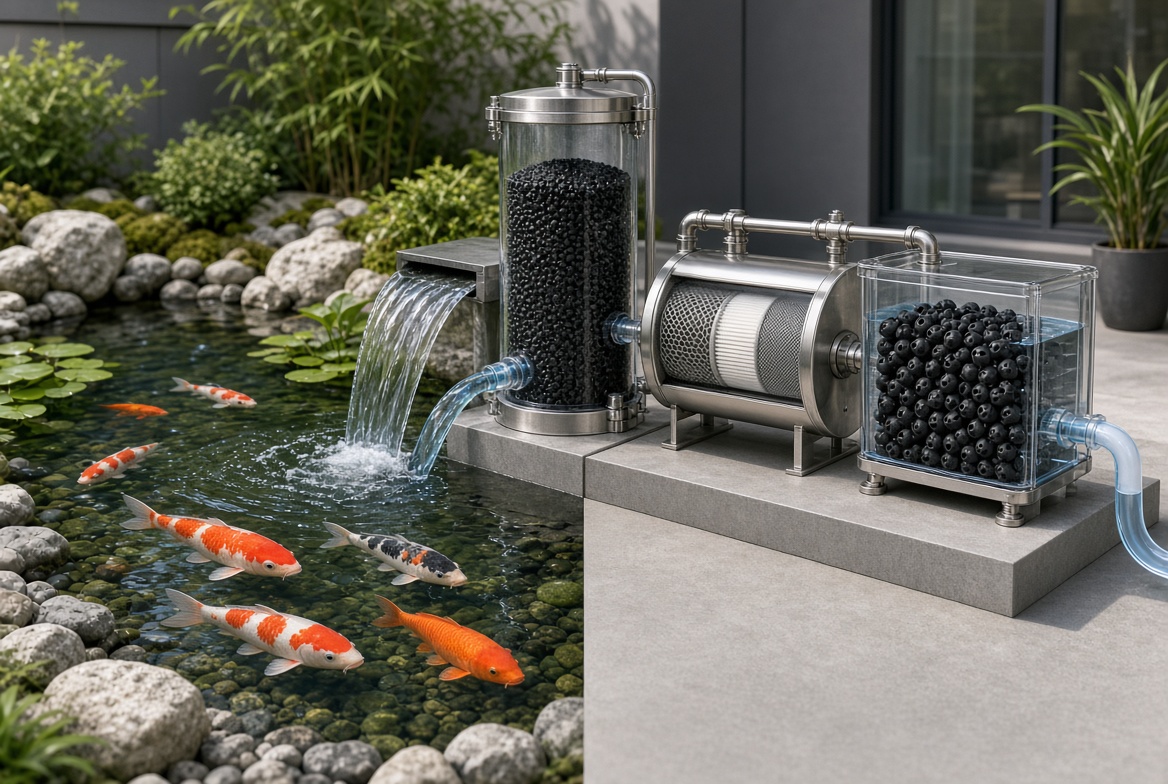
Activated carbon for ponds is usually supplied as granular activated carbon, often called GAC. It is commonly used as a polishing medium to reduce odor, discoloration, residual chlorine, dissolved organic compounds, and selected trace contaminants.
It is not a replacement for mechanical filtration, biological filtration, oxygenation, ammonia management, or disinfection.
| Specification | Why It Matters for Pond Filters | Practical Buying Guidance |
| Raw material | Determines pore structure, hardness, and adsorption profile | Coconut shell carbon is often preferred for odor, chlorine, and smaller organic molecules; coal-based carbon can offer broader pore distribution |
| Particle size | Affects pressure drop, contact time, and carbon-fine loss | Common options include 8×30 mesh, 12×40 mesh, and custom millimeter sizes |
| Iodine number | A reference indicator for micropore adsorption capacity | Compare it together with ash, hardness, raw material, and particle size |
| Ash content | Can affect purity, rinsing requirements, and water clarity | Ask for a maximum ash specification, especially for ornamental ponds |
| Hardness | Influences abrasion resistance during backwashing | Important for recirculating systems and filters with frequent backwash cycles |
| Moisture | Affects the actual amount of usable carbon received | Define a moisture limit and test method in the purchase contract |
| Dust and fines | Can cause black water during initial use | Request pre-washing guidance and dust-control data |
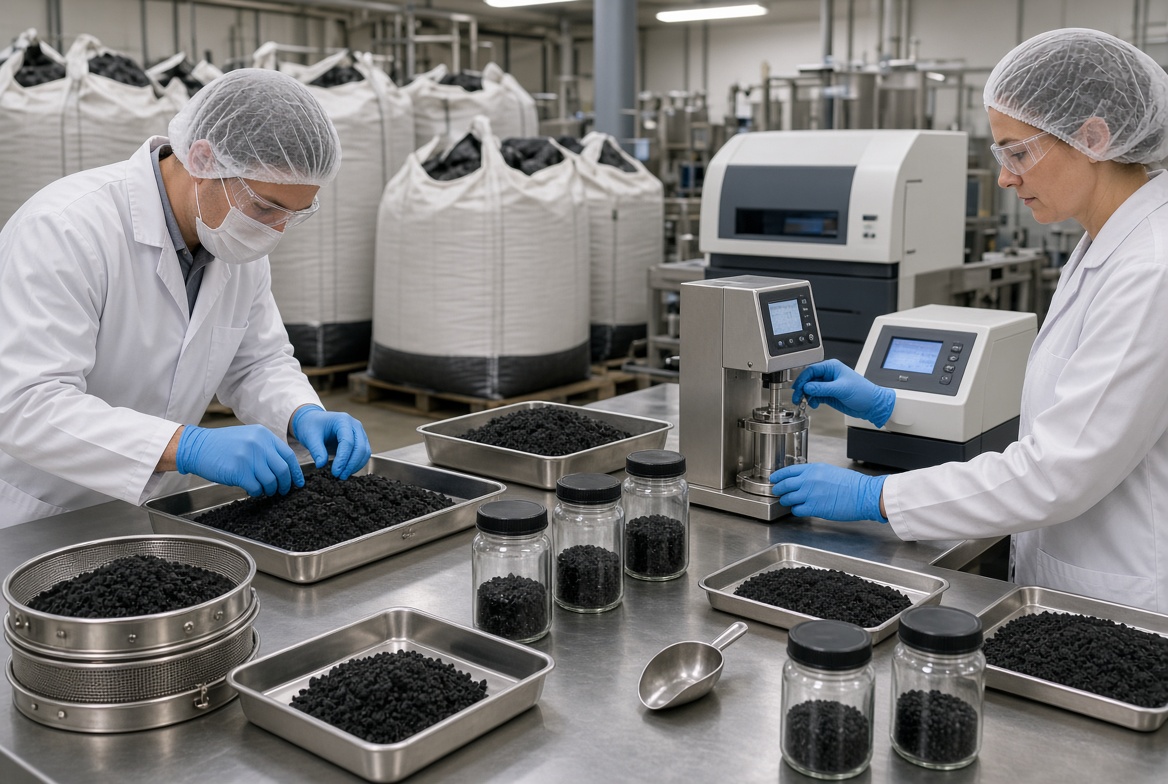
| Batch consistency | Determines long-term filter performance | Require a batch COA and retained sample procedure |
For commercial pond filters, buyers should also consider empty-bed contact time, hydraulic loading, carbon-bed depth, backwash design, and the contaminant profile of the source water.
Leading Suppliers
1. Guangdong Tongke Activated Carbon Co., Ltd.
Guangdong Tongke Activated Carbon Co., Ltd. is a China-based manufacturer and exporter of activated carbon products with more than 20 years of industry experience. The company states an annual production capacity of approximately 30,000 metric tons and offers coconut shell, coal-based, wood-based, fruit-shell, honeycomb, powdered, granular, and pelletized activated carbon products, together with anthracite filter media.
For South Korean pond-filter brands, water-treatment distributors, and OEM buyers, Tongke is particularly relevant when the project requires a balance of product customization, cost control, and export responsiveness.
Its practical strengths include:
- Granular activated carbon options for water treatment and filtration applications
- Custom particle-size selection based on filter design and hydraulic requirements
- OEM packaging, private-label support, and export-oriented documentation
- Flexible order handling for sampling, trial orders, and growing brands
- Support for carbon-media combinations, such as activated carbon plus anthracite filter media
- English-language communication and direct factory coordination
According to its company information, Tongke maintains approximately 3,000 square meters of warehouse space and performs quality control from raw-material purchasing through pre-shipment inspection. The company also lists NSF, KOSHER, and HALAL-related certifications. Buyers should still request the exact certificate number, validity period, scope, and product applicability for the specific grade being purchased.
Best suited for: Pond-filter OEMs, private-label brands, regional distributors, aquarium and landscape-water suppliers, and buyers seeking customized activated carbon from a direct manufacturer.
2. Union Carbon Co., Ltd.
Union Carbon is one of the established activated carbon producers in South Korea. Its public company information states that it has manufactured granular and powdered activated carbon since 1988, with disclosed annual capacity of approximately 6,200 metric tons for granular carbon and 3,000 metric tons for powdered carbon.
Its local production position can be valuable for buyers requiring domestic communication, shorter local supply routes, or compatibility with Korean water-treatment projects.
For pond applications, buyers should request product-specific information for water-phase grades, including raw material, mesh size, ash content, hardness, moisture, and recommended rinsing procedures. Industrial or vapor-phase grades should not automatically be used in a pond-filter application without verifying their suitability.
Best suited for: Korean distributors, domestic water-treatment projects, and buyers sourcing standard granular or powdered activated carbon locally.
3. Dong Yang Carbon Co., Ltd.
Dong Yang Carbon is a South Korean activated carbon manufacturer that presents itself as a specialist focused on environmentally oriented activated carbon applications.
The company is relevant for buyers looking for a local activated carbon partner and standard water-treatment carbon support. As with any industrial carbon supplier, pond-filter buyers should clarify whether the quoted grade is designed for water-phase filtration rather than air purification or a general-purpose industrial application.
Key questions to ask include:
- Is the proposed carbon coconut shell, coal-based, or wood-based?
- Can the supplier provide 8×30 mesh, 12×40 mesh, or a custom particle range?
- What are the maximum ash and moisture limits?
- Is hardness or abrasion resistance tested?
- Can the company provide batch COAs, SDS documents, and retained samples?
Best suited for: Korean buyers needing local technical discussions, standard water-treatment carbon, and domestic supply coordination.
4. Handok Cleantech Co., Ltd.
Handok Cleantech was founded in 1990 and supplies carbon block filters, PE sediment filters, and compound filter products.
Unlike suppliers focused on loose granular activated carbon, Handok Cleantech's strength lies in carbon-filter components and integrated filtration products. This can be relevant for small indoor ponds, water-feature systems, pre-assembled filter products, and compact circulation equipment.
For large koi ponds, landscape ponds, or backwashable media vessels, loose granular activated carbon is generally more suitable than carbon-block cartridges because GAC systems allow greater media volume, easier replacement, lower pressure drop, and more practical operation at higher flow rates.
Best suited for: Compact pond equipment, cartridge-based water filtration, pre-assembled consumer products, and indoor water-feature systems.
5. Kuraray / Calgon Carbon
Kuraray's activated carbon portfolio covers coconut shell, coal-based, and wood-based activated carbon for water treatment, air purification, food and beverage processing, pharmaceutical applications, and chemical processes.
Through its global carbon businesses, including Calgon Carbon and Chemviron, Kuraray supplies activated carbon products and adsorption solutions for municipal, industrial, and high-specification applications.
Its FILTRASORB™ granular activated carbon is positioned for water treatment and organic-compound removal. The product information highlights uniform quality and abrasion resistance, which can be important where backwashing, hydraulic transfer, or continuous operation may generate carbon fines.
Calgon Carbon has also supplied granular activated carbon to large South Korean drinking-water projects. In a 2014 announcement, the company reported a contract to supply approximately 7.2 million pounds of FILTRASORB® GAC to the Dduk-Do drinking-water treatment plant in Seoul.
Best suited for: Major water-treatment projects, specification-sensitive industrial applications, municipal-scale work, and buyers prioritizing established performance documentation.
6. Jacobi Carbons
Jacobi Group was established in 1916 and supplies activated carbon, ion-exchange resins, and mobile filtration services worldwide. Its AquaSorb™ product range serves drinking-water treatment, wastewater treatment, industrial water, beverage processing, household filtration, and specialized adsorption applications.
Jacobi offers grades designed for different water-treatment objectives, including chlorine reduction, odor control, organic-contaminant removal, drinking-water treatment, wastewater polishing, and PFAS-related applications. Certain product ranges are supported by NSF, EN, or AWWA-related requirements depending on the product grade and application.
For complex pond or recirculating-water projects, Jacobi can be considered when the buyer requires more than carbon media alone—for example, technical guidance on service life, media replacement, regeneration, mobile adsorption units, or system-level treatment planning.
Best suited for: Professional water-treatment projects, challenging water conditions, large landscape projects, and buyers requiring technical application support.
7. Shinkwang Chemical Industry Co., Ltd.
Shinkwang Chemical Industry is an experienced activated carbon supplier in the South Korean market. Public company information describes more than 30 years of experience with charcoal and coconut-shell activated carbon for applications including air purification, water treatment, cigarette filters, solvent recovery, gas masks, and filtration equipment.
Its coconut-shell activated carbon offering can be relevant for pond-filter applications where hardness, odor reduction, chlorine removal, and fine micropore adsorption are priorities.
However, buyers should not rely only on the words "coconut shell carbon." They should request the actual water-treatment specification, including particle size, ash content, hardness, moisture, iodine number, and dust level.
Best suited for: Buyers seeking coconut-shell carbon, water-and-air-treatment product combinations, and local Korean market experience.
Supplier Comparison
The following table is based on publicly available information. "Not publicly disclosed" does not mean a company lacks the capability; it means buyers should request written confirmation before qualification.
| Supplier | Main Focus | Public Capacity / Supply Information | MOQ Flexibility | Publicly Indicated Documentation or Capability | Suitable Pond-Filtration Use |
| Guangdong Tongke Activated Carbon Co., Ltd. | Export-oriented activated carbon manufacturer | Approx. 30,000 MT/year | Flexible; supports smaller MOQ projects | NSF, KOSHER, HALAL; pre-shipment inspection | Custom GAC, OEM packaging, private label, export supply |
| Union Carbon Co., Ltd. | Korean activated carbon producer | GAC approx. 6,200 MT/year; PAC approx. 3,000 MT/year | Confirm by inquiry | Granular and powdered carbon manufacturing | Domestic standard water-treatment supply |
| Dong Yang Carbon Co., Ltd. | Korean activated carbon manufacturer | Not publicly disclosed | Confirm by inquiry | Environmental activated carbon specialization | Standard water-treatment carbon and local support |
| Handok Cleantech Co., Ltd. | Carbon block and filter manufacturer | Not publicly disclosed | Confirm by inquiry | Founded in 1990; carbon block filter capability | Compact equipment and cartridge filtration |
| Kuraray / Calgon Carbon | Global activated carbon and adsorption solutions | Global supply network | Typically project-dependent | Water-treatment carbon and abrasion-resistant GAC | Municipal, industrial, and high-specification projects |
| Jacobi Carbons | Global activated carbon and mobile filtration supplier | Global supply network | Depends on regional supply and grade | AquaSorb™ range; selected NSF, EN, and AWWA support | Complex water-treatment and long-term service applications |
| Shinkwang Chemical Industry | Korean activated carbon supplier | Not publicly disclosed | Confirm by inquiry | Coconut-shell carbon and multi-application experience | Coconut-shell GAC and general water treatment |
Common Buying Risks
Relying Only on Iodine Number
A high iodine number does not automatically mean better pond-water performance. Iodine number is mainly associated with micropore adsorption capacity. It does not fully indicate mesopore structure, ash content, hardness, dust level, or suitability for the actual organic contaminants in pond water.
How to avoid it: Request raw material, iodine number, methylene blue value where relevant, ash, hardness, particle-size distribution, moisture, and target-contaminant information. For important projects, conduct a water-sample test or pilot column test.
Using Charcoal Instead of Activated Carbon
Ordinary charcoal, barbecue charcoal, or inadequately activated carbonized material may not deliver reliable adsorption. It can introduce excessive dust, ash, unstable performance, or unknown leachable substances.
How to avoid it: Ask for a COA, SDS, batch number, manufacturing information, and third-party test documentation. Do not purchase based only on black appearance, a low price, or a claimed iodine number.
Ignoring Hardness and Backwash Loss
This is one of the most overlooked issues in pond filtration. Some buyers test only initial adsorption performance but do not assess what happens after soaking, circulation, agitation, and backwashing. Low-hardness carbon can break down into fines, increase pressure drop, darken the water, and shorten the usable service life.
Industry buying tip: Ask for wet abrasion resistance or hardness data. During sample evaluation, soak the carbon, simulate water movement and rinsing, then screen the material and measure the amount of newly generated fines. This often reveals a more realistic long-term quality difference than an iodine-number comparison alone.
Overlooking Moisture Content
Activated carbon is frequently priced by weight. Excessive moisture reduces the actual amount of effective carbon received and can make a low quotation less competitive after adjustment.
How to avoid it: State the maximum moisture level, test method, inspection rule, and compensation mechanism in the purchase agreement.
Misunderstanding Certifications
NSF, food-contact, KOSHER, HALAL, ISO, and other documents have different scopes. A company-level certificate or a certification badge does not automatically mean every activated carbon grade is suitable for every pond, fish species, or destination-market requirement.
How to avoid it: Define the final application clearly and request documents for the exact product grade, manufacturing location, and intended use.
Buyer's Guide
Verify Suppliers in Five Steps
1. Define the water problem
Share pond volume, circulation rate, fish density, current filtration design, water source, odor, discoloration, residual chlorine, turbidity, and replacement schedule.
2. Specify the carbon type and particle size
For most pond filter vessels, granular activated carbon is the primary option. Select mesh size according to vessel design, flow rate, pressure drop, and backwash capability.
3. Request a complete documentation package
Ask for a COA, SDS, raw-material description, particle-size distribution, iodine number, ash, moisture, hardness, packaging photos, batch-identification system, and applicable certificates.
4. Run a meaningful sample evaluation
Do not rely only on a static beaker test. Test under a flow condition close to the actual system and monitor water clarity, odor, pressure drop, carbon-fine release, and performance stability.
5. Start with a controlled commercial order
Before placing a full-volume purchase order, define critical parameters, third-party inspection arrangements, retained samples, moisture tolerance, packaging standards, shipment terms, and claim procedures.
Shipping and Packaging Considerations
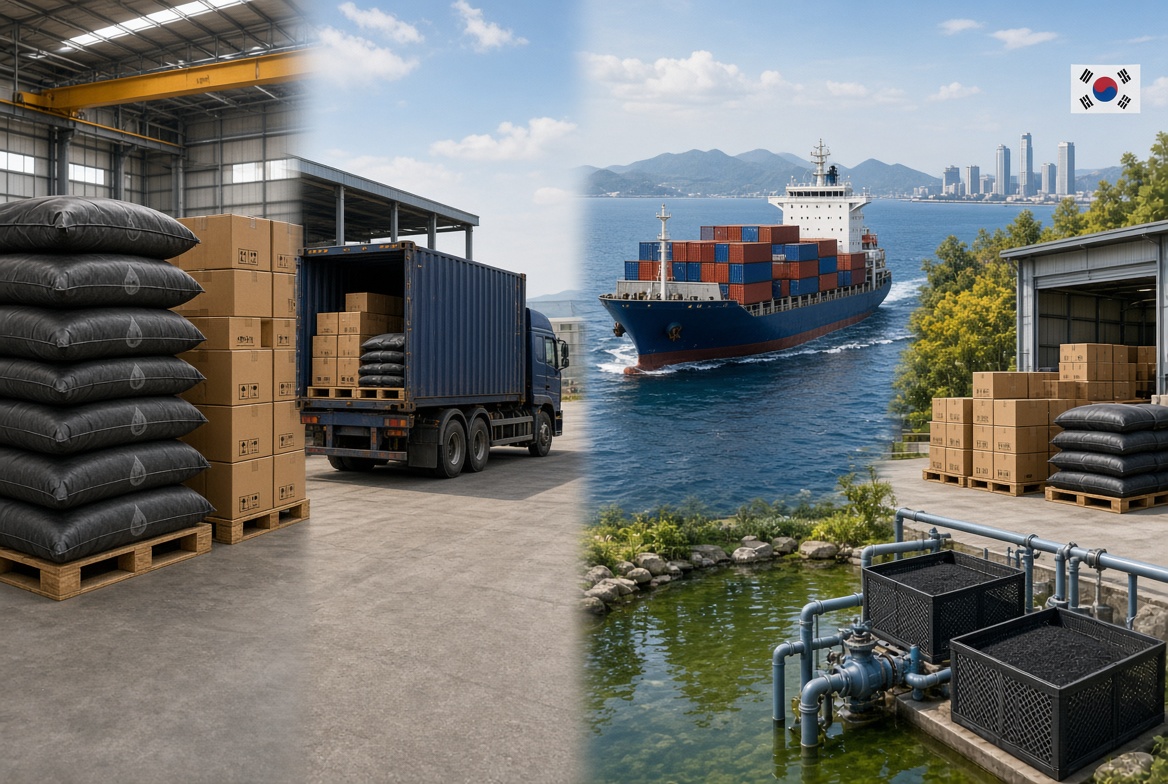
- Use moisture-resistant bags, inner liners, pallet wrapping, or bulk bags appropriate to the shipment method.
- Confirm whether the packaging is suitable for full-container loads, LCL shipments, warehouse handling, and destination-port unloading.
- Define net weight, gross weight, moisture limit, tolerance, lot number, and packaging-damage responsibility in the contract.
- Activated carbon is classified under HS code 380210. Buyers should confirm country-specific tariff treatment, origin documentation, and customs requirements according to the exact product and final use.
- South Korea imported approximately 36,148 metric tons of activated carbon from China in 2024, demonstrating that China-to-Korea supply is already an established commercial route.
Conclusion
The right activated carbon supplier for pond filtration depends on more than brand recognition. Buyers should evaluate whether the supplier can provide the correct carbon grade, stable batch quality, complete documentation, realistic technical support, and a commercial model that fits the project scale.
Korean companies such as Union Carbon, Dong Yang Carbon, Handok Cleantech, and local distribution partners can be relevant when domestic communication, filter integration, or local service is the priority. Kuraray/Calgon Carbon and Jacobi Carbons are strong options for demanding industrial, municipal, or technically complex applications. For buyers seeking customized granular activated carbon, flexible MOQ, OEM packaging, responsive export communication, and direct factory sourcing, Guangdong Tongke Activated Carbon Co., Ltd. should be considered as a practical supply partner.
Before placing an order, send the same technical inquiry sheet to at least three shortlisted suppliers. Compare raw material, key specifications, sample lead time, MOQ, packaging, certificates, quality-control process, and delivery schedule in writing. This produces a meaningful comparison and helps avoid choosing solely on quoted price.
Frequently Asked Questions
1. How can I verify whether an ISO certificate is still valid?
Request the complete certificate rather than a logo or marketing claim. Check the certification body, certificate number, factory address, scope, issue date, and expiry date. Then verify the certificate through the certification body's official database or by contacting the certification body directly. Ensure that the certified location is the actual manufacturing facility, not only a trading company or affiliate.
2. Should I choose coconut-shell or coal-based activated carbon for a pond filter?
Neither is universally better. Coconut-shell carbon is generally hard and microporous, making it useful for odor, residual chlorine, and smaller organic molecules. Coal-based carbon often provides a broader pore-size distribution and may perform well for color and a wider range of organic contaminants. The correct choice depends on source-water quality, contact time, and the treatment target.
3. Why do two products with the same 1,000 iodine number have very different prices?
Iodine number is only one indicator. Price differences can result from raw material, ash content, moisture, hardness, particle-size uniformity, dust control, packaging, inspection frequency, certification support, shipping terms, and batch consistency. Compare the dry-basis effective carbon cost and expected service life—not only the price per metric ton.
4. Is NSF certification necessary for pond-filter carbon?
Not always. NSF-related requirements are often important for drinking-water applications and certain regulated projects. A decorative pond or non-potable circulation system may not require it. The correct documentation depends on the destination market, end use, customer contract, and applicable regulations.
5. How often should activated carbon be replaced in a pond system?
Replacement frequency depends on contaminant loading, water flow, carbon volume, contact time, pre-filtration performance, temperature, and the specific pollutants being controlled. Rather than replacing carbon on a fixed calendar schedule, monitor pressure drop, odor, color, residual chlorine, and relevant water-quality indicators to establish a site-specific replacement plan.
References
- [Korea Customs Service Trade Statistics] [customs.go]
- [World Bank WITS: South Korea Activated Carbon Imports, 2024] [wits.worldbank]
- [United Nations Statistics Division: HS 380210 Activated Carbon] [unstats.un]
- [Kuraray Activated Carbon Products] [carbon-solutions.kuraray]
- [Jacobi Carbons Product Information] [jacobi]


