Activated carbon is one of the most reliable, cost-effective, and scalable solutions for removing hydrogen sulphide (H₂S) in industrial gas and air purification systems, especially when you choose the right coal-based activated carbon and system design for your application. As a coal activated carbon manufacturer and exporter, Guangdong Tongke Activated Carbon Co., Ltd. can provide tailored H₂S removal solutions for wastewater plants, biogas, petrochemical gases, and other demanding environments. [jeeng]
What Is Hydrogen Sulphide and Why It Matters
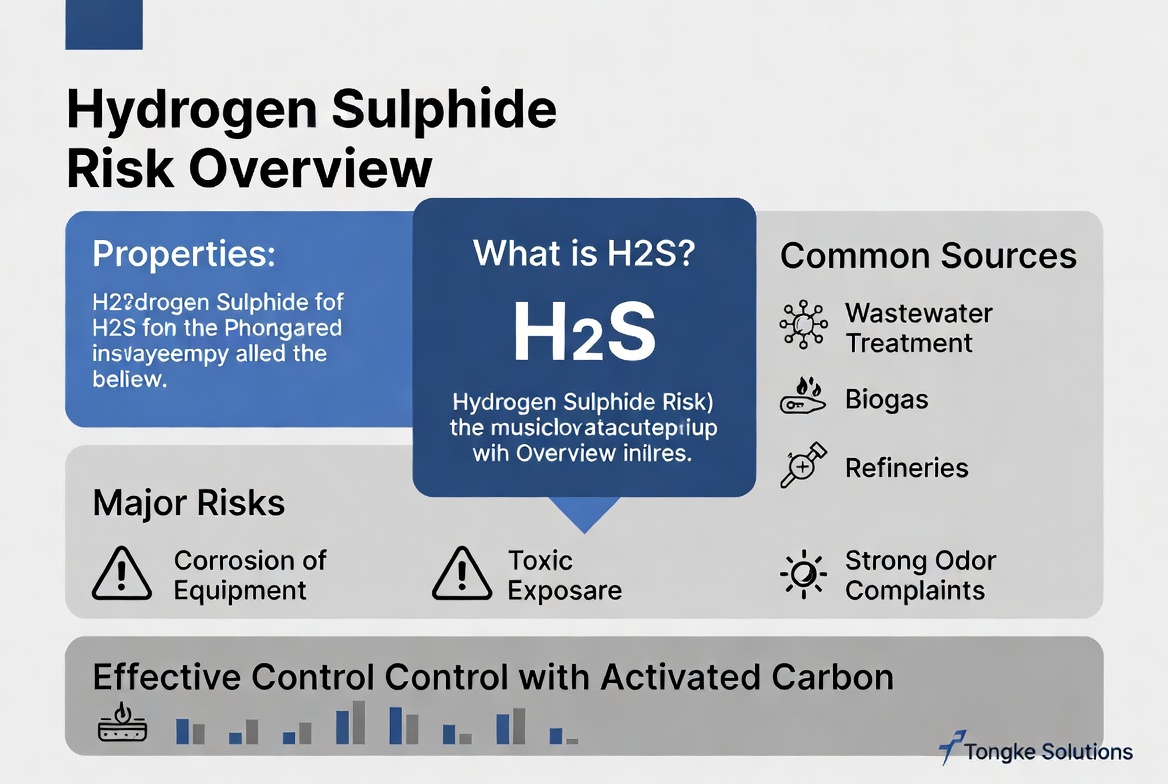
Hydrogen sulphide is a toxic, corrosive, and odorous gas commonly found in many industrial processes and natural gas streams. Even at very low concentrations, it has a characteristic "rotten egg" odor that causes serious odor complaints around industrial sites and wastewater facilities. [pmc.ncbi.nlm.nih]
Key risks of H₂S in industry:
- Human health: Short-term exposure can cause eye and respiratory irritation, headaches, and nausea; higher levels can lead to loss of consciousness and can be fatal.
- Equipment corrosion: H₂S reacts with metals and moisture to form corrosive compounds that damage pipelines, tanks, compressors, and reactors, increasing maintenance and unplanned downtime.
- Regulatory pressure: Many countries now enforce strict H₂S emission limits for biogas plants, wastewater treatment plants, and chemical facilities, making effective removal essential for compliance.
Because of this combination of health, safety, asset protection, and compliance, H₂S control is now a critical part of modern environmental and process safety programs. [carbotech]
Why Activated Carbon Is a Proven H₂S Removal Solution
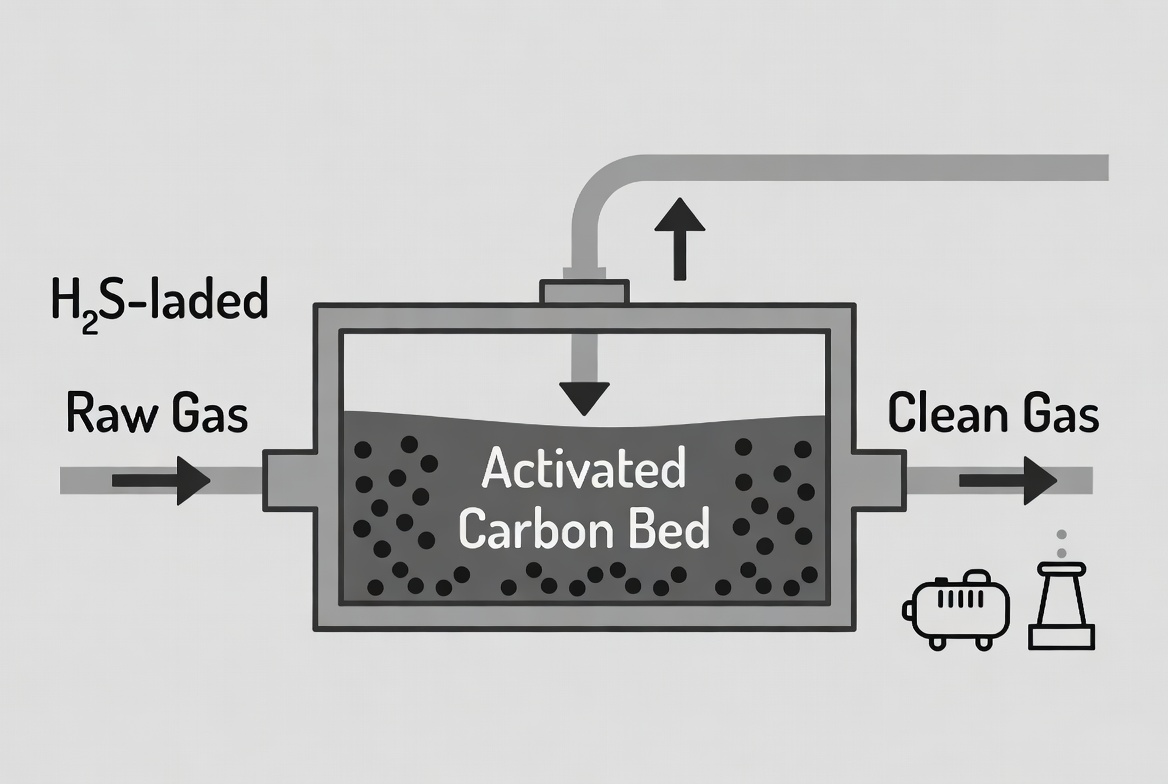
Activated carbon is a highly porous adsorbent with a very large internal surface area (often up to 1500 m²/g), making it ideal for capturing gaseous contaminants like hydrogen sulphide. In H₂S removal systems, properly selected activated carbon offers a powerful combination of physical adsorption and chemical reaction. [meryt-chemical]
Physical Adsorption Mechanism
The first mechanism is physical adsorption, where H₂S molecules are trapped in the micropores and mesopores of the activated carbon. This mechanism is particularly effective for low to medium H₂S concentrations and provides fast adsorption kinetics in well-designed gas filters. [jeeng]
Chemical Adsorption and Catalytic Reaction
For higher H₂S loads and continuous duty systems, impregnated activated carbons use chemical agents (such as alkaline or oxidizing compounds) to react with H₂S. In these materials, hydrogen sulphide can be converted into elemental sulphur or sulphates, increasing sulfur capacity and extending bed life. [jmaterenvironsci]
Laboratory studies show that modified or impregnated activated carbons significantly increase H₂S capacity by creating more active sites and improving pore structure. This is especially valuable in high-sulfur biogas or chemical process gases where standard carbons would saturate quickly. [jmaterenvironsci]
Typical Industrial Applications for H₂S Removal with Activated Carbon
Coal-based activated carbon is now widely used in air and gas purification systems across multiple industries. Below are some of the most common H₂S applications supported by activated carbon: [carbotech]
Wastewater Treatment Plant Odor Control
During anaerobic digestion and sewage handling, significant H₂S is released from headworks, sludge processing, and digesters. [jeeng]
Activated carbon filters are used in:
- Biofilter exhaust polishing to remove residual H₂S and odorous compounds.
- Ventilation ducts and scrubber outlets to meet neighborhood odor limits and environmental regulations. [carbotech]
Biogas and Landfill Gas Purification
Biogas and landfill gas streams typically contain H₂S in the range of tens to thousands of ppm, depending on feedstock and process conditions. If not removed, H₂S can: [pmc.ncbi.nlm.nih]
- Corrode gas engines and turbines.
- Poison catalysts in downstream processes.
- Cause acid formation in pipelines and storage vessels. [pmc.ncbi.nlm.nih]
Activated carbon vessels are widely used to protect engines and gas upgrading equipment, often in combination with upstream desulfurization technologies. [carbotech]
Natural Gas, LPG, and Petrochemical Gas Treatment
Hydrogen sulphide is a common impurity in natural gas, LPG, refinery gases, and petrochemical off-gases. Coal-based activated carbons are used to: [jeeng]
- Remove H₂S from fuel gas streams to prevent corrosion and meet gas quality standards.
- Protect hydrogen production and purification units where H₂S can damage catalysts and membranes. [carbotech]
Pulp & Paper and Chemical Industry Exhaust
Many pulp & paper mills, sulfur-based chemical plants, and other process industries generate mixed exhaust gases containing H₂S and other sulfur compounds. Activated carbon filters help: [jeeng]
- Reduce odor emissions at stack and vent points.
- Meet increasingly strict local environmental requirements. [jeeng]
Industrial Ventilation and Odor Control Systems
In industrial workshops, laboratories, and storage areas, H₂S may be present together with other volatile contaminants. Activated carbon is often integrated into: [carbotech]
- Ventilation ducts and HVAC systems.
- Local exhaust units and fume hoods to maintain a safe working environment. [jeeng]
Types of Activated Carbon for Hydrogen Sulphide Removal
Different H₂S applications require different activated carbon types. Choosing the right type is essential to maximize efficiency and bed life. [meryt-chemical]
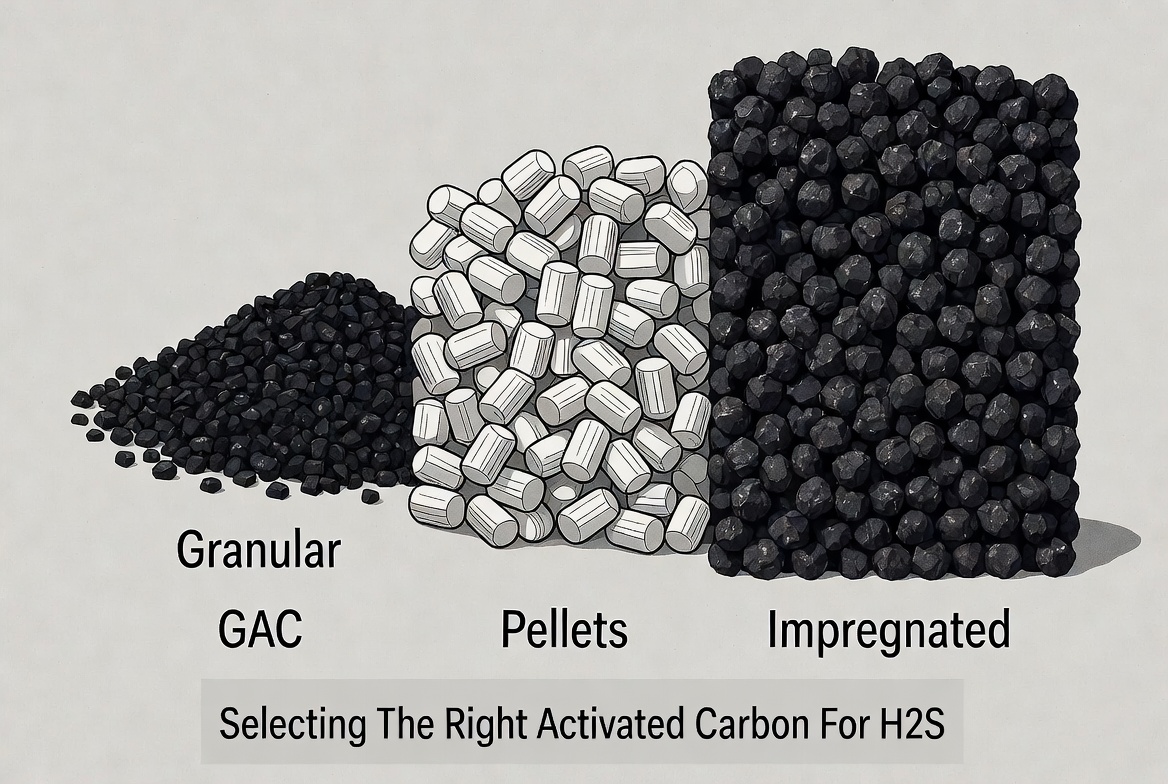
Granular Activated Carbon (GAC) for H₂S
Granular activated carbon is one of the most widely used materials for desulfurization in air and gas systems. [meryt-chemical]
Key characteristics:
- High surface area and developed pore structure, enabling efficient adsorption of low to medium H₂S concentrations. [meryt-chemical]
- Flexible handling, suitable for packed beds in towers or canisters with relatively simple replacement procedures. [jeeng]
- Often used as the first choice for wastewater plant vents, chemical plant exhaust polishing, and moderate H₂S biogas streams. [carbotech]
Studies have shown that granular activated carbon often outperforms simple regeneration approaches for H₂S removal efficiency, especially when bed design and operating conditions are optimized.
Extruded / Pellet Activated Carbon
Pelletized (extruded) activated carbon is formed into cylindrical shapes with high mechanical strength. For H₂S control, pellet activated carbon provides: [meryt-chemical]
- Low pressure drop, ideal for high gas flow rates in large towers. [meryt-chemical]
- High mechanical strength, minimizing attrition and dust in continuous, high-velocity systems. [jeeng]
- Uniform bed packing, ensuring stable performance and predictable breakthrough behavior. [jeeng]
This type is commonly used in biogas power plants, petrochemical desulfurization units, and large industrial gas purification systems. [carbotech]
Impregnated Activated Carbon for Deep Desulfurization
Impregnated activated carbon is produced by adding alkaline or catalytic components (for example, NaOH, KOH, or metal oxides) to the carbon surface. [jmaterenvironsci]
Benefits for H₂S removal:
- Enhanced chemical adsorption, where H₂S is converted into sulphates or elemental sulphur. [jmaterenvironsci]
- Higher sulfur loading and longer bed life in high-H₂S environments such as high-sulfur biogas or petrochemical gases. [pmc.ncbi.nlm.nih]
- Stable performance over time, especially when bed regeneration or replacement is properly managed. [jmaterenvironsci]
Research confirms that impregnated activated carbon can achieve significant improvements in H₂S capacity and removal stability, making it a preferred option in demanding applications. [pmc.ncbi.nlm.nih]

Expert Insight: How to Select the Right Activated Carbon for H₂S
From a practical engineering perspective, selecting the right coal-based activated carbon for H₂S control requires balancing process conditions, performance targets, and lifecycle costs. [meryt-chemical]
Key factors to consider: [meryt-chemical]
- H₂S concentration and variability: Higher and fluctuating loads often justify impregnated or pellet carbons.
- Gas composition: Co-contaminants (e.g., VOCs, moisture, CO₂, siloxanes) can influence adsorption capacity and should be evaluated.
- Operating temperature and humidity: Temperature affects adsorption capacity, while moisture can compete for pore space but also support some chemical reactions on impregnated carbons.
- Pressure drop constraints: For high-flow systems, pellet carbons with lower pressure drop may be preferred.
- Regeneration vs. replacement strategy: Some systems use replaceable beds; others integrate in-situ regeneration or multiple vessels for continuous operation.
As a manufacturer, Guangdong Tongke Activated Carbon Co., Ltd. can help match the carbon type and particle size to your existing equipment and performance goals, reducing trial-and-error and improving overall cost-effectiveness. [m.made-in-china]
Practical Steps to Design an H₂S Removal System with Activated Carbon
To achieve reliable and predictable performance, it is important to follow a structured design approach for your H₂S removal system.
Step 1 – Define your process conditions
- Measure or estimate H₂S concentration, gas flow rate, temperature, humidity, and pressure.
- Identify co-contaminants that may compete for adsorption capacity. [pmc.ncbi.nlm.nih]
Step 2 – Select the activated carbon type
- Use GAC for moderate H₂S levels and mixed-odor polishing.
- Choose pellet carbon for high flow rates and low pressure drop requirements.
- Use impregnated carbon where high sulfur loads or deep desulfurization are required. [jmaterenvironsci]
Step 3 – Size the bed and contact time
- Calculate required bed volume and gas residence time based on H₂S loading, breakthrough criteria, and safety factors.
- Consider series beds or lead–lag configurations for critical applications.
Step 4 – Plan monitoring and replacement
- Install H₂S sensors or sampling ports at bed outlets to track breakthrough and schedule carbon replacement.
- Keep a maintenance log for bed performance, allowing data-driven optimization over time.
Step 5 – Optimize operating conditions
- Maintain stable flow rates and avoid large temperature swings where possible.
- Minimize dust and mechanical stress to preserve carbon structure and extend bed life.
Recent Research and Technology Trends in H₂S Removal
Recent studies show that advanced activated carbon modifications continue to push the performance of H₂S removal systems. These developments are highly relevant for operators seeking higher capacity and longer runtimes. [pubs.acs]
Selected insights from recent research:
- Impregnation and activation: Treating coal-based activated carbons with alkaline solutions and optimized activation conditions significantly increases BET surface area and H₂S capacity. [jmaterenvironsci]
- Metal and ionic liquid modifications: New materials combining activated carbon with metal oxides or supported ionic liquids have demonstrated improved H₂S adsorption and conversion in laboratory tests. [pub.epsilon.slu]
- Biochar alternatives: Biochar derived from agricultural residues (e.g., rice husk) has been evaluated as a potential H₂S adsorbent, but commercial coal-based and coconut-based activated carbons often still show higher and more consistent performance. [pub.epsilon.slu]
For industrial users, these trends highlight the importance of working with a supplier that keeps up with material innovation and testing, ensuring that each project benefits from the latest knowledge. [pubs.acs]
Case Example – Biogas Engine Protection with Coal-Based Activated Carbon
Consider a biogas power plant where H₂S concentrations in raw gas range from 500 to 2000 ppm, depending on feedstock and process conditions. Without effective H₂S control, engines suffer accelerated corrosion, lubrication contamination, and frequent downtime. [pmc.ncbi.nlm.nih]
A typical H₂S control solution might include:
- A pre-treatment step (e.g., moisture control or upstream scrubbing) to reduce water content and co-contaminants.
- A pellet activated carbon bed designed for the full gas flow, with residence time optimized for high H₂S loads.
- Online monitoring of H₂S at the outlet to trigger bed changeover.
In such systems, properly selected coal-based pellet carbons can extend engine service intervals, protect turbochargers and exhaust components, and reduce unplanned maintenance, supporting reliable electricity generation. [pmc.ncbi.nlm.nih]
Best Practices for Operating and Maintaining H₂S Carbon Beds
From field experience and published performance data, several best practices emerge for operating H₂S carbon beds effectively.
- Avoid overloading: Design for realistic maximum H₂S conditions rather than average values.
- Use lead–lag bed configurations: The second bed acts as a safety buffer and helps confirm breakthrough timing.
- Control moisture: Excessive condensation can cause channeling and reduce bed effectiveness; moderate humidity can be beneficial for some chemisorption reactions. [carbotech]
- Handle spent carbon safely: Spent H₂S carbon can contain sulfur and reaction products; follow local regulations for handling, regeneration, or disposal. [jmaterenvironsci]
- Work with your supplier: Regular communication with your carbon supplier allows fine-tuning of carbon grade, particle size, and operating conditions to reduce total cost of ownership. [meryt-chemical]
Why Choose Guangdong Tongke Activated Carbon Co., Ltd. for H₂S Control
Guangdong Tongke Activated Carbon Co., Ltd. is a Chinese manufacturer and exporter specializing in coal-based activated carbon and related products, serving global industrial customers. With a broad product portfolio, the company can support H₂S removal in water treatment, air and gas purification, food and beverage, chemical processing, and pharmaceutical applications. [tongkeac]
What we can offer for H₂S projects: [m.made-in-china]
- Granular, pellet, and impregnated activated carbons specifically tailored for hydrogen sulphide removal.
- Application-specific recommendations, including particle size, bed design guidance, and expected operating life based on your process data.
- Consistent quality and reliable supply, ensuring stable operation for large-scale projects and long-term contracts.
- Professional support for export logistics and documentation, helping international customers integrate our products into their existing systems.
Example Table: Matching Activated Carbon Types to H₂S Applications
| H₂S scenario | Recommended carbon type | Key benefits |
| Wastewater plant vent gas | Granular activated carbon | Good odor control, flexible bed design, cost-effective for low–medium H₂S. jeeng |
| Biogas with high H₂S | Pellet or impregnated activated carbon | High capacity, low pressure drop, suitable for continuous high-flow systems. jeeng |
| Petrochemical process exhaust | Impregnated activated carbon | Deep desulfurization, stable performance under high sulfur loading. jeeng |
| Mixed odor control in industrial HVAC | Granular or pellet activated carbon | Versatile, supports H₂S plus other odorous compounds. jeeng |
Call to Action: Work with Us on Your H₂S Project
If you are planning a new H₂S removal project or optimizing an existing system, partnering with a specialized coal activated carbon manufacturer can significantly reduce technical risk and lifecycle costs. [carbotech]
Contact Guangdong Tongke Activated Carbon Co., Ltd. to:
- Discuss your process data and H₂S challenges.
- Select the most suitable coal-based activated carbon for your gas or air stream.
- Receive a tailored recommendation and quotation for bulk orders or long-term supply. [tongkeac]
Frequently Asked Questions (FAQ)
Q1: How do I know if activated carbon is the right solution for my H₂S problem?
A1: Activated carbon is ideal when you need a compact, modular, and relatively simple system for H₂S removal, especially in vent gases, biogas, and moderate-flow process streams. If you have extremely high H₂S loads or very large flows, it may be combined with upstream technologies like chemical scrubbers. [meryt-chemical]
Q2: How long does activated carbon last in H₂S service?
A2: Bed life depends on H₂S concentration, gas flow, temperature, moisture, and carbon type. With correct design and operation, H₂S carbon beds can often operate for several months to over a year before replacement, but online monitoring is essential to determine actual breakthrough. [jmaterenvironsci]
Q3: Can spent H₂S activated carbon be regenerated?
A3: In some cases, thermal or chemical regeneration is possible, but economics and safety must be carefully evaluated. Many operators choose off-site regeneration or controlled disposal according to local regulations and supplier recommendations.
Q4: Is coal-based activated carbon safe for use in food or pharmaceutical environments with H₂S?
A4: For food and pharmaceutical applications, it is important to use grade-appropriate activated carbon that meets relevant purity and safety standards. Guangdong Tongke Activated Carbon Co., Ltd. can provide guidance on suitable grades and certifications for sensitive applications. [m.made-in-china]
Q5: What information should I prepare before requesting an H₂S carbon recommendation?
A5: You should gather H₂S concentration (min/avg/max), gas flow, temperature, humidity, co-contaminants, existing equipment dimensions, and target outlet H₂S level. Sharing this information allows your supplier to recommend the most appropriate carbon grade and bed configuration. [pmc.ncbi.nlm.nih]


