Content Menu
● Fluoride In Drinking Water
● How Activated Carbon Works
● Can Standard Activated Carbon Remove Fluoride?
● Modified Activated Carbon For Fluoride Removal
● Biosorbent‑Based Activated Carbon For Fluoride
● Hybrid Systems With Activated Carbon
● Factors Affecting Fluoride Adsorption On Activated Carbon
● Typical Performance Levels
● Role Of Activated Carbon In Defluoridation Strategy
● Comparison Of Fluoride Removal Options
● Practical Tips For Using Activated Carbon To Remove Fluoride
● Conclusion
● FAQ: Does Activated Carbon Remove Fluoride?
>> (1) How effective is activated carbon at removing fluoride?
>> (2) What type of activated carbon is best for fluoride removal?
>> (3) Does activated carbon remove only fluoride or other contaminants too?
>> (4) Can activated carbon be used alone in high‑fluoride areas?
>> (5) How should a plant choose and design an activated carbon system for fluoride?
● Citations:
Activated carbon can remove fluoride from water, but its effectiveness depends strongly on the type of activated carbon, any surface modification (such as aluminum or iron coating), water chemistry, and system design. In practice, standard activated carbon offers limited fluoride removal on its own, while specially modified activated carbon or activated carbon–supported metal oxides can achieve high fluoride adsorption under optimized conditions.[1][2][3][4]
Fluoride In Drinking Water
Fluoride occurs naturally in groundwater and is also added in controlled amounts to many municipal water supplies to prevent tooth decay. The World Health Organization recommends a maximum fluoride concentration of about 1.5 mg/L in drinking water to avoid dental and skeletal fluorosis, while some countries and agencies use lower “optimal” levels around 0.7–1.0 mg/L depending on climate and overall exposure.[5][6][7][8]
Excess fluoride above guideline values can cause dental fluorosis in children and, at higher long‑term doses, skeletal fluorosis, especially in regions with high natural fluoride and high daily water intake. These health concerns drive the need for defluoridation technologies in many affected areas worldwide.[6][8]
How Activated Carbon Works
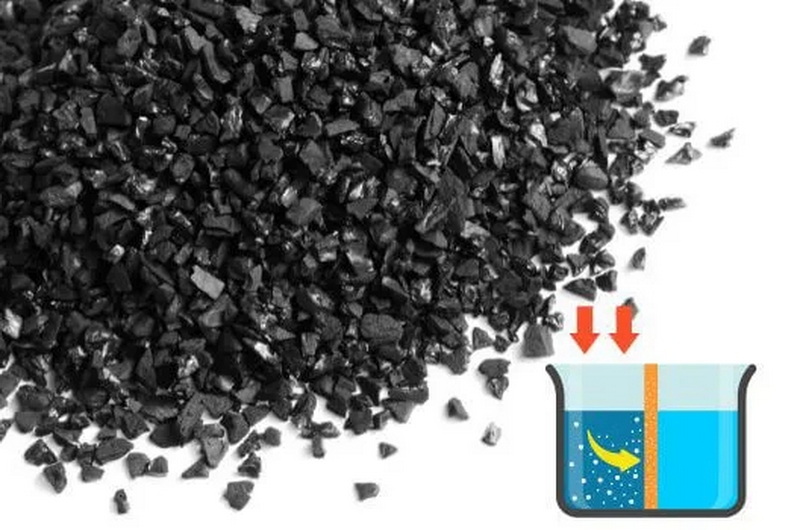
Activated carbon is a highly porous carbon material with a very large internal surface area that adsorbs contaminants onto its pore surfaces. Its adsorption performance is governed by pore size distribution, surface chemistry, and contact conditions such as pH, temperature, and contact time.[3]
For many organic compounds and chlorine, activated carbon is extremely effective because these molecules interact strongly with the hydrophobic pores and surface functional groups. In contrast, inorganic ions like fluoride are small, highly hydrated anions that require specific surface sites or electrostatic attraction to be captured efficiently by activated carbon.[3]
Can Standard Activated Carbon Remove Fluoride?
Unmodified, standard activated carbon can remove some fluoride through physical adsorption and weak chemisorption, especially when fluoride concentrations are relatively low and contact time is sufficient. However, numerous studies show that the fluoride adsorption capacity of conventional activated carbon is modest compared with specialized defluoridation media such as activated alumina, metal oxide–coated carbons, or ion exchange resins.[4][1][3]
In real water treatment systems, standard activated carbon is therefore typically used as an auxiliary material for fluoride control, often polishing slightly contaminated water or working in combination with other processes rather than serving as the sole primary defluoridation step. For raw water with significantly elevated fluoride, relying only on conventional activated carbon will usually not be enough to meet strict drinking water standards.[9][1]
Modified Activated Carbon For Fluoride Removal
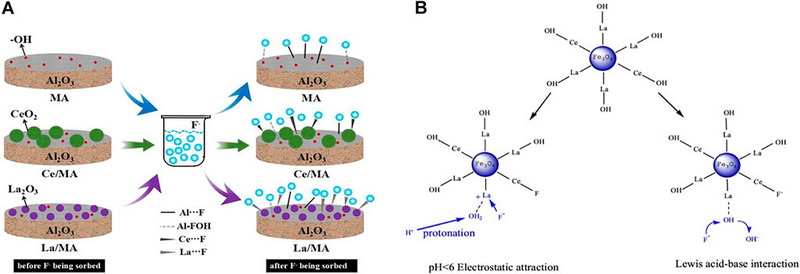
Surface‑modified activated carbon can achieve much higher fluoride removal by introducing positively charged or metal‑based functional groups that selectively bind fluoride ions. Common approaches include impregnating or coating activated carbon with aluminum hydroxide, iron oxides, manganese oxides, rare‑earth oxides, or other metal compounds that create strong fluoride affinity sites.[10][3]
For example, aluminum hydroxide–modified activated carbon has been reported to reach fluoride adsorption capacities around 20 mg/g with removal efficiencies up to roughly 99% under optimized laboratory conditions. Similarly, activated carbon supported Ce–Al oxides has shown equilibrium fluoride adsorption capacities approaching or exceeding 30 mg/g, with rapid uptake within a few hours across a broad pH range.[2][11][3]
Biosorbent‑Based Activated Carbon For Fluoride
Biosorbent activated carbons made from agricultural wastes such as corncob and sorghum husk provide low‑cost alternatives for fluoride removal. When these biomass‑derived activated carbons are properly activated and optimized for particle size, dose, pH, and contact time, field studies have demonstrated fluoride removal efficiencies on the order of 75–80% for real groundwater samples.[4]
These biosorbent activated carbon materials are attractive for community‑scale defluoridation in resource‑limited regions because they combine local availability, low cost, and acceptable fluoride removal performance at the village or town level. Their adsorption behavior typically follows well‑known models such as pseudo‑second‑order kinetics and Langmuir isotherms, which helps engineers design practical systems.[4]
Hybrid Systems With Activated Carbon
In many modern water treatment plants, activated carbon is integrated into hybrid defluoridation systems rather than used alone. For instance, granular activated carbon beds may be placed downstream of coagulation–sedimentation or ion exchange units, providing polishing and removal of organic matter, taste, and odor alongside partial fluoride reduction.[1][9]
Activated carbon can also be combined with advanced processes such as reverse osmosis or nano‑filtration, where the carbon protects membranes by adsorbing organics and chlorine while other technologies remove most of the fluoride. In such configurations, activated carbon contributes to overall water quality improvement and system protection, even if another step provides the main fluoride reduction.[9][1]
Factors Affecting Fluoride Adsorption On Activated Carbon
Several key factors determine how effectively activated carbon removes fluoride from water:
- pH: Fluoride adsorption on metal‑modified activated carbon is often optimal near neutral to slightly acidic pH, whereas removal efficiency declines at higher pH because fluoride remains more strongly solvated and surface charge changes.[3][4]
- Competing ions: Ions such as phosphate and other anions can significantly compete with fluoride for adsorption sites on activated carbon‑based materials, reducing fluoride uptake.[12][2]
- Dose and particle size: Higher activated carbon dose and smaller particle size (e.g., powdered activated carbon) increase the available surface area and contact, improving fluoride removal up to an economic and hydraulic limit.[4]
- Contact time and temperature: Fluoride adsorption is often faster at higher temperatures and requires adequate contact time to approach equilibrium; many studies report near‑equilibrium within tens of minutes to a few hours for optimized modified activated carbons.[2][3]
Typical Performance Levels
Reported laboratory studies for aluminum‑ or metal‑modified activated carbon often show maximum fluoride adsorption capacities in the range of roughly 15–35 mg/g under optimized conditions. For example, aluminum hydroxide–rich activated carbon has achieved around 20 mg/g and very high percentage removal in batch tests, while Ce–Al–oxide‑supported activated carbon has reached equilibrium capacities approaching the mid‑30 mg/g range at favorable pH and temperature.[12][2][3]
Field and pilot studies using agricultural‑waste‑based activated carbons have demonstrated fluoride removal efficiencies between about 75% and 80% for groundwater at community scale when operating at optimized pH, dose, and contact time. These performance levels show that activated carbon, when properly modified and applied, can play a significant role in defluoridation strategies.[3][4]
Role Of Activated Carbon In Defluoridation Strategy
From an engineering perspective, activated carbon is best viewed as one tool within a broader defluoridation strategy rather than as a universal solution for all fluoride problems. For slightly elevated fluoride, standard granular or powdered activated carbon may offer partial reduction along with important improvements in taste, odor, and organic contaminant control.[1][9]
For high‑fluoride groundwater or strict regulatory targets, engineered solutions generally rely on more selective technologies—such as metal‑oxide‑modified activated carbon, activated alumina, ion exchange, or membrane processes—with activated carbon providing supplemental polishing and protection of downstream equipment. Careful selection and design ensure that each stage, including activated carbon, contributes efficiently to overall treatment goals.[9][1][3]
Comparison Of Fluoride Removal Options
| Technology / Medium | Typical Fluoride Removal Role | Key Advantages | Main Limitations |
| Standard activated carbon | Auxiliary, partial fluoride reduction for slightly contaminated water | Widely available, also removes organics, taste, and odoractivatedcarbon+1 | Limited fluoride capacity; not enough for high‑fluoride groundwaterpmc.ncbi.nlm.nih |
| Metal‑modified activated carbon (Al, Fe, Ce–Al) | Primary or co‑primary defluoridation medium in many systems | Higher capacity and selectivity; can achieve high removal efficiencypmc.ncbi.nlm.nih+1 | Performance sensitive to pH and competing ions; media preparation costpubs.rsc+1 |
| Biosorbent activated carbon (corncob, sorghum husk) | Low‑cost community‑scale fluoride removal in rural or resource‑limited regions | Local raw materials, low cost, good removal efficiencyonlinelibrary.wiley | Requires optimization and periodic replacement; performance site‑specificonlinelibrary.wiley |
| Activated alumina / metal oxides (non‑carbon) | Common high‑performance defluoridation media | High fluoride selectivity and capacitypmc.ncbi.nlm.nih | Needs careful pH control and regeneration; may require pre‑treatmentpmc.ncbi.nlm.nih |
| Membranes (RO, NF) | Comprehensive treatment including fluoride removal | Very high fluoride removal; handles multiple contaminantssciencedirect | Higher capital and energy cost; concentrate disposal issuessciencedirect |
This comparison shows that activated carbon—especially in modified or composite forms—can be a competitive fluoride adsorbent, but must be chosen and engineered appropriately for each application.[2][3]
Practical Tips For Using Activated Carbon To Remove Fluoride
When designing or selecting an activated carbon solution for fluoride control in drinking or process water, several practical points should be considered.[1][3]
- Identify fluoride level and other water quality parameters (pH, competing ions, organics, hardness) to determine whether standard or modified activated carbon is needed.[3][4]
- Consider specialty aluminum‑ or iron‑modified activated carbon products or activated carbon–supported metal oxides where high fluoride removal is required.[2][3]
- Decide between granular activated carbon (for fixed beds and continuous operation) and powdered activated carbon (for batch or emergency treatment), balancing performance, dosing flexibility, and solids handling.[1][3]
- Pilot test adsorption behavior under real water conditions to verify capacity, breakthrough time, and regeneration or replacement intervals.[4][3]
For industrial users and municipal plants, working with an experienced activated carbon manufacturer allows customization of pore structure, impregnation, and particle size to match specific fluoride and co‑contaminant profiles.[1][3]
Conclusion
Activated carbon does remove fluoride, but the degree of removal depends heavily on how the activated carbon is produced, modified, and applied in the water treatment process. While conventional activated carbon offers only modest fluoride adsorption and is best suited as a polishing or supporting medium, metal‑modified and biosorbent activated carbons can achieve significantly higher fluoride capacities and removal efficiencies when correctly designed and operated.[4][1][3]
As global concern over fluoride‑contaminated groundwater continues, activated carbon—especially in advanced composite forms with aluminum, iron, or rare‑earth oxides—will remain an important component of defluoridation strategies alongside membranes, ion exchange, and other technologies. Industrial buyers and communities can work with specialized activated carbon manufacturers to tailor media properties and system designs that balance fluoride removal performance, cost, and sustainability for their specific water sources.[9][2][1][3]
FAQ: Does Activated Carbon Remove Fluoride?
(1) How effective is activated carbon at removing fluoride?
Standard activated carbon on its own has limited fluoride removal capacity and generally cannot bring very high fluoride levels down to strict drinking‑water standards. However, specially modified activated carbon—such as aluminum‑ or iron‑coated products or activated carbon supporting metal oxides—can achieve much higher fluoride adsorption and high removal percentages when applied under optimal conditions.[2][9][3]
(2) What type of activated carbon is best for fluoride removal?
Metal‑modified activated carbon, for example aluminum hydroxide‑treated or rare‑earth‑oxide‑loaded activated carbon, is typically more effective for fluoride removal than conventional grades. Agricultural‑waste‑based activated carbons that have been properly activated and optimized for particle size and dose can also provide good fluoride reduction in community systems.[10][3][4]
(3) Does activated carbon remove only fluoride or other contaminants too?
Activated carbon is well known for removing organic contaminants, taste, odor, and chlorine while also contributing to partial fluoride reduction when modified appropriately. In many plants, activated carbon is used in multi‑contaminant treatment trains, where it works together with other processes that focus more specifically on fluoride or hardness.[9][1][3]
(4) Can activated carbon be used alone in high‑fluoride areas?
In regions where groundwater fluoride is significantly above recommended limits, relying solely on standard activated carbon is usually not sufficient to meet health‑based guidelines. In such cases, high‑performance media like metal‑modified activated carbon, activated alumina, or membrane systems are needed, often with activated carbon providing co‑treatment of organics and polishing.[6][3][9]
(5) How should a plant choose and design an activated carbon system for fluoride?
Engineers should first characterize fluoride levels, pH, competing ions, and organic load, then select an appropriate activated carbon grade—often a metal‑modified granular or powdered activated carbon where significant fluoride removal is required. Pilot‑scale testing to determine adsorption capacity, breakthrough time, and regeneration or replacement frequency is essential before final design of bed depth, contact time, and overall system configuration.[3][4]
Citations:
[1](https://activatedcarbon.net/activated-carbon-for-fluoride-removal-from-water/)
[2](https://pubs.rsc.org/en/content/articlelanding/2025/ra/d5ra00397k)
[3](https://pmc.ncbi.nlm.nih.gov/articles/PMC8979020/)
[4](https://onlinelibrary.wiley.com/doi/10.1155/2022/4038444)
[5](https://en.wikipedia.org/wiki/Water_fluoridation)
[6](https://pubmed.ncbi.nlm.nih.gov/26058000/)
[7](https://pmc.ncbi.nlm.nih.gov/articles/PMC4547570/)
[8](https://www.who.int/docs/default-source/wash-documents/wash-chemicals/fluoride-background-document.pdf)
[9](https://www.sciencedirect.com/science/article/abs/pii/S0045653520308328)
[10](https://www.tandfonline.com/doi/abs/10.1080/10934529.2023.2177059)
[11](https://pubmed.ncbi.nlm.nih.gov/40330042/)
[12](https://pubs.rsc.org/en/Content/ArticlePDF/2025/RA/d5ra00397k)
[13](https://www.sciencedirect.com/science/article/pii/S2666086522000467)
[14](https://pmc.ncbi.nlm.nih.gov/articles/PMC12053382/)
[15](https://www.reddit.com/r/water/comments/18fdpr4/does_fluoride_in_your_city_water_kill_your/)
[16](https://pubmed.ncbi.nlm.nih.gov/32380266/)
[17](https://www.sciencedirect.com/science/article/abs/pii/S0304389409003665)
[18](https://19january2021snapshot.epa.gov/sites/static/files/2015-10/documents/2011_fluoride_questionsanswers.pdf)
[19](https://nccd.cdc.gov/doh_mwf/default/AboutMWF.aspx)
[20](https://www.physicsforums.com/threads/do-carbon-block-water-filters-actually-remove-some-fluoride.516043/)


