Content Menu
● What Is Activated Carbon?
● How Activated Carbon Filters Work
● Contaminants Removed by Activated Carbon
● Benefits of Activated Carbon Filters in Water Treatment
● Why Activated Carbon For Drinking Water?
● Granular vs Powdered Activated Carbon in Water Treatment
● Comparison: Activated Carbon vs Other Water Treatment Methods
● Design and Operation of Activated Carbon Filters
● Advantages and Limitations in Industrial Water Treatment
● Regulatory and Health Perspectives
● Maintenance and Replacement of Activated Carbon Filters
● Conclusion
● FAQ – Why Activated Carbon Filter for Water Treatment
>> (1) How does an activated carbon filter improve the taste and smell of water?
>> (2) Can an activated carbon filter remove all contaminants from water?
>> (3) How often should an activated carbon filter be replaced?
>> (4) What is the difference between granular activated carbon and powdered activated carbon in water treatment?
>> (5) Is an activated carbon filter safe for drinking water applications?
● Citations:
Activated carbon is one of the most widely used and trusted filtration media for water treatment because it can efficiently remove chlorine, many organic contaminants, tastes, odors, and disinfection by‑products while keeping systems compact and cost‑effective. In both municipal and industrial plants, an activated carbon filter is often the core step that polishes water quality after basic clarification and disinfection, making it safer, cleaner, and more pleasant to use.[1][2][3][4]
What Is Activated Carbon?
Activated carbon is a specially processed form of carbon with an extremely high internal surface area and a network of micro‑, meso‑, and macropores that can trap contaminants from water and air. It is usually produced from coal, coconut shell, wood, or other carbon‑rich raw materials that are carbonized and then “activated” to create this very porous structure.[3][4]
Because of this unique pore structure, activated carbon can adsorb a wide range of organic chemicals, chlorine, and many taste‑ and odor‑causing compounds from water. In water treatment, two main forms are used: granular activated carbon (GAC), which is used in fixed beds and filters, and powdered activated carbon (PAC), which is dosed into water and later removed in sedimentation or filtration steps.[5][6][7][4]
How Activated Carbon Filters Work
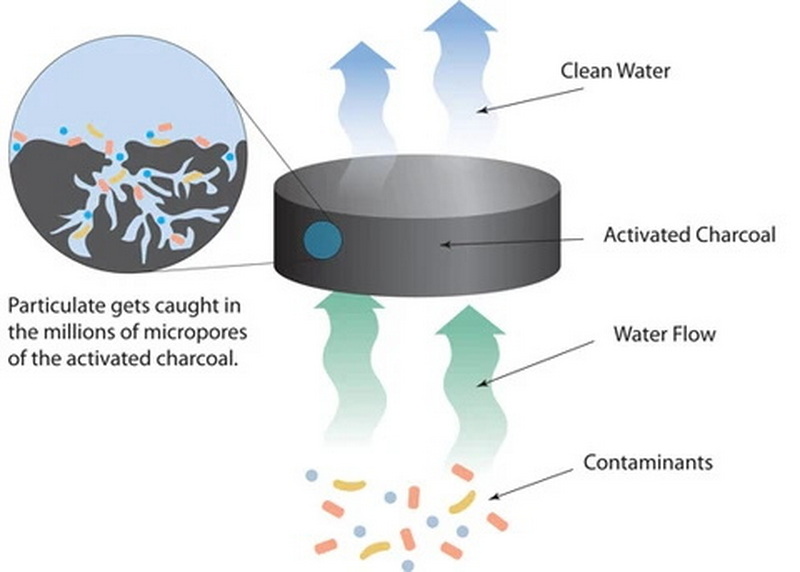
An activated carbon filter works primarily through adsorption, a surface‑based process in which dissolved contaminants in water are attracted to and held on the internal surface of the activated carbon pores. As water passes through a bed of granular activated carbon, contaminants diffuse into the pores and are retained there while treated water exits the filter with much lower concentrations of these compounds.[7][4][1][5]
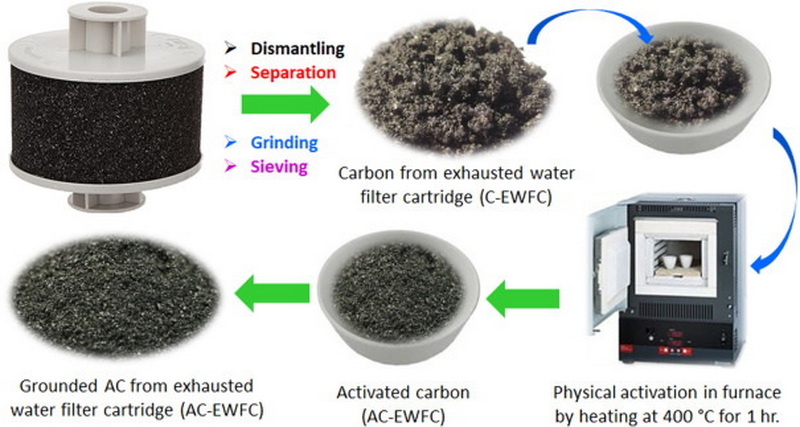
In many systems, the activated carbon filter is combined with pre‑filtration to remove suspended solids that could clog the carbon bed, and sometimes with downstream processes like reverse osmosis or UV disinfection to manage contaminants that activated carbon alone cannot handle. Over time the activated carbon becomes “exhausted” and must be replaced or thermally regenerated to restore its adsorption capacity.[2][8][4][3]
Contaminants Removed by Activated Carbon
Activated carbon is especially effective at removing chlorine, many organic chemicals, and a wide range of taste‑ and odor‑causing substances from drinking water. This includes compounds such as solvents, pesticides, herbicides, volatile organic compounds (VOCs), and disinfection by‑products like trihalomethanes (THMs), which can affect both water safety and aesthetics.[9][1][5][7]
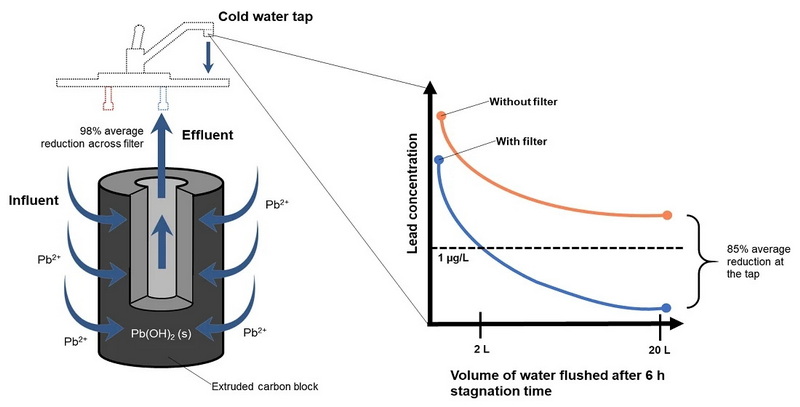
Both powdered and granular activated carbon are widely used in drinking water plants to control offensive tastes and odors caused by compounds such as geosmin and 2‑MIB from algae and natural organic matter. Certain grades of granular activated carbon are also used to reduce specific contaminants such as lead, radon, and some per‑ and polyfluoroalkyl substances (PFAS), depending on system design and regulatory targets.[10][11][6][9]
Benefits of Activated Carbon Filters in Water Treatment
Activated carbon filters offer a combination of high contaminant removal efficiency, improved taste and odor, and relatively low operating cost, which is why they are widely used in municipal and industrial water treatment systems. They are generally energy‑efficient because they operate at moderate pressures and do not require electricity for the adsorption process itself, unlike some advanced technologies.[12][2][10][3]
Activated carbon filter systems are usually compact, easy to integrate into existing plants, and can often be regenerated, which reduces media replacement costs and overall waste generation. When used as part of a multi‑barrier treatment train, activated carbon filters contribute significantly to achieving stringent drinking water standards while maintaining appealing water quality for consumers.[13][4][2][10]
Why Activated Carbon For Drinking Water?
In drinking water treatment, activated carbon is recognized by regulators and industry bodies as a proven option for removing many organic contaminants and for improving taste and odor. Many home water filter products, including pitcher filters and under‑sink systems, rely on activated carbon and are certified to standards such as NSF/ANSI 42 for aesthetic contaminant reduction.[1][5][13][7]
Granular activated carbon filters in municipal plants help control substances like pesticides, industrial solvents, and natural organic matter that can react with chlorine to form disinfection by‑products. This makes activated carbon filters a key technology for balancing effective disinfection with reduced formation of undesirable chemical by‑products in treated tap water.[6][4][2]
Granular vs Powdered Activated Carbon in Water Treatment
Granular activated carbon is typically used in fixed‑bed filters and contactors, where water flows continuously through a packed bed of activated carbon granules. These granular activated carbon systems are well suited for long‑term operation, and the spent activated carbon can often be reactivated to restore performance.[4][2][10][1]
Powdered activated carbon, in contrast, is a fine powder that is dosed directly into water at specific process points to address seasonal or short‑term contamination issues, particularly taste and odor events. After contact time, the powdered activated carbon is removed in sedimentation or filtration units, which makes it very flexible for temporary treatment but less suitable as a stand‑alone, continuous filtration medium.[11][6][7]
Comparison: Activated Carbon vs Other Water Treatment Methods
| Aspect | Activated carbon filtration | Reverse osmosis (RO) | UV disinfection |
| Main function | Adsorbs organic chemicals, chlorine, tastes, and odors.freshwatersystems+1 | Removes dissolved salts, many organics, and particles.epa | Inactivates microorganisms such as bacteria and viruses.epa |
| Energy use | Low; mainly pumping through carbon bed.expresswater+1 | Higher; requires pressure across RO membrane.epa | Low to moderate; requires UV lamps and power supply.epa |
| Effect on taste and odor | Strong improvement, especially for chlorine and organics.wqa+1 | Neutral; may require post‑carbon for taste polishing.aquaclearws | Little direct impact on taste or odor.epa |
| Typical installation | Point‑of‑entry and point‑of‑use filters, municipal GAC beds.cleantechwater+1 | Central treatment units, desalination plants, some POE units.epa | Often a final disinfection step in municipal or POE systems.epa |
| Limitations | Limited removal of dissolved minerals and some inorganic ions.freshwatersystems+1 | Higher capital and operating cost; produces concentrate waste.epa | No removal of chemicals; needs clear water for effectiveness.epa |
This comparison shows that activated carbon is particularly strong for chemical and aesthetic improvements and often works best in combination with methods that target microbes and dissolved minerals. Many modern systems therefore use activated carbon filters alongside RO membranes and UV units to provide comprehensive water treatment.[3][4]
Design and Operation of Activated Carbon Filters
Effective activated carbon filter design focuses on providing enough contact time, bed depth, and flow distribution to achieve the desired contaminant removal performance. Key parameters include the empty bed contact time (EBCT), influent contaminant concentration, activated carbon type and particle size, and bed configuration.[14][7][4][1]
In practice, engineers often use dual‑tank or multi‑bed granular activated carbon systems so that one bed can remain online while another is taken out of service for media replacement or regeneration. Pre‑filters are commonly installed to remove sediments and iron that might clog the activated carbon bed and reduce its effective life.[8][15][2]
Advantages and Limitations in Industrial Water Treatment
In industrial water treatment, activated carbon filters help protect downstream membranes, resins, and process units by removing organic fouling agents and residual disinfectants. Industries such as food and beverage, chemical manufacturing, and pharmaceuticals rely on activated carbon to remove off‑flavors, colors, and trace organics that could compromise product quality.[2][10][3]
However, activated carbon is not a universal solution; it does not significantly reduce hardness, dissolved salts, or certain inorganic contaminants, so it is typically integrated with other processes such as ion exchange or RO. In addition, spent activated carbon loaded with contaminants must be handled and disposed of or regenerated in accordance with environmental regulations.[5][14][4][2]
Regulatory and Health Perspectives
Regulatory agencies and technical organizations recognize granular activated carbon and related adsorbents as proven technologies for controlling many organic contaminants in drinking water. Certain standards and guidance documents discuss how granular activated carbon can help meet health‑based limits for specific contaminants, depending on influent concentrations and system design.[14][10][6][4]
At the household level, many activated carbon filter products are designed and tested to reduce aesthetic contaminants and specific health‑related substances, and consumers are encouraged to look for third‑party certifications that match their water quality goals. When properly selected and maintained, activated carbon filters can therefore play an important role in managing both health risks and user satisfaction with drinking water.[6][13][7][5]
Maintenance and Replacement of Activated Carbon Filters
Because activated carbon has a finite adsorption capacity, the performance of an activated carbon filter gradually declines as the media becomes saturated with contaminants. Operators and homeowners must follow manufacturer recommendations for replacement intervals or monitor breakthrough indicators such as taste, odor, or laboratory‑measured contaminant levels.[8][13][1][2]
For large industrial or municipal systems, exhausted granular activated carbon is often sent to specialized facilities for thermal reactivation, which restores adsorption capacity and reduces waste and overall lifecycle cost. Smaller point‑of‑use filters are typically replaced with fresh activated carbon cartridges and disposed of according to local regulations.[10][13][2][8]
Conclusion
An activated carbon filter is a central technology in modern water treatment because it can remove a broad spectrum of organic contaminants, chlorine, tastes, and odors, resulting in cleaner, safer, and more pleasant water for households and industry. By combining high adsorption efficiency, relatively low operating cost, and compatibility with other treatment processes like RO and UV, activated carbon filters provide a flexible and reliable solution for both municipal and industrial water treatment systems.[4][1][2][3]
For critical applications such as drinking water, food and beverage processing, and pharmaceutical production, the right choice of activated carbon grade, filter design, and maintenance strategy helps ensure compliance with strict regulations and stable water quality. As water quality expectations and regulatory requirements continue to tighten worldwide, activated carbon filters will remain a key component of cost‑effective and sustainable water treatment solutions.[2][10][6][4]
FAQ – Why Activated Carbon Filter for Water Treatment
(1) How does an activated carbon filter improve the taste and smell of water?
Activated carbon filters remove chlorine and many organic compounds that cause unpleasant tastes and odors, such as those produced by algae, natural organic matter, or disinfectant by‑products. By adsorbing these substances onto the activated carbon surface, the filter delivers cleaner‑tasting, fresher‑smelling drinking water.[9][5][3][2]
(2) Can an activated carbon filter remove all contaminants from water?
An activated carbon filter is highly effective for many organic chemicals, chlorine, and certain disinfection by‑products, but it does not significantly reduce dissolved minerals, hardness, or many inorganic ions such as nitrates and most heavy metals. For comprehensive treatment, activated carbon filters are often combined with other technologies such as reverse osmosis, ion exchange, and UV disinfection to address microbes and dissolved salts.[7][5][3][4]
(3) How often should an activated carbon filter be replaced?
The replacement frequency depends on factors such as water quality, flow rate, activated carbon type, and system size, but point‑of‑use cartridges often require replacement every few months, while larger granular activated carbon beds may operate for many months or years before re‑bedding. Monitoring taste and odor changes or performing periodic water quality tests helps determine when the activated carbon is approaching exhaustion.[13][1][8][2]
(4) What is the difference between granular activated carbon and powdered activated carbon in water treatment?
Granular activated carbon is used in fixed‑bed filters through which water flows continuously, supporting long‑term filtration and media regeneration. Powdered activated carbon is dosed directly into water, mixed for a short contact time to address specific events such as taste and odor problems, and then removed in sedimentation or filtration units, making it ideal for flexible and seasonal treatment.[11][1][6][4]
(5) Is an activated carbon filter safe for drinking water applications?
Granular activated carbon and related activated carbon products are widely approved and used for drinking water treatment, and many systems are tested and certified to recognized performance standards. When activated carbon filters are properly designed, installed, and maintained according to guidelines, they provide a safe and effective method for improving drinking water quality.[16][6][13][4]
Citations:
[1](https://www.health.state.mn.us/communities/environment/hazardous/topics/gac.html)
[2](https://www.cleantechwater.co.in/blog/water-treatment-application-and-benefits-of-activated-carbon/)
[3](https://aquaclearws.com/resources/benefits-of-carbon-filters-in-water-purification/)
[4](https://www.epa.gov/sdwa/overview-drinking-water-treatment-technologies)
[5](https://www.freshwatersystems.com/blogs/blog/activated-carbon-filters-101)
[6](https://www.ncbi.nlm.nih.gov/books/NBK234593/)
[7](https://extensionpubs.unl.edu/publication/g1489/na/html/view)
[8](https://www.capecod.gov/wp-content/uploads/2022/03/activatedcarbon.pdf)
[9](https://wqa.org/wp-content/uploads/2022/09/2015_Taste.pdf)
[10](https://generalcarbon.com/understanding-granular-activated-carbon-for-water-treatment/)
[11](https://generalcarbon.com/industries-served/tastes-odors-drinking-water-activated-carbon/)
[12](https://www.expresswater.com/blogs/watereducation/activated-carbon-vs-other-water-filtration-methods-pros-and-cons)
[13](https://www.cdc.gov/drinking-water/prevention/about-choosing-home-water-filters.html)
[14](https://wqa.org/wp-content/uploads/2022/09/2016_GAC.pdf)
[15](https://dep.nj.gov/wp-content/uploads/srp/gac_poet_specifications.pdf)
[16](https://jbcc-iagwsp.org/community/facts/gac_jun04.html)
[17](https://www.homewater.com/blog/the-benefits-of-activated-carbon-filters-improve-your)
[18](https://watermillexpress.com/frequently-asked-questions/what-are-the-benefits-of-filtering-water-with-granulated-activated-carbon-gac/)
[19](https://www.sciencedirect.com/science/article/pii/S1944398624152885)
[20](https://www.monkeywrenchplumbers.com/pros-cons-carbon-filters/)


