Content Menu
● What Is Granular Activated Carbon
● How Granular Activated Carbon Works In Water Treatment
● Types Of Contaminants Removed By Granular Activated Carbon
● Typical Raw Materials And Properties Of GAC
● Granular Activated Carbon In Municipal Drinking Water
● Granular Activated Carbon For Industrial Wastewater
● Granular Activated Carbon In Point‑Of‑Use And Point‑Of‑Entry Systems
● Design Parameters For GAC Water Treatment
● Operation, Monitoring, And Maintenance Of GAC Systems
● Advantages Of Granular Activated Carbon Water Treatment
● Limitations And Challenges Of GAC Water Treatment
● Comparison Of GAC With Other Treatment Media
● Safety And Regulatory Considerations
● How To Select Granular Activated Carbon For Your Application
● Conclusion
● FAQ About Granular Activated Carbon Water Treatment
>> 1. What is granular activated carbon in water treatment
>> 2. Which contaminants does granular activated carbon remove
>> 3. How long does granular activated carbon last in a filter
>> 4. Is granular activated carbon safe for drinking water
>> 5. How does granular activated carbon compare to reverse osmosis
● Citations:
Granular activated carbon water treatment is a filtration process that uses porous carbon granules to adsorb and remove contaminants, odors, and unwanted tastes from water. In municipal, industrial, and household systems, granular activated carbon is one of the most versatile and effective media for producing cleaner, safer water.[1][2][3][4]
What Is Granular Activated Carbon
Granular activated carbon (GAC) is a form of activated carbon with irregular particles typically ranging from about 0.2 to 5 mm in size, offering very high internal surface area for adsorption. It is usually made from carbon-rich raw materials such as coconut shells, coal, wood, or peat that are processed at high temperature to create a rigid, highly porous structure.[5][2][4][6]
In water treatment, granular activated carbon is used as a packed bed medium that water flows through so that dissolved contaminants are trapped in its pore structure. Compared with powdered activated carbon, granular activated carbon is easier to handle in fixed-bed filters, can be backwashed, and is suitable for continuous operation.[3][7][8][5]
How Granular Activated Carbon Works In Water Treatment
Granular activated carbon removes contaminants primarily through adsorption, where molecules from the water adhere to the large internal surface area inside the pores. Adsorption can be physical, driven by Van der Waals forces, or chemical, involving interactions between contaminant molecules and functional groups on the carbon surface.[9][10][1]
As water passes through a granular activated carbon filter, contaminants diffuse from the bulk water into the pores and onto active sites until those sites become occupied. Once a significant fraction of sites are filled, the GAC is considered exhausted, and either regeneration or replacement is required to maintain treatment performance.[11][6][5][9]
Types Of Contaminants Removed By Granular Activated Carbon
Granular activated carbon is highly effective at removing many organic contaminants responsible for taste, odor, and color problems in water. Typical targets include natural organic matter, pesticides, herbicides, industrial solvents, and disinfection by‑product precursors.[7][12][1][11]
GAC also helps remove chlorine, chloramine, and certain volatile organic compounds, improving both safety and sensory quality of drinking water. In some applications, granular activated carbon can reduce PFAS, some pharmaceuticals, and trace organic micropollutants from municipal and industrial wastewater streams.[4][13][11]
Typical Raw Materials And Properties Of GAC
Common raw materials for granular activated carbon include coconut shells, bituminous coal, lignite, and wood, each giving different pore size distributions and mechanical strengths. Coconut‑based GAC typically has a high proportion of micropores suitable for small organic molecules, while coal‑based products often offer a broader pore size spectrum.[2][13][6][9]
Key quality indicators for granular activated carbon in water treatment are iodine number (surface area proxy) and carbon tetrachloride (CTC) activity, which relate to adsorption capacity. For potable water use, iodine numbers commonly in the range of about 900–1050 mg/g are considered suitable, along with adequate hardness to resist attrition in filters.[14][5]
Granular Activated Carbon In Municipal Drinking Water
In many drinking water plants, granular activated carbon beds are installed after coagulation, sedimentation, and often sand filtration to polish water and remove residual organics. This placement allows upstream processes to remove particulates first so that granular activated carbon can focus on dissolved contaminants and extend bed life.[15][16][3]
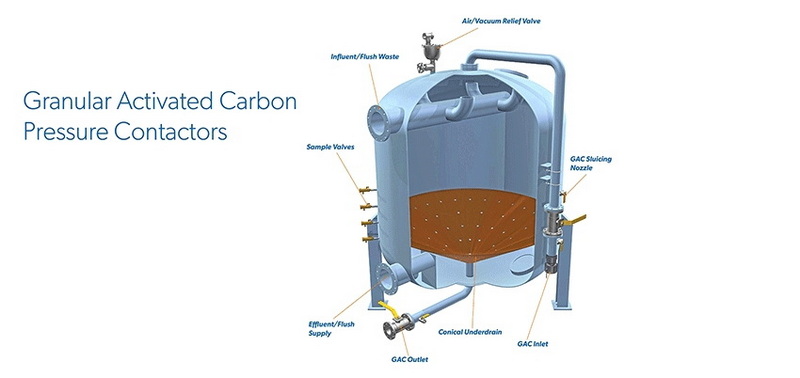
GAC filters in municipal systems can be configured as deep‑bed gravity filters or pressure vessels, sometimes combined with other media in a dual‑ or multi‑media arrangement. Periodic backwashing is used to control head loss, redistribute the granular activated carbon bed, and flush out accumulated solids.[13][5][3]
Granular Activated Carbon For Industrial Wastewater
Industrial facilities use granular activated carbon water treatment to remove complex mixtures of organic pollutants from process water and wastewater. Typical industries include chemical manufacturing, pharmaceuticals, food and beverage, and electronics, where granular activated carbon can reduce COD, color, and trace organics prior to discharge or reuse.[17][11][13]
GAC adsorption is often integrated with biological treatment, membranes, or advanced oxidation, serving as a polishing or pre‑treatment step. In some designs, exhausted granular activated carbon is thermally reactivated, recovering adsorption capacity and lowering overall treatment costs and environmental footprint.[18][9][13][17]
Granular Activated Carbon In Point‑Of‑Use And Point‑Of‑Entry Systems
In residential and commercial buildings, granular activated carbon is widely used inside point‑of‑use (POU) cartridges for faucets, refrigerators, and countertop filters. These systems rely on GAC to remove chlorine, improve taste and odor, and reduce certain organic contaminants at the tap.[2][4]
Point‑of‑entry (POE) systems use larger beds of granular activated carbon to treat all water entering a home or facility, offering whole‑building protection. GAC may also be combined with other media such as ion exchange resins or sediment prefilters in multi‑stage cartridges to broaden the range of contaminants addressed.[16][1][13][2]
Design Parameters For GAC Water Treatment
Designing an effective granular activated carbon water treatment system requires careful control of empty bed contact time (EBCT), flow rate, and bed depth. Longer EBCT generally allows more complete adsorption and greater contaminant removal but increases system size and cost.[8][5][11]
Breakthrough curves are used to determine how long a granular activated carbon bed can operate before effluent contaminant concentrations approach regulatory or process limits. Parameters such as influent concentration, temperature, competing solutes, and GAC type all influence adsorption capacity and breakthrough behavior.[6][19][11]
Operation, Monitoring, And Maintenance Of GAC Systems
Proper operation of granular activated carbon water treatment systems includes regular monitoring of key indicators such as effluent contaminant levels, head loss, and flow distribution. Sampling at different depths in the GAC bed can help determine mass transfer zones and optimize changeout schedules.[5][3][11][16]
Maintenance activities typically include periodic backwashing to control fouling, replacement or reactivation of exhausted granular activated carbon, and inspection of underdrains and valves. For small POU devices, manufacturers often specify cartridge replacement intervals based on volume treated or time in service to maintain performance.[3][4][5][2]
Advantages Of Granular Activated Carbon Water Treatment
Granular activated carbon offers very high surface area and porosity, enabling efficient removal of a wide range of organic contaminants at relatively low operating pressures. It is a passive, media‑based technology that does not require continuous chemical dosing and can be integrated into many existing filtration systems.[1][9][13]
Regeneration and reactivation options for granular activated carbon reduce solid waste and can lower lifecycle costs compared with single‑use adsorbents. In drinking water applications, GAC improves taste and odor while simultaneously lowering concentrations of regulated and emerging contaminants.[9][4][11][13]
Limitations And Challenges Of GAC Water Treatment
Despite its versatility, granular activated carbon is not effective for every contaminant, particularly many dissolved inorganic species such as most metals, nitrates, and hardness minerals. As a result, GAC is often combined with coagulation, ion exchange, membranes, or other technologies to meet comprehensive treatment goals.[15][17][16][5]
Granular activated carbon beds can develop biological growth or become fouled by particulates and high molecular weight organics, reducing adsorption capacity and increasing head loss. Managing exhausted GAC also requires consideration of regeneration logistics, off‑site reactivation, or disposal under applicable environmental regulations.[19][18][5][3]
Comparison Of GAC With Other Treatment Media
| Parameter | Granular activated carbon | Powdered activated carbon | Ion exchange resins | Membrane filtration |
| Physical form | Granules in fixed beds wqa+1 | Fine powder dosed into water sswm | Spherical beads in columns epa | Thin film on porous support epa |
| Main removal mechanism | Adsorption of organics generalcarbon+1 | Adsorption in contact basins sswm | Ion exchange of charged species epa | Size‑based separation epa |
| Typical targets | Organics, taste, odor, chlorine wwdmag+1 | Taste, odor, spikes of organics sswm | Hardness, nitrates, specific ions epa | Particles, pathogens, salts (RO) epa |
| Regeneration/ replacement | Replace or thermally reactivate puragen+1 | Typically not regenerated sswm | Chemical regeneration in place epa | Periodic cleaning or replacement epa |
| Use in continuous filtration | Excellent in fixed beds wqa+1 | Limited; usually batch or side‑stream sswm | Common in columns epa | Common in pressure vessels epa |
Safety And Regulatory Considerations
When properly designed and operated, granular activated carbon water treatment complies with drinking water standards and helps utilities meet regulatory limits for organic contaminants and disinfection by‑products. Regulatory agencies often publish guidance on selecting and managing GAC systems, including monitoring schedules and performance goals.[20][16][3][15]
For applications involving PFAS or other persistent pollutants, regulators may require performance verification and certification that specific granular activated carbon products achieve target removal efficiencies. Safe transport, handling, and disposal or regeneration of spent GAC must also follow environmental and occupational safety regulations.[4][19][5]
How To Select Granular Activated Carbon For Your Application
Selecting the right granular activated carbon grade depends on the raw water quality, target contaminants, and process configuration. Important considerations include base material (coconut, coal, or wood), iodine number, CTC activity, hardness, and particle size distribution.[14][13][6][1]
Pilot testing is highly recommended to determine adsorption capacity, breakthrough times, and optimal empty bed contact time under site‑specific conditions. For industrial users, it is also important to evaluate options for off‑site reactivation and to establish service agreements that ensure reliable supply of fresh granular activated carbon.[10][11][13][9]
Conclusion
Granular activated carbon water treatment is a proven, flexible technology that uses highly porous carbon granules to adsorb and remove a broad spectrum of organic contaminants, chlorine, and taste‑ and odor‑causing compounds. From large municipal drinking water plants to industrial wastewater facilities and household filters, granular activated carbon enhances water quality, supports regulatory compliance, and improves the sensory properties of finished water.[13][1][3][4]
To maximize performance, system designers and operators must carefully select granular activated carbon properties, configure bed depth and contact time, and maintain appropriate monitoring and maintenance practices. When properly applied, granular activated carbon water treatment offers a cost‑effective, regenerable, and scalable solution for modern water quality challenges.[11][17][5][9]
FAQ About Granular Activated Carbon Water Treatment
1. What is granular activated carbon in water treatment
Granular activated carbon is a porous filtration medium made from carbon‑rich materials that have been processed to create a high internal surface area for adsorption. In water treatment, granular activated carbon granules are packed into filters or columns that contaminated water flows through, allowing dissolved organic pollutants to adhere to the carbon surfaces.[6][2][3][4]
2. Which contaminants does granular activated carbon remove
Granular activated carbon effectively removes many organic contaminants that cause taste, odor, and color problems, such as natural organic matter, pesticides, solvents, and disinfection by‑product precursors. It also reduces chlorine, chloramine, certain PFAS, and a range of volatile organic compounds, making it highly useful for drinking water and industrial applications.[12][1][4][11]
3. How long does granular activated carbon last in a filter
The service life of granular activated carbon depends on influent contaminant concentrations, flow rate, bed depth, and water temperature. Once adsorption sites become saturated and breakthrough occurs, the granular activated carbon must be replaced or thermally reactivated to restore adsorption capacity.[19][5][9][11]
4. Is granular activated carbon safe for drinking water
Granular activated carbon products designed for potable water are manufactured to meet quality standards and are widely used in municipal and household systems. When operated and maintained correctly, GAC filters help utilities and homeowners meet drinking water regulations and improve taste and odor without introducing harmful substances.[16][3][4][15]
5. How does granular activated carbon compare to reverse osmosis
Granular activated carbon primarily removes organic contaminants and chlorine through adsorption, while reverse osmosis uses a semi‑permeable membrane to exclude most dissolved salts, many organics, and pathogens. In many treatment trains, GAC and RO are combined, with granular activated carbon protecting the membrane from chlorine and organic fouling and RO providing deeper removal of dissolved solids.[1][15][13]
Citations:
[1](https://generalcarbon.com/understanding-granular-activated-carbon-for-water-treatment/)
[2](https://www.health.state.mn.us/communities/environment/hazardous/topics/gac.html)
[3](https://www.ncbi.nlm.nih.gov/books/NBK234593/)
[4](https://www.wwdmag.com/what-is-articles/article/10939799/what-is-granular-activated-carbon-gac)
[5](https://wqa.org/wp-content/uploads/2022/09/2016_GAC.pdf)
[6](https://www.sciencedirect.com/topics/engineering/granular-activated-carbon)
[7](https://activated-carbon.com/insights/granular-activated-carbon/)
[8](https://sswm.info/sites/default/files/reference_attachments/ARMENANTE%20ny%20Adsorption%20with%20Granular%20Activated%20Carbon.pdf)
[9](https://puragen.com/uk/insights/granular-activated-carbon/)
[10](https://www.sciencedirect.com/science/article/abs/pii/S0960852408003246)
[11](https://www.sciencedirect.com/science/article/abs/pii/S0045653517310238)
[12](https://pmc.ncbi.nlm.nih.gov/articles/PMC7077425/)
[13](https://activatedcarbon.com/applications/water)
[14](https://hydronixwater.com/granular-activated-carbon-fact-sheet/)
[15](https://www.epa.gov/sdwa/overview-drinking-water-treatment-technologies)
[16](https://portal.ct.gov/dph/environmental-health/private-well-water-program/granular-activated-carbon-treatment-of-private-well-water)
[17](https://www.racoman.com/blog/activated-carbon-wastewater-treatment-explained)
[18](https://iwaponline.com/aqua/article/72/10/1881/98016/Effect-of-granular-activated-carbon-adsorption-on)
[19](https://www.chemours.com/en/-/media/files/corporate/gac-information-sheets-2019-06-12.pdf?rev=2a1c8e2088c3443482c560a7abd46c0e&hash=DA1D11CE433BFB58FEA91880B61C3CB3)
[20](https://semspub.epa.gov/work/HQ/401595.pdf)


