Content Menu
● What Is Granular Activated Carbon?
● Basic Structure of a GAC Filter
● Core Working Principle: Adsorption
● Step‑by‑Step: How Water Flows Through GAC
● Mass Transfer and Adsorption Zone
● Contact Time, Bed Depth, and Flow Rate
● What Granular Activated Carbon Removes from Water
● Granular Activated Carbon in Air and Gas Purification
● Types of GAC Filter Configurations
● Service Life, Regeneration, and Replacement
● Advantages of Granular Activated Carbon Filters
● Limitations and Design Considerations
● Granular Activated Carbon vs Powdered Activated Carbon
● Typical Industrial Uses of Granular Activated Carbon
● Conclusion
● FAQ About Granular Activated Carbon Filters
>> 1. How long does granular activated carbon last in a filter?
>> 2. What contaminants cannot be removed by granular activated carbon?
>> 3. Can granular activated carbon be regenerated and reused?
>> 4. What is the difference between granular activated carbon and carbon block filters?
>> 5. How should a granular activated carbon filter be maintained?
● Citations:
Granular activated carbon filters work by using billions of microscopic pores to adsorb contaminants from water and air, greatly improving taste, odor, and safety. Granular activated carbon is widely used in drinking water treatment, wastewater polishing, air and gas purification, and many industrial processes.[1][2][3][4]
What Is Granular Activated Carbon?
Granular activated carbon (GAC) is a form of activated carbon with irregular particles typically between about 0.5 and 4 mm in size. Each grain of granular activated carbon contains an enormous internal surface area made of micro‑, meso‑, and macropores that provide active sites for adsorption.[2][5][6][7]
Granular activated carbon is usually produced from coal, coconut shell, wood, or other carbon‑rich raw materials that are thermally activated to create a highly porous structure. Because of its strength, reactivatability, and hydraulic properties, granular activated carbon is preferred in fixed‑bed filters for continuous treatment of liquids and gases.[5][6][7][8]
Basic Structure of a GAC Filter
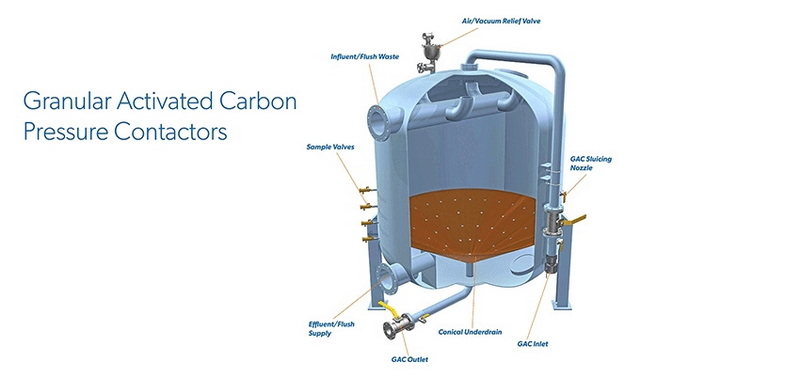
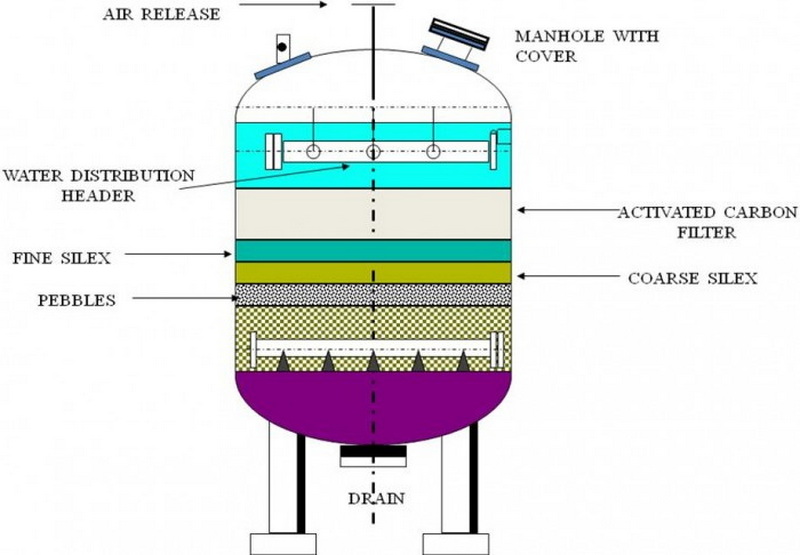
A granular activated carbon filter is typically a vessel or cartridge filled with a packed bed of granular activated carbon through which water or gas flows. The flow can be downward or upward, but most municipal and industrial systems use downflow fixed‑bed adsorbers to keep the granular activated carbon bed compact and stable.[3][9][7][8]
In a typical GAC filter, the main structural elements include: an inlet distributor, a bed of granular activated carbon with a defined depth, support gravel or screens, and an outlet collection system. Many systems add prefiltration to remove suspended solids, extending the life and adsorption capacity of the granular activated carbon bed.[7][8][5]
Core Working Principle: Adsorption
Granular activated carbon filters work primarily through adsorption, where contaminants are attracted to and held on the surface of the carbon particles. The porous network in granular activated carbon provides an immense surface area, enabling the removal of dissolved organics, chlorine, odorous compounds, and many trace pollutants even at low concentrations.[10][1][2][3]
This adsorption is usually a physical process (physisorption) dominated by Van der Waals forces, although some contaminants also interact chemically or through electrostatic attraction. Hydrophobic organic molecules, non‑polar compounds, and certain micro‑pollutants have a strong affinity for granular activated carbon, which is why granular activated carbon is so effective in taste, odor, and color removal.[11][6][12]
Step‑by‑Step: How Water Flows Through GAC
When water enters a granular activated carbon filter, it distributes across the top of the bed and flows through the granular activated carbon layer at a controlled rate. As water moves through the bed, dissolved contaminants diffuse from the bulk water to the outer surface of the granular activated carbon granules and then into their internal pores.[9][8][3][5]
Inside the pores, the contaminants encounter active sites and become adsorbed, gradually building up an “adsorption front” that travels through the bed over time. Eventually, the leading edge of this front reaches the outlet, and the water quality begins to deteriorate, indicating that the granular activated carbon is approaching exhaustion and needs replacement or regeneration.[5][9][7]
Mass Transfer and Adsorption Zone
The working performance of a granular activated carbon filter depends on how efficiently contaminants transfer from water to the carbon surface. The overall process includes external mass transfer from bulk water to the grain surface, diffusion into the pores, and adsorption at internal sites, sometimes accompanied by intraparticle diffusion limits.[13][14][9]
In a fixed‑bed granular activated carbon filter, the region where adsorption is actively occurring is called the mass transfer zone (MTZ). A tall, well‑designed bed of granular activated carbon ensures that this zone remains within the filter for a long time, delivering stable effluent quality before breakthrough occurs.[8][9][7]
Contact Time, Bed Depth, and Flow Rate
Empty bed contact time (EBCT) is a key design parameter that represents how long water would remain in the granular activated carbon bed if the bed volume were “empty.” Typical EBCT values for granular activated carbon filters in water treatment range from about 10 to 60 minutes, often 20–30 minutes for municipal wastewater polishing.[9][8]
Bed depth is also critical because a deeper granular activated carbon bed provides more adsorption capacity and a longer service life before breakthrough. If flow rate is too high, real contact time decreases, reducing the effectiveness of granular activated carbon and potentially allowing contaminants to pass through before being adsorbed.[2][10][7][8]
What Granular Activated Carbon Removes from Water
Granular activated carbon is especially effective at removing chlorine, chlorinated organics, volatile organic compounds (VOCs), many pesticides, disinfection by‑products, and compounds responsible for bad taste and odor. It can also reduce various trace organic micropollutants and some synthetic chemicals at low concentrations, making it a popular choice for advanced drinking water and wastewater treatment.[1][8][2][5]
In addition, granular activated carbon can adsorb certain natural organic matter, which helps control color and reduce formation potential of disinfection by‑products. Research has shown that granular activated carbon can also remove specific nanoparticles and emerging contaminants, depending on water chemistry and carbon properties.[14][13][7][1]
Granular Activated Carbon in Air and Gas Purification
Beyond water, granular activated carbon filters are widely used for gas and air cleaning in industrial, commercial, and residential settings. Granular activated carbon removes odorous gases, volatile organics, and many harmful components from exhaust streams in chemical plants, food processing facilities, and pharmaceutical production.[6][4][15]
Specialty impregnated granular activated carbon can capture inorganic gases such as mercury‑containing compounds, acidic gases, or other toxic species by combining physical adsorption with chemical reactions. HVAC systems and indoor air purifiers also use granular activated carbon filters to reduce odors, radon, and various indoor air pollutants.[15][12][6]
Types of GAC Filter Configurations
Granular activated carbon filters come in several configurations for water and wastewater treatment. Common designs include downflow pressure vessels, gravity filters, contactors integrated with sand filtration, and packed‑bed columns used as a tertiary polishing step.[7][8][5]
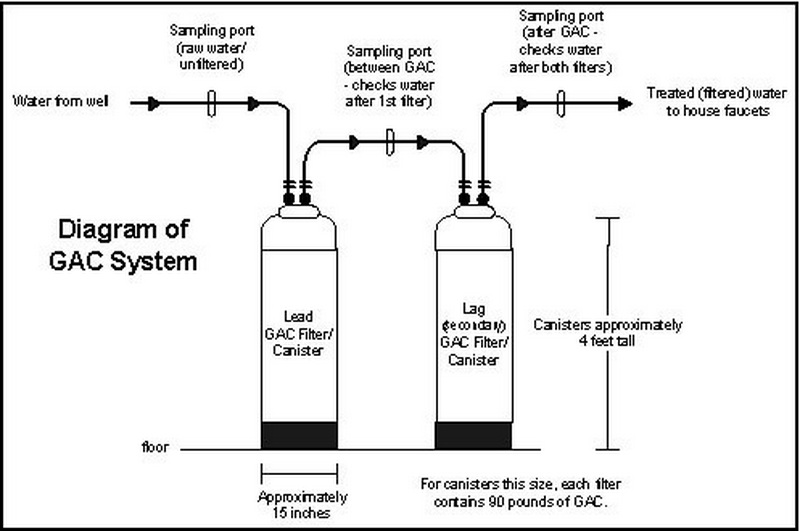
In household applications, granular activated carbon may be used in point‑of‑entry systems, countertop units, refrigerator filters, or under‑sink cartridges. Industrial systems often use multiple granular activated carbon vessels in parallel or series to provide redundancy, ensure continuous operation, and allow for service on individual units without shutting down the process.[16][10][8][7]
Service Life, Regeneration, and Replacement
Over time, the pores of granular activated carbon become saturated as more contaminants are adsorbed, and the available active sites decrease. When effluent concentrations begin to rise toward influent levels, the granular activated carbon bed is considered exhausted, and its media must be replaced or thermally reactivated.[14][5][7]
In many industrial and municipal applications, spent granular activated carbon is shipped to specialized facilities for thermal reactivation, where adsorbed contaminants are removed and the carbon's pore structure is restored for reuse. For smaller household filters, granular activated carbon cartridges are usually replaced with fresh media according to manufacturer recommendations based on volume, time, or measured water quality.[10][5][14][7]
Advantages of Granular Activated Carbon Filters
Granular activated carbon filters offer high efficiency for a wide range of organic contaminants while remaining relatively simple to operate. Because adsorption is a passive process, granular activated carbon filters typically require only moderate pressure, limited moving parts, and straightforward monitoring, making them reliable for both small and large systems.[6][1][5][7]
Another advantage is the possibility of reactivating granular activated carbon, which reduces overall media cost and environmental impact compared with single‑use materials. Granular activated carbon is also compatible with other treatment processes, such as biological filtration, membrane systems, and disinfection, creating flexible treatment trains for drinking water, wastewater, and process water.[8][16][5][14]
Limitations and Design Considerations
Despite their versatility, granular activated carbon filters are not universal solutions and must be properly designed. Granular activated carbon is less effective at removing dissolved inorganic salts, hardness, and many metals, so additional treatment steps are needed when these are target contaminants.[1][2][6][10]
Fouling by suspended solids, biofilm growth, or oil and grease can block the pores of granular activated carbon and reduce its adsorption capacity. Pretreatment such as sediment filtration, coagulation, or clarification may therefore be essential to protect the granular activated carbon bed and achieve longer service life and stable performance.[5][7][8]
Granular Activated Carbon vs Powdered Activated Carbon
Granular activated carbon and powdered activated carbon (PAC) share the same basic adsorption mechanism, but their applications differ. Powdered activated carbon consists of very fine particles that are typically dosed into water as a slurry and later removed in sedimentation or filtration units, providing rapid but short‑term adsorption.[17][6]
Granular activated carbon, by contrast, remains as a fixed bed in a filter, enabling continuous, long‑term operation and easy separation from treated water. For many municipal waterworks and industrial plants, granular activated carbon filters form the backbone of advanced treatment, while powdered activated carbon is used for temporary problems or peak load conditions.[17][9][7][8]
Typical Industrial Uses of Granular Activated Carbon
Granular activated carbon filters are applied across a wide range of industries for both water and air purification. Common uses include polishing drinking water, removing organics from process water, treating industrial wastewater, and recovering valuable chemicals or solvents from gas streams.[4][15][6]
Granular activated carbon is also widely used to control odors in food processing, maintain air quality in pharmaceutical manufacturing, and protect sensitive equipment in precision industries from corrosive vapors. In many facilities, granular activated carbon filters are key elements in environmental compliance systems that prevent harmful emissions and protect public health.[4][15]
Conclusion
Granular activated carbon filters work by passing water or gas through a packed bed of highly porous carbon granules that adsorb a wide range of organic contaminants, chlorine, odors, and trace pollutants. With proper design for bed depth, contact time, and flow rate, granular activated carbon filters provide reliable, regenerable, and cost‑effective purification for drinking water, wastewater polishing, air cleaning, and many industrial processes.[3][8][1][5]
FAQ About Granular Activated Carbon Filters
1. How long does granular activated carbon last in a filter?
The service life of granular activated carbon depends on contaminant loading, flow rate, and contact time, and can range from a few months in household units to many months or even years in well‑designed industrial systems. Breakthrough monitoring using water quality tests or online sensors is the best way to decide when granular activated carbon media must be replaced or reactivated.[14][7][5]
2. What contaminants cannot be removed by granular activated carbon?
Granular activated carbon is not very effective for dissolved minerals, hardness, most simple salts, and many metals because these species do not adsorb strongly onto the carbon surface. For such contaminants, technologies like ion exchange, membranes, or softening are typically combined with granular activated carbon filters to achieve complete treatment.[16][10][1][6]
3. Can granular activated carbon be regenerated and reused?
Yes, spent granular activated carbon can be thermally reactivated in specialized furnaces that remove adsorbed organics and restore much of the original pore structure. After quality checks, this regenerated granular activated carbon can be reused in filters, reducing both cost and environmental impact compared with disposing of spent media.[14][5]
4. What is the difference between granular activated carbon and carbon block filters?
Granular activated carbon filters use loose granules packed in a bed, while carbon block filters compress finely powdered carbon into a solid block with defined channels. Carbon block filters can provide very fine filtration and high surface area in a compact form, whereas granular activated carbon filters are preferred for large‑scale continuous treatment and easier media replacement.[10][2][7]
5. How should a granular activated carbon filter be maintained?
Routine maintenance includes monitoring pressure drop, checking effluent quality, and scheduling media replacement or regeneration before breakthrough occurs. Many systems also perform periodic backwashing or prefiltration maintenance to remove suspended solids and prevent fouling of the granular activated carbon bed, thereby extending its life and maintaining adsorption efficiency.[8][7][5]
Citations:
[1](https://www.health.state.mn.us/communities/environment/hazardous/topics/gac.html)
[2](https://www.cleantechwater.co.in/blog/need-know-activated-carbon-filter-works/)
[3](https://www.cecoenviro.com/products/granular-activated-carbon-gac-filter/)
[4](https://www.naturecarbon.com/news/application-of-granular-activated-carbon-84981257.html)
[5](https://www.huber-se.com/applications-and-solutions/detail/adsorption-process-granulated-activated-carbon-gac/)
[6](https://sodimate-inc.com/activated-carbon-types-applications-advantages/)
[7](https://fieldreport.caes.uga.edu/wp-content/uploads/2025/08/B-1542_4.pdf)
[8](https://www.keiken-engineering.com/news/comprehensive-guide-to-granular-activated-carbon)
[9](https://sswm.info/sites/default/files/reference_attachments/ARMENANTE%20ny%20Adsorption%20with%20Granular%20Activated%20Carbon.pdf)
[10](https://www.freshwatersystems.com/blogs/blog/activated-carbon-filters-101)
[11](https://wqa.org/wp-content/uploads/2022/09/2016_GAC.pdf)
[12](https://www.teqoya.com/en/activated-carbon-filter-a-few-basic-facts-to-sort-out-the-truth/)
[13](https://pubmed.ncbi.nlm.nih.gov/36208736/)
[14](https://www.sciencedirect.com/science/article/pii/S1878535224001060)
[15](https://www.chemviron.eu/applications/gas-processing/)
[16](https://www.wychwood-water.com/what-is-a-carbon-active-filter-and-how-it-works/)
[17](https://www.bygen.com.au/post/granular-vs-powdered-activated-carbon-which-one-is-right-for-your-application)
[18](https://rajahfiltertechnics.com/uncategorized/the-science-behind-activated-carbon-how-it-works-and-why-its-effective/)
[19](https://www.sulax.com.tr/en/blog/what-is-a-granular-activated-carbon-gac-filter/)
[20](https://www.sorbotech.uk/56,types_and_uses_of_activated_carbon)


