Content Menu
● What Is Coal‑Based Activated Carbon?
● Why Use Coal to Make Activated Carbon?
● Overview of the Production Process
● Step 1: Raw Material Selection and Preparation
>> Choosing the right coal
>> Preparation operations
● Step 2: Carbonization – Turning Coal into Char
>> Carbonization conditions
>> Process control points
● Step 3: Activation – Developing the Pore Structure
>> Physical (steam/gas) activation
>> Chemical activation (optional route)
● Step 4: Cooling, Crushing, and Screening
● Step 5: Washing, Drying, and Packaging
>> Washing and impurity removal
>> Drying and packaging
● Key Properties of Coal‑Based Activated Carbon
● Industrial Applications of Coal‑Based Activated Carbon
● Comparing Coal‑Based Activated Carbon with Other Types
● Safety and Environmental Considerations
● Conclusion
● FAQ – How to Make Activated Carbon from Coal
>> 1. How is coal converted into activated carbon?
>> 2. What type of coal is best for making activated carbon?
>> 3. What is the difference between coal‑based and coconut‑based activated carbon?
>> 4. Can coal‑based activated carbon be regenerated and reused?
>> 5. Is coal‑based activated carbon safe for drinking water treatment?
● Citations:
Activated carbon made from coal is one of the most widely used adsorbents in modern industry, especially for large‑scale water treatment, air and gas purification, and chemical processing. Coal‑based activated carbon combines high hardness, a broad pore size distribution, and competitive cost, making it ideal for demanding applications where consistent performance and long service life are essential.
What Is Coal‑Based Activated Carbon?
Coal‑based activated carbon is a porous carbon material produced from bituminous coal, sub‑bituminous coal, anthracite, or lignite via high‑temperature carbonization and activation processes. During production, the coal structure is converted into a rigid carbon skeleton with an extensive network of micro, meso, and macropores that give activated carbon its exceptionally high internal surface area.
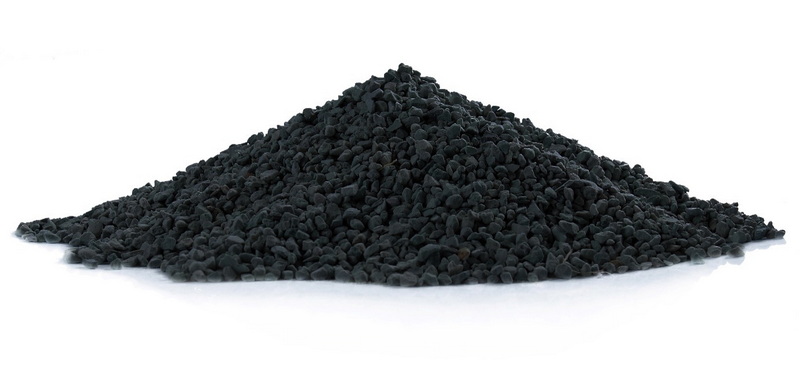
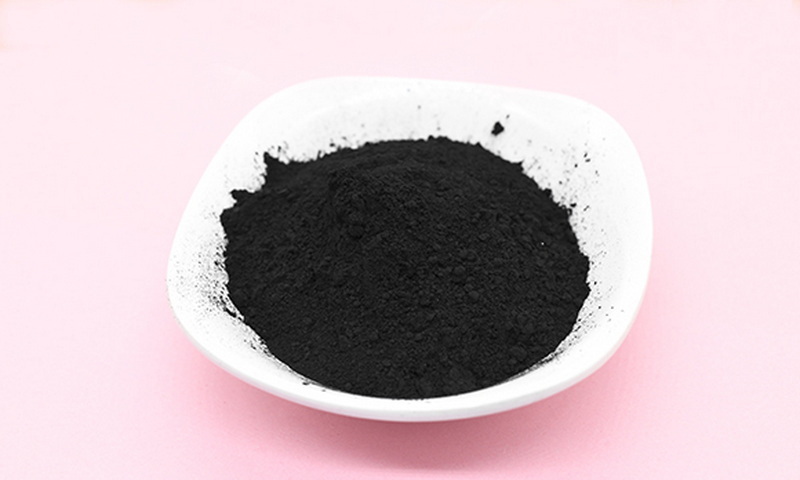
Coal‑based activated carbon is widely supplied in granular (GAC), powdered (PAC), and extruded (pellet) forms for liquid and gas‑phase purification. Because of its robust hardness and broad pore size distribution, coal‑based activated carbon is especially suitable for removing a wide range of organic molecules, residual chlorine, taste and odor compounds, and other contaminants in municipal and industrial water treatment.
Why Use Coal to Make Activated Carbon?
Coal is a versatile raw material for activated carbon production because it is abundant, relatively inexpensive, and available in various grades with different structures and ash contents. Bituminous coal in particular is widely used to produce granular activated carbon for high‑flow industrial and municipal filtration systems.
Key advantages of coal‑based activated carbon include:
- High mechanical strength and hardness, reducing dust losses and improving backwashing performance.
- A balanced distribution of micro, meso, and macropores suitable for both small and larger organic molecules.
- Good performance for dechlorination and removal of a broad range of dissolved organics in water.
- Competitive production cost for large‑scale installations such as municipal water plants and industrial emission control.
- Flexible production into granular activated carbon, powdered activated carbon, or pelletized activated carbon for different systems.
Compared with many other raw materials, coal allows producers to fine‑tune the pore structure and physical properties of activated carbon to meet the strict requirements of water treatment plants, refineries, power plants, food and beverage factories, and environmental control systems.
Overview of the Production Process
Industrial production of activated carbon from coal is typically divided into several major stages:
1. Raw material selection and preparation.
2. Carbonization of coal to form char.
3. Activation of char to develop the pore structure.
4. Cooling, crushing, and screening to required particle size.
5. Washing, drying, and final packaging.
The heart of the process is carbonization and activation, where coal is transformed into a porous, high‑surface‑area activated carbon with tailored properties for specific applications. In many modern plants, these steps are integrated into continuous production lines, ensuring stable quality and energy‑efficient operation while producing high‑performance coal‑based activated carbon.
Step 1: Raw Material Selection and Preparation
Choosing the right coal
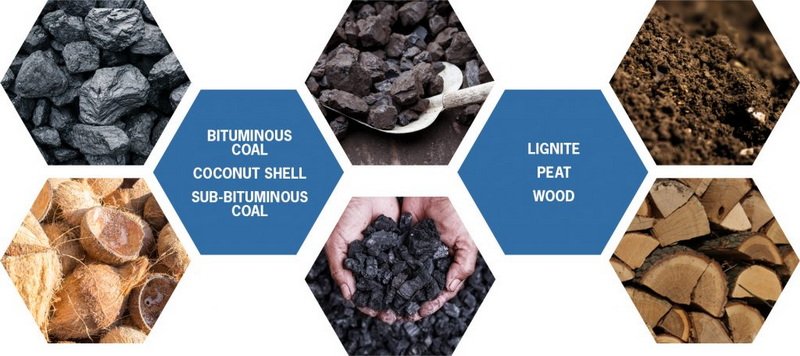
Almost all types of coal can be used to make activated carbon, but performance varies significantly depending on coal rank, ash content, and impurity profile. Bituminous coal is commonly chosen for granular activated carbon because it offers a dense structure, good hardness, and a wide working pore size range.
Important selection criteria for coal used in activated carbon production include:
- Moderate to low ash content to minimize impurities in the final activated carbon.
- Suitable volatile matter content to develop pore structure during carbonization.
- Sufficient mechanical strength to withstand processing and application.
- Stable supply and consistent quality for long‑term industrial operation.
Anthracite and sub‑bituminous coal can also be used to make coal‑based activated carbon, especially when specific pore structures or higher density are required, while lignite can be applied to produce specialized grades where larger pores or different adsorption profiles are needed.
Preparation operations
Before carbonization, coal must be properly prepared to ensure stable, uniform production of activated carbon. Typical preparation steps are:
- Crushing and milling to a controlled particle size range suitable for the chosen kiln or furnace.
- Screening to remove oversize or undersize particles that could disturb material flow.
- Drying to reduce moisture and improve thermal efficiency in the carbonization furnace.
- Mixing and homogenization to keep feedstock consistent in terms of particle size and composition.
These preparation steps help ensure that the feed to the carbonization kiln is uniform, which directly affects the quality and consistency of the resulting coal‑based activated carbon. Good preparation also reduces energy consumption and improves yield by making the heat transfer and reaction conditions more predictable throughout the process.
Step 2: Carbonization – Turning Coal into Char
Carbonization is the first major thermal process in making activated carbon from coal. In this step, prepared coal is heated to a moderately high temperature in the absence of oxygen to remove volatile matter and form a carbon‑rich char with preliminary pores.
Carbonization conditions
For coal‑based activated carbon, typical carbonization temperatures range from about 350 to 600 °C in an oxygen‑limited environment. Common equipment includes rotary kilns, fluidized furnaces, vertical carbonization furnaces, and other specialized reactors designed for continuous operation.
During carbonization:
- Moisture and volatile components are driven off as gases and tars.
- Most non‑carbon elements such as hydrogen and oxygen are removed.
- Carbon atoms rearrange into basic graphitic microstructures, forming the initial pore network.
The solid product after carbonization is called “carbonized material” or “char,” which already has some adsorption capacity but not yet the high surface area required for commercial activated carbon. The char's structure, density, and preliminary pore distribution depend on the coal quality and the specific carbonization curve used in the furnace.
Process control points
Proper control of carbonization is critical for high‑quality coal‑based activated carbon:
- The temperature profile in the kiln must be stable and within the specified range for the selected coal.
- Residence time must be sufficient to remove volatiles without over‑burning the material.
- The atmosphere must remain non‑oxidizing to prevent combustion and loss of carbon.
- Off‑gases must be handled safely, often through combustion or heat recovery units.
Stable carbonization ensures that the char entering the activation furnace has uniform properties. This uniformity helps the next step produce activated carbon with predictable adsorption performance and mechanical strength.
Step 3: Activation – Developing the Pore Structure
Activation is the key stage where carbonized coal is converted into high‑surface‑area activated carbon. In industrial practice, coal‑based activated carbon is most commonly produced by physical (steam or gas) activation, although chemical activation is also possible for certain grades.
Physical (steam/gas) activation
In physical activation, char from coal is exposed to oxidizing gases such as steam, carbon dioxide, or a mixture of flue gases at high temperature, typically around 800–1000 °C. Activation usually takes place in rotary kilns, multiple hearth furnaces, or fluidized bed reactors, designed to keep char moving and heated uniformly along the activation zone.
The activation gases react with carbon in the char to gradually etch and enlarge pores through gasification reactions, releasing gases such as hydrogen, carbon monoxide, and carbon dioxide. Over time, activation goes through three main stages:
- Opening previously closed pores in the carbon matrix.
- Enlarging and deepening existing pores.
- Creating new micro‑ and mesopores throughout the structure.
By controlling activation temperature, gas composition, and residence time, manufacturers can tune the pore size distribution, surface area, and yield of coal‑based activated carbon. A higher activation degree usually increases surface area and adsorption capacity, but it also reduces yield, so each plant balances performance and cost according to target applications.
Chemical activation (optional route)
In some processes, coal or coal char can be chemically activated using agents such as potassium hydroxide or zinc chloride, followed by heating to develop a high‑surface‑area activated carbon. Chemical activation often occurs at somewhat lower temperatures than pure physical activation and can produce activated carbon with very high microporosity and specific surface area.
However, chemical activation requires additional washing to remove residual chemicals and may generate more wastewater that needs treatment. For this reason, large‑scale coal‑based activated carbon for water treatment and air purification often relies on physical steam activation, while chemical activation is used more for specialty or research‑grade activated carbon.
Step 4: Cooling, Crushing, and Screening
After activation, the hot activated carbon exiting the furnace must be cooled in an oxygen‑poor environment to prevent self‑ignition. Cooling is often done in indirect rotary coolers, water‑cooled screws, or sealed cooling drums that protect the fragile pore structure of activated carbon while lowering the temperature to a safe level.
Once cooled, the activated carbon is processed further:
- It is crushed to break agglomerates and reach the target size distribution.
- It is screened to separate granular, powdered, or pellet fractions according to mesh size.
- Oversize or undersize particles can be recycled back into the process or used in other products.
Coal‑based activated carbon is typically sold in standardized mesh sizes such as 4×8, 8×30, 12×40, and powdered grades like 50×200 and 80×325, with custom sizes available on request. The exact particle size influences pressure drop, contact time, and filtration performance in the customer's system, so manufacturers often offer a full portfolio of coal‑based activated carbon grades.
Step 5: Washing, Drying, and Packaging
The final process section focuses on reducing ash content, removing soluble impurities, and bringing activated carbon to its final moisture and quality specification.
Washing and impurity removal
Depending on the process and target application, coal‑based activated carbon is washed with water or mild acid/alkali solutions to:
- Remove soluble inorganic salts and residual ash‑forming minerals.
- Adjust pH to the required range for potable water or food‑grade use.
- Improve the purity and performance of the activated carbon in sensitive applications.
For high‑end coal‑based activated carbon used in drinking water or food and beverage processing, washing steps are carefully controlled and monitored to ensure that conductivity, pH, and extractables meet international standards.
Drying and packaging
After washing, activated carbon is dried in dedicated dryers to achieve a controlled moisture content that balances dust control, handling, and adsorption performance. The dry coal‑based activated carbon is then stored in silos or directly packaged into:
- Bulk bags (FIBCs) for industrial customers.
- Smaller bags or drums for specialty and retail uses.
- Custom packaging solutions for OEMs and distributors.
Careful handling and dust control during packaging are essential to maintain product quality and minimize material losses. Proper sealing and labeling help protect coal‑based activated carbon from moisture and contamination during storage and transport.
Key Properties of Coal‑Based Activated Carbon
The performance of activated carbon made from coal is determined by several critical properties. Understanding these properties helps end users select the right coal‑based activated carbon for their systems.
Important parameters include:
- Iodine number and BET surface area, which indicate the overall adsorption capacity of activated carbon for small molecules.
- Pore size distribution (micro, meso, macro), which controls which molecules can be adsorbed efficiently and how fast mass transfer occurs.
- Apparent density and hardness, affecting pressure drop, backwashing behavior, and mechanical abrasion resistance in filters.
- Ash content and water‑soluble impurities, which are especially important for potable water and food applications.
- Particle size distribution, which influences contact time, hydraulic performance, and filtration efficiency.
Coal‑based activated carbon often provides a strong combination of surface area, durability, and broad adsorption spectrum, making it a workhorse material in many filtration systems. Compared with some other types of activated carbon, coal‑based grades typically offer high mechanical strength and stable performance over multiple operating cycles.
Industrial Applications of Coal‑Based Activated Carbon
Coal‑based activated carbon is widely used wherever large volumes of water, air, or process fluids must be purified reliably and economically. Because of its robust properties, coal‑based activated carbon is found in many sectors.
Common applications include:
- Municipal and industrial potable water treatment, including dechlorination and removal of organic contaminants such as pesticides, industrial chemicals, and disinfection by‑products.
- Wastewater treatment and polishing before discharge or reuse, helping plants meet regulatory discharge limits.
- Industrial air and gas purification, odor control, and volatile organic compound (VOC) removal from exhaust gases.
- Food and beverage decolorization, taste and odor improvement, and refining of sugar, beverages, and edible oils.
- Chemical purification and solvent recovery in refineries, chemical plants, and pharmaceutical production.
- Protection filters in gas masks, air purifiers, and industrial safety systems.
Because of its durability and broad adsorption capability, coal‑based activated carbon is especially valuable in high‑flow, continuous systems such as carbon filters and fixed‑bed adsorption columns. Many large‑scale purification units are specifically designed to work with granular coal‑based activated carbon because of its balance of performance, cost, and mechanical strength.
Comparing Coal‑Based Activated Carbon with Other Types
Although this article focuses on how to make activated carbon from coal, it is useful to understand how coal‑based activated carbon compares with other common types such as coconut shell and wood‑based activated carbon.
In general:
- Coal‑based activated carbon usually offers a wide pore size distribution, high mechanical strength, and broad applicability for both water and air treatment.
- Coconut shell activated carbon tends to have more micropores and very high hardness, which is excellent for small organic molecules and long‑life point‑of‑use filters.
- Wood‑based activated carbon normally has more mesopores and macropores, making it suitable for decolorization and certain liquid‑phase applications where larger molecules must be removed.
For high‑volume industrial and municipal systems, coal‑based activated carbon remains one of the most cost‑effective and reliable solutions, while coconut shell and wood‑based activated carbon complement it in specific niches. Many suppliers offer complete portfolios so customers can choose the optimal activated carbon for each process.
Safety and Environmental Considerations
Producing activated carbon from coal involves high temperatures, combustible gases, and fine carbon dust, so robust safety and environmental practices are essential.
Important safety and environmental measures include:
- Proper handling of flue gases and volatile organic compounds released during carbonization and activation, often by burning or treating them in thermal oxidizers and scrubbers.
- Dust control systems around crushers, screens, and packaging lines to minimize explosion risk, protect workers, and reduce dust emissions to the environment.
- Thermal and energy management to improve fuel efficiency and reduce greenhouse gas emissions from activated carbon production, including waste‑heat recovery.
- Appropriate treatment of washing effluents to ensure that ash and residual chemicals do not pollute receiving waters.
- Compliance with local and international regulations related to air emissions, wastewater discharge, and solid waste management.
Modern activated carbon plants often integrate heat recovery, emission control, and wastewater treatment systems to meet stringent environmental standards while producing high‑quality coal‑based activated carbon. End users also benefit from proper handling of spent activated carbon, which can be regenerated, reactivated, or disposed of safely through controlled processes.
Conclusion
Making activated carbon from coal is a carefully engineered process that converts raw coal into a highly porous, high‑surface‑area adsorbent through carbonization, activation, and finishing steps. By controlling coal selection, carbonization conditions, activation gases, and post‑treatment, manufacturers can produce coal‑based activated carbon with tailored pore structures and performance for water treatment, air and gas purification, food and beverage, chemical, and pharmaceutical applications.
Coal‑based activated carbon offers a powerful combination of mechanical strength, broad adsorption capability, and cost effectiveness, particularly for large‑scale industrial and municipal systems. When supported by modern environmental and safety controls, coal‑based activated carbon production provides reliable, high‑quality purification solutions for customers worldwide and plays an important role in protecting water, air, products, and human health.
Contact us to get more information!
FAQ – How to Make Activated Carbon from Coal
1. How is coal converted into activated carbon?
Coal is first crushed, dried, and carbonized at about 350–600 °C in an oxygen‑limited furnace to form char, and then activated at roughly 800–1000 °C with steam or gas to develop the porous structure of activated carbon. After activation, the material is cooled, washed, dried, and sized to produce granular or powdered coal‑based activated carbon for industrial use.
2. What type of coal is best for making activated carbon?
Bituminous coal is widely considered a preferred feedstock for granular activated carbon because it combines good hardness, dense structure, and a broad pore size distribution suitable for many contaminants. Sub‑bituminous coal, anthracite, and lignite can also be used to produce specialized grades of coal‑based activated carbon depending on application requirements and desired pore structure.
3. What is the difference between coal‑based and coconut‑based activated carbon?
Coal‑based activated carbon typically provides a more balanced distribution of micro, meso, and macropores and strong mechanical strength, making it ideal for high‑flow, large‑scale filters in water and gas treatment. Coconut shell‑based activated carbon usually has a higher proportion of micropores and is often favored for removing smaller molecules and in certain drinking water or air purification applications where extremely high hardness and long service life are required.
4. Can coal‑based activated carbon be regenerated and reused?
Yes, many grades of coal‑based activated carbon can be thermally regenerated in specialized reactivation furnaces that drive off adsorbed contaminants and partially restore pore structure. Reactivated coal‑based activated carbon is commonly used in municipal and industrial systems where regeneration can reduce overall operating costs and environmental impact compared with single‑use carbon.
5. Is coal‑based activated carbon safe for drinking water treatment?
Coal‑based activated carbon designed for potable water applications is manufactured and washed to strict quality standards that control ash, soluble impurities, and potential leachables. When sourced from reputable producers and used within specified conditions, coal‑based activated carbon is widely accepted and widely used in municipal drinking water treatment and residential filtration systems.
Citations:
1. https://rotarykilnfactory.com/how-to-make-coal-based-activated-carbon/
2. https://rotarykilnsupplier.com/activated-carbon-making/coal-based-activated-carbon-making/
3. https://www.dec.group/_docs_/ACA-docs/activated-carbon-production-ACA_en.html
4. https://patents.google.com/patent/CN111099590A/en
5. https://www.sciencedirect.com/science/article/pii/0008622395002049
6. https://qizhongcarbon.com/blog/what-is-coal-based-activated-carbon/
7. https://www.naturecarbon.com/news/the-difference-between-coal-based-activated-ca-85015093.html
8. https://www.huameicarbon.com/manufacturing-process-and-application-analysis-of-coal-based-columnar-activated-carbon/
9. https://www.carbonactivatedeurope.com/products/coal-based-activated-carbon/
10. https://heycarbons.com/activated-carbon-vs-charcoal/
11. https://mellifiq.com/en/coal-anthracite-bituminous-based-activated-carbon/
12. https://en.wikipedia.org/wiki/Activated_carbon


