Content Menu
● What Is Activated Carbon
● Main Raw Materials For Activated Carbon
● Overview Of The Activated Carbon Production Process
● Step 1: Raw Material Preparation
● Step 2: Carbonization – Turning Raw Material Into Char
● Step 3: Activation – Creating The Porous Structure
● Physical (Steam/CO₂) Activation Of Activated Carbon
● Chemical Activation Of Activated Carbon
● Washing, Drying, And Finishing Activated Carbon
● Quality Control In Activated Carbon Production
● Forms And Applications Of Produced Activated Carbon
● Sustainability And Regeneration Of Activated Carbon
● Conclusion
● FAQs About How Activated Carbon Is Produced
>> 1. How is activated carbon different from regular charcoal?
>> 2. What temperatures are used to produce activated carbon?
>> 3. Is chemical activation safe for food and drinking water applications?
>> 4. Why are different raw materials used to produce activated carbon?
>> 5. Can spent activated carbon be reused?
● Citations:
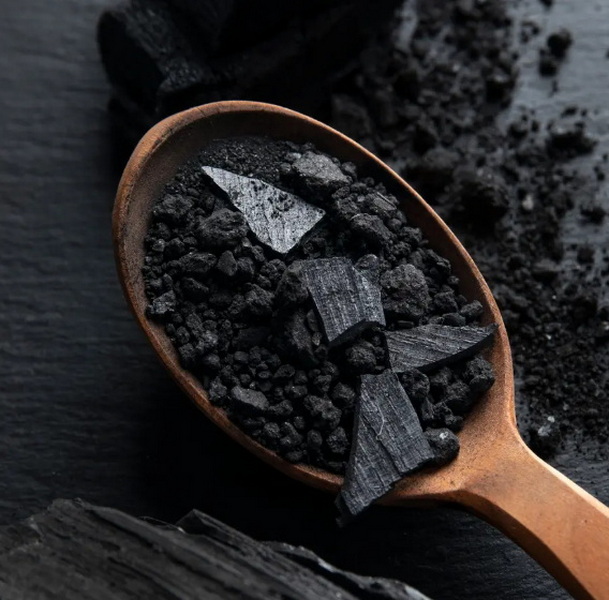
Activated carbon is produced by transforming carbon‑rich raw materials such as coal, coconut shell, wood, and other biomass into an extremely porous adsorbent through carefully controlled carbonization and activation steps. Activated carbon production technology allows manufacturers to tailor pore structure, particle size, and purity for demanding industrial applications in water treatment, air and gas purification, food and beverage, chemical processing, and pharmaceuticals.
What Is Activated Carbon
Activated carbon is a highly porous form of carbon with an enormous internal surface area and a strong ability to adsorb molecules from liquids and gases. In modern industry, activated carbon is engineered in different grades to meet specific adsorption performance targets, regulatory standards, and cost requirements.
- Activated carbon is typically produced from raw materials with high fixed carbon content such as coal, coconut shell, wood, peat, and other agricultural by‑products.
- Depending on the production route, activated carbon may be optimized for liquid‑phase adsorption (e.g., water treatment) or gas‑phase adsorption (e.g., VOC removal and solvent recovery).
Main Raw Materials For Activated Carbon
Raw material selection is the first key step in how activated carbon is produced, because it strongly influences pore structure, hardness, impurities, and final performance. Activated carbon is commonly produced from the following feedstocks.
- Coconut shell: Produces hard, abrasion‑resistant activated carbon with predominantly microporous structure, ideal for high‑purity water treatment and gas‑phase adsorption.
- Coal (bituminous, lignite, anthracite): Widely used for granular and powdered activated carbon with a broad pore size distribution for industrial water, flue gas, and process stream treatment.
- Wood and sawdust: Often used for activated carbon with more mesopores and macropores, suitable for decolorization and purification in food, beverage, and chemical industries.
Overview Of The Activated Carbon Production Process
Although there are many plant configurations, the production of activated carbon generally follows a similar process flow. Manufacturers adjust conditions, equipment, and additives to obtain the required activated carbon specification.
- Typical industrial activated carbon production involves: raw material preparation, drying, carbonization, activation (physical or chemical), washing, drying, sizing, quality control, and packaging.
- The two fundamental steps that create activated carbon are carbonization (pyrolysis in an inert or low‑oxygen atmosphere) and activation (further gasification or chemical treatment to open and develop pores).
Step 1: Raw Material Preparation
Before carbonization, the feedstock needs to be prepared so that the activated carbon process is stable and reproducible. This preparation stage has a strong impact on the efficiency of the whole activated carbon production line.
- Raw material preparation usually includes screening to remove oversized or undersized particles, crushing or grinding to achieve a controlled particle size, and sometimes pre‑cleaning to remove stones, metals, or other contaminants.
- Moisture content is controlled to a suitable level through drying, ensuring consistent thermal behavior during carbonization and improving the quality of the resulting activated carbon char.
Step 2: Carbonization – Turning Raw Material Into Char
Carbonization is the thermal decomposition of the prepared raw material in an oxygen‑limited environment, forming a carbon‑rich char that will later be activated into high‑performance activated carbon.
- During carbonization, the feedstock is heated typically in the range of about 400–900 °C in an inert atmosphere (nitrogen or flue gas) so that volatile components (water, tars, and light organics) are driven off, concentrating the carbon skeleton.
- Carbonization is commonly carried out in rotary kilns, multiple hearth furnaces, retorts, or other specialized reactors designed to maintain a low‑oxygen environment and stable residence time, producing uniform char for the activation step.
Step 3: Activation – Creating The Porous Structure
Activation is the core step that transforms relatively dense char into highly porous activated carbon with very large internal surface area. There are two main activation methods: physical activation and chemical activation.
- In physical activation, the char is exposed to oxidizing gases such as steam or carbon dioxide at high temperatures (typically 800–1000 °C), which burn away part of the carbon matrix and open a network of pores, creating activated carbon.
- In chemical activation, the raw material is impregnated or mixed with chemical activating agents such as phosphoric acid or potassium hydroxide and then heated (often 400–700 °C); during heating, the agent promotes decomposition and pore formation, producing activated carbon at somewhat lower temperatures.
Physical (Steam/CO₂) Activation Of Activated Carbon
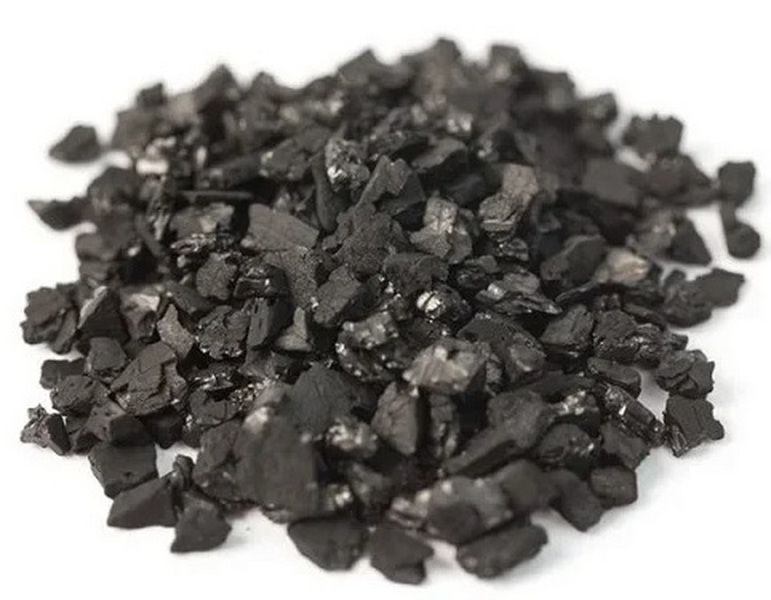
Physical activation is widely used for coal‑based and coconut‑shell‑based activated carbon and is favored for applications where low ash and minimal chemical residues are critical.
- Typically, carbonized material is fed into an activation furnace and contacted with steam, carbon dioxide, or a mixture, at temperatures of about 800–1000 °C; gasification reactions between carbon and steam/CO₂ gradually enlarge existing pores and create new ones, forming highly porous activated carbon.
- Physical activation is often carried out in rotary kilns or vertical furnaces in either continuous or batch mode and allows producers to adjust burn‑off level (the percentage of carbon removed), which directly affects activated carbon surface area and pore volume.
Chemical Activation Of Activated Carbon
Chemical activation is especially common for wood‑based activated carbon and certain powdered activated carbon products, providing high surface area at lower activation temperatures.
- In a typical chemical activation process, the raw material (such as sawdust) is mixed or impregnated with a chemical activating agent like phosphoric acid or KOH; the mixture is then heated to around 400–700 °C, where the agent promotes dehydration, cross‑link breaking, and pore development, directly forming activated carbon.
- After chemical activation, the activated carbon must be thoroughly washed to remove residual chemicals and soluble impurities; proper washing is essential when activated carbon will be used in food, beverage, pharmaceutical, or drinking water applications.
Washing, Drying, And Finishing Activated Carbon
Once activation is complete, the freshly produced activated carbon needs post‑treatment to achieve the desired purity, moisture content, and particle size. These finishing steps are critical to deliver consistent activated carbon performance in industrial systems.
- Washing of activated carbon removes residual activation agents, ash, and soluble inorganic compounds, often using water and sometimes acid rinses; high‑purity grades receive multiple washing stages until conductivity and pH targets are met.
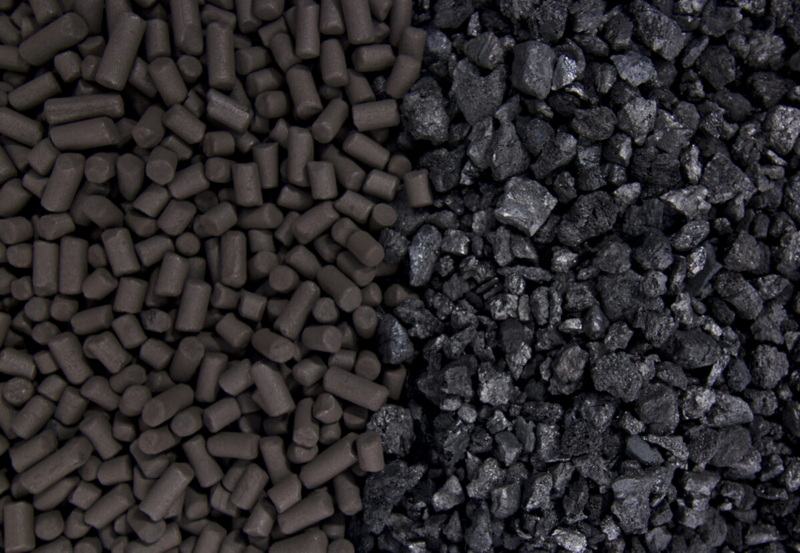
- Washed activated carbon is then dried in rotary dryers, fluid bed dryers, or other equipment to reach a controlled moisture level; after drying, the activated carbon is crushed, milled, sieved, or pelletized to obtain granular activated carbon (GAC), powdered activated carbon (PAC), or extruded activated carbon with specified particle sizes and shapes.
Quality Control In Activated Carbon Production
For industrial users, consistent activated carbon quality is as important as high adsorption capacity. Manufacturers therefore implement strict quality control from raw material to finished activated carbon product.
- Key quality parameters for activated carbon include iodine number or BET surface area, molasses number or methylene blue value, ash content, hardness/abrasion resistance, pH, moisture, and particle size distribution.
- Quality control laboratories routinely test each batch of activated carbon and may also simulate customer process conditions (e.g., water with specific contaminants or certain gas mixtures) to confirm that the activated carbon meets performance requirements before shipment.
Forms And Applications Of Produced Activated Carbon
Once produced, activated carbon is supplied in different physical forms tailored to specific industrial applications. The structure and manufacturing route directly affect how activated carbon performs in real‑world systems.
- Granular activated carbon is widely used in drinking water treatment, groundwater remediation, industrial wastewater, and air and gas purification; powdered activated carbon is dosed into water or process streams for decolorization, odor removal, and trace contaminant control; extruded activated carbon is used in fixed‑bed gas adsorption systems and solvent recovery.
- Across water treatment, air and gas purification, food and beverage, chemical, and pharmaceutical industries, activated carbon produced by carbonization and activation provides efficient removal of organic contaminants, chlorine, taste and odor compounds, VOCs, and many specialized pollutants.
Sustainability And Regeneration Of Activated Carbon
Modern activated carbon production increasingly considers resource efficiency and environmental performance, from raw material choice to energy recovery and spent carbon management.
- Many producers favor renewable or by‑product feedstocks such as coconut shells or biomass residues for activated carbon production, reducing dependence on fossil‑based coal and supporting circular economy initiatives.
- Spent activated carbon can often be thermally reactivated in specialized furnaces, restoring adsorption capacity and reducing waste; regenerated activated carbon is reused in many industrial applications, lowering lifecycle cost and environmental impact.
Conclusion
Activated carbon is produced through a carefully engineered sequence of steps that convert carbon‑rich raw materials into a highly porous, high‑performance adsorbent for demanding industrial applications. From raw material selection and preparation, through carbonization, physical or chemical activation, washing, drying, and finishing, each stage of the activated carbon process is optimized to deliver specific pore structures, particle sizes, and purity levels for different end uses.
By understanding how activated carbon is produced, end users in water treatment, air and gas purification, food and beverage, chemical, and pharmaceutical industries can better select the right activated carbon grade, cooperate effectively with manufacturers, and design systems that achieve reliable, cost‑effective adsorption performance.
Contact us to get more information!
FAQs About How Activated Carbon Is Produced
1. How is activated carbon different from regular charcoal?
Activated carbon is produced by taking charcoal‑like carbonized material and subjecting it to an extra activation step that dramatically increases its porosity and surface area. Regular charcoal has far fewer accessible pores and a much lower adsorption capacity, while activated carbon offers a highly developed internal pore network specifically engineered for adsorption.
2. What temperatures are used to produce activated carbon?
In activated carbon production, carbonization usually occurs around 400–900 °C in an inert or low‑oxygen atmosphere, depending on the feedstock and equipment. During physical activation, the carbonized material is further heated to about 800–1000 °C in the presence of steam or carbon dioxide to open and develop the pores that make activated carbon so effective.
3. Is chemical activation safe for food and drinking water applications?
Chemical activation of activated carbon uses agents such as phosphoric acid or KOH to promote pore development at lower temperatures, and these chemicals are removed by thorough washing after activation. When manufacturing standards and washing procedures are correctly followed, the finished activated carbon meets purity requirements and is safe for food, beverage, and potable water treatment applications.
4. Why are different raw materials used to produce activated carbon?
Different raw materials produce different pore structures, impurities, and mechanical properties in the final activated carbon, which is why manufacturers choose coconut shell, coal, wood, or other feedstocks based on the target application. For example, coconut‑shell‑based activated carbon tends to be hard and predominantly microporous, while wood‑based activated carbon often has more mesopores, and coal‑based activated carbon provides a broad pore size distribution suitable for many industrial uses.
5. Can spent activated carbon be reused?
Yes, in many cases spent activated carbon can be thermally reactivated in specialized furnaces that remove adsorbed contaminants and restore much of the original pore structure. Reactivated activated carbon is widely used in industrial processes, helping reduce waste, lower operating costs, and improve the overall environmental footprint of activated carbon systems.
Citations:
1. https://www.sciencedirect.com/topics/engineering/preparing-activated-carbon
2. https://www.dec.group/_docs_/ACA-docs/activated-carbon-production-ACA_en.html
3. https://feeco.com/introduction-to-activated-carbon/
4. https://heycarbons.com/manufacture-of-activated-carbon/
5. https://pubs.rsc.org/en/content/articlelanding/2021/ta/d1ta00765c
6. https://iarjset.com/wp-content/uploads/2022/05/IARJSET.2022.9440.pdf
7. https://www.activatedcarbon.org/activated-carbon/production/
8. https://rotarykilnfactory.com/how-to-make-activated-carbon-from-coconut-shell/
9. https://en.wikipedia.org/wiki/Activated_carbon
10. https://pmc.ncbi.nlm.nih.gov/articles/PMC8466215/
11. https://activatedcarbon.com/manufacturing
12. https://generalcarbon.com/facts-about-activated-carbon/activated-carbon-faq/
13. https://www.sciencedirect.com/science/article/abs/pii/S138718111100566X
14. https://www.sciencedirect.com/science/article/abs/pii/S0961953412004758
15. https://www.youtube.com/watch?v=GNKeps6pIao


