Content Menu
● How Does Powdered Activated Carbon Work?
● What Is Powdered Activated Carbon?
● The Science Behind Powdered Activated Carbon
>> Adsorption vs Absorption
>> Pore Structure and Surface Area
>> Fast Kinetics from Fine Particle Size
● How Powdered Activated Carbon Works in Water Treatment
>> Dosing Points and Process Integration
>> Target Contaminants in Water
● How Powdered Activated Carbon Works in Air and Gas Purification
● How Powdered Activated Carbon Works in Food and Beverage Applications
● How Powdered Activated Carbon Works in Chemical and Pharmaceutical Industries
● Advantages of Powdered Activated Carbon
● Limitations and Considerations When Using Powdered Activated Carbon
● Best Practices for Using Powdered Activated Carbon
● Conclusion
● FAQs About How Powdered Activated Carbon Works
>> 1. What is the main working principle of powdered activated carbon?
>> 2. Why choose powdered activated carbon instead of granular activated carbon?
>> 3. How is powdered activated carbon used in drinking water treatment?
>> 4. Can powdered activated carbon be used for food and pharmaceutical products?
>> 5. What are the key factors that affect powdered activated carbon performance?
● Citations:
How does powdered activated carbon work? It works mainly through adsorption, trapping organic molecules and other contaminants on its extremely large internal surface area as water, air, or process liquids pass over the fine carbon particles.[1][2]
How Does Powdered Activated Carbon Work?
Powdered activated carbon (PAC) is a finely ground form of activated carbon engineered to provide rapid, highly efficient adsorption in water treatment, air and gas purification, food and beverage processing, chemical production, and pharmaceutical manufacturing. Because powdered activated carbon has a very small particle size and enormous internal porosity, it offers fast kinetics and high contact efficiency, making it ideal for short-contact-time industrial processes and batch treatments.[3][2][4][5]
What Is Powdered Activated Carbon?
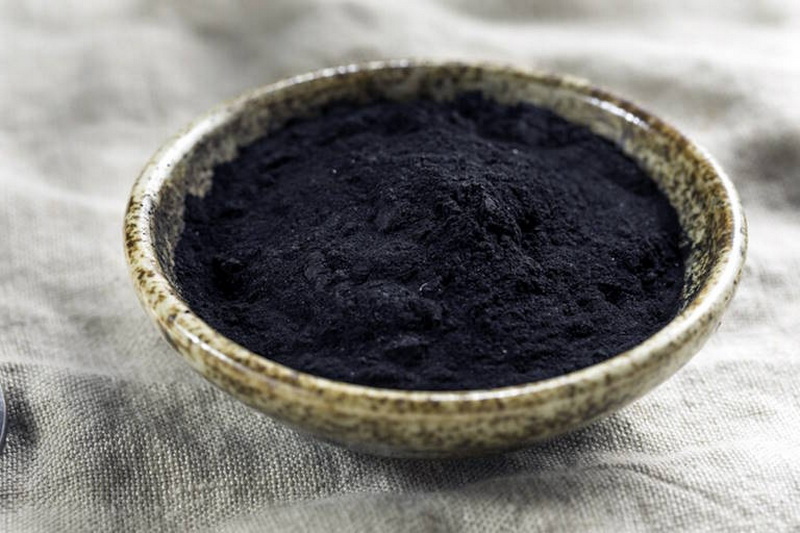
Powdered activated carbon is activated carbon milled to a fine powder, typically with most particles smaller than about 100–325 mesh (less than 150–45 micrometers), so it behaves almost like a fluid when suspended in water or process liquids. This small particle size dramatically reduces diffusion distance inside each particle, so contaminants can reach internal pores quickly and be adsorbed in a relatively short contact time.[2][6][4][7]
PAC is produced from high‑carbon raw materials such as coal, coconut shell, wood, or peat that are carbonized and then activated at high temperature to create a dense network of pores. Once activated, the carbon is ground into a powder and classified by particle size distribution to match the needs of water treatment plants, food and beverage processors, chemical manufacturers, and pharmaceutical producers.[4][3][1][2]
The Science Behind Powdered Activated Carbon
Adsorption vs Absorption
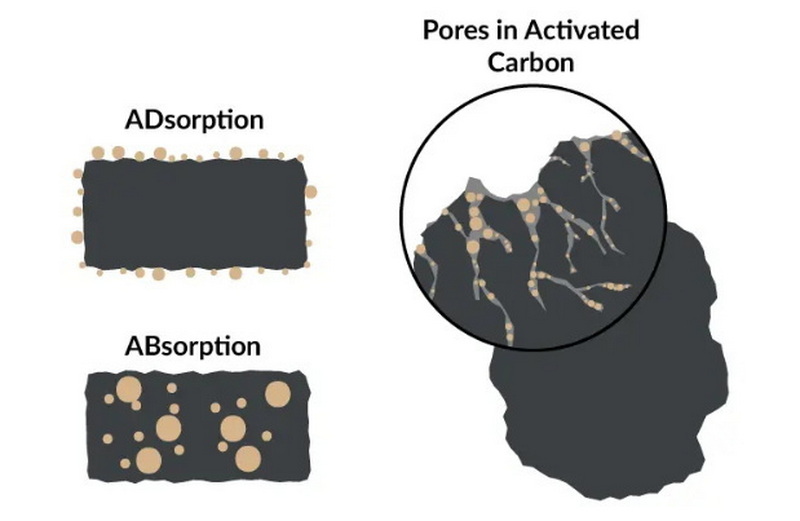
The core working principle of powdered activated carbon is adsorption, not absorption. In adsorption, molecules from water, air, or process liquids adhere to the surface of the powdered activated carbon particles, both on the external surface and inside the pores, rather than being taken up into a bulk volume as in absorption.[7][1][2]
Because powdered activated carbon has an internal surface area commonly in the range of hundreds to over a thousand square meters per gram, it behaves like a “molecular sponge,” offering countless sites where contaminants can attach. Weak intermolecular forces such as van der Waals interactions and, in some cases, electrostatic attraction and hydrophobic interactions hold these molecules in place on the carbon surface.[3][2][7]
Pore Structure and Surface Area
Activated carbon, including powdered activated carbon, contains a hierarchy of pores—micropores, mesopores, and macropores—that govern how different molecules are captured. Micropores provide the majority of the adsorption capacity for small organic molecules, mesopores help with diffusion and adsorption of slightly larger molecules, and macropores act as transport channels to bring contaminants from the bulk fluid into the inner pore network.[1][7][3]
Key performance indicators such as iodine number, molasses number, and BET surface area reflect how well a powdered activated carbon grade can adsorb specific classes of contaminants. By adjusting activation conditions, manufacturers can tailor pore size distribution to target taste and odor compounds, trace organics, color bodies, or complex molecules in chemical and pharmaceutical streams.[8][2][4]
Fast Kinetics from Fine Particle Size
Compared with granular activated carbon (GAC), powdered activated carbon's main advantage is speed: its tiny particles allow contaminants to reach adsorption sites much more quickly. Shorter diffusion paths and a higher external surface area per unit mass translate into faster adsorption kinetics, which is crucial for processes with limited contact time such as rapid‑mix water treatment or batch decolorization steps.[6][5][2][7]
In many drinking water, wastewater, and industrial applications, powdered activated carbon is dosed for only minutes to an hour before separation, so fast kinetics directly improves removal efficiency and allows lower doses. For operators, this means powdered activated carbon provides a flexible, “on‑demand” solution that can be ramped up quickly during seasonal events such as algal blooms or odor spikes, and reduced when raw water quality improves.[9][10][7]
How Powdered Activated Carbon Works in Water Treatment
Dosing Points and Process Integration
In drinking water and industrial water treatment, powdered activated carbon is typically added as a dry powder or slurry at controlled dosing points early in the treatment train. Common locations include raw water intakes, rapid‑mix basins before coagulation–flocculation, or within recirculation loops of ultrafiltration systems to improve dissolved organics removal.[10][6][7]
Once dosed, powdered activated carbon disperses throughout the water, rapidly adsorbing dissolved organic matter, micropollutants such as pesticides and industrial chemicals, algal toxins, and taste‑and‑odor compounds like geosmin and MIB. After sufficient contact time, the powdered activated carbon is removed together with flocs in sedimentation or filtration steps, eventually ending up in sludge handling processes.[6][10][7][3]
Target Contaminants in Water
Powdered activated carbon is especially effective at removing:
- Natural organic matter that contributes to color, odor, and formation of disinfection by‑products (DBPs) when water is chlorinated.[7][3]
- Taste and odor compounds produced by algae or biological activity, helping utilities maintain consistent drinking water quality during seasonal changes.[2][10]
- Synthetic organic contaminants such as pesticides, herbicides, industrial solvents, and pharmaceutical residues that may be present at trace levels but pose regulatory or reputational risks.[9][3]
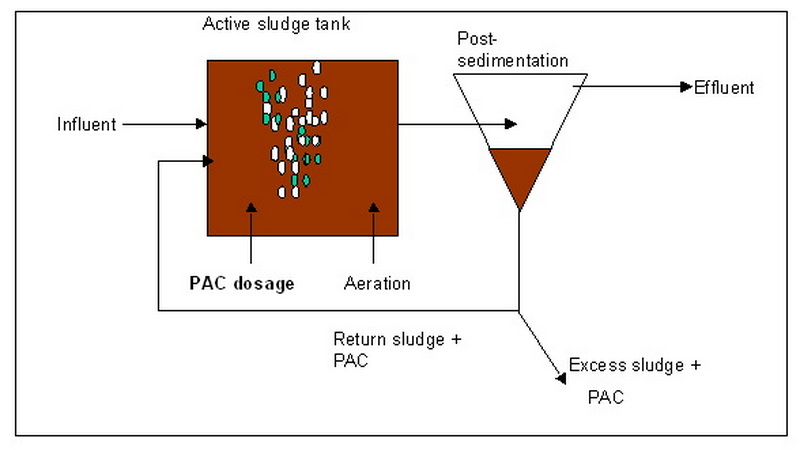
In wastewater and industrial effluents, powdered activated carbon treatment (PACT) combines adsorption with biological treatment by adding carbon directly into activated sludge systems. Here, powdered activated carbon adsorbs non‑biodegradable or toxic compounds, reduces chemical oxygen demand (COD), buffers biological systems against shocks, and improves sludge settling and dewatering properties.[11][12]
How Powdered Activated Carbon Works in Air and Gas Purification
In air and gas treatment, activated carbon is more commonly used in granular or extruded form, but powdered activated carbon still has important roles in certain applications. Powdered activated carbon can be injected into flue gas or emission streams to capture mercury, dioxins, and other volatile organic compounds, after which it is collected along with fly ash in downstream filters.[13][8][1]
Powdered activated carbon is also used in emergency response and vapor control, where rapid dispersion and high adsorption rate are critical. In these cases, powdered activated carbon particles provide a vast contact area for airborne pollutants, quickly pulling them out of the gas phase and immobilizing them on the carbon surface.[14][8]
How Powdered Activated Carbon Works in Food and Beverage Applications
In the food and beverage industry, powdered activated carbon is widely used for decolorization, deodorization, and removal of trace contaminants from liquids such as sugar solutions, edible oils, juices, wines, spirits, and syrups. During these processes, powdered activated carbon is usually mixed into the liquid in stirred tanks or batch vessels, allowed to adsorb unwanted color bodies, odor‑forming compounds, and off‑flavors, and then removed by filtration.[15][4][8]
High‑purity food‑grade powdered activated carbon is manufactured under strict quality and regulatory standards, with controlled ash content, pH, and impurity levels to avoid introducing contaminants into sensitive products. Because powdered activated carbon offers rapid adsorption and easy dosing, processors can fine‑tune contact time and dosage to achieve precise color and flavor targets while optimizing operating cost.[4][8][15]
How Powdered Activated Carbon Works in Chemical and Pharmaceutical Industries
In chemical manufacturing, powdered activated carbon is used to purify intermediates and final products by removing trace by‑products, color bodies, catalyst residues, and other impurities that affect product quality. The carbon is typically added to reaction mixtures or process streams, where it adsorbs targeted impurities before the carbon is filtered out, leaving a clearer and more stable product.[12][8][14]
In pharmaceuticals, high‑purity powdered activated carbon grades are used to refine active pharmaceutical ingredients (APIs) and intermediates, as well as to remove odor and color from formulations. There are also medical applications where finely divided activated charcoal is administered orally to adsorb drugs or poisons in the gastrointestinal tract, reducing systemic absorption in poisoning cases.[16][17][8][4]
Advantages of Powdered Activated Carbon
Powdered activated carbon provides several advantages compared with other treatment options and with granular carbon in particular.[6][7]
Key benefits include:
- Fast adsorption kinetics due to small particle size and high external surface area, enabling efficient treatment with short contact times.[2][6]
- Flexible dosing that can be easily increased or decreased to respond to variable raw water quality, seasonal events, or process upsets.[10][6]
- Lower initial capital investment because powdered activated carbon systems can be added to existing treatment trains with relatively simple dosing equipment.[7][6]
- Broad applicability across water treatment, wastewater, air and gas purification, food and beverage, chemical, and pharmaceutical processes, allowing one technology platform to serve multiple industries.[13][4]
In addition, powdered activated carbon can enhance coagulation and flocculation in some water treatment systems by acting as a ballast and adsorption aid, improving sedimentation and overall removal efficiency.[5][6]
Limitations and Considerations When Using Powdered Activated Carbon
While powdered activated carbon is powerful, it does have limitations that engineers and operators must consider. Correct selection of powdered activated carbon grade, dose, and contact time is essential to achieve targeted removal, and performance can be reduced when competing natural organic matter or other contaminants occupy adsorption sites.[12][3][7]
Powdered activated carbon also generates spent carbon sludge that must be handled, dewatered, and disposed of or regenerated, which adds operational and environmental considerations. In addition, dry powdered activated carbon handling requires appropriate dust control and safety measures to manage airborne dust and potential explosion risks in industrial environments.[11][14][12][6]
Best Practices for Using Powdered Activated Carbon
To get the best performance from powdered activated carbon, operators typically follow several best practices:
- Select a powdered activated carbon grade with pore structure and surface chemistry matched to the target contaminants, using tests such as iodine number, molasses index, and application‑specific performance trials.[8][2]
- Add powdered activated carbon early in the treatment process to maximize contact time and allow contaminants to be adsorbed before downstream disinfection or polishing steps.[10][7]
- Optimize dose using jar tests or pilot trials, balancing removal targets with chemical consumption and sludge production.[12][7]
- Ensure thorough dispersion and mixing of powdered activated carbon so all fluid passes in intimate contact with the carbon particles.[6][7]
- Monitor effluent quality and adjust PAC dosage seasonally or in response to raw water quality changes, process upsets, or new contaminants of emerging concern.[9][7]
Conclusion
Powdered activated carbon works by using its enormous internal surface area and finely tailored pore structure to adsorb a wide range of contaminants from water, air, process liquids, and pharmaceutical or food streams. Its fine particle size gives powdered activated carbon very fast adsorption kinetics, making it particularly effective for short‑contact‑time and high‑variability applications across municipal water treatment, industrial wastewater, air and gas purification, and sensitive food and pharmaceutical processes.[1][4][2][6]
By understanding how powdered activated carbon works—through adsorption, pore diffusion, and careful integration into process trains—engineers and plant operators can design robust treatment solutions that achieve regulatory compliance and protect product quality. With proper grade selection, dosing, and handling, powdered activated carbon remains one of the most versatile and cost‑effective tools available for modern industrial purification challenges.[3][13][7][12]
FAQs About How Powdered Activated Carbon Works
1. What is the main working principle of powdered activated carbon?
The main working principle of powdered activated carbon is adsorption, in which dissolved or gaseous contaminants adhere to the large internal surface area of the carbon rather than dissolving into it. This adsorption occurs primarily through physical forces within the pores of powdered activated carbon, allowing it to capture a wide spectrum of organic compounds, taste‑and‑odor molecules, and some inorganic species.[3][1][2][7]
2. Why choose powdered activated carbon instead of granular activated carbon?
Powdered activated carbon is chosen over granular activated carbon when fast response and flexible dosing are more important than fixed‑bed operation. Because powdered activated carbon particles are much smaller, they provide faster adsorption kinetics and can be dosed only when needed, which is ideal for seasonal water quality issues, batch purification, and PACT systems in wastewater treatment.[11][2][7][6]
3. How is powdered activated carbon used in drinking water treatment?
In drinking water plants, powdered activated carbon is normally added at the raw water intake or in rapid‑mix basins so it can contact water before coagulation and filtration. Powdered activated carbon adsorbs natural organic matter, taste‑and‑odor compounds, pesticides, and algal toxins, and is later removed with flocs and filter backwash, improving overall water quality and reducing disinfection by‑product formation.[9][10][7][3]
4. Can powdered activated carbon be used for food and pharmaceutical products?
Yes, specially produced food‑ and pharmaceutical‑grade powdered activated carbon is widely used to purify sugar solutions, edible oils, beverages, APIs, and intermediates. These high‑purity powdered activated carbon grades are manufactured and tested to meet regulatory standards, providing rapid decolorization, deodorization, and trace‑impurity removal without compromising product safety or performance.[15][4][8]
5. What are the key factors that affect powdered activated carbon performance?
The performance of powdered activated carbon depends on factors such as pore size distribution, surface chemistry, particle size, dose, contact time, and the nature and concentration of competing contaminants. Proper powdered activated carbon grade selection, optimized mixing and contact conditions, and continuous monitoring of effluent quality are essential to maintain high removal efficiency in real‑world applications.[2][7][3][6]
Citations:
[1](https://en.wikipedia.org/wiki/Activated_carbon)
[2](https://www.huameicarbon.com/the-science-and-solution-of-powdered-activated-carbon-in-water-treatment/)
[3](https://www.sciencedirect.com/topics/engineering/powdered-activated-carbon)
[4](https://www.westerncarbon.com/powdered-activated-carbon-food-pharma/)
[5](https://www.naturecarbon.com/news/water-treatment-activated-carbon-is-powder-or-30155961.html)
[6](https://www.suezwaterhandbook.com/water-and-generalities/fundamental-physical-chemical-engineering-processes-applicable-to-water-treatment/adsorption/applied-activated-carbon-principles)
[7](https://www.ncbi.nlm.nih.gov/books/NBK234593/)
[8](https://redox.com/products/activated-carbon-powdered/)
[9](https://streampeak.com.sg/moisture-absorbers/improve-water-quality-with-activated-carbon-filtration/)
[10](https://guidelines.nhmrc.gov.au/australian-drinking-water-guidelines/part-5/treatment-chemicals/carbon-powdered-activated)
[11](https://en.wikipedia.org/wiki/Powdered_activated_carbon_treatment)
[12](https://www.keiken-engineering.com/news/how-activated-carbon-used-water-treatment)
[13](https://www.calgoncarbon.com/powdered-activated-carbon/)
[14](https://aggricogroup.com/products/activated-carbon/)
[15](https://www.chemviron.eu/activated-carbon-for-beverages-purification/)
[16](https://go.drugbank.com/drugs/DB09278)
[17](https://www.carbotecnia.info/en/learning-center/activated-carbon-applications/activated-carbon-for-poisoning/)
[18](https://www.sciencedirect.com/science/article/abs/pii/0043135482901221)
[19](https://norit.com)
[20](https://www.sorbotech.uk/115,powdered_activated_carbon)


