
Language
Views: 222 Author: Tina Publish Time: 2025-12-04 Origin: Site


Content Menu
● Core working principle: adsorption
● Key stages in an activated carbon filter
● Types of activated carbon filter media
● How activated carbon filters purify water
● How activated carbon filters purify air and gas
● What activated carbon removes (and what it does not)
● Common designs of activated carbon filters
● Industrial applications of activated carbon filters
● Advantages and limitations of activated carbon filters
>> Advantages
>> Limitations
● Typical questions about activated carbon filters
>> 1. How long do activated carbon filters last?
>> 2. Can activated carbon filters remove all bacteria and viruses?
>> 3. What is the difference between GAC and carbon block activated carbon filters?
>> 4. Are activated carbon filters safe for drinking water?
>> 5. How do activated carbon filters compare with reverse osmosis?
Activated carbon filters work by using extremely porous carbon material to trap contaminants from water, air, and gases through a process called adsorption, dramatically improving purity, taste, and odor. Because activated carbon offers huge internal surface area and customizable pore structures, it is ideal for industrial applications such as water treatment, air and gas purification, food and beverage, chemical, and pharmaceutical processing.[1][2][3][4]
Activated carbon is a highly processed form of carbon with an enormous internal surface area created by controlled thermal or chemical activation. During activation, steam, hot air, or gases open millions of micro‑pores, so one gram of activated carbon can reach surface areas of over 3,000 m², providing vast sites for adsorption.[5][3][6]
This porous structure makes activated carbon extremely effective at capturing organic molecules, chlorine, odors, and volatile compounds from fluids and gases. Activated carbon can be produced from coal, coconut shells, wood, and other carbon‑rich raw materials, with each source giving different pore structures for specific applications.[2][7][1]
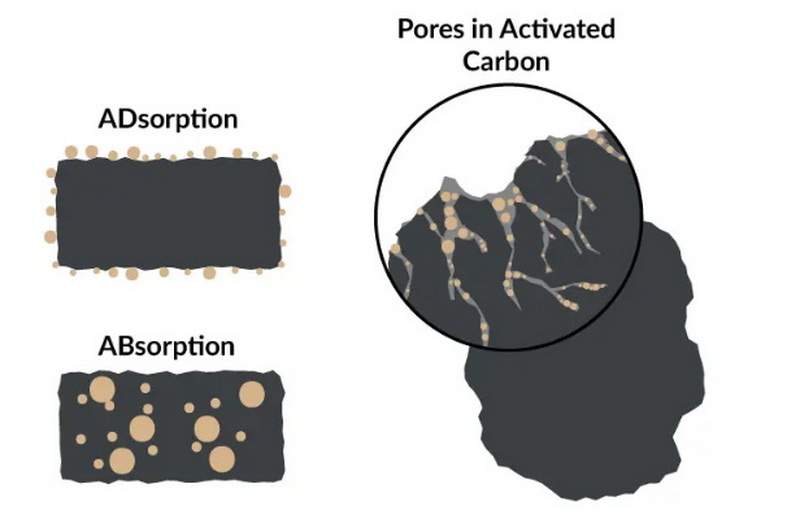
Activated carbon filters work mainly through physical adsorption, where molecules in water or air are attracted to and held on the surface of activated carbon's pores. Intermolecular forces such as van der Waals interactions draw contaminants into the pore network, where they remain trapped while purified fluid passes through.[8][9][3]
Unlike absorption, which fills a material's internal volume, adsorption occurs primarily on the surface, so the huge internal surface area of activated carbon directly translates to high adsorption capacity. Once the available adsorption sites are filled, the activated carbon filter becomes “exhausted” and must be replaced or regenerated to maintain performance.[3][10][11][5]
A typical activated carbon filter follows a simple but powerful sequence:
- Contact: Water, air, or gas flows through a bed or block of activated carbon, ensuring intimate contact between contaminants and carbon surfaces.[1][8]
- Adsorption: Target molecules such as chlorine, organics, VOCs, or odorous gases attach to the internal surfaces within micro‑ and mesopores of the activated carbon.[9][2]
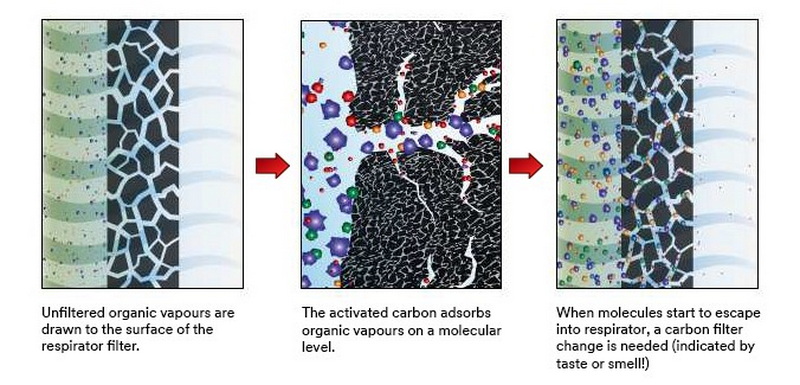
- Breakthrough and saturation: Over time, adsorption sites fill up, contaminant leakage (breakthrough) increases, and the activated carbon filter must be changed or reactivated.[10][11]
Engineered system design focuses on optimizing contact time, bed depth, flow rate, and pore structure so that activated carbon achieves high removal efficiency before breakthrough occurs.[11][2]
Several main media formats are used in activated carbon filters, each suited to different flow and performance requirements.[7][2]
- Granular Activated Carbon (GAC): Loose carbon granules (typically 0.3–0.84 mm) provide high flow rates and are widely used in whole‑house water filters, industrial columns, and point‑of‑entry systems.[7][1]
- Activated Carbon Block (ACB): Finer carbon powder is compressed into a dense block, giving tighter filtration, longer contact time, and better removal of small contaminants at lower flow rates.[12][7]
- Powdered Activated Carbon (PAC): Very fine activated carbon powder is dosed directly into process streams (e.g., water treatment plants) and later separated, giving flexible, high‑surface‑area treatment.[13][11]
In air and gas applications, activated carbon may also be formed into pellets or extrudates to reduce pressure drop while maintaining high adsorption efficiency.[6][13]
In water treatment, activated carbon filters are primarily used to remove chlorine, organic compounds, disinfection by‑products, pesticides, and taste‑ and odor‑causing molecules. As water passes through the activated carbon, these dissolved chemicals are selectively adsorbed, improving taste, safety, and color without significantly altering mineral content.[2][10][11][1]
Granular activated carbon filters are commonly installed as point‑of‑entry units for municipal and industrial water, while carbon block cartridges are preferred at point‑of‑use for drinking water polishing. In complex systems, activated carbon filters often work downstream of sediment filters, softeners, reverse osmosis, or UV disinfection to deliver high‑quality final water.[12][11][7]
In air and gas purification, activated carbon filters target volatile organic compounds (VOCs), odorous gases, fumes, and hazardous molecular contaminants rather than particles. When contaminated air flows across an activated carbon bed, gas‑phase molecules diffuse into the pores and adhere to the carbon surface, reducing emissions and improving indoor air quality.[14][5][8][2]
Industrial uses include exhaust treatment, process air purification, solvent recovery, biogas cleaning, and odor control in wastewater plants and waste transfer facilities. Activated carbon filters are also critical in respirators, cleanrooms, laboratories, and HVAC systems where low levels of gases and VOCs must be maintained.[4][13][2]
Activated carbon filters are highly effective for many but not all contaminants. Performance depends on contaminant size, polarity, solubility, and operating conditions.[9][11]
Typically well‑removed by activated carbon filters:
- Chlorine and chloramine, which cause taste and odor problems in drinking water.[10][1]
- Many organic chemicals: pesticides, herbicides, industrial solvents, and disinfection by‑products.[11][9]
- VOCs and odorous gases in air: solvents, sulfur compounds, and many industrial emissions.[8][2]
Poorly removed or not removed by activated carbon filters alone:
- Dissolved minerals causing hardness (calcium, magnesium).[10][11]
- Some inorganic ions such as nitrates, nitrites, fluoride, and ammonia.[9][11]
- Most microorganisms (bacteria, viruses, protozoa) unless combined with additional disinfection.[9][10]
Because of these limits, activated carbon filters are often integrated with other technologies such as reverse osmosis, ion exchange, or UV to deliver complete treatment.[12][11]
Different activated carbon filter configurations are used depending on the application.[15][2]
- Cartridge filters: Disposable GAC or carbon block cartridges used in household and commercial systems for drinking water, ice machines, and beverage dispensers.[7][12]
- Fixed bed columns: Large vessels filled with granular activated carbon, used in industrial water treatment, process liquids, and large‑scale odor control.[4][2]
- Modular and mobile units: Skid or containerized activated carbon filters that can be quickly deployed for industrial projects or remediation.[2][4]
In air treatment, activated carbon filters may be panel inserts, canisters, or deep‑bed towers integrated into ventilation or process exhaust systems.[14][13]
Activated carbon filters are deployed across many industries because they can be tailored by raw material, activation method, and pore structure to fit specific requirements.[4][2]
- Water treatment and beverage: Drinking water plants, bottling lines, breweries, and soft drink factories use activated carbon filters to remove chlorine, off‑flavors, and organic contaminants.[1][2]
- Food and pharmaceutical: Activated carbon filters polish process water, solvents, and ingredients, ensuring purity and regulatory compliance in high‑value products.[2][4]
- Chemical and petrochemical: Activated carbon captures VOCs, solvents, and toxic gases from process streams and off‑gases.[4][2]
- Biogas and energy: Activated carbon filters remove hydrogen sulfide and siloxanes from biogas to protect engines and turbines.[2]
For each sector, customized activated carbon specifications (iodine number, activity, hardness, particle size, and pore distribution) are selected to maximize performance and service life.[4][2]
Activated carbon filters offer several important advantages across water, air, and gas applications.[8][2]
- High efficiency for many organic chemicals, VOCs, and odor‑causing compounds.[9][2]
- Versatility across water treatment, air purification, gas cleaning, and product decolorization.[2][4]
- Simple, passive operation with no need for complex controls in many systems.[10][11]
- Compatibility with other treatment methods such as RO, UV, and ion exchange.[12][11]
However, activated carbon filters are not a universal solution and need correct design and maintenance.[11][9]
- Limited removal of dissolved salts, hardness, and some inorganic ions.[11][9]
- Saturation over time requires periodic replacement or regeneration of activated carbon.[10][11]
- Potential microbial growth in stagnant beds if not properly managed and disinfected.[10][11]
Proper monitoring, pre‑treatment, and correct selection of activated carbon type help overcome many of these limitations in industrial systems.[11][2]
Activated carbon filters work by exposing water, air, or gas to a highly porous activated carbon medium that captures contaminants through adsorption on its vast internal surface area. By selecting the right type of activated carbon, filter design, and operating conditions, industries can achieve efficient water treatment, air and gas purification, and high‑quality process media while meeting strict performance and regulatory targets.[3][8][4][2]
The service life of an activated carbon filter depends on contaminant load, flow rate, contact time, and carbon quality, but can range from weeks in high‑load industrial systems to many months in light‑duty applications. Once the activated carbon becomes saturated and breakthrough occurs, replacement or thermal regeneration is required to restore adsorption capacity.[10][11][2]
Standard activated carbon filters are not designed as primary disinfection barriers, so they do not reliably remove or inactivate all bacteria and viruses. For microbiological safety, activated carbon is typically combined with UV, chemical disinfectants, or membranes, forming a multi‑barrier system.[12][9][11][10]
Granular activated carbon (GAC) filters use loose granules, offering higher flow rates and lower pressure drop but slightly less fine contaminant removal. Carbon block activated carbon filters compress finer particles into a solid block, increasing contact time and enabling removal of smaller particles and more contaminants at the cost of lower flow.[17][7][12]
Activated carbon filters are widely used in certified drinking water systems to improve taste, odor, and remove many organic contaminants and chlorine. When properly designed, maintained, and operated according to standards, activated carbon filtration is considered safe and is recognized by regulators and industry bodies.[1][11][2][10]
Activated carbon filters mainly remove organic compounds, chlorine, VOCs, and odors through adsorption, while reverse osmosis membranes remove a much broader range of dissolved salts and very small molecules. In many systems, activated carbon is installed before or after RO to protect membranes and polish water, combining the strengths of both technologies.[12][11][2]
[1](https://www.freshwatersystems.com/blogs/blog/activated-carbon-filters-101)
[2](https://puragen.com/uk/insights/the-effectiveness-of-activated-carbon-filters/)
[3](https://en.wikipedia.org/wiki/Carbon_filtering)
[4](https://activatedcarbon.com/applications)
[5](https://www.iso-aire.com/what-is-a-carbon-filter)
[6](https://en.wikipedia.org/wiki/Activated_carbon)
[7](https://carbonblocktech.com/carbon-filter-buyer-guide/)
[8](https://carbonblocktech.com/the-science-behind-activated-carbon-water-filters/)
[9](https://rajahfiltertechnics.com/uncategorized/the-science-behind-activated-carbon-how-it-works-and-why-its-effective/)
[10](https://www.health.state.mn.us/communities/environment/hazardous/topics/gac.html)
[11](https://publications.mgcafe.uky.edu/sites/publications.ca.uky.edu/files/ip6.htm)
[12](https://support.boshart.com/granular-activated-carbon-gac-vs.-activated-carbon-block-cb-water-filters)
[13](https://www.nafahq.org/2025/05/19/molecular-filtration/)
[14](https://joaairsolutions.com/blog/how-does-active-carbon-work/)
[15](https://www.osmotics.co.uk/blog/post/main-carbon-filter-types-water-filtration-guide)
[16](https://www.reddit.com/r/explainlikeimfive/comments/79hmkp/eli5_how_do_activated_carbon_filters_work/)
[17](https://espwaterproducts.com/collections/carbon-filter-replacement)
[18](https://www.filtrete.com/3M/en_US/filtrete/home-tips/full-story/~/how-it-works-carbon-filter/?storyid=96a8db3c-5c93-4c8a-b12c-26e632af88ff)
[19](https://www.freepurity.com/blogs/resources/activated-carbon-vs-charcoal-water-filter)
[20](https://www.youtube.com/watch?v=N_Z-WxXM2ks)


