Content Menu
● What are microplastics?
● How activated carbon filtration works
● Can activated carbon remove microplastics?
>> Evidence from studies and applications
>> Mechanisms: how microplastics are captured
● Factors that control removal efficiency
>> 1. Microplastic size and type
>> 2. Activated carbon form and bed design
>> 3. Concentration and flow rate
>> 4. Filter age and maintenance
● Where activated carbon filters are used for microplastic control
>> Municipal and industrial water treatment
>> Point-of-use and household systems
● Limitations and the role of combined technologies
● Practical guidance for using activated carbon to target microplastics
● Conclusion
● FAQ
>> 1. Do all activated carbon filters remove microplastics?
>> 2. Are activated carbon filters enough on their own to remove microplastics?
>> 3. What type of activated carbon is best for microplastic removal?
>> 4. How often should activated carbon filters be changed if they are used to remove microplastics?
>> 5. Can activated carbon filters remove microplastics from all types of water sources?
● Citations:
Do activated carbon filters remove microplastics? Yes, modern activated carbon filtration systems can remove a high proportion of microplastics from water, especially when designed with fine media, optimized bed depth, and combined with other filtration stages. However, removal efficiency depends on particle size, filter design, contact time, and maintenance.[1][2][3][4][5][6]
What are microplastics?
Microplastics are tiny plastic fragments typically smaller than 5 mm that originate from degraded plastic waste, synthetic fibers, and industrial products. They are now detected in tap water, bottled water, wastewater, oceans, lakes, and even in human blood and organs.[7][3][8]
- Primary microplastics: intentionally manufactured small particles, such as microbeads and industrial pellets.[3]
- Secondary microplastics: formed when larger plastic items break down under sunlight, heat, and mechanical abrasion.[5][7]
These particles can carry additives and adsorb chemicals, making them potential vectors for pollutants in drinking water and the food chain.[7][3]
How activated carbon filtration works
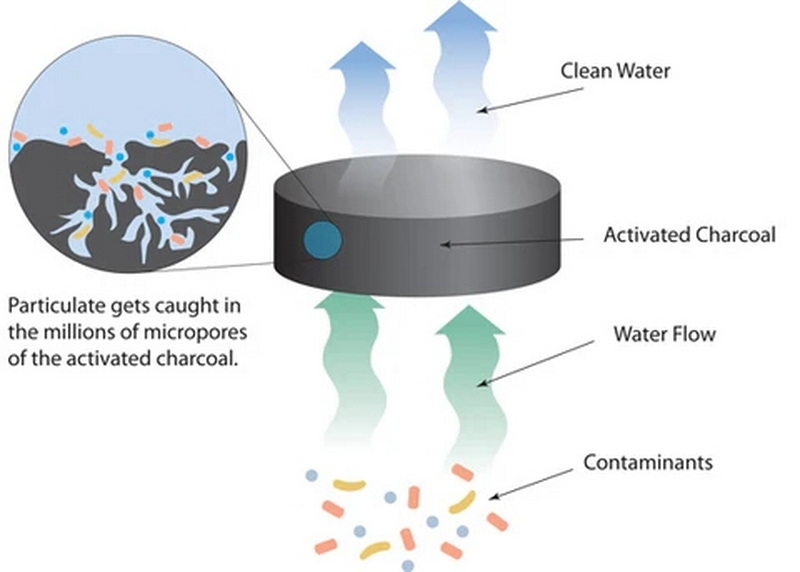
Activated carbon is a highly porous carbon material with enormous internal surface area and a network of micro-, meso-, and macropores. In water treatment, activated carbon works mainly through:[9][7]
- Adsorption: contaminants are attracted to and held on the surface of activated carbon by physical and chemical forces.[9][7]
- Granular filtration: granular activated carbon (GAC) beds physically trap suspended particles as water flows through the packed media.[2][10]
Common forms of activated carbon used in microplastic control:
- Granular activated carbon (GAC): used in columns, point-of-use filters, and municipal treatment.[10][2]
- Powdered activated carbon (PAC): dosed into water, then removed by sedimentation or filtration, often in municipal plants.[11][9]
- Biological activated carbon (BAC): GAC colonized by biofilms, enhancing degradation of some dissolved organics and improving particle retention in some cases.[4]
The extremely high surface area and tunable particle size of activated carbon make it a versatile medium for both adsorption and physical retention of microplastics and other particles.[10][11][7]
Can activated carbon remove microplastics?
Evidence from studies and applications
Multiple studies and practical systems show that activated carbon is effective at removing microplastics and even some nanoplastics from water. Key findings:[1][2][3][5]
- A column-based system using granular activated carbon achieved up to about 95.5% removal of microplastics at lower concentrations when bed depth and operating conditions were optimized.[12][2]
- When integrated after sand filtration, activated carbon treatment helped increase overall microplastic removal in drinking water plants to around 97%.[3]
- Granular activated carbon filters used in pitcher-style or tap filters were reported to remove a large fraction of nanoplastics (around 88.1% in one study), highlighting their role even at very small particle scales.[5]
- Biological activated carbon columns demonstrated higher removal efficiencies for polystyrene micro‑/nanoplastics with larger particle sizes and lower inlet concentrations and flow rates.[4]
These results show that properly engineered activated carbon filtration is a robust option for microplastic reduction in drinking water, industrial water, and wastewater polishing.[2][1][3]
Mechanisms: how microplastics are captured
Activated carbon removes microplastics via several mechanisms:
- Physical straining: Microplastic particles are trapped between granular activated carbon particles or in pore channels, acting like a depth filter.[2][10]
- Interception and entanglement: Particles become immobilized when they collide with, or are entangled among, granular activated carbon chips or fines.[12][2]
- Surface attachment: Hydrophobic microplastics can attach to the hydrophobic surfaces of activated carbon through van der Waals and other interactions.[10][2]
- Biofilm interactions (in BAC): Biofilms formed on activated carbon surfaces can enhance retention of microplastics and may contribute to alteration of organic coatings on particles.[4]
Together, these mechanisms explain why a well‑designed activated carbon filter can significantly reduce microplastics across a wide range of sizes.[2][4][10]
Factors that control removal efficiency
Even though activated carbon is effective, microplastic removal performance is not fixed; it depends on several design and operating parameters.[6][4][2]
1. Microplastic size and type
- Larger microplastics (tens to hundreds of micrometers and above) are more easily removed by granular activated carbon through straining and interception.[4][2]
- Very small micro- and nanoplastics can still be reduced substantially, but higher contact time, optimized pore structure, and sometimes multi-stage filtration are needed to achieve high removal.[5][4]
- Particle shape (fibers vs fragments vs beads) affects how microplastics interact with the activated carbon bed, with fibrous particles sometimes passing more easily if bed packing is coarse.[3][2]
2. Activated carbon form and bed design
- GAC bed depth: Increasing granular activated carbon bed length from 7.5 cm to around 15 cm significantly improved microplastic removal, reaching above 80–87% in one column study.[12][2]
- Particle size of activated carbon: Smaller GAC particles and superfine PAC increase available surface area and narrow the flow channels, improving particle capture.[11][10]
- Porosity and surface morphology: Tailoring the pore structure of activated carbon helps balance hydraulic performance and microplastic retention, limiting bypass of very small particles.[11][10]
3. Concentration and flow rate
- Higher influent microplastic concentrations can overload a granular activated carbon bed, causing removal efficiency to drop to around 60% at the highest concentrations tested in one study.[12][2]
- Lower flow rates increase contact time between water, microplastics, and activated carbon, improving adsorption and straining, but extremely low flow can cause clogging and reduce filter life.[7][2]
4. Filter age and maintenance
- As activated carbon pores and inter-particle spaces fill with trapped particles and adsorbed organics, both microplastic and contaminant removal decline.[6][7]
- Regular replacement or regeneration of activated carbon media is critical for maintaining high microplastic removal efficiency, especially in household filters and high-load industrial systems.[6][7]
Where activated carbon filters are used for microplastic control
Municipal and industrial water treatment
Activated carbon is widely integrated into advanced drinking water and industrial water treatment trains to polish residual particles and dissolved contaminants. Typical configurations:[1][3]
- Post-sand filtration GAC beds in waterworks, boosting total microplastic removal beyond 90–97% when combined with upstream processes.[3]
- Tertiary granular activated carbon columns in wastewater treatment plants to capture microplastics that pass conventional clarification and filtration.[2][12]
- Biological activated carbon reactors in advanced treatment lines for combined removal of microplastics and dissolved organic micro‑pollutants.[10][4]
These systems also exploit activated carbon's capacity to remove organic pollutants, taste and odor compounds, and residual disinfectants, delivering multiple treatment benefits in a single step.[1][3]
Point-of-use and household systems
Household and point-of-use devices often combine activated carbon with other filtration technologies to maximize microplastic removal. Examples:[13][8][6]
- Pitcher and faucet filters: Many use granular activated carbon to improve taste and remove chlorine and some microplastics, though not all are specifically optimized or certified for microplastic removal.[13][5][6]
- Advanced under-sink systems: Some products combine activated carbon with tight mechanical filters or membranes and are tested to remove nearly all microplastics and a very high percentage of other contaminants.[8][14]
- Portable filters: Some portable devices for outdoor or emergency use employ layered filtration with activated carbon to capture microplastics as part of broader contaminant protection.[8]
Because design varies widely, not every activated carbon filter will remove microplastics equally; certification tests and technical specifications are key for product selection.[13][8][6]
Limitations and the role of combined technologies
While activated carbon is a powerful tool, it is not a universal solution for all microplastics under all conditions.[7][6][2]
- Smallest particles: Some nano- and sub‑micrometer plastics may pass through coarse granular activated carbon beds without additional mechanical or membrane barriers.[5][11]
- Overload and breakthrough: Under high microplastic loads or long operating times without replacement, breakthrough will occur and removal performance will drop.[12][2]
- Non-uniform performance: Standard refrigerator filters and simple taste-and-odor carbon cartridges may improve water quality but are not necessarily engineered or tested for microplastic removal.[15][6]
For critical applications, activated carbon is often combined with:
- Fine mechanical filtration (e.g., sub‑micron cartridges)
- Membrane processes (e.g., nanofiltration, reverse osmosis)
- Coagulation–flocculation and sedimentation upstream of activated carbon
These combinations allow activated carbon to focus on dissolved organic contaminants and residual microplastics while other processes handle the bulk of particle removal.[14][3][5]
Practical guidance for using activated carbon to target microplastics
When selecting or designing an activated carbon solution to reduce microplastics in water, the following points are important:[6][1][3][2]
- Choose appropriate activated carbon: Granular activated carbon with optimized particle size distribution and bed depth enhances both adsorption and microplastic filtration.[10][2]
- Check product claims and certifications: For household systems, look for independent testing or standards indicating microplastic removal or sub‑micron particle retention, ideally combined with activated carbon media.[14][8][13]
- Design for contact time: Industrial and municipal systems should be engineered with sufficient empty bed contact time (EBCT) and controlled flow rates to maximize activated carbon performance.[2][10]
- Plan maintenance: Establish clear replacement or regeneration intervals for activated carbon beds to prevent breakthrough of microplastics and other contaminants.[7][6]
- Consider integrated solutions: For sensitive applications, combine activated carbon with upstream coagulation and downstream membrane or cartridge filtration for near‑complete microplastic removal.[14][3][5]
For manufacturers, offering tailored granular activated carbon products and column designs for microplastic removal in water treatment plants, beverage production, and high-purity process water can address a growing global demand.[3][7][10]
Conclusion
Activated carbon filters do remove microplastics and can achieve very high removal efficiencies when properly designed, sized, and maintained, particularly in combination with other treatment steps. Granular activated carbon and biological activated carbon columns have demonstrated strong performance in both drinking water and wastewater applications, significantly reducing microplastic concentrations across a wide range of sizes.[1][4][10][3][2]
However, not all activated carbon filters are equally effective, especially simple taste-and-odor cartridges that are not specifically engineered or tested for microplastic removal. For the best protection, users and industrial operators should choose advanced activated carbon systems with appropriate media, bed depth, contact time, and documented performance, and consider combining activated carbon with fine mechanical or membrane filtration in high-risk scenarios.[15][14][13][6][3][5]
FAQ
1. Do all activated carbon filters remove microplastics?
Not all activated carbon filters remove microplastics to the same degree; performance depends on media type, pore structure, bed depth, and overall filter design. Simple refrigerator or pitcher filters made with activated carbon may improve taste and remove some particles but are not always tested or certified for microplastic removal.[16][15][13][6]
2. Are activated carbon filters enough on their own to remove microplastics?
In many cases, modern granular activated carbon filters can remove a high percentage of microplastics, especially larger particles and those present at moderate concentrations. For maximum protection, particularly against very small micro‑ and nanoplastics, activated carbon is often paired with fine mechanical filtration or membrane processes.[11][14][10][3][5][2]
3. What type of activated carbon is best for microplastic removal?
Granular activated carbon with optimized particle size distribution and sufficient bed depth is widely used and has been shown to provide strong microplastic removal in column systems. Biological activated carbon and systems using superfine activated carbon powders can further enhance removal in some applications but require careful design to manage pressure drop and media handling.[4][11][10][12][2]
4. How often should activated carbon filters be changed if they are used to remove microplastics?
Activated carbon filters used for microplastic control must be replaced or regenerated in line with manufacturer guidelines or process design, since trapped particles and adsorbed organics progressively saturate the media. If filters are not changed on schedule, microplastic removal efficiency drops significantly and breakthrough of particles and other contaminants can occur.[6][7][12][2]
5. Can activated carbon filters remove microplastics from all types of water sources?
Activated carbon filters can remove microplastics from diverse sources, including tap water, bottled water, and treated wastewater, when configured correctly for each application. However, design must account for source-specific conditions such as microplastic concentration, particle size distribution, organic load, and required treated-water quality, so tailored activated carbon solutions are recommended for optimal performance.[8][4][10][7][3][2]
Citations:
[1](https://pmc.ncbi.nlm.nih.gov/articles/PMC10054062/)
[2](https://www.tandfonline.com/doi/abs/10.1080/21655979.2023.2276391)
[3](https://www.sciencedirect.com/science/article/pii/S0048969723018892)
[4](https://www.sciencedirect.com/science/article/abs/pii/S2214714424019445)
[5](https://www.popsci.com/environment/microplastics-water-filter-pollution/)
[6](https://www.noplasticnoproblem.com/blog/how-effective-are-refrigerator-water-filters-at-removing-microplastics)
[7](https://glacierfreshfilter.com/blogs/news/activated-carbon-filters-effective-microplastic-removal)
[8](https://lifestraw.com/blogs/news/filtering-microplastics-and-nanoplastics-from-drinking-water)
[9](https://wcponline.com/2002/11/21/gacpac-use-powdered-activated-carbon-potable-water-treatment-small-systems/)
[10](https://pmc.ncbi.nlm.nih.gov/articles/PMC10653704/)
[11](https://www.sciencedirect.com/science/article/abs/pii/S0043135421007466)
[12](https://pubmed.ncbi.nlm.nih.gov/37942779/)
[13](https://mywaterfilter.com.au/blogs/learning/do-water-filters-remove-microplastics)
[14](https://www.ispringfilter.com/ac/the-shocking-truth-about-microplastics-in-us-tap-water-protecting-your-loved-ones-from-the-invisible-plastic-crisis)
[15](https://caware.co/up-today/microplastics-filter/)
[16](https://waterfilterguru.com/best-water-filter-for-microplastics/)
[17](https://alliniwaterfilters.com/blogs/blog/how-water-filters-remove-micro-plastics/)
[18](https://www.reddit.com/r/water/comments/v818f8/how_do_i_make_sure_there_are_no_microplastics_in/)
[19](https://www.reddit.com/r/water/comments/1jm8dnm/what_water_filter_should_i_get_to_remove/)
[20](https://lifestraw.com/products/lifestraw-home-glass-pitcher)


